

Genesis 50 is the closing chapter of the patriarchal narrative and of the entire book of Genesis. It opens with Joseph weeping over his father’s body and ends with a coffin in Egypt. The chapter records, with characteristic narrative restraint, three connected scenes: the funeral procession that carries Jacob’s body back to the cave of Machpelah, the brothers’ renewed fear after Jacob’s death and Joseph’s final pardon, and Joseph’s own death with his charge that his bones be carried out of Egypt when God brings the family back to the land of promise.
The chapter is the structural completion of the Joseph cycle. Joseph’s you meant evil against me, but God meant it for good in verse 20 is the cycle’s final and most concentrated providence statement, the formal closure of what has been building since the dreams of chapter 37. The chapter is also the seed of everything that follows. The book of Exodus will open with the children of Israel were fruitful, and increased abundantly (Exodus 1:7), echoing the Genesis 47:27 vocabulary, but with a Pharaoh who did not know Joseph (Exodus 1:8). The coffin in Egypt at the end of Genesis 50 will be the theological hinge: the family will leave the land, four hundred years will pass, and when Israel finally goes up out of Egypt, the bones will go with them. The first verse of Joshua’s report on the conquest finally closes the loop: the bones of Joseph, which the children of Israel brought up out of Egypt, they buried at Shechem (Joshua 24:32).
The chapter ends Genesis with a coffin and a promise. The coffin holds the body of the man through whom God preserved life. The promise holds the land. The book closes with both held together: a body in Egypt, a hope in Canaan, and the long wait between.
A · Genesis 50:1–14 · The funeral procession back to Machpelah
¹ Joseph fell on his father’s face, wept on him, and kissed him. ² Joseph commanded his servants, the physicians, to embalm his father; and the physicians embalmed Israel. ³ Forty days were used for him, for that is how many the days it takes to embalm. The Egyptians wept for him for seventy days. ⁴ When the days of weeping for him were past, Joseph spoke to Pharaoh’s staff, saying, “If now I have found favor in your eyes, please speak in the ears of Pharaoh, saying, ⁵ ‘My father made me swear, saying, “Behold, I am dying. Bury me in my grave which I have dug for myself in the land of Canaan.” Now therefore, please let me go up and bury my father, and I will come again.’” ⁶ Pharaoh said, “Go up, and bury your father, just like he made you swear.” ⁷ Joseph went up to bury his father; and with him went up all the servants of Pharaoh, the elders of his house, all the elders of the land of Egypt, ⁸ all the house of Joseph, his brothers, and his father’s house. Only their little ones, their flocks, and their herds, they left in the land of Goshen. ⁹ There went up with him both chariots and horsemen. It was a very great company. ¹⁰ They came to the threshing floor of Atad, which is beyond the Jordan, and there they lamented with a very great and severe lamentation. He mourned for his father seven days. ¹¹ When the inhabitants of the land, the Canaanites, saw the mourning in the floor of Atad, they said, “This is a grievous mourning by the Egyptians.” Therefore its name was called Abel Mizraim, which is beyond the Jordan. ¹² His sons did to him just as he commanded them, ¹³ for his sons carried him into the land of Canaan, and buried him in the cave of the field of Machpelah, which Abraham bought with the field, as a possession for a burial site, from Ephron the Hittite, before Mamre. ¹⁴ Joseph returned into Egypt, he, and his brothers, and all that went up with him to bury his father, after he had buried his father. (Genesis 50:1–14, World English Bible)
- Joseph fell on his father’s face, wept on him, and kissed him (verse 1). The Hebrew vayipol Yosef al-pnei aviv vayevk alav vayishaq-lo, “and Joseph fell on his father’s face and wept upon him and kissed him,” uses three quick verbs in succession. The chapter opens with what twenty-two years of separation and seventeen years of restored proximity have come to. The vizier of Egypt, the second-in-command of an empire, falls on his dead father’s face and weeps and kisses him. The chapter is recording, in three verbs, the depth of the loss.
- Joseph commanded his servants, the physicians, to embalm his father; and the physicians embalmed Israel. Forty days were used for him, for that is how many the days it takes to embalm. The Egyptians wept for him for seventy days (verses 2 to 3). The chapter is recording, with characteristic Hebrew Bible cultural specificity, that Jacob is given a full Egyptian state-funeral preparation. The forty-day embalming process and the seventy-day public mourning period match what Egyptian sources record for high officials. The chapter is honest that the patriarch’s body will be prepared for burial by Egyptian methods. The cycle is not pretending the family is not in Egypt.
Influence callout: Ray Vander Laan
Vander Laan’s reading of the embalming-and-mourning detail names it as one of the chapter’s most culturally precise notes. The forty days for embalming and the seventy days of mourning are the Egyptian state pattern. Vander Laan argues that the chapter is being honest about how Jacob is being treated. He receives, in death, the honors of an Egyptian senior official. The chapter is not flattening this into a Hebrew-only funeral; it is recording, with characteristic cultural precision, the Egyptian dimension of the patriarchal funeral. The cycle is consistently honest about the cultural texture of the descent.
Pushback note
Some readings have flattened the Egyptian embalming into a sign that the family has been corrupted by Egyptian religion (the embalming served the Egyptian afterlife theology of preservation for resurrection). The chapter does not seem to share this concern. The text records the embalming with no theological qualification. The patriarch’s body is being preserved for the long journey back to Canaan; the Egyptian methods serve that practical purpose. The cycle is recording the embalming as a logistical fact, not as a religious compromise.
- Verses 4 to 6 record Joseph’s request to Pharaoh, conveyed through the royal household. The Hebrew vayedabber Yosef el-bet Faro, “and Joseph spoke to Pharaoh’s house,” uses the indirect court protocol: the vizier in mourning does not approach Pharaoh directly but communicates through the household. The chapter is recording, with characteristic cultural precision, the formal procedure for a senior official in mourning to request leave.
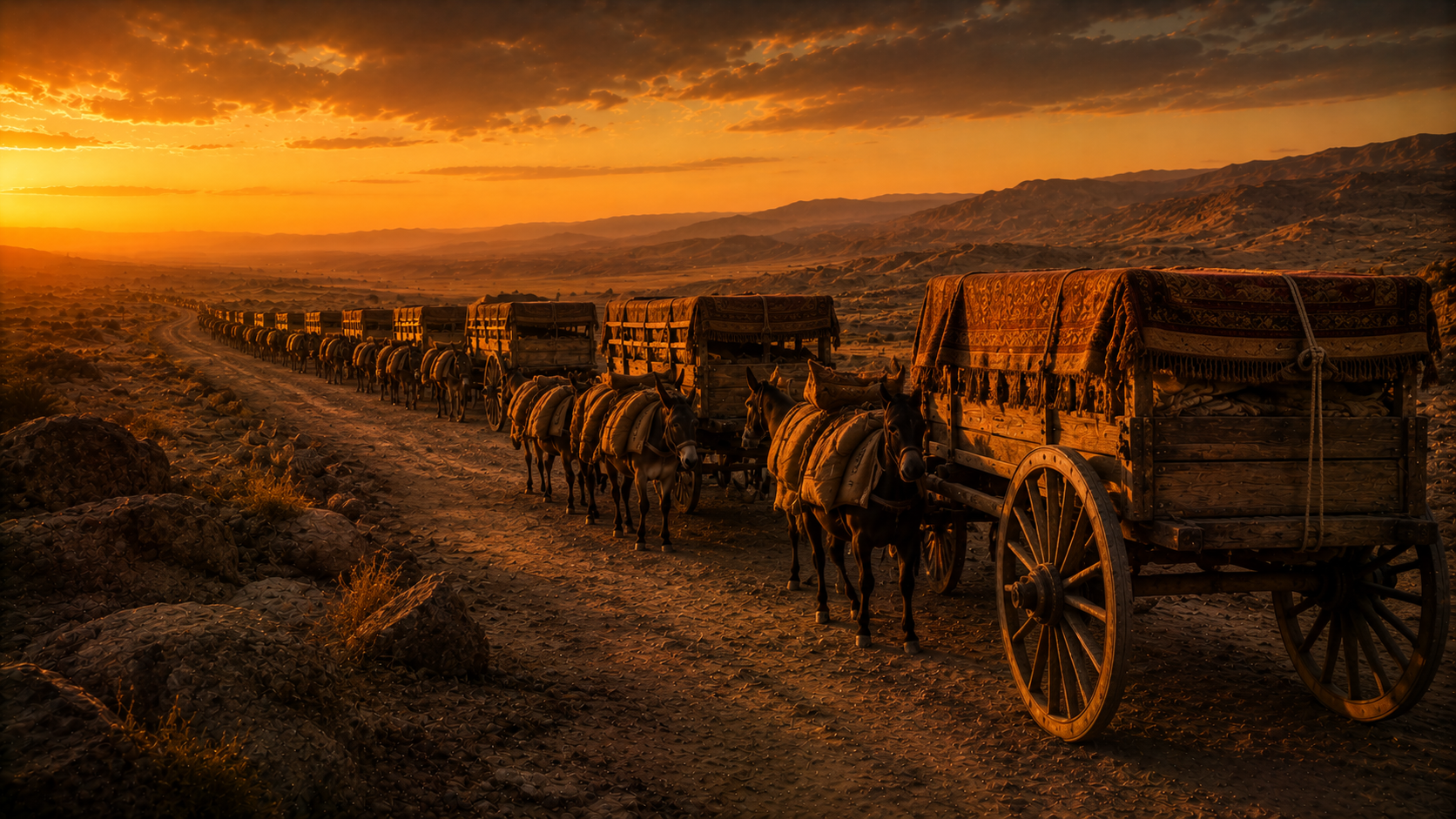
- The funeral procession (verses 7 to 9) is one of the chapter’s most striking images. With him went up all the servants of Pharaoh, the elders of his house, all the elders of the land of Egypt, all the house of Joseph, his brothers, and his father’s house. Only their little ones, their flocks, and their herds, they left in the land of Goshen. There went up with him both chariots and horsemen. It was a very great company. The Hebrew machaneh kaved me’od, “a very heavy/great camp,” names a state-level procession. The patriarch is being escorted to his burial place by the entire Egyptian senior court, supplemented by the family’s own household.
Influence callout: Walter Brueggemann
Brueggemann’s reading of the funeral procession names it as the chapter’s quiet theological irony. The patriarch who refused to be buried in Egypt is being carried out of Egypt by the entire Egyptian state apparatus. Brueggemann argues that the chapter is recording, with characteristic Hebrew Bible irony, that the imperial center is honoring the patriarch’s commitment to a burial place that defies the imperial center’s usual claim on its officials. The Egyptian elite, who in normal circumstances would have buried Jacob in Egypt with full state honors, are escorting him out of the country. The chapter is teaching, in narrative form, that the patriarchal commitment to the land of promise has produced a moment where the empire itself is conscripted into the patriarchal hope.
- They came to the threshing floor of Atad, which is beyond the Jordan, and there they lamented with a very great and severe lamentation (verse 10). The Hebrew misped gadol ve-kaved me’od, “a great and very heavy lamentation,” is the chapter’s funeral-pause vocabulary. The threshing floor of Atad is the procession’s stopping point on the way to Hebron, somewhere east of the Jordan. The seven-day mourning here is the Hebrew funeral period (the shiva).
- The Canaanites’ renaming of the place (verse 11) is one of the chapter’s most touching details. When the inhabitants of the land, the Canaanites, saw the mourning in the floor of Atad, they said, “This is a grievous mourning by the Egyptians.” Therefore its name was called Abel Mizraim. The Hebrew Avel Mitzraim, “the meadow of Egypt” or “the mourning of Egypt,” is the place’s new name. The chapter is recording, with characteristic narrative humor, that the local Canaanites identified the procession by its dominant Egyptian character. They saw the chariots and the horsemen and the Egyptian officials; they did not understand they were watching the burial of a Canaanite patriarch in Canaanite ancestral land. The chapter is honest about how the procession appeared to outsiders.
- His sons did to him just as he commanded them, for his sons carried him into the land of Canaan, and buried him in the cave of the field of Machpelah (verses 12 to 13). The Hebrew vaya’asu vanav lo ken, “and his sons did for him so,” names the formal completion of the patriarchal command. The sons, not the Egyptian officials, are the ones who carry the patriarch to the cave. The chapter is recording, with characteristic narrative precision, that the actual burial is performed by the family. The Egyptian state escorted the patriarch to the threshold of the land; the sons completed the burial.
Influence callout: Marty Solomon
Solomon’s reading of the Machpelah burial names it as one of the chapter’s deepest covenantal moments. The cave that Abraham purchased in Genesis 23 for four hundred shekels of silver, where Sarah was buried, where Abraham was buried, where Isaac and Rebekah were buried, where Leah was buried, now receives Jacob. Solomon argues that the chapter is recording, in geographic terms, the Hebrew Bible’s first family-tomb-as-anchor-point in the land. The cave at Machpelah is the deeded patriarchal property in Canaan. While the family is in Egypt, the cave is what they hold in the land. The chapter is teaching, in narrative form, the foundational role that ancestral burial places have always played in the Hebrew Bible’s geographic imagination.
- Joseph returned into Egypt, he, and his brothers, and all that went up with him to bury his father, after he had buried his father (verse 14). The chapter is recording, with characteristic narrative restraint, the return. The patriarch is buried; the family returns to Egypt. The Hebrew is precise: they go back. The descent that started in chapter 46 is, for now, permanent.
B · Genesis 50:15–21 · The brothers’ renewed fear and Joseph’s final pardon
¹⁵ When Joseph’s brothers saw that their father was dead, they said, “It may be that Joseph will hate us, and will fully pay us back for all the evil which we did to him.” ¹⁶ They sent a message to Joseph, saying, “Your father commanded before he died, saying, ¹⁷ ‘You shall tell Joseph, “Now please forgive the disobedience of your brothers, and their sin, because they did evil to you.”‘ Now, please forgive the disobedience of the servants of the God of your father.” Joseph wept when they spoke to him. ¹⁸ His brothers also went and fell down before his face; and they said, “Behold, we are your servants.” ¹⁹ Joseph said to them, “Don’t be afraid, for am I in the place of God? ²⁰ As for you, you meant evil against me, but God meant it for good, to save many people alive, as is happening today. ²¹ Now therefore don’t be afraid. I will provide for you and your little ones.” He comforted them, and spoke kindly to them. (Genesis 50:15–21, World English Bible)
- When Joseph’s brothers saw that their father was dead, they said, “It may be that Joseph will hate us, and will fully pay us back for all the evil which we did to him” (verse 15). The Hebrew lu yistemenu Yosef, “what if Joseph will treat us with hostility?”, uses the verb satam (to hold a grudge, to oppose with sustained hostility). The chapter is recording, with characteristic Hebrew Bible psychological honesty, that the brothers’ fear has not actually been resolved. The reconciliation in chapter 45 was real, but the underlying anxiety has remained. The death of the father, who had been the buffer between the wrong and the wronged, exposes the unresolved fear.
Influence callout: Walter Brueggemann
Brueggemann’s reading of the brothers’ second fear names it as one of the chapter’s most pastorally important moments. The chapter is honest. The reconciliation that happened in chapter 45 did not, in fact, fully relieve the brothers’ guilt. They have lived for seventeen years in Egypt under Joseph’s provision, and the question what if he hates us has remained. Brueggemann argues that the chapter is recording, with characteristic Hebrew Bible realism, that long-standing wrong does not always fully release just because the wronged person says forgiving words. The brothers’ fear is not a sign that Joseph’s earlier forgiveness was insincere; it is a sign that the brothers’ guilt was deep enough to require multiple confirmations. The chapter is being pastorally honest about how the released party often does not feel released for a long time.
- The brothers’ approach (verses 16 to 17) is layered. They sent a message to Joseph, saying, “Your father commanded before he died, saying …” The Hebrew is unusual. The brothers do not approach Joseph directly; they send a message; the message attributes a command to Jacob. The chapter is leaving open the question of whether Jacob actually said this. The Hebrew text contains no record elsewhere of Jacob giving any such command. The brothers may be invoking the dead patriarch’s authority to seek what they cannot bring themselves to ask for directly.
Pushback note
Some readings have taken the brothers’ attribution of the command to Jacob as straightforward fact: Jacob really said this before he died. The Hebrew text gives us no other record of such a command, and the narrative indicators (the indirectness, the message-via-third-party form, the brothers’ fearful framing) suggest the brothers may be inventing the command for their own protection. The chapter is honest either way. If Jacob did say it, the brothers are passing on a paternal directive. If Jacob did not say it, the brothers are at the kind of low point where they will use whatever leverage they can find. The Hebrew Bible is not always interested in resolving these ambiguities; it lets the text stand as the brothers reported it.
- Now, please forgive the disobedience of the servants of the God of your father (verse 17b). The Hebrew construction avdei Elohei avikha, “the servants of the God of your father,” is the brothers’ theological self-naming. They are claiming, in the petition, to be members of the same covenant family. The chapter is recording, with characteristic Hebrew Bible precision, that the brothers are appealing on covenantal grounds.
- Joseph wept when they spoke to him (verse 17c). The Hebrew vayevk Yosef be-dabbram elav, “and Joseph wept as they spoke to him,” is the cycle’s quiet pastoral reversal. The brothers expected anger; they encountered tears. The vizier weeps when his brothers, after seventeen years, are still afraid of him.
Influence callout: Brian Zahnd
Zahnd’s reading of Joseph wept when they spoke to him names it as one of the chapter’s most theologically loaded moments. Joseph is grieved that his brothers, after all the years of provision, after the embraces in chapters 45 and 46, are still living in fear of him. Zahnd argues that the chapter is recording, in one short verse, the grief of the wronged-and-forgiving party at the wronging-and-fearful party’s continued inability to receive the forgiveness. The chapter is teaching what Christian theology will later articulate: the deepest grief of the forgiving one is the inability of the forgiven one to believe the forgiveness. The wept response of Joseph is the model. The cycle is, in this verse, the Hebrew Bible’s gentlest portrait of what it means to forgive.
- His brothers also went and fell down before his face; and they said, “Behold, we are your servants” (verse 18). The Hebrew hinenu lekha la-avadim, “behold, we are servants to you,” is the brothers’ final self-offering. The chapter is recording, with characteristic narrative precision, that the brothers’ second prostration before Joseph (the first was in chapter 42) is now an offering of permanent servitude. They are no longer asking for forgiveness; they are offering themselves as slaves.
- Joseph said to them, “Don’t be afraid, for am I in the place of God?” (verse 19). The Hebrew al-tira’u ki ha-tachat Elohim ani, “do not be afraid, for am I in the place of God?”, is one of the cycle’s most theologically loaded refusals. Joseph refuses the role of judge. Punishment is not his to give. The chapter is recording, with characteristic Hebrew Bible care, that Joseph’s posture toward the brothers is grounded in his refusal to occupy the divine seat. He is not God; the punishment of his brothers is not his to administer.
Influence callout: N.T. Wright
Wright’s reading of am I in the place of God? names it as the cycle’s deepest theological hinge. Joseph is refusing the role of vengeance because vengeance is not the role of any human, including the wronged one. The chapter is recording, in one short Hebrew clause, the Hebrew Bible’s foundational teaching on the proper limits of human retribution. Wright argues that the verse will be picked up by the apostle Paul in Romans 12:19 (beloved, never avenge yourselves, but leave it to the wrath of God), where the same theological limit on human vengeance is named. The chapter is the Old Testament foundation for what the New Testament will articulate as the cruciform refusal of retaliation.
- As for you, you meant evil against me, but God meant it for good, to save many people alive, as is happening today (verse 20). The Hebrew atem chashavtem alai ra’ah, Elohim chashava le-tovah, “you intended evil against me, God intended it for good,” is the cycle’s final and most concentrated providence statement. The Hebrew uses the same verb (chashav, to think, to intend, to weave) for both the brothers’ intention and God’s. The chapter is recording, with characteristic Hebrew Bible care, that the same action carried two intentions: a human intention of evil, and a divine intention of preservation. The two are not the same. Neither erases the other.
Word study: chashav (חָשַׁב), “to think, to intend, to plan, to weave”
The Hebrew verb in 50:20, used twice. Chashav covers both deliberate planning and the kind of weaving-together that produces a complex outcome. The chapter is using the verb deliberately for both the brothers and God: both intended; both planned; both wove the action into a story. The Hebrew is not saying the intentions were the same; it is saying the verb is the same. The brothers wove evil; God wove good through the same action. The verb will become foundational in the Hebrew Bible’s theology of providence: God who thinks peace toward us (Jeremiah 29:11), God who plans to give us a future and a hope.
Influence callout: Tim Mackie
Mackie’s reading of you meant evil against me, but God meant it for good names it as the cycle’s structural completion. The Joseph cycle has been building toward this verse since chapter 37. The dreams, the sale, the years of slavery, the Potiphar’s wife false accusation, the prison, the cupbearer’s forgetting, the rise before Pharaoh, the famine, the return of the brothers, the test, Judah’s speech, the reveal, the embrace, the descent, the seventeen years, the funeral procession back to Machpelah, the brothers’ renewed fear, this verse. Mackie argues that the chapter is teaching the cycle’s most carefully constructed theological grammar. Human evil is real; divine providence is real; God works through human action without sanitizing it. The verse is the Hebrew Bible’s foundational providence statement. The book of Genesis is closing with it.
- Now therefore don’t be afraid. I will provide for you and your little ones. He comforted them, and spoke kindly to them (verse 21). The Hebrew vaynachem otam vaydabber al-libam, “and he comforted them and spoke to their hearts,” is one of the chapter’s most pastoral closings. The cycle ends, before the death-vignette of Joseph, with Joseph speaking to the heart of his brothers. The Hebrew construction dibber al-lev (speaking to the heart) is the same the prophet Hosea will use for God’s tender approach to wayward Israel (Hosea 2:14: I will allure her, and bring her into the wilderness, and speak to her heart). The chapter is recording, in patriarchal vocabulary, the kind of heart-spoken comfort that the Hebrew Bible will continue to describe as the deepest reconciling word.
C · Genesis 50:22–26 · Joseph’s death and the bones in the coffin
²² Joseph lived in Egypt, he, and his father’s house. Joseph lived one hundred ten years. ²³ Joseph saw Ephraim’s children to the third generation. The children also of Machir, the son of Manasseh, were born on Joseph’s knees. ²⁴ Joseph said to his brothers, “I am dying, but God will surely visit you, and bring you up out of this land to the land which he swore to Abraham, to Isaac, and to Jacob.” ²⁵ Joseph took an oath from the children of Israel, saying, “God will surely visit you, and you shall carry up my bones from here.” ²⁶ So Joseph died, being one hundred ten years old, and they embalmed him, and he was put in a coffin in Egypt. (Genesis 50:22–26, World English Bible)
- Joseph lived in Egypt, he, and his father’s house. Joseph lived one hundred ten years (verse 22). The Hebrew me’ah va-eser shanim, “one hundred and ten years,” is the lifespan that ancient Egyptian wisdom literature considered the ideal. The chapter is recording, with characteristic cultural specificity, that Joseph’s lifespan was, by Egyptian standards, the perfect length. The cycle is being honest about the cultural framing of the patriarchal numbers.
- Joseph saw Ephraim’s children to the third generation. The children also of Machir, the son of Manasseh, were born on Joseph’s knees (verse 23). The Hebrew yulladu al-birkei Yosef, “they were born upon the knees of Joseph,” is the patriarchal-adoption formula. The chapter is recording, with characteristic narrative restraint, that Joseph lived long enough to see and to formally bless his great-grandchildren. The cycle ends with the patriarch surrounded by descendants.
Influence callout: Marty Solomon
Solomon’s reading of the born on Joseph’s knees detail names it as the cycle’s quiet structural completion of the inheritance theme. Joseph, who was sold into Egypt as a teenager and who was not present for his own father’s middle years, lives long enough to receive his great-grandchildren on his knees in formal patriarchal adoption. Solomon argues that the chapter is recording, with characteristic Hebrew Bible care, the full restoration of patriarchal continuity. What the brothers’ violence almost broke is now extended through three generations of grandchildren on Joseph’s lap.
- Joseph said to his brothers, “I am dying, but God will surely visit you, and bring you up out of this land to the land which he swore to Abraham, to Isaac, and to Jacob” (verse 24). The Hebrew paqod yifqod Elohim etkhem, “God will surely visit you” (the doubled construction is intensifying), is the chapter’s most prophetic line. The verb paqad (to visit, to attend to, to take notice) is one of the Hebrew Bible’s most theologically loaded verbs. The chapter is laying down the vocabulary that the book of Exodus will pick up: I have surely visited you, and seen what is done to you in Egypt (Exodus 3:16).
Word study: paqad (פָּקַד), “to visit, to attend to, to take notice”
The Hebrew verb in 50:24, paqod yifqod Elohim, “God will surely visit.” The verb covers a wide range: to visit a person, to attend to a need, to take notice of a wrong, to muster troops, to appoint to a task. In the Hebrew Bible, paqad in the divine subject is foundational. Joseph’s deathbed promise God will surely visit you uses the doubled-verb intensification. The chapter is laying down, in patriarchal vocabulary, the seed of the entire exodus theology. The God who has been silent through four hundred years of Egyptian residence will paqad. The verb will return at the burning bush (I have surely visited you, Exodus 3:16) as the formal opening of the exodus narrative.
Influence callout: N.T. Wright
Wright’s reading of paqod yifqod Elohim names it as the chapter’s foundational hinge for the rest of the Hebrew Bible. The book of Genesis is closing with the promise that God will visit the family. Wright argues that the chapter is laying down the basic shape of Hebrew Bible eschatology: the family lives in the not yet; the visitation is coming; the promise points forward. The chapter is teaching, in patriarchal vocabulary, the same posture that the Psalter will continue to model and that the New Testament will read forward through the resurrection. The God who has been silent will visit. The Hebrew Bible’s hope is a paqad hope.
- Joseph took an oath from the children of Israel, saying, “God will surely visit you, and you shall carry up my bones from here” (verse 25). The Hebrew hashbe’a Yosef et-bnei Yisrael, “Joseph made the children of Israel swear,” is the patriarchal-oath formula. Joseph, having been sworn by his own father in chapter 47 about Jacob’s bones, now swears the family about his own bones. The chapter is recording, with characteristic narrative symmetry, the parallel oath structure between the two patriarchs.
Influence callout: Walter Brueggemann
Brueggemann’s reading of Joseph’s bones-oath names it as the chapter’s deepest theological closure. The book of Genesis ends with the family sworn to carry the patriarch’s bones out of Egypt when God visits. Brueggemann argues that the chapter is teaching, in narrative form, the Hebrew Bible’s distinctive grammar of hope. The body stays in the coffin; the bones wait; the family is sworn; the hope rests in a paqad that has not yet happened. The chapter is the Hebrew Bible’s foundational picture of waiting. Hebrews 11 will read the verse forward (by faith Joseph, when his end was near, made mention of the departure of the children of Israel, and gave instructions concerning his bones), naming Joseph’s deathbed oath as one of the great acts of patriarchal faith. The book of Genesis closes with this faith.
- So Joseph died, being one hundred ten years old, and they embalmed him, and he was put in a coffin in Egypt (verse 26). The Hebrew vayyasem ba’aron be-Mitzraim, “and he was placed in a coffin in Egypt,” is the closing image of the book of Genesis. The book that opened with In the beginning God created the heavens and the earth closes with a coffin in Egypt. The chapter is recording, with characteristic Hebrew Bible restraint, the most theologically compressed ending in the patriarchal narrative.
Influence callout: Brian Zahnd
Zahnd’s reading of he was put in a coffin in Egypt names it as the chapter’s most pastorally important closing image. The book of Genesis ends in a coffin and in a foreign land. Zahnd argues that the chapter is being honest about where the patriarchal generation has ended up. The promises of Genesis 12 are not fulfilled; the family is not in the land; the great nation is not yet visible; the blessing to all the families of the earth has not happened. The book closes with a coffin and a sworn promise that God will visit. Zahnd argues that this is exactly the shape of the Hebrew Bible’s deepest hope. Faith looks at coffins in foreign lands and trusts that God will visit. The chapter is teaching, in its closing image, the same posture that will eventually find its New Testament summary in Hebrews 11: all these died in faith, not having received the promises, but having seen them and welcomed them from afar.
Influence callout: Tim Mackie
Mackie’s reading of the closing coffin names it as the deliberate structural ending of the entire book. Genesis opens with creation: heavens, earth, sea, life, image of God, the seventh-day rest. Genesis closes with a coffin in Egypt. Mackie argues that the chapter is doing intentional theological architecture in its bookends. The book that began with the cosmos at peace ends with a body waiting for visitation. The arc is honest. Eden is lost; the patriarchs are dispersed; the family is in Egypt; the bones are in a coffin. The hope is not naive. The book has been, throughout, the Hebrew Bible’s most realistic portrait of how creation has been received and abused and how the covenant family has been, in turn, threatened and preserved. The closing coffin is the structural opposite of the opening cosmos, and the paqod yifqod Elohim promise is what holds the two ends together. The book ends with the family waiting.
- The book of Joshua will eventually close the loop. Joshua 24:32: the bones of Joseph, which the children of Israel brought up out of Egypt, they buried at Shechem. When Israel finally goes up out of Egypt under Moses, Exodus 13:19 will record that Moses took the bones of Joseph with him, for Joseph had made the children of Israel solemnly swear. The promise made on Joseph’s deathbed in Genesis 50:25 is fulfilled in Joshua 24:32. The bones of the patriarch wait in their coffin for four hundred years and then are carried up. The Hebrew Bible’s storyline is built across these waits.
Reflection prompts
- The brothers, seventeen years after the reconciliation in chapter 45, are still afraid that Joseph hates them. The death of the patriarch exposes the unresolved fear. Where in your life is there a reconciliation that happened in word but has not fully released the underlying anxiety, and what does it mean to consider that some forgiveness needs to be received multiple times before it is actually believed?
- You meant evil against me, but God meant it for good. The cycle’s final providence statement holds two truths together without collapsing them: the brothers’ wrong is real, and God’s preserving work through it is real. Where in your life are you currently being asked to hold both halves of a similar statement, and what does it mean to refuse to let either half go?
- The book of Genesis ends with a coffin in Egypt and an oath about bones. The patriarchal generation closes without seeing the promises fulfilled; the hope is laid down in a sworn promise about future visitation. Where in your life are you currently in the position of laying down an oath about something you will not personally see, and what does it mean to consider that this kind of unfulfilled-yet-sworn hope is exactly the shape of the Hebrew Bible’s faith?