
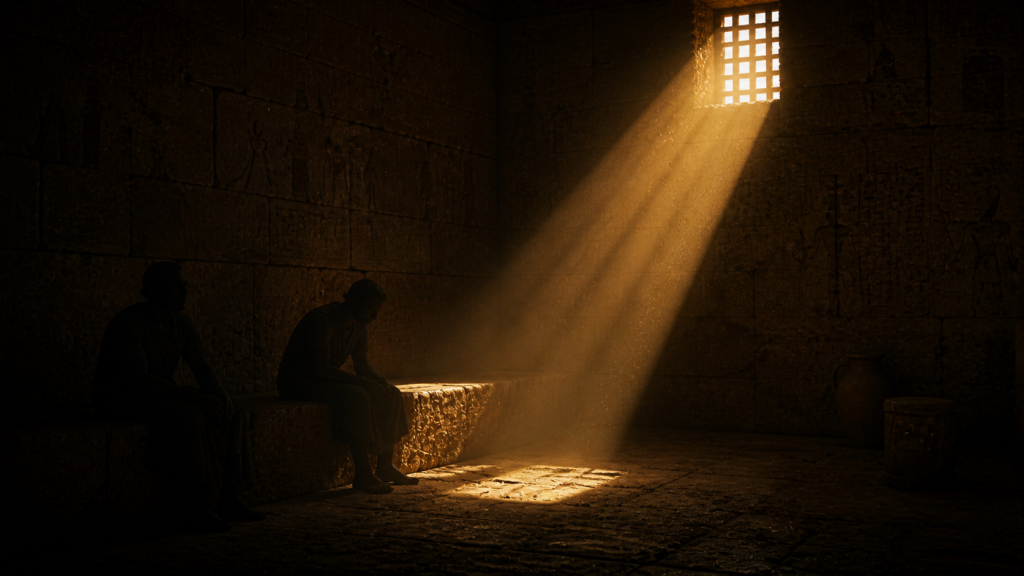
Genesis 40 picks up Joseph in the high-status prison where chapter 39 left him. The pattern that runs through the Joseph cycle (rise, fall, rise) is about to take its next turn. Two officials from Pharaoh’s court (the chief cupbearer and the chief baker) have offended their master and have been thrown into the same prison Joseph oversees. They both have troubling dreams on the same night. Joseph offers to interpret: do not interpretations belong to God? Please tell them to me. The interpretations turn out to be the chapter’s quiet pivot. The cupbearer’s dream means restoration in three days; the baker’s dream means execution in three days. The chapter ends with Joseph asking the cupbearer to remember him before Pharaoh, and with the cupbearer forgetting.
The chapter is doing structural work. Joseph’s gift for dream-interpretation, which has been latent in the cycle since his own dreams in chapter 37, is now being used in service of others. The chapter establishes Joseph as a dream-interpreter in a context that will pay off in chapter 41, when Pharaoh’s own dreams will require an interpreter and the cupbearer will finally remember. The chapter is the bridge.
The chapter also makes one of the cycle’s most repeated theological claims explicit. Do not interpretations belong to God? is the patriarchal narrative’s first articulation of what will become the cycle’s deepest claim: the meaning of dreams, the meaning of events, the meaning of suffering belongs to God. Joseph is not the source of the meaning; he is the instrument through whom God’s interpretation comes. The chapter is preparing the reader for the cycle’s later articulations, especially Joseph’s words to his brothers in chapters 45 and 50.
A · Genesis 40:1–8 · The two officials and the dreams
¹ After these things, the butler of the king of Egypt and his baker offended their lord, the king of Egypt. ² Pharaoh was angry with his two officers, the chief cup bearer and the chief baker. ³ He put them in custody in the house of the captain of the guard, into the prison, the place where Joseph was bound. ⁴ The captain of the guard assigned them to Joseph, and he took care of them. They stayed in prison many days. ⁵ They both dreamed a dream, each man his dream, in one night, each man according to the interpretation of his dream, the cup bearer and the baker of the king of Egypt, who were bound in the prison. ⁶ Joseph came in to them in the morning, and saw them, and saw that they were sad. ⁷ He asked Pharaoh’s officers who were with him in custody in his master’s house, saying, “Why do you look so sad today?” ⁸ They said to him, “We have dreamed a dream, and there is no one who can interpret it.” Joseph said to them, “Don’t interpretations belong to God? Please tell it to me.” (Genesis 40:1–8, World English Bible)
- The chapter opens with two officials being added to Joseph’s prison. The Hebrew word for “butler” or “cupbearer” (mashqeh) and “baker” (ofeh) name two of the most trusted positions in an ANE royal court. The cupbearer was responsible for ensuring no poison reached the king’s wine; the baker was responsible for the same with the king’s bread. Both held positions of intimate trust. To “offend” the king (the Hebrew is unspecific, chat’u, “they sinned”) was a serious matter.
- Verse 3 places them in the prison, the place where Joseph was bound. The narrator is using exactly the same construction the chapter ended Genesis 39 with. The geography is being deliberately preserved. Joseph is in Pharaoh’s high-status prison; the cupbearer and baker are now in the same facility. The chapter is preparing the reader: this is the kind of prison where Pharaoh’s officers go, and Joseph is the prisoner who runs it.
- The captain of the guard assigned them to Joseph, and he took care of them. The Hebrew word vayesharetam, “and he served them,” is a specific verb. The same root will be used in the priestly literature for the Levites’ service in the tabernacle (sharatu, to minister, to attend). Joseph is, in the prison, performing a kind of ministry. The chapter is using priestly-tinged vocabulary for the slave-overseer’s care of his prisoners.
- Verse 6 is the chapter’s quiet pastoral note. Joseph came in to them in the morning, and saw them, and saw that they were sad. The Hebrew vehinam zo’afim, “and behold, they were dejected,” names what the chapter wants the reader to feel. Joseph notices. The same young man who has been forgotten by his brothers, falsely accused by his master’s wife, and imprisoned without cause, comes into the prison cell of two strangers in the morning and notices that they are downcast. The chapter is recording Joseph as the kind of person whose attention is still tuned to others’ emotional state, even after everything that has happened to him.
Influence callout: Walter Brueggemann
Brueggemann’s reading of this small detail names it as the chapter’s pastoral hinge. The patriarchal narrative could have shown us a Joseph hardened by injustice, focused on his own grievance, indifferent to two foreign officials whose problems are not his. Instead, the chapter shows him noticing. Why do you look so sad today? Brueggemann argues that this is the cycle’s quiet teaching about the effects of the Yahweh ito refrain that closed chapter 39. The presence does not just produce favor and prosperity; it produces a person whose attention does not collapse inward. Joseph in chapter 40 is a man who, despite every reason for self-pity, is paying attention to the men in his cell.
- The officials’ answer is the chapter’s setup. We have dreamed a dream, and there is no one who can interpret it. The Hebrew word for “interpret” (pater, related to pitron, “interpretation”) will run through chapters 40 and 41 as the cycle’s recurring vocabulary. The officials’ problem is not the dreams themselves; it is the absence of an interpreter. They are in prison, away from Pharaoh’s court magicians and dream-interpreters. The dreams are heavy on them; no one can read them.
- Verse 8 is the chapter’s central theological line. Don’t interpretations belong to God? Please tell it to me. The Hebrew is halo l’Elohim pitronim, sapru-na li, “are not interpretations to God? please tell to me.” Joseph is making two claims at once. First, the source of interpretation is God; the interpreter is not the producer of meaning, only its receiver. Second, despite this, Joseph offers himself: please tell it to me. He is not claiming the gift; he is offering to be the channel.
Word study: pater (פָּתַר), “interpret”
The Hebrew verb for dream-interpretation that runs through chapters 40 and 41. The verb appears nine times across these two chapters. The cognate noun pitron (interpretation) appears five times. The cycle is using a deliberately concentrated vocabulary for what Joseph does. The verb is rare in the rest of the Hebrew Bible; the Joseph cycle is its primary home. The chapter is making the verb a structural keyword for the cycle’s central act: the receiving and naming of God’s meaning in events the surrounding people cannot read.
Influence callout: Tim Mackie
Mackie’s reading of do not interpretations belong to God names it as the cycle’s foundational theological move. Joseph is establishing, before any specific dream is interpreted, that the interpreter is not the source. Mackie reads this as the chapter’s quiet pastoral teaching about how God’s meaning gets carried in human events: through people who recognize they are not the meaning-makers but who are willing to be the meaning-receivers. The Joseph cycle will keep returning to this. By chapter 45, when Joseph addresses his brothers, the cycle’s whole pastoral theology will be packed into similar sentences: you intended evil… but God intended good. The seeds of that interpretation are in 40:8.
B · Genesis 40:9–19 · The two interpretations
⁹ The chief cup bearer told his dream to Joseph, and said to him, “In my dream, behold, a vine was in front of me, ¹⁰ and in the vine were three branches. It was as though it budded, its blossoms shot out, and its clusters produced ripe grapes. ¹¹ Pharaoh’s cup was in my hand; and I took the grapes, and pressed them into Pharaoh’s cup, and I gave the cup into Pharaoh’s hand.” ¹² Joseph said to him, “This is its interpretation: the three branches are three days. ¹³ Within three more days, Pharaoh will lift up your head, and restore you to your office. You will give Pharaoh’s cup into his hand, the way you did when you were his cup bearer. ¹⁴ But remember me when it is well with you. Please show kindness to me, and make mention of me to Pharaoh, and bring me out of this house. ¹⁵ For indeed, I was stolen away out of the land of the Hebrews, and here also I have done nothing that they should put me into the dungeon.” ¹⁶ When the chief baker saw that the interpretation was good, he said to Joseph, “I also was in my dream, and behold, three baskets of white bread were on my head. ¹⁷ In the uppermost basket there were of all kinds of baked food for Pharaoh, and the birds ate them out of the basket on my head.” ¹⁸ Joseph answered, “This is its interpretation: the three baskets are three days. ¹⁹ Within three more days, Pharaoh will lift up your head from off you, and will hang you on a tree; and the birds will eat your flesh from off you.” (Genesis 40:9–19, World English Bible)

- The cupbearer’s dream (verses 9 to 11) is rich with Egyptian-court imagery. A vine with three branches that bud, blossom, and ripen in rapid sequence. Pharaoh’s cup in the cupbearer’s hand. Grapes pressed directly into the cup. The dream condenses a whole vineyard’s growth cycle into a single sequence and ends with the cupbearer doing what cupbearers do: handing the cup to Pharaoh.
- Joseph’s interpretation (verses 12 to 13) is precise. The three branches are three days. Within three more days, Pharaoh will lift up your head, and restore you to your office. The Hebrew idiom vayisa et-roshecha, “he will lift up your head,” is a specific phrase meaning to be granted audience, to be restored to favor, to be released from a low position. The same idiom will return in verse 19, applied differently to the baker. The chapter is using the same Hebrew phrase as the pivot, with two opposite meanings.
Word study: yisa et-rosh (יִשָּׂא אֶת־רֹאשׁ), “lift up the head”
The Hebrew idiom can mean either “restore to favor” or, in certain contexts, “execute by hanging.” The cup-bearer’s head will be lifted up in restoration; the baker’s head will be lifted off in execution. The chapter is using one Hebrew phrase with two literal opposite meanings, depending on the dream’s context. The same idiom will return in 2 Kings 25:27 (Jehoiachin’s release from Babylonian prison: Evil-merodach lifted up the head of Jehoiachin), where the restoration meaning is operative. The Joseph chapter is using the idiom precisely.
- Joseph’s request (verses 14 to 15) is the chapter’s most pastorally moving moment. After interpreting the cupbearer’s dream as restoration, Joseph asks for one thing in return: remember me when it is well with you. Please show kindness to me, and make mention of me to Pharaoh, and bring me out of this house. The Hebrew word zechor, “remember,” is the same root used of God remembering Noah, remembering Abraham (when sparing Lot), remembering Rachel. Joseph is asking the cupbearer for the kind of memory the patriarchal narrative has been associating with Yahweh. The chapter does not say so explicitly; the verbal echo is doing the work.
- I was stolen away out of the land of the Hebrews (verse 15). The Hebrew word gunnov, “stolen,” is precise. Joseph names what happened to him as theft, not as fate or as judgment. He is the kidnapped one. The chapter is recording his honest naming of his situation: he is here through wrong, not through deserving.
- The baker’s dream (verses 16 to 17) follows a parallel structure. Three baskets of white bread on the baker’s head. The top basket has bread for Pharaoh. Birds eat from the top basket. The dream is darker: the baker is unable to keep the food intact, the very job he was responsible for in life.
Pushback note
Some readings have softened the chapter’s record of Joseph’s parallel interpretations by emphasizing how careful Joseph was to interpret each dream truthfully even when the truth was hard. The chapter does support that reading. Joseph does not flatter the baker; he tells him exactly what the dream means. The chapter is recording, with characteristic restraint, that Joseph’s interpretive integrity is consistent. He does not bend the meaning to please his hearers. The Hebrew text is unambiguous: the birds will eat your flesh from off you. Joseph speaks it. The baker hears it. The chapter does not editorialize about the cost.
- The interpretive parallel is precise. The cupbearer’s three branches equal three days; the baker’s three baskets equal three days. The cupbearer’s Pharaoh will lift up your head means restoration; the baker’s Pharaoh will lift up your head from off you means execution. The same phrase, the same number, the same idiom, two opposite outcomes. The chapter is showing Joseph as a careful interpreter of small differences, not a flat application of formulas.
C · Genesis 40:20–23 · The fulfillment and the forgetting
²⁰ On the third day, which was Pharaoh’s birthday, he made a feast for all his servants, and he lifted up the head of the chief cup bearer and the head of the chief baker among his servants. ²¹ He restored the chief cup bearer to his position again, and he gave the cup into Pharaoh’s hand; ²² but he hanged the chief baker, as Joseph had interpreted to them. ²³ Yet the chief cup bearer didn’t remember Joseph, but forgot him. (Genesis 40:20–23, World English Bible)
- On the third day. The interpretation is fulfilled exactly. Pharaoh’s birthday becomes the occasion for the court reorganization. The Hebrew yom huledet et-Paroh, “the day of Pharaoh’s birth,” is one of the few birthday references in the Hebrew Bible (the only other major reference is in Job 1:4, where Job’s children feast on each other’s birthdays). The chapter is locating the fulfillment on a specific Egyptian court holiday.
- Verse 20 uses Joseph’s idiom in both senses simultaneously. He lifted up the head of the chief cup bearer and the head of the chief baker among his servants. The Hebrew vayisa et-rosh sar ha-mashqim ve-et-rosh sar ha-ofim, “and he lifted up the head of the chief cupbearer and the head of the chief baker,” is recording the fulfillment in the same phrase Joseph used in his interpretation. One head will be lifted in restoration; one will be lifted in execution. The narrator is enacting the wordplay.
- The fulfillment is recorded in verses 21 and 22 with parallel economy. He restored the chief cupbearer to his position again, and he gave the cup into Pharaoh’s hand; but he hanged the chief baker. Joseph’s interpretation is vindicated in detail. The dreams meant exactly what he said.
- Verse 23 is the chapter’s quiet sting. Yet the chief cupbearer didn’t remember Joseph, but forgot him. The Hebrew construction velo zachar… vayishkachehu, “and he did not remember… and he forgot him,” uses both the verb of remembering and the verb of forgetting. The chapter does not just say the cupbearer failed to remember; it says he actively forgot. Joseph’s request, his interpretation’s accuracy, the kindness he had asked for, all are forgotten.
Influence callout: Walter Brueggemann
Brueggemann’s reading of the chapter’s closing forgetting names it as the patriarchal narrative’s quiet pastoral honesty. Joseph did everything he could. He interpreted faithfully. He spoke kindly. He asked for help in the most reasonable possible way. And the man whose freedom he helped secure forgot him. Brueggemann argues that the chapter is teaching, in narrative form, that human gratitude is not a reliable mechanism for justice. The cupbearer’s restoration produces no reciprocal kindness. Joseph stays in prison. The chapter does not soften this. The patriarchal narrative is honest that people who do the right thing for others sometimes find themselves forgotten by the very people they helped.
Influence callout: Tim Mackie
Mackie’s reading of the chapter’s closing structure names it as the cycle’s deliberate setup for chapter 41. The cupbearer’s forgetting is not the chapter’s last word; it is the chapter’s pause before chapter 41’s resolution. Mackie argues that the cycle is teaching, in its structure, that God’s timing is not the same as human timing. Joseph is forgotten in chapter 40 because the chapter is not yet the right time for his rise. Two more years will pass (per chapter 41:1) before the cupbearer remembers, and the remembering will only happen because Pharaoh has a dream the court magicians cannot interpret. The chapter ends in the forgetting because the forgetting is part of the long preparation.
- The chapter ends here, in the silence of the forgetting. Joseph remains in prison. The cupbearer is back in Pharaoh’s court. Two years are about to pass before the next chapter’s events will lift Joseph out. The chapter has been careful to record both the fulfillment of the interpretations (Joseph’s gift is vindicated) and the failure of the gratitude (Joseph’s request is not honored). Both are part of the cycle’s pastoral teaching. The patriarchal narrative is honest about the gap between doing the right thing and being remembered for it.
Reflection prompts
- Joseph notices that the cupbearer and baker are sad. The chapter records this small attentiveness as part of who he is becoming. Where in your life has suffering tempted you to collapse your attention inward, and what would it look like to keep noticing the others in the cell with you?
- Do not interpretations belong to God? Joseph names the source of meaning before he offers his service. The interpreter is not the meaning-maker. Where in your life have you been tempted to claim meaning that is not yours to give, and what changes when you frame yourself as a receiver rather than a producer of it?
- The cupbearer forgets Joseph. The chapter does not soften this. Where in your life have you done a faithful thing for someone whose gratitude did not arrive, and what does it look like to keep doing the next faithful thing without making the gratitude the test of whether you should keep going?