
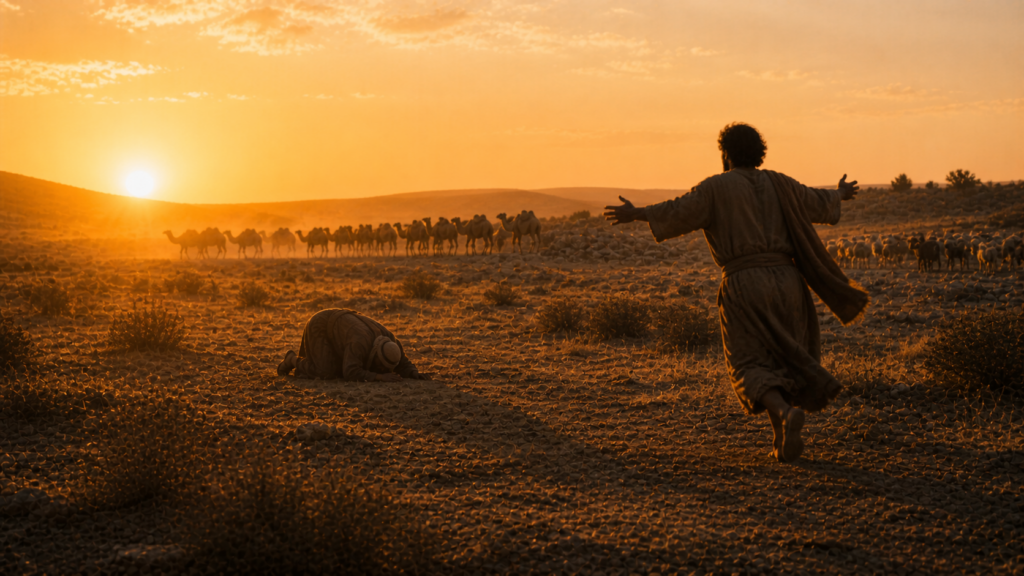
Genesis 33 is the chapter of the meeting Jacob has been afraid of for twenty years. He has wrestled God in the night; the sun has risen; he is limping. He looks up and sees Esau coming, with the four hundred men. He divides his children among the wives. He goes ahead of them, bows seven times, and approaches his brother. Esau runs to meet him, embraces him, falls on his neck, kisses him, and they weep.
That is the chapter’s center. After all the dread, after all the gifts sent ahead, after all the strategic dividing, after the night of wrestling, the meeting is met by an embrace and a weeping. The chapter does not explain Esau’s posture. It does not record what happened to him in the twenty years between his murderous resolution at the end of chapter 27 and his run to meet his brother here. The chapter just records the embrace. Whatever happened, Esau is not the man he was.
The rest of the chapter is the brothers’ careful negotiation of how to part again. Esau wants to travel with Jacob; Jacob declines, citing the children’s pace and the flocks. Esau goes back to Seir. Jacob travels on, eventually to Shechem, where he buys a piece of land from the sons of Hamor and erects an altar called El-Elohe-Yisrael, “God, the God of Israel.” The chapter is, in its quiet way, the formal close of the Jacob-and-Esau arc that has run since chapter 25. The brothers will meet only one more time, at their father Isaac’s burial in chapter 35. The chapter is recording the moment at which the contest for the blessing finally ends.
A · Genesis 33:1–11 · The embrace
¹ Jacob lifted up his eyes, and looked, and, behold, Esau was coming, and with him four hundred men. He divided the children among Leah, Rachel, and the two servants. ² He put the servants and their children in front, Leah and her children after, and Rachel and Joseph at the rear. ³ He himself passed over in front of them, and bowed himself to the ground seven times, until he came near to his brother. ⁴ Esau ran to meet him, embraced him, fell on his neck, kissed him, and they wept. ⁵ He lifted up his eyes, and saw the women and the children; and said, “Who are these with you?” He said, “The children whom God has graciously given your servant.” ⁶ Then the servants came near with their children, and they bowed themselves. ⁷ Leah also and her children came near, and bowed themselves. After them, Joseph came near with Rachel, and they bowed themselves. ⁸ Esau said, “What do you mean by all this company which I met?” Jacob said, “To find favor in the sight of my lord.” ⁹ Esau said, “I have enough, my brother; let that which you have be yours.” ¹⁰ Jacob said, “Please, no, if I have now found favor in your sight, then receive my present at my hand, because I have seen your face, as one sees the face of God, and you were pleased with me. ¹¹ Please take the gift that I brought to you, because God has dealt graciously with me, and because I have enough.” He urged him, and he took it. (Genesis 33:1–11, NRSVue)
- The chapter opens with the same construction we have tracked through several earlier chapters. Jacob lifted up his eyes. The patriarchal figure does what the patriarchal narrative has had him do at decisive moments. He lifts his eyes; he sees what is coming; the chapter pivots. The eyes that saw Rachel at the well in chapter 29 now see Esau coming with four hundred men.
- The dividing of the children (verses 1 to 2) is calculated. Jacob places the slave-women and their children in front, then Leah and her children, then Rachel and Joseph at the rear. The arrangement reveals the patriarch’s hierarchy of love: those most precious to him are placed farthest from the danger. The chapter records the placement without softening it. The four mothers and their children are not equal in Jacob’s heart, and the chapter is honest about it.
- Verse 3 records Jacob’s approach. He himself passed over in front of them, and bowed himself to the ground seven times, until he came near to his brother. The Hebrew construction vayishtachu artzah sheva pe’amim uses the same verb (shacha, to bow down deeply, prostrate) used for worship of God elsewhere. Seven prostrations, in ANE convention, was the gesture of a vassal toward a great king. The patriarchal grandson is approaching his brother in the posture of a subject before a sovereign. The man who took the be lord over your brothers blessing in chapter 27 is, in chapter 33, performing the inverse. The chapter is recording the formal reversal. Whatever the blessing meant, whatever the renaming at Jabbok meant, the patriarch is approaching his brother as a servant.
- Verse 4 is the chapter’s stunning surprise. Esau ran to meet him, embraced him, fell on his neck, kissed him, and they wept. The Hebrew uses four verbs in rapid sequence: vayaratz… vayechabqehu… vayipol… vayishaqehu… vayivku. The verbs pile up. There is no description of words spoken before the embrace; the brothers’ bodies act before their tongues. The man who twenty years earlier said I will kill my brother Jacob (27:41) runs to meet him and weeps on his neck.
Influence callout: Walter Brueggemann
Brueggemann’s reading of this scene names it as one of the patriarchal narrative’s most pastorally important moments. The chapter does not explain Esau’s transformation. It does not give us the twenty years of work that produced the run, the embrace, the weeping. The chapter just records the moment. Brueggemann argues that this is the patriarchal narrative’s quiet pastoral honesty about reconciliation: it does not arrive on schedule, it does not arrive because anyone deserved it, and it does not arrive in proportion to the wrong that produced the breach. The chapter is recording a grace the chapter does not explain. The reader is invited to receive it as the chapter receives it: with surprise, with gratitude, and without trying to flatten it into a moral pattern.
Influence callout: Brian Zahnd
Zahnd’s broader reading of these reconciliation moments often names them as the Hebrew Bible’s most cruciform pastoral work. The patriarch has lived in fear of this meeting for twenty years. He has prepared with gifts. He has wrestled the night before. He has approached with his face to the ground. And the brother runs. Zahnd argues that the chapter is teaching, in Esau’s run, what the gospel will later articulate at the cross: love that runs toward the wrongdoer is the chapter’s most important theological move. Esau, in this scene, is the parable of the prodigal son’s father in advance. He runs.
- The exchange of words (verses 5 to 11) is layered with face-vocabulary. Jacob calls his children the children whom God has graciously given your servant. The wives and slaves and sons all bow, in turn. Esau asks about the gift. What do you mean by all this company which I met? Jacob explains: to find favor in the sight of my lord.
- Verse 9 is Esau’s first attempt at refusal. I have enough, my brother; let that which you have be yours. The Hebrew is yesh-li rav, achi, “I have abundance, my brother.” Esau does not need the gift. He has prospered in Seir; he is a man of substance; his welcome is not conditional on payment. The chapter records Esau’s quiet dignity in refusing the appeasement.
- Jacob’s response (verses 10 to 11) contains the chapter’s most theologically charged sentence. Please, no, if I have now found favor in your sight, then receive my present at my hand, because I have seen your face, as one sees the face of God, and you were pleased with me. The Hebrew is ki al-ken ra’iti faneicha kir’ot pnei Elohim va-tirtzeni, “for I have seen your face as the seeing of the face of God, and you have accepted me.” The chapter is naming the connection between the previous chapter and this one. Jacob saw God face to face at Peniel and his life was preserved. He has now seen Esau’s face and been received. The two facings are placed side by side. The chapter is making the claim that the face of the brother who forgives carries something of the face of God who forgave.
Word study: pnei Elohim (פְּנֵי אֱלֹהִים), “face of God”
The Hebrew phrase pnei Elohim is used in Genesis 32:30 (Peniel, “face of God”) and in Genesis 33:10. The chapter is connecting the two scenes deliberately. The patriarch saw the face of God at the Jabbok and his life was preserved. He now sees the face of his brother and is received. The two facings are framed as parallel. The chapter is making a careful theological move: the experience of God’s forgiving face at Peniel becomes the lens through which the patriarch can recognize Esau’s forgiving face at the meeting. Reconciliation between humans, the chapter is suggesting, is reflective of and dependent on reconciliation with God. The two faces participate in the same kind of grace.
Influence callout: Marty Solomon (Bema)
Solomon’s teaching on this scene often emphasizes the chapter’s deliberate face-of-God / face-of-the-brother parallel. The patriarch has just experienced one face-of-God encounter; he now experiences another. The chapter is teaching, in its narrative structure, that the face of the brother who forgives is, in some real sense, the face of God to the one being forgiven. Solomon argues that this is one of the patriarchal narrative’s quiet preparations for the Sermon on the Mount and the Lord’s Prayer: forgive us our debts, as we have forgiven our debtors. The face-of-God experience is bound up with the face-of-the-brother experience. The chapter is teaching this pastoral theology in narrative form.
- Please take the gift that I brought to you, because God has dealt graciously with me, and because I have enough (verse 11). Jacob now uses the same vocabulary Esau used (I have enough, Hebrew yesh-li kol, “I have all”). The two brothers are now naming, side by side, that they both have enough. The poverty fear that drove the patriarchal grandson out of Beersheba and the murderous desire that drove Esau’s resolution are both, in this chapter, named as no longer in operation. He urged him, and he took it. The gift is accepted. The reconciliation is sealed.
B · Genesis 33:12–17 · The diverging paths
¹² Esau said, “Let us take our journey, and let us go, and I will go before you.” ¹³ Jacob said to him, “My lord knows that the children are tender, and that the flocks and herds with me have their young, and if they overdrive them one day, all the flocks will die. ¹⁴ Please let my lord pass over before his servant, and I will lead on gently, according to the pace of the livestock that are before me and according to the pace of the children, until I come to my lord to Seir.” ¹⁵ Esau said, “Let me now leave with you some of the people who are with me.” He said, “Why? Let me find favor in the sight of my lord.” ¹⁶ So Esau returned that day on his way to Seir. ¹⁷ Jacob traveled to Succoth, built himself a house, and made shelters for his livestock. Therefore the name of the place is called Succoth. (Genesis 33:12–17, World English Bible)
- Esau’s offer (verse 12) is generous. Let us take our journey, and let us go, and I will go before you. The brother who came with four hundred men now offers to escort the patriarchal household. The chapter is, again, recording an Esau the chapter does not flatter into being more than he is. He is genuinely offering protection.
- Jacob’s decline (verses 13 to 14) is careful and somewhat evasive. He cites the children’s tender age, the flocks’ young, the slow pace. He proposes that Esau go ahead and that he himself will catch up at Seir.
Pushback note
Jacob’s promise to come to Seir (verse 14) is, in the rest of the chapter, not kept. The patriarchal grandson does not, in fact, follow Esau to Seir; he goes to Succoth and then to Shechem. Some commentators have read this as Jacob’s continuing deceit; the patriarch has been transformed by the night at the Jabbok, but the calculating instincts have not fully dissolved. Other commentators read the promise as a politely-vague commitment that did not require literal fulfillment. The chapter does not resolve the tension. We can name Jacob’s transformation as real and his complete sanctification as still in progress. Both are honest readings of the chapter.
- Esau’s second offer (verse 15) is also gracious: let me now leave with you some of the people who are with me. He is offering an armed escort. Jacob declines again, with the same construction (let me find favor in the sight of my lord). The two brothers part. The chapter records the parting in two short sentences. So Esau returned that day on his way to Seir. Jacob traveled to Succoth.
- Succoth (Hebrew Sukkot, “shelters” or “booths”) is named for the temporary structures Jacob builds for his livestock. The place-name commemorates the way-station nature of his stay. He does not yet build a house in the promised land; he builds sukkot, temporary shelters, the same Hebrew word that will later name Israel’s wilderness pilgrimage feast (the Feast of Tabernacles). The patriarch is, in this small detail, foreshadowing the wilderness pattern. The covenant family will spend much of its life in sukkot.
Influence callout: Tim Mackie
Mackie’s literary reading of the place-names in the patriarchal narrative often pauses on details like this. Sukkot will reappear in Israel’s wilderness narrative; the Feast of Sukkot will become one of the three pilgrimage feasts; the temporary-shelter motif will run through the prophets and into the New Testament (the Transfiguration, where Peter wants to make three skenas). Mackie reads the place-name here as the chapter’s quiet seeding of a motif that will run for the rest of the canon. The patriarchal grandson, returning to the land, builds the first sukkot in scripture. The covenant family’s relationship with the land will, for centuries to come, often look more like sukkot than like a permanent house.
C · Genesis 33:18–20 · Shechem and the second piece of land
¹⁸ Jacob came in peace to the city of Shechem, which is in the land of Canaan, when he came from Paddan Aram; and encamped before the city. ¹⁹ He bought the parcel of ground where he had spread his tent, at the hand of the children of Hamor, Shechem’s father, for one hundred pieces of money. ²⁰ He erected an altar there, and called it El Elohe Israel. (Genesis 33:18–20, World English Bible)

- The chapter ends with Jacob’s arrival at Shechem and the purchase of land. The Hebrew construction vayavo Yaakov shalem, “Jacob came in peace” (or “Jacob came whole/complete”), has often been noted as a small theological signal. Shalem shares its root with shalom, “peace, wholeness.” The patriarchal grandson, who left the land in chapter 28 alone and afraid, returns shalem, with eleven sons, four mothers, livestock, wealth, and a body that bears the limp of his encounter with God. The Hebrew is doing quiet work.
- Shechem is named here for the first time as a named place in the Jacob narrative. The site has appeared earlier (Abraham’s first stop in the land at the oak of Moreh in 12:6); now it returns as the first city Jacob enters in his return. The narrative is doing geographic theology again. The patriarch enters the land at the same site his grandfather entered it.
Influence callout: Ray Vander Laan
Vander Laan’s geographic teaching on Shechem is helpful here. The site sits in the central highlands, in the cleft between Mount Gerizim and Mount Ebal, and will become one of the most important covenantal sites in the Hebrew Bible. Joshua will renew the covenant here (Joshua 24); the tribes will pronounce blessings and curses from the two mountains (Deuteronomy 27); Jeroboam will make Shechem his first capital (1 Kings 12). Vander Laan reads the patriarchal narrative’s repeated naming of Shechem as the deliberate establishing of a sacred geographic spine that the rest of the Bible will keep coming back to. Jacob’s purchase of land here is the second piece of the patriarchal land claim (Abraham’s burial cave at Machpelah was the first).
- Verse 19 records the transaction. He bought the parcel of ground where he had spread his tent, at the hand of the children of Hamor, Shechem’s father, for one hundred pieces of money. The Hebrew word for “pieces of money” (qesitah) is a unit of unknown precise value, used only here, in Joshua 24:32, and in Job 42:11. The transaction is precise: Jacob is making a legal land purchase, with witnesses, in the same way Abraham did at Machpelah. The patriarchal land claim is being slowly built one parcel at a time.
- The altar (verse 20) is named El-Elohe-Yisrael (Hebrew El-Elohei-Yisrael), “God, the God of Israel.” The patriarch is, in the act of naming the altar, formally acknowledging his new covenant name. The altar’s name does not invoke Yaakov; it invokes Yisrael. The renaming at Jabbok is being used. The covenant family’s altar is being inscribed with the name the divine wrestler gave the patriarch the night before his meeting with Esau.
Influence callout: N.T. Wright
Wright’s reading of the patriarchal land-altars (Abraham’s at Shechem, Bethel, Hebron; Isaac’s at Beer-sheba; Jacob’s now at Shechem) names them as the slow geographical establishing of the covenant family’s claim on the land they have been promised but do not yet rule. Each altar is a marker. Each altar names a divine encounter. Each altar is the patriarchal family’s quiet investment in territory that will not become Israel’s politically for many centuries. Wright argues that the patriarchal narrative is teaching a kind of patient covenant geography: the land is claimed by altar before it is ruled by king. Genesis 33:20 is the first patriarchal altar built under the new covenant name Yisrael. The geography that the patriarchs walked is now being walked by the patriarch the divine wrestler renamed.
- The chapter ends quietly. No fanfare. No record of celebration. Just the altar, the name, the land. The next chapter will record the trouble at Shechem (the violence of Genesis 34); the chapter ends before that begins. For one chapter’s length, the patriarchal grandson has come shalem into the land, with the covenant heir behind him, the limping father out in front, the altar named after the new name, and the long road to Bethel still ahead.
Reflection prompts
- The chapter records Esau’s run to meet his brother without explaining the twenty years that produced it. Reconciliation, in the patriarchal narrative, sometimes arrives without a trackable narrative cause. Where in your life has reconciliation showed up unexpectedly, and what does it mean to receive it without explaining it?
- I have seen your face, as one sees the face of God. The patriarchal grandson connects the face of his forgiving brother to the face of God who forgave him the night before. Where in your life has another person’s grace toward you carried something of the face of God you needed to recognize? What would it take to let the human face be enough?
- The patriarchal household builds sukkot (temporary shelters) at the first stop in the land. The covenant family, returning home, does not yet build a house. They build booths. Where in your life have you been tempted to make permanent what is meant to be temporary, and what does it look like to live in sukkot on the way to whatever permanence is actually coming?