

Genesis 32 is one of the most theologically dense chapters in the Hebrew Bible. The patriarchal grandson, having broken with Laban at Mizpah, is now walking toward the brother he has not seen in twenty years, the brother who once intended to kill him. The chapter traces the night between the two encounters: a vision of angels at Mahanaim, a frantic preparation for the meeting with Esau, a strategic dividing of the household into two camps, an extended prayer of remarkable theological honesty, the sending of waves of livestock as appeasement, the crossing of the family across the river Jabbok, and then, in the dark, alone, the wrestling.
A man wrestles with Jacob until daybreak. The man cannot prevail; he touches the patriarch’s hip socket and dislocates it. Jacob refuses to let go: I will not let you go unless you bless me. The man asks his name. Jacob, who has been Yaakov (heel-holder, supplanter) for sixty-plus years, names himself for the first time in the Hebrew Bible: Jacob. The man renames him Yisrael, “for you have struggled with God and with men, and have prevailed.” Jacob asks the man’s name; the man refuses. The man blesses Jacob. The patriarch names the place Peniel (“face of God”): I have seen God face to face, and my life is preserved. The sun rises. Jacob walks on, limping, toward Esau.
The chapter is doing several things at once. It is recording a transformation that will mark the patriarch for the rest of his life. It is establishing the name Israel (which will be the name of the people, the land, and the eschatological community of God’s people) at its origin. It is showing us a Jacob whose long contest with everyone in his life (Esau, Isaac, Laban) has now been answered by a contest with God himself. It is giving us, in the limping patriarch at the end of the chapter, the Hebrew Bible’s first portrait of a person whose encounter with God has cost him his stride.
The chapter has been read for over two thousand years and continues to resist exhaustive reading. Whatever else the chapter is doing, it is an invitation to the reader: this is the kind of encounter the covenant produces, and the people who have been through it walk differently afterward.
A · Genesis 32:1–8 · Mahanaim and the dividing of the company
¹ Jacob went on his way, and the angels of God met him. ² When he saw them, Jacob said, “This is God’s army.” He called the name of that place Mahanaim. ³ Jacob sent messengers in front of him to Esau, his brother, to the land of Seir, the field of Edom. ⁴ He commanded them, saying, “This is what you shall tell my lord, Esau: ‘This is what your servant, Jacob, says. I have lived as a foreigner with Laban, and stayed until now. ⁵ I have cattle, donkeys, flocks, male servants, and female servants. I have sent to tell my lord, that I may find favor in your sight.’” ⁶ The messengers returned to Jacob, saying, “We came to your brother Esau. He is coming to meet you, and four hundred men are with him.” ⁷ Then Jacob was greatly afraid and was distressed. He divided the people who were with him, and the flocks, and the herds, and the camels, into two companies; ⁸ and he said, “If Esau comes to the one company, and strikes it, then the company which is left will escape.” (Genesis 32:1–8, World English Bible)
- The chapter opens with a brief theophany. Jacob went on his way, and the angels of God met him. The Hebrew word malakhei Elohim, “messengers of God,” is the same vocabulary the chapter 28 ladder dream used (28:12). The patriarchal grandson had angels ascending and descending on a staircase as he left the land twenty years earlier; now, as he reenters the land, the angels meet him at the boundary. The chapter is, again, doing structural work. The exit and the return are framed by the same divine company.
- He called the name of that place Mahanaim. The Hebrew Machanaim is a dual noun, “two camps” or “double camp.” The narrator does not explain why Jacob chose the dual. Some readings see Jacob’s camp and the angelic camp as the two; others see Jacob’s company and the larger divine host. The dual itself, however, anticipates the chapter’s later structural move: Jacob will divide his own household into two camps in verse 7. The word Mahanaim is the chapter’s first hint that what is coming will involve doubled, layered presences.
Word study: Mahanaim (מַחֲנָיִם), “two camps”
The Hebrew is a dual form of machaneh (camp, encampment). The dual signals two distinct camps. The chapter uses the place-name to frame the encounter: Jacob meets a divine machaneh at the same site where he is about to divide his own household into two machanot. The chapter’s geography and the chapter’s strategy converge in the place-name. Mahanaim will reappear later in the Hebrew Bible (notably in 2 Samuel 17, where David takes refuge there during Absalom’s revolt), and the dual-camp resonance carries forward.
- Jacob sends messengers ahead to Esau (verses 3 to 5). The Hebrew word for “messenger” (malakh) is the same word that just named the angels of God in verse 1. The chapter is using the same vocabulary across human and divine emissaries. Jacob’s malakhim go to Esau; God’s malakhim met Jacob at Mahanaim. The chapter is layering registers.
- The message Jacob gives his messengers is itself revealing. This is what your servant, Jacob, says. The patriarchal grandson, who took the blessing of be lord over your brothers in chapter 27, is now self-identifying as your servant. He calls Esau my lord. The grammatical reversal is telling. The man who took the dominance position in the blessing is, twenty years later, presenting himself in the subordinate position to the brother he displaced.
- The messengers’ report (verse 6) is brief and ominous. Esau is coming to meet you, and four hundred men are with him. Four hundred is, in ANE military terms, a substantial private force. The number does not say Esau is coming to kill you, but it does not say Esau is coming peacefully. The chapter is making sure the reader feels the weight of the unknown.
- Jacob’s response (verses 7 to 8) is honest in two short clauses. Then Jacob was greatly afraid and was distressed. The Hebrew is vayira… vayetzer, “and he feared and was distressed.” The patriarchal grandson, who has been the chapter’s most calculating figure, is now afraid. The narrator records the fear without softening it. The man who took the blessing has spent twenty years in exile and is now, on the eve of his reentry, terrified of the brother he wronged.
- The dividing of the camp (verses 7 to 8) is strategic. If Esau comes to the one company, and strikes it, then the company which is left will escape. Jacob’s plan is not heroic. It is preservation. He is splitting his household so that part of it will survive even if the other part is destroyed. The patriarch’s love for his family runs through, but the chapter is not romanticizing him. He is, even in fear, calculating.
B · Genesis 32:9–21 · The prayer and the gifts
⁹ Jacob said, “God of my father Abraham, and God of my father Isaac, Yahweh, who said to me, ‘Return to your country, and to your relatives, and I will do you good,’ ¹⁰ I am not worthy of the least of all the loving kindnesses, and of all the truth, which you have shown to your servant; for with just my staff I crossed over this Jordan; and now I have become two companies. ¹¹ Please deliver me from the hand of my brother, from the hand of Esau; for I fear him, lest he come and strike me, and the mothers with the children. ¹² You said, ‘I will surely do you good, and make your offspring as the sand of the sea, which can’t be counted because there are so many.’” ¹³ He stayed there that night, and took from that which he had with him, a present for Esau, his brother: ¹⁴ two hundred female goats and twenty male goats, two hundred ewes and twenty rams, ¹⁵ thirty milk camels and their colts, forty cows, ten bulls, twenty female donkeys and ten foals. ¹⁶ He delivered them into the hands of his servants, every herd by itself, and said to his servants, “Pass over before me, and put a space between herd and herd.” ¹⁷ He commanded the foremost, saying, “When Esau, my brother, meets you, and asks you, saying, ‘Whose are you? Where are you going? Whose are these before you?’ ¹⁸ Then you shall say, ‘They are your servant, Jacob’s. It is a present sent to my lord, Esau. Behold, he also is behind us.’” ¹⁹ He commanded also the second, and the third, and all that followed the herds, saying, “This is how you shall speak to Esau, when you find him. ²⁰ You shall say, ‘Not only that, but behold, your servant, Jacob, is behind us.’” For, he said, “I will appease him with the present that goes before me, and afterward I will see his face. Perhaps he will accept me.” ²¹ So the present passed over before him, and he himself stayed that night in the camp. (Genesis 32:9–21, World English Bible)
- The prayer (verses 9 to 12) is one of the most theologically alert prayers in the Hebrew Bible, and it is offered by the man who has been the patriarchal narrative’s most calculating figure. Three movements: – Address: God of my father Abraham, and God of my father Isaac, Yahweh. Jacob anchors his prayer in the patriarchal divine name and the covenant family lineage. – Confession: I am not worthy of the least of all the loving kindnesses, and of all the truth. The Hebrew is qatonti mi-kol ha-chasadim u-mi-kol ha-emet, “I have been made small from all the chesed and emet.” The patriarchal grandson is naming his unworthiness in language that uses the two great covenant words (chesed, “loving-kindness,” and emet, “truth”). He is acknowledging that everything he has, he has by gift. – Petition: Please deliver me from the hand of my brother… lest he come and strike me, and the mothers with the children. The plea is concrete. He is asking for survival, for himself and for the women and children with him. – Reminder: You said, “I will surely do you good, and make your offspring as the sand of the sea.” Jacob is, at the prayer’s close, holding Yahweh to the promise. The covenant promise of innumerable offspring is being invoked as the basis for the request.
Influence callout: Walter Brueggemann
Brueggemann’s reading of this prayer names it as one of the patriarchal narrative’s most fully formed pieces of theological speech. The patriarchal grandson is praying in the language of Sinai before Sinai: chesed, emet, the divine name, the covenant promise. He is, for the first time in the chapter, the man who has been formed by twenty years of divine pursuit. The prayer is not a calculating man’s calculation; it is a fearful man’s honest naming of what he knows about God. Brueggemann argues that the wrestling later in the chapter cannot be understood without this prayer first. The man who will refuse to let the divine encounter end without a blessing has, in this prayer, already been formed by what the divine encounter has been doing for twenty years.
- The gift to Esau (verses 13 to 21) is enormous. The Hebrew totals: 200 female goats, 20 male goats, 200 ewes, 20 rams, 30 milk camels with colts, 40 cows, 10 bulls, 20 female donkeys, 10 foals. Five hundred fifty animals total. Jacob is sending, in waves, a substantial portion of his accumulated wealth.
- The strategy is psychologically careful. The animals are sent in successive herds with space between them. Each herd is to be presented as Jacob’s gift to my lord, Esau. Each subsequent herd reinforces the message. Jacob’s stated reasoning (verse 20) is I will appease him with the present that goes before me, and afterward I will see his face. Perhaps he will accept me.
Word study: kipper et-panav (אֲכַפְּרָה פָנָיו), “I will appease his face”
The Hebrew word kapar in verse 20 is the verb that will become foundational for the Hebrew Bible’s atonement theology. Yom Kippur (Day of Atonement) takes its name from this root. Here it is used in its pre-Levitical, more primitive sense: to cover, to wipe away, to make appeasement. Jacob is, at face value, trying to kapar his brother’s face by means of the gift. The chapter is using the language of atonement, in the patriarchal narrative’s narrative form, before the Mosaic sacrificial system is given. The atonement Jacob is attempting is interpersonal; the atonement Leviticus will systematize is theological. The same Hebrew root carries both, suggesting that the biblical imagination treats them as connected: making things right with the offended, whether human or divine, runs through the same vocabulary.
- Perhaps he will accept me (verse 20). The Hebrew is ulai yisa panai, “perhaps he will lift up my face.” The idiom is reciprocal. Jacob is hoping that, after he has tried to kapar Esau’s face, Esau will yisa his face. The chapter is using face-vocabulary throughout (his face… my face… see his face… lift my face), and the face-vocabulary will reach its theological climax later in the chapter when Jacob sees God face to face at Peniel.
C · Genesis 32:22–32 · The wrestling at Jabbok
²² He rose up that night, and took his two wives, and his two servants, and his eleven sons, and crossed over the ford of the Jabbok. ²³ He took them, and sent them over the stream, and sent over that which he had. ²⁴ Jacob was left alone, and wrestled with a man there until the breaking of the day. ²⁵ When he saw that he didn’t prevail against him, he touched the hollow of his thigh, and the hollow of Jacob’s thigh was strained as he wrestled. ²⁶ The man said, “Let me go, for the day breaks.” Jacob said, “I won’t let you go unless you bless me.” ²⁷ He said to him, “What is your name?” He said, “Jacob.” ²⁸ He said, “Your name will no longer be called Jacob, but Israel; for you have fought with God and with men, and have prevailed.” ²⁹ Jacob asked him, “Please tell me your name.” He said, “Why is it that you ask what my name is?” He blessed him there. ³⁰ Jacob called the name of the place Peniel: for, he said, “I have seen God face to face, and my life is preserved.” ³¹ The sun rose on him as he passed over Peniel, and he limped because of his thigh. ³² Therefore the children of Israel don’t eat the sinew of the hip, which is on the hollow of the thigh, to this day, because he touched the hollow of Jacob’s thigh in the sinew of the hip. (Genesis 32:22–32, NRSVue)
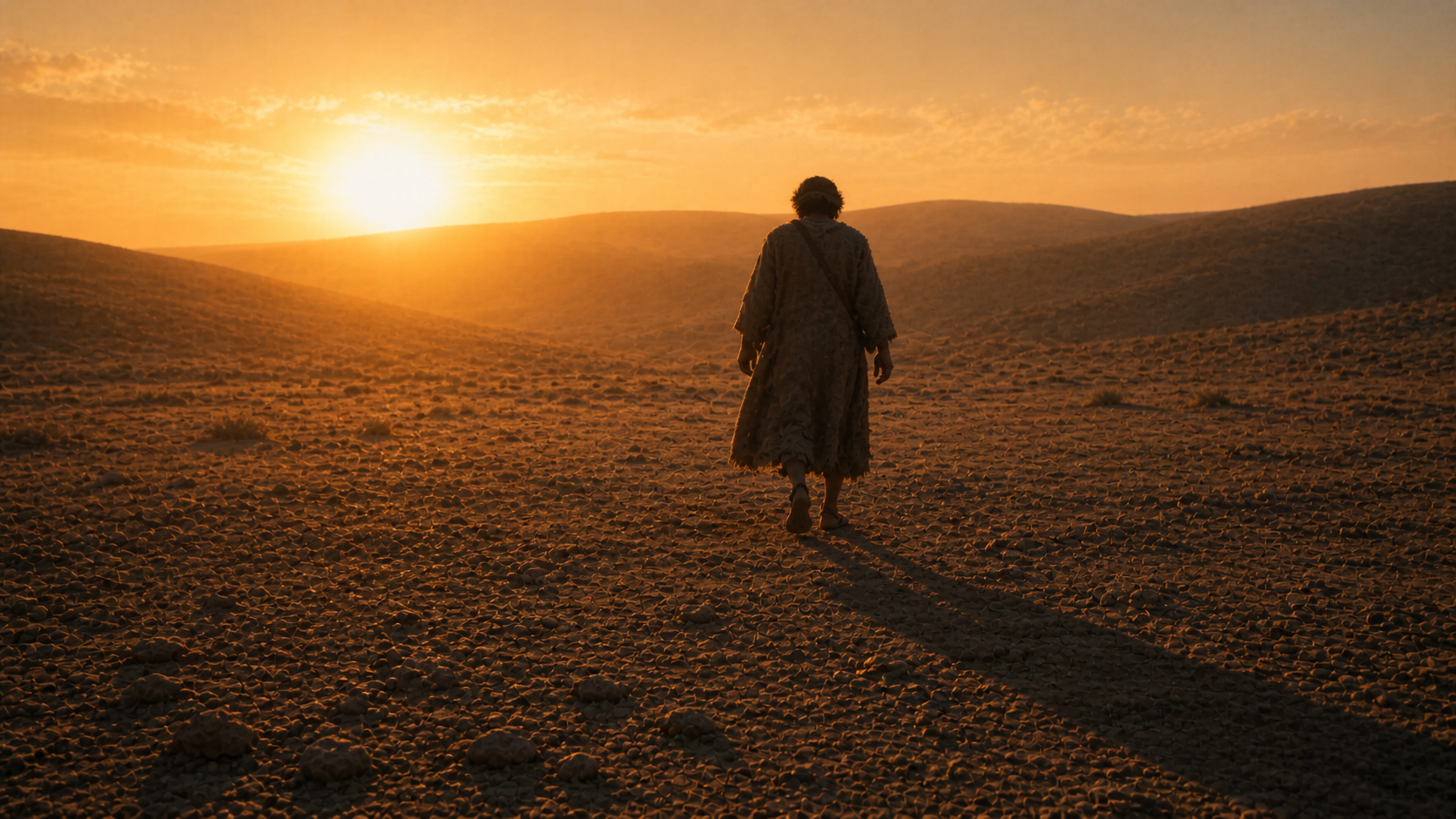
- The chapter’s central scene begins with a careful sequence. Jacob takes his entire household across the Jabbok by night. He stays behind alone. The narrator’s setup is precise. The patriarch is alone, in the dark, by the ford of the Jabbok, on the night before the meeting with his brother. The household has crossed; Jacob has not yet crossed.
- The Jabbok (Hebrew Yaboq) is itself a wordplay. The river’s name shares consonants with the verb avaq, “to wrestle,” which is the verb the chapter will use for what is about to happen. The narrator may be invoking the wordplay: the man named Yaakov wrestles (avaq) at the Yaboq. The chapter is playing with sound-clusters across all three names.
- Jacob was left alone, and wrestled with a man there until the breaking of the day. The Hebrew word for “man” is ish, the standard Hebrew word for a male human being. The narrator does not yet identify the man as a divine being. The encounter starts as a wrestling match between two men. The chapter’s slow revelation of who the ish actually is matches the chapter’s slow theological work.
- The wrestling lasts the entire night. The Hebrew construction vaye’aveq, “and he wrestled,” is intensive. The verb appears only in this chapter; it is otherwise absent from the Hebrew Bible. The narrator is using a word as unusual as the encounter.
Word study: avaq (אָבַק), “to wrestle”
The Hebrew verb appears only in Genesis 32:24 to 25 (the noun form ma’aveq, “wrestling-place,” appears once at Isaiah 41:12 in some readings). The root may be related to avaq (אָבָק), “dust,” giving the sense of wrestling-in-the-dust. The chapter has chosen a unique word for a unique encounter. The Hebrew Bible will not use this verb again. Avaq is the verb of the night at the Jabbok, and only of that night.
- Verse 25 marks the chapter’s pivot. When he saw that he didn’t prevail against him, he touched the hollow of his thigh, and the hollow of Jacob’s thigh was strained as he wrestled. The man does something Jacob cannot do back: a single touch dislocates the patriarch’s hip. The narrator is, with quiet precision, telling us who the man actually is. Whatever has been wrestling Jacob through the night is something that can break him with a touch but has chosen, until now, to wrestle on equal terms. The man’s strength is not equal to Jacob’s; the man’s strength is restrained.
Influence callout: Tim Mackie
Mackie’s reading of the wrestling scene argues that the chapter’s deepest theological move is in verse 25. The man could have ended the contest at any moment; the touch on the thigh proves it. The chapter is not recording a divine being who could not defeat Jacob; it is recording a divine being who chose to wrestle Jacob to the end of his strength. The wrestling is itself the act of grace. Jacob is being formed by being met at his own pitch of effort. Mackie reads this as one of the patriarchal narrative’s deepest portraits of how God relates to humanity: not by overpowering, but by meeting, by wrestling, by waiting for the human partner to come to the limit of their own capacity.
- Let me go, for the day breaks (verse 26). The man asks to be released. The detail has been read variously. Some readings (especially Jewish midrashic) connect it to ANE conventions about divine beings being unable to remain visible after sunrise. Others read it as the man’s deference to Jacob’s exhausted state. Whatever the reading, the next sentence is the chapter’s definitive line.
- I won’t let you go unless you bless me. The Hebrew is lo ashalech-cha ki im-berakh-tani, “I will not send you unless you bless me.” The patriarchal grandson, after a night of wrestling, has decided that the divine encounter must produce a blessing. He is not letting go without it. The man who took the blessing by deception in chapter 27 is now, in chapter 32, refusing to let go of the divine encounter without a freely given blessing.
- The exchange of names (verses 27 to 28) is the chapter’s most theologically charged moment. The man asks Jacob’s name. Jacob names himself for the first time in the Hebrew Bible: Yaakov. The name, as we have tracked since chapter 25, carries the meaning heel-holder, supplanter, deceiver. For sixty-plus years he has been Yaakov. He names himself now, in front of the divine being he has been wrestling, with the name that has carried his whole moral life.
- The man’s response is the renaming. Your name will no longer be called Jacob, but Israel; for you have fought with God and with men, and have prevailed. The Hebrew name Yisrael (יִשְׂרָאֵל) is interpreted by the chapter as “one who strives with God” or “God strives.” The verb sarah (to struggle, to contend, to prevail) plus El (God). The renaming is a vocational commission. The man whose old name marked him as a supplanter has been renamed for the contest he has just fought and survived.
Word study: Yisrael (יִשְׂרָאֵל), “Israel”
The Hebrew name combines sarah (to struggle, to contend) with El (God). The chapter’s stated meaning is “one who has struggled with God and with men, and has prevailed.” The name is grammatically ambiguous (it could mean “God strives” or “one who strives with God”); the chapter’s interpretation in 32:28 makes the second the canonical reading. The renaming is foundational for the rest of the Hebrew Bible. The patriarch is Yisrael. His descendants are bnei Yisrael. The land will be called Eretz Yisrael. The people, the place, and the eschatological community of God’s people will all carry the name first given to Jacob at the Jabbok. The chapter is naming the people of God, in advance, by the experience of the patriarchal grandson who refused to let go of the divine wrestling.
Influence callout: Marty Solomon (Bema)
Solomon’s teaching on the name Yisrael often pauses on its grammatical complexity. The name is not “one who has been victorious over God”; it is “one who has been engaged in serious contest with God and has not let go.” The “prevailing” the chapter names is not the prevailing of overpowering; it is the prevailing of holding on. Solomon argues, in line with much Jewish reading, that the name is being passed to a people whose vocation is to not let go of the divine encounter, even when the encounter wounds them. The name is not a triumph; it is a commission.
Influence callout: Brian Zahnd
Zahnd’s broader reading of the patriarchal narrative often names this scene as the patriarchal cycle’s deepest cruciform moment. The patriarch is wounded by the very encounter that blesses him. The blessing comes through the night of wrestling; the limp comes through the touch that could have killed but only wounded. Zahnd argues that this is one of the patriarchal narrative’s deep portraits of how God forms people: not by exempting them from the wound, but by giving the blessing through the night, with the wound included. The man who limps for the rest of his life walks differently because of what he received.
- Jacob’s question (verse 29) is bold. Please tell me your name. The man refuses. Why is it that you ask what my name is? The refusal preserves the mystery. The patriarchal grandson has been in contest with a divine being whose name he is not given. The chapter is not interested in collapsing the encounter into a clean theological category; it leaves the man unnamed.
- He blessed him there. The blessing is given, in the chapter’s stark Hebrew, without specification of content. The chapter does not record the words. The blessing is enough; the chapter does not need to spell it out.
- Jacob called the name of the place Peniel: for, he said, “I have seen God face to face, and my life is preserved.” The Hebrew name is Peni’el, “face of God.” The patriarch is naming the place by what happened there. The phrase I have seen God face to face is theologically significant. Exodus 33:20 will later say no man can see me and live. The patriarch has, in this chapter, encountered the divine in a way that should have been fatal and was not. And my life is preserved (Hebrew vatinatzel nafshi, “and my soul was rescued”) names the gift inside the gift.
Word study: Peniel (פְּנִיאֵל), “face of God”
The Hebrew place-name combines panim (“face”) with El (“God”). The patriarch is naming the place by what he believes happened there. The face-vocabulary that has run through this chapter (Esau’s face, the face of God, the lifted face) reaches its theological resolution at Peniel. The patriarch’s account (I have seen God face to face) is not metaphorical; it is the chapter’s theological claim. The face-of-God encounter is the hinge between what has been and what will be.
- Verse 31 closes the chapter’s main movement. The sun rose on him as he passed over Peniel, and he limped because of his thigh. The dawn breaks; the patriarch crosses the Jabbok; he is now walking with a limp. The Hebrew word vehu tzole’a, “and he was limping,” is unusual; the verb appears in the prophets later (Micah 4:6, Zephaniah 3:19) as a descriptor of God’s gathering of the lame. The patriarch carries, for the rest of his life, the bodily mark of the night.
- The dietary note in verse 32 is the chapter’s quiet permanence. The children of Israel don’t eat the sinew of the hip, which is on the hollow of the thigh, to this day. The narrator is recording a Jewish dietary practice that the chapter explains by reference to this night. Whether the practice originated here or was preserved here, the chapter is saying: the limp of the patriarch is not just his own; it is permanently remembered in the eating practices of the people who carry his renamed name.
Reflection prompts
- The patriarch is alone, in the dark, on the night before the most fearful meeting of his life. The encounter that meets him there is not the brother he was afraid of; it is God. Where in your life are you currently afraid of one meeting, and what does it mean to consider that the deeper meeting on the road may be one you have not yet realized you were walking toward?
- The renaming requires Jacob to name himself first. The man asks what is your name? Jacob has to say Yaakov, with everything that name has carried for sixty years. Where in your life are you being asked to speak honestly about who you have been, in front of God, before a new name can be given?
- The patriarch leaves the encounter blessed and limping. The blessing comes through the wound, and the wound stays for the rest of his life. Where in your life have you carried a permanent mark from an encounter that also blessed you? What does it look like to recognize the limp not as a wound to be healed but as the visible record of the night?