

Genesis 31 is the chapter where Jacob’s twenty years in Haran finally end. Yahweh tells him to return to the land. He calls his wives to the field, lays out the case for leaving, secures their agreement. Rachel, before they go, steals her father’s teraphim (household gods). The household departs without telling Laban. Laban discovers the flight three days later, pursues for seven days, catches up at Mount Gilead, but is warned by God in a dream the night before the encounter: take heed that you do not speak to Jacob either good or bad. Laban’s confrontation, when it finally comes, is therefore restrained. He searches for the gods Rachel has hidden under the camel saddle she is sitting on. He does not find them. The chapter ends with a treaty between father-in-law and son-in-law at a heap of stones called Mizpah, the famous benediction (the LORD watch between you and me when we are absent from one another) sworn over the boundary, and the two men parting for the last time.
The chapter is doing several things at once. It is closing the Laban arc, finally, after twenty years. It is recording the wives’ theological reorientation: Rachel and Leah, who have been silent through most of chapter 30’s rivalry, here speak in unison about their father’s exploitation and their willingness to leave. It is introducing one of the patriarchal narrative’s strangest scenes: Rachel’s theft of the teraphim. And it is setting up the geographic and emotional pivot of the next chapter: Jacob is now between Laban (behind him) and Esau (ahead of him), with twenty years of unresolved family fear closing in from both directions.
The chapter is long because the reckoning is long. Twenty years of service do not get summarized in a sentence; they get articulated in a confrontation at Gilead. The Mizpah benediction has often been preached as a tender prayer for absent loved ones; in its original context, it is a treaty boundary marker between two men who do not trust each other. The chapter is honest about that.
A · Genesis 31:1–16 · The decision to leave and the wives’ agreement
¹ He heard the words of Laban’s sons, saying, “Jacob has taken away all that was our father’s. From that which was our father’s, has he gotten all this wealth.” ² Jacob saw the expression on Laban’s face, and behold, it was not toward him as before. ³ Yahweh said to Jacob, “Return to the land of your fathers, and to your relatives, and I will be with you.” ⁴ Jacob sent and called Rachel and Leah to the field to his flock, ⁵ and said to them, “I see the expression on your father’s face, that it is not toward me as before; but the God of my father has been with me. ⁶ You know that I have served your father with all of my strength. ⁷ Your father has deceived me, and changed my wages ten times, but God didn’t allow him to hurt me. ⁸ If he said, ‘The speckled will be your wages,’ then all the flock bore speckled. If he said, ‘The streaked will be your wages,’ then all the flock bore streaked. ⁹ Thus God has taken away your father’s livestock, and given them to me. ¹⁰ During mating season, I lifted up my eyes, and saw in a dream, and behold, the male goats which leaped on the flock were streaked, speckled, and grizzled. ¹¹ The angel of God said to me in the dream, ‘Jacob,’ and I said, ‘Here I am.’ ¹² He said, ‘Now lift up your eyes, and behold, all the male goats which leap on the flock are streaked, speckled, and grizzled, for I have seen all that Laban does to you. ¹³ I am the God of Bethel, where you anointed a pillar, where you vowed a vow to me. Now arise, get out from this land, and return to the land of your birth.’” ¹⁴ Rachel and Leah answered him, “Is there yet any portion or inheritance for us in our father’s house? ¹⁵ Aren’t we considered as foreigners by him? For he has sold us, and has also used up our money. ¹⁶ For all the riches which God has taken away from our father, that is ours and our children’s. Now then, whatever God has said to you, do.” (Genesis 31:1–16, World English Bible)
- The chapter opens with the chill that has been building since the end of chapter 30. Jacob saw the expression on Laban’s face, and behold, it was not toward him as before. The Hebrew construction einennu immo, “is not with him,” names the change without explaining it. Laban’s sons are grumbling that Jacob has taken what should have been their inheritance; the father’s face is harder; the household is no longer the welcoming house Jacob arrived at twenty years ago.
- Yahweh’s word in verse 3 is brief and decisive. Return to the land of your fathers, and to your relatives, and I will be with you. Three commitments, in three short clauses. The covenant promise of presence, made in the Bethel theophany twenty years earlier (28:15), is being recommitted here. The patriarchal grandson is being told to go home, with the same divine guarantee that brought him out.
Influence callout: Tim Mackie
Mackie’s reading of the Jacob cycle notes the chiastic structure spanning chapters 28 to 35. The cycle opens with a theophany at Bethel and closes with a return to Bethel. In between, Jacob spends twenty years in Haran, builds a family, accumulates wealth, and is shaped by exile. Genesis 31:3 is the chapter’s structural pivot: the Yahweh who sent him out is now sending him back. The covenant promise of I will be with you is being kept on both ends of the cycle. Mackie reads this as one of the patriarchal narrative’s most carefully shaped arcs: every theophany on the way out is matched by a theophany on the way back.
- Verses 4 to 13 record Jacob’s case to his wives. He calls them to the field (away from Laban’s hearing), reviews the twenty years, accuses Laban of repeatedly changing his wages, names what God has done, and tells them about the dream in which the angel of God said: I am the God of Bethel, where you anointed a pillar, where you vowed a vow to me. Now arise, get out from this land, and return to the land of your birth.
- The dream’s reference to Bethel (verse 13) is crucial. The chapter is reminding the patriarchal grandson of the vow he made at the staircase. He had said: if God will be with me, and will keep me in this way that I go, and will give me bread to eat, and clothing to put on, so that I come again to my father’s house in peace, and the LORD will be my God (28:20-21). Yahweh is, in chapter 31’s dream, holding Jacob to that vow. The conditions have been met. The patriarch has been with God, has been kept, has been provided for, has been told to return. The conditional vow is now being collected.
- The wives’ response (verses 14 to 16) is one of the patriarchal narrative’s most striking moments of women speaking in unison. Rachel and Leah answered him. The same Rachel and Leah who have been competing for the patriarch’s attention through chapter 30 are, in chapter 31, speaking with one voice against their father. Is there yet any portion or inheritance for us in our father’s house? Aren’t we considered as foreigners by him? For he has sold us, and has also used up our money.
Influence callout: Nijay Gupta
The kind of reading Gupta and others have done on women in biblical narrative finds something important here. Rachel and Leah have been treated, throughout the previous chapters, as objects of contest, of inheritance, of patriarchal arrangement. Here, in chapter 31, they speak as agents. They name what their father has done to them. They name what their father has done to their money (the bride-price for both of them, which by ANE custom should have been held for them as future security). They name his treatment of them as foreign. And they then say something stunning: now then, whatever God has said to you, do. The matriarchs’ agreement is given without coercion; they are, in this scene, fully free moral actors making the decision to leave the household they grew up in. The chapter is, briefly but consequentially, recording their voice.
- The wives’ phrase he has sold us (verse 15) is sharp Hebrew. The bride-price (the seven years of labor for each daughter) was supposed to be deposited as a kind of dowry-equivalent for the wife. Laban has consumed it for himself. The matriarchs are not being theatrical; they are accusing their father of having effectively sold them and pocketed the money. The Hebrew word vayokal, “and he has consumed/devoured” (verse 15), is the strongest accusation in the chapter.
B · Genesis 31:17–35 · The theft, the flight, the search
¹⁷ Then Jacob rose up, and set his sons and his wives on the camels, ¹⁸ and he took away all his livestock, and all his possessions which he had gathered, including the livestock which he had gained in Paddan Aram, to go to Isaac his father, to the land of Canaan. ¹⁹ Now Laban had gone to shear his sheep; and Rachel stole the teraphim that were her father’s. ²⁰ Jacob deceived Laban the Syrian, in that he didn’t tell him that he was running away. ²¹ So he fled with all that he had. He rose up, passed over the River, and set his face toward the mountain of Gilead. ²² Laban was told on the third day that Jacob had fled. ²³ He took his relatives with him, and pursued him seven days’ journey. He overtook him in the mountain of Gilead. ²⁴ God came to Laban the Syrian in a dream of the night, and said to him, “Take heed to yourself that you don’t speak to Jacob either good or bad.” ²⁵ Laban caught up with Jacob. Now Jacob had pitched his tent in the mountain, and Laban with his relatives encamped in the mountain of Gilead. ²⁶ Laban said to Jacob, “What have you done, that you have deceived me, and carried away my daughters like captives of the sword? ²⁷ Why did you flee secretly, and deceive me, and didn’t tell me, that I might have sent you away with mirth and with songs, with tambourine and with harp; ²⁸ and didn’t allow me to kiss my sons and my daughters? Now have you done foolishly. ²⁹ It is in the power of my hand to hurt you, but the God of your father spoke to me last night, saying, ‘Take heed to yourself that you don’t speak to Jacob either good or bad.’ ³⁰ Now, you have surely gone away because you greatly longed for your father’s house, but why have you stolen my gods?” ³¹ Jacob answered Laban, “Because I was afraid, for I said, ‘Lest you should take your daughters from me by force.’ ³² Anyone you find your gods with shall not live. Before our relatives, discern what is yours with me, and take it.” For Jacob didn’t know that Rachel had stolen them. ³³ Laban went into Jacob’s tent, into Leah’s tent, and into the tent of the two female servants; but he didn’t find them. He went out of Leah’s tent, and entered into Rachel’s tent. ³⁴ Now Rachel had taken the teraphim, put them in the camel’s saddle, and sat on them. Laban felt around all the tent, but didn’t find them. ³⁵ She said to her father, “Don’t let my lord be angry that I can’t rise up before you; for I’m having my period.” He searched, but didn’t find the teraphim. (Genesis 31:17–35, World English Bible)
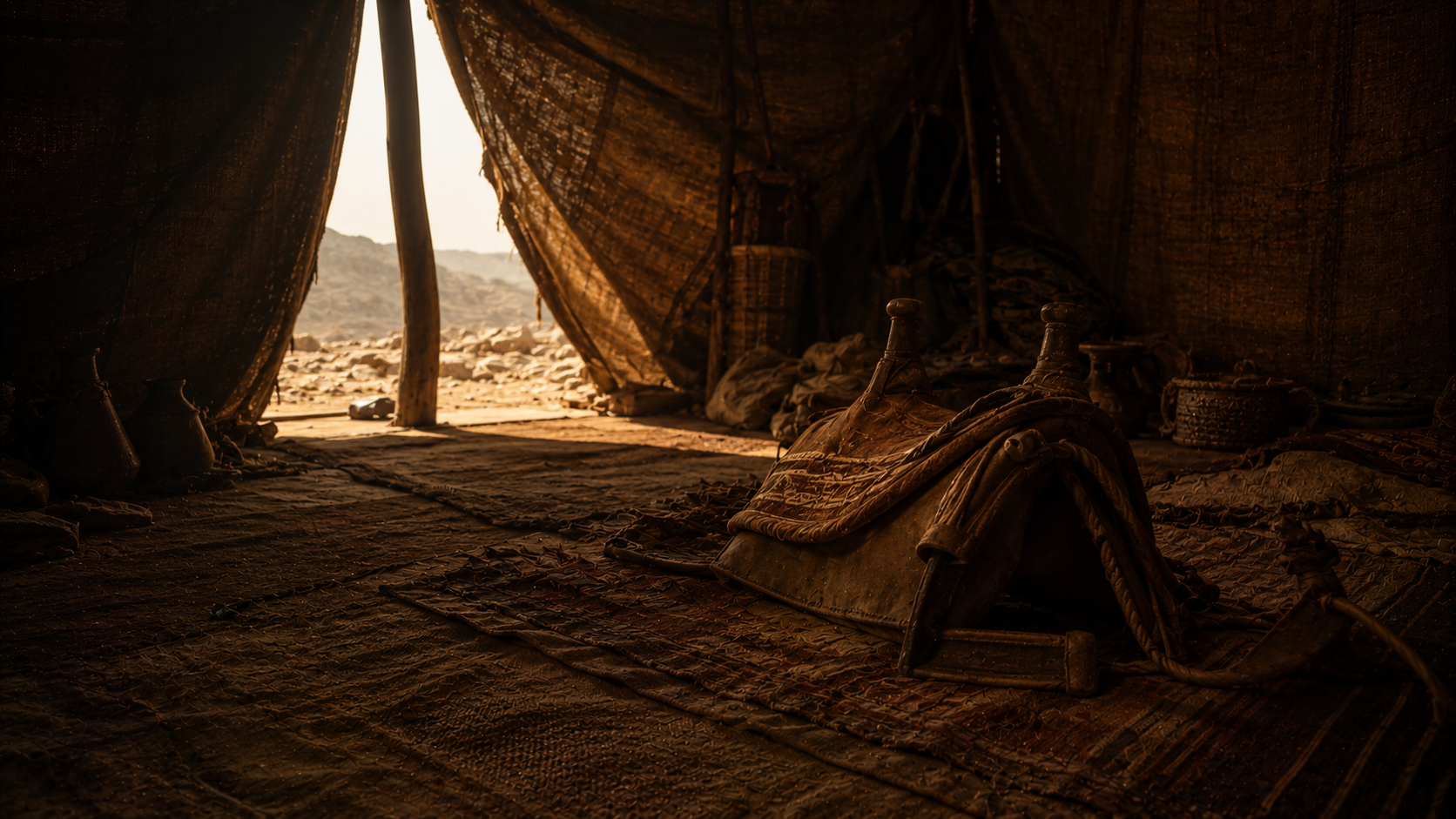
- Verses 17 and 18 record the departure with quick economy. Jacob loads the wives and children on camels; he takes the livestock; he heads back toward Canaan. He does not announce the move to Laban. The chapter records this as Jacob deceived Laban (verse 20), the Hebrew word vayignov, “and he stole away,” running parallel to the verb vatignov, “and she stole,” used of Rachel in the previous verse. The household departs by stealing its way out of Haran in the broad sense: Jacob steals the moment, Rachel steals the gods.
- Rachel’s theft of the teraphim (verse 19) is the chapter’s strangest scene. The Hebrew word teraphim refers to small household idols, often associated with family inheritance and the protective spirits of the household. ANE legal documents (the Nuzi tablets) suggest that possession of the teraphim could establish inheritance rights in a household. Rachel may be staking a claim; she may be acting out of religious attachment; she may be acting out of resentment toward her father. The chapter does not explain. It just records the theft.
Word study: teraphim (תְּרָפִים), “household gods”
The Hebrew word for small ANE household idols, often kept as protective figures for the family. The same word appears in Judges 17 (Micah’s household shrine), 1 Samuel 19 (Michal’s deception with David), and the prophetic literature where the teraphim are condemned alongside other idols. ANE legal documents from Nuzi suggest possession of the teraphim may have functioned as a legal claim on family inheritance. Rachel’s theft is, on the most generous reading, an attempt to secure her share of her father’s estate; on the harsher reading, it is the chapter’s quiet acknowledgment that the matriarch is not yet free of her father’s religious world. The chapter does not resolve which.
Pushback note
Some readings have moralized Rachel’s theft as straightforward sin. The chapter is more careful. The narrator records the theft without editorializing; the consequences are left to play out. Rachel will die in childbirth in chapter 35, and some Jewish midrashic readings have connected her early death to Jacob’s curse in verse 32 (anyone you find your gods with shall not live), pronounced unknowingly. The text does not make the connection explicit. We can read the chapter forward, naming the theft as a real act with real consequences, without flattening Rachel’s life into morality-tale.
- The pursuit (verses 22 to 24) is Laban’s last move toward control. He learns of the flight on the third day; he takes his relatives; he pursues for seven days; he overtakes Jacob at Gilead. The geography is carefully named. Mount Gilead is the boundary region between Aram (Laban’s territory) and the eastern edge of Canaan. The two men are about to meet at the line.
- Verse 24 is the chapter’s quiet theological insertion. God came to Laban the Syrian in a dream of the night, and said to him, “Take heed to yourself that you don’t speak to Jacob either good or bad.” The dream-theophany to a non-covenant figure echoes the earlier scene with Abimelech in chapter 20, where Yahweh had also intervened in a dream to protect the patriarchal household from a pagan king’s potential harm. The chapter is showing what the wives have been saying: God has been with Jacob through the twenty years, and God is intervening to protect him from his father-in-law.
Influence callout: Walter Brueggemann
Brueggemann’s reading of these dream-warnings to non-covenant figures (Abimelech in 20, Laban in 31, Pharaoh in 41) names them as the Hebrew Bible’s quiet theology of providence. Yahweh works on the covenant family’s behalf in the dreams of foreigners. The chapter is recording, with characteristic restraint, that the patriarchal walk is not maintained only by what Jacob does; it is also maintained by what Yahweh does in the imaginations of the people around Jacob. Brueggemann argues that this is one of the patriarchal narrative’s most pastoral moves: the covenant family is being protected in ways the covenant family does not always know about.
- Laban’s confrontation (verses 26 to 30) is restrained because of the dream. He complains. He accuses Jacob of deceiving him, of not letting him kiss his daughters and grandchildren goodbye, of depriving him of the celebratory send-off. He admits the divine restraint: it is in the power of my hand to hurt you, but the God of your father spoke to me last night. Then he asks his real question: why have you stolen my gods?
- Jacob’s response (verses 31 to 32) is two-part. First, he names his fear: he thought Laban would take the daughters back by force. Second, he denies the theft: anyone you find your gods with shall not live. The Hebrew word for “shall not live” (lo yichyeh) is unambiguous. Jacob is, without knowing it, pronouncing a death-curse on Rachel.
- The search (verses 33 to 35) is the chapter’s most pointed comic-and-tragic scene. Laban searches Jacob’s tent, then Leah’s, then the two slave-women’s tents. Then Rachel’s. Rachel has put the teraphim in the camel saddle she is sitting on. She tells her father, Don’t let my lord be angry that I can’t rise up before you; for I’m having my period. Laban searches; he does not find them. The chapter records Rachel’s deception of her father in the same kind of compact, sharp narrative the chapter records Jacob’s earlier deception of his own father. The patriarchal family’s deceptive instincts run in the matrilineal line as well as the patrilineal.
Pushback note
Some readings have softened Rachel’s deception by emphasizing her cleverness or by reframing it as cultural shrewdness. The chapter does not flatter her any more than it flatters Jacob. She lies to her father; she sits on his stolen gods; she invokes a culturally awkward situation (menstruation) to keep him from searching the saddle. The deception is real. The chapter is honest about it. We can name Rachel as a woman of remarkable agency and as a woman whose agency is sometimes turned to deception. Both are true.
C · Genesis 31:36–55 · The reckoning and the Mizpah covenant
³⁶ Jacob was angry, and argued with Laban. Jacob answered Laban, “What is my trespass? What is my sin, that you have hotly pursued me? ³⁷ Now that you have felt around in all my stuff, what have you found of all your household stuff? Set it here before my relatives and your relatives, that they may judge between us two. ³⁸ These twenty years I have been with you. Your ewes and your female goats have not cast their young, and I haven’t eaten the rams of your flocks. ³⁹ That which was torn of animals, I didn’t bring to you. I bore its loss. From my hand you required it, whether stolen by day or stolen by night. ⁴⁰ This was my situation: in the day the drought consumed me, and the frost by night; and my sleep fled from my eyes. ⁴¹ These twenty years I have been in your house. I served you fourteen years for your two daughters, and six years for your flock, and you have changed my wages ten times. ⁴² Unless the God of my father, the God of Abraham, and the fear of Isaac, had been with me, surely now you would have sent me away empty. God has seen my affliction and the labor of my hands, and rebuked you last night.” ⁴³ Laban answered Jacob, “The daughters are my daughters, the children are my children, the flocks are my flocks, and all that you see is mine: and what can I do today to these my daughters, or to their children whom they have borne? ⁴⁴ Now come, let us make a covenant, you and I; and let it be for a witness between me and you.” ⁴⁵ Jacob took a stone, and set it up for a pillar. ⁴⁶ Jacob said to his relatives, “Gather stones.” They took stones, and made a heap. They ate there by the heap. ⁴⁷ Laban called it Jegar Sahadutha, but Jacob called it Galeed. ⁴⁸ Laban said, “This heap is witness between me and you today.” Therefore it was named Galeed ⁴⁹ and Mizpah, for he said, “Yahweh watch between me and you, when we are absent one from another. ⁵⁰ If you afflict my daughters, or if you take wives in addition to my daughters, no man is with us; behold, God is witness between me and you.” ⁵¹ Laban said to Jacob, “See this heap, and see the pillar, which I have set between me and you. ⁵² May this heap be a witness, and the pillar be a witness, that I will not pass over this heap to you, and that you will not pass over this heap and this pillar to me, for harm. ⁵³ The God of Abraham, and the God of Nahor, the God of their father, judge between us.” Then Jacob swore by the fear of his father, Isaac. ⁵⁴ Jacob offered a sacrifice on the mountain, and called his relatives to eat bread. They ate bread, and stayed all night on the mountain. ⁵⁵ Early in the morning, Laban rose up, and kissed his sons and his daughters, and blessed them. Laban departed and returned to his place. (Genesis 31:36–55, World English Bible)
- Jacob’s speech (verses 36 to 42) is the chapter’s longest single utterance and the patriarchal grandson’s first fully spoken assertion of his own dignity. The man who arrived at Haran with nothing has, in twenty years, learned to name what he has done and what has been done to him. The speech has rhythm: twenty years of service. Faithful tending of the flocks. Bearing the cost of losses. Heat of day, cold of night, sleeplessness. Fourteen years for the daughters, six for the flock, ten changes of wages. Unless the God of my father… had been with me, surely now you would have sent me away empty.
Influence callout: Walter Brueggemann
Brueggemann’s reading of this speech names it as the patriarchal grandson’s coming-of-age. The deceiver who fled Beersheba with his mother’s frantic instructions has, in twenty years of contest with his father-in-law, become a man who speaks with authority. The speech is not bragging; it is naming. I have not eaten the rams of your flocks. I have not brought you torn animals. I have borne the loss myself. The patriarchal narrative is showing the slow formation of Jacob into someone whose voice carries his own integrity. Brueggemann argues that the next chapter’s wrestling at Jabbok cannot happen until this chapter has happened: the man who will refuse to let go of the divine encounter must first have learned to refuse to let his father-in-law erase him.
- Verse 42 contains a striking divine name: the fear of Isaac (Hebrew pachad Yitzchaq). The construction is unusual; some translations render it “the awesome one of Isaac” or “the God whom Isaac fears.” Whatever the precise meaning, the patriarchal grandson is invoking his father’s God by a name that signals reverent worship. The covenant has been transmitted across three generations.
- Laban’s response (verses 43 to 44) is unguarded. He admits everything is his (the daughters, the children, the flocks) and yet acknowledges he can do nothing more. The shift from contest to treaty happens in the same verse. Now come, let us make a covenant, you and I. The two men have spent twenty years in tension; they will spend the rest of their lives apart, on different sides of a border. The treaty is the formal recognition of the separation.
- The treaty stones (verses 45 to 48) are erected with full ANE protocol. Jacob takes a stone for a pillar. The relatives gather more stones for a heap. The two parties eat together at the heap (covenant meal). The heap is named Galeed (Hebrew, “heap of witness”) and Jegar Sahadutha (Aramaic, “heap of witness,” Laban’s language). The bilingual naming captures the two parties’ distinct cultures meeting at the boundary.
- Verse 49 introduces the famous name. Mizpah, from the Hebrew tzaphah (to watch). Yahweh watch between me and you, when we are absent one from another. This is the Mizpah benediction, often quoted in modern Christian settings as a tender prayer for absent loved ones. In its original context, the benediction is a treaty boundary clause. Yahweh watch is Yahweh enforce; the verb is the language of surveillance, not affection. Laban is invoking Yahweh as the boundary-enforcer who will keep each man on his side of the heap.
Pushback note
The Mizpah benediction has often been preached in modern Christian contexts as a sweet sentimental blessing for absent friends and family. Its original meaning is sharper. May the LORD watch between you and me when we are apart is a treaty oath sworn by two men who do not trust each other. Watch is enforce. The benediction is asking Yahweh to make sure neither of us crosses this heap to harm the other. The phrase has a beautiful sound and a lovely sentimental resonance, but reading it as Hallmark-card affection misses what the chapter is actually doing. The chapter is recording the formal end of a contentious relationship, sealed by an oath that says, in effect, we are leaving each other alone, and Yahweh will keep watch that we do.
Influence callout: Tim Mackie
Mackie’s reading of the Mizpah covenant emphasizes its function as the patriarchal cycle’s formal closure of the Laban arc. The chapter is bringing the twenty-year Haran period to an explicit, witnessed, divinely-sealed end. The two parties cannot ever again raise a claim against each other; the heap of stones stands as the formal record. Mackie argues that the chapter is doing structural work: the Jacob narrative cannot move into chapter 32 (the wrestling at Jabbok) until chapter 31 has formally ended the relationship that has shaped the patriarch’s last twenty years. The pillar at Mizpah is the closing of the Laban book.
- Verses 50 and 52 add two specific stipulations to the covenant. First (verse 50): if you afflict my daughters, or if you take wives in addition to my daughters, no man is with us; behold, God is witness. Laban is asserting his ongoing claim on his daughters’ welfare. Second (verse 52): I will not pass over this heap to you, and you will not pass over this heap and this pillar to me, for harm. The boundary is now territorial: neither party crosses for hostile purposes.
- Verse 53 invokes a layered set of divine names: the God of Abraham, and the God of Nahor, the God of their father, judge between us. Abraham and Nahor were brothers (chapter 11:27); Laban is descended from Nahor; Jacob from Abraham. The two patriarchs’ divine names are being held side by side. Whether the God of Nahor is the same deity as the God of Abraham under a different name, or a different deity altogether, is left ambiguous. The chapter does not resolve it. Then Jacob swore by the fear of his father, Isaac, the patriarchal grandson swearing by the patriarchal divine name his own family knows.
- The chapter ends quietly. Sacrifice on the mountain. Bread eaten together. A night spent on the mountain. Early in the morning, Laban rises, kisses his sons and daughters, blesses them, and goes home. The scene is more tender than the chapter has been throughout. The man who has been the patriarchal antagonist for twenty years parts from his daughters and grandchildren with a kiss and a blessing. The chapter is honest enough to record both the long contest and the quiet farewell.
Reflection prompts
- Yahweh’s word to Jacob in verse 3 is brief: return… and I will be with you. The same promise made twenty years earlier at Bethel is being recommitted. Where in your life has a long commitment from God turned out to span a longer arc than you originally understood? What does it look like to recognize the recommitment when it comes?
- Rachel and Leah, who have spent two chapters in rivalry, here speak with one voice: whatever God has said to you, do. Their unity arrives not from resolving their rivalry but from naming a shared situation under their father. Where in your life has a shared difficulty with someone outside the relationship produced unity inside it? What might it cost to keep that unity once the shared difficulty is past?
- The Mizpah benediction is often preached as tender sentiment, but its original meaning is a treaty enforcement oath between two men who do not trust each other. Where in your life have you been tempted to soften the boundary you actually need? What does it look like to invoke God’s watching presence not as warmth but as enforcement?