

Genesis 28 is Jacob’s first chapter alone. The household has pulled itself apart in chapter 27. Jacob, with his father’s reluctant blessing and his mother’s frantic instruction, sets out for Haran on foot, alone. The chapter records the journey north in two scenes. First, Isaac’s official farewell and renewed Abrahamic blessing to Jacob (so the deception’s blessing is now affirmed in the open). Second, the night at a place Jacob will name Bethel, where he sleeps with a stone for a pillow and dreams a dream that becomes one of the patriarchal narrative’s central theophanies.
The dream is famous. A sulam (often translated “ladder,” though “ramp” or “staircase” is closer to the Hebrew) reaches from the earth to heaven. Angels of God ascend and descend on it. Yahweh stands above (or beside) it. The covenant is renewed directly to Jacob: I am the LORD, the God of Abraham your father and the God of Isaac… in you and in your offspring all the families of the earth shall be blessed. The patriarch’s promise has been transmitted to the grandson on the night he is fleeing his brother’s murderous intent.
Jacob’s response is the chapter’s most quoted line: Surely the LORD is in this place, and I did not know it. The fugitive who is sleeping on a stone in the open country has discovered, by accident, that the covenant God of his father and grandfather meets him in the wilderness, on the road, on a stone, in his fear, in his flight. The chapter is establishing what will become a recurring theme of the Jacob narrative: God shows up in the places Jacob does not expect him.
The chapter ends with Jacob’s vow. The vow is famously conditional. If God will be with me, and will keep me in this way that I go, and will give me bread to eat, and clothing to put on, so that I come again to my father’s house in peace, and the LORD will be my God. Some readers have heard this as the prayer of a man whose faith is still developing; others as the cautious vow of a calculating bargainer. The chapter does not editorialize; it just records. Jacob is at the beginning of his patriarchal walk. The walk is going to take twenty years.
A · Genesis 28:1–9 · The send-off
¹ Isaac called Jacob, blessed him, and commanded him, “You shall not take a wife of the daughters of Canaan. ² Arise, go to Paddan Aram, to the house of Bethuel your mother’s father. Take a wife from there from the daughters of Laban, your mother’s brother. ³ May God Almighty bless you, and make you fruitful, and multiply you, that you may be a company of peoples, ⁴ and give you the blessing of Abraham, to you and to your offspring with you, that you may inherit the land where you travel, which God gave to Abraham.” ⁵ Isaac sent Jacob away. He went to Paddan Aram to Laban, son of Bethuel the Syrian, Rebekah’s brother, Jacob’s and Esau’s mother. ⁶ Now Esau saw that Isaac had blessed Jacob and sent him away to Paddan Aram, to take him a wife from there, and that as he blessed him he gave him a command, saying, “You shall not take a wife of the daughters of Canaan,” ⁷ and that Jacob obeyed his father and his mother, and was gone to Paddan Aram. ⁸ Esau saw that the daughters of Canaan didn’t please Isaac, his father. ⁹ Esau went to Ishmael, and took, in addition to the wives that he had, Mahalath the daughter of Ishmael, Abraham’s son, the sister of Nebaioth, to be his wife. (Genesis 28:1–9, World English Bible)
- The chapter opens with Isaac’s official farewell. The patriarch, whose blessing in chapter 27 was extracted by deception, now blesses Jacob publicly and intentionally, with full knowledge of what he is doing. The Hebrew construction makes the difference. Chapter 27’s blessing was given in the dark to a son the patriarch thought was Esau; chapter 28’s blessing is given in daylight to Jacob, by name, with the explicit instruction to go to Paddan Aram and find a wife from the family of his uncle Laban. The chapter is recording the patriarchal blessing being affirmed a second time, on the open record.
- Verse 3 introduces a divine name we have heard once before: El Shaddai, “God Almighty.” The same name God used to renew the covenant to Abram in Genesis 17:1. Isaac is invoking the patriarchal divine name as he passes the blessing to the next generation. The chapter is performing the formal transmission: the same God, the same blessing, the same fertility-and-multiplication promise, now landing on Jacob.
- Give you the blessing of Abraham, to you and to your offspring with you, that you may inherit the land (verse 4). The Abrahamic covenant has, in this verse, been formally extended into the third generation. The land promise is now Jacob’s. The offspring promise is now Jacob’s. The patriarchal cycle is doing what it must do: passing the inheritance forward.
Influence callout: N.T. Wright
Wright’s reading of the patriarchal narrative emphasizes how each generation’s covenant transmission is a deliberate handing-on. Abraham received the original call. Isaac received it directly in Genesis 26:24 (“I am the God of Abraham your father”). Jacob now receives it from Isaac (28:3 to 4) and will receive it directly from Yahweh in 28:13 to 15. The covenant is not Abraham’s alone; it is being formally re-enacted with each generation, with each transmission, in three voices (the previous patriarch, the receiving patriarch’s own response, and Yahweh’s direct word). The chapter is recording the covenant in all three of these registers.
- Esau’s response (verses 6 to 9) is the chapter’s small dark counterpoint. Watching Jacob be sent to find a non-Canaanite wife, Esau realizes his own Canaanite marriages have grieved his parents. His response is to take an additional wife from Ishmael’s line. The narrator records this without commentary, but the symbolism is sharp. Esau is trying to repair his standing with his parents by marrying within the wider Abrahamic family; he chooses the line of Ishmael (the son cast out of the household decades earlier). The chapter is showing Esau attempting a gesture of correction that misses the point. The covenant line was never about ethnic purity; it was about the specific calling Yahweh placed on Jacob through Isaac. Esau cannot enter that calling by marrying an Ishmaelite. The gesture is touching and futile in equal measure.
B · Genesis 28:10–17 · The dream at Bethel
¹⁰ Jacob went out from Beersheba, and went toward Haran. ¹¹ He came to a certain place, and stayed there all night, because the sun had set. He took one of the stones of the place, and put it under his head, and lay down in that place to sleep. ¹² He dreamed, and behold, a stairway set upon the earth, and its top reached to heaven. Behold, the angels of God were ascending and descending on it. ¹³ Behold, the LORD stood above it, and said, “I am the LORD, the God of Abraham your father, and the God of Isaac. The land on which you lie, I will give to you and to your offspring. ¹⁴ Your offspring will be as the dust of the earth, and you will spread abroad to the west, and to the east, and to the north, and to the south. In you and in your offspring shall all the families of the earth be blessed. ¹⁵ Behold, I am with you, and will keep you, wherever you go, and will bring you again into this land. For I will not leave you, until I have done that which I have spoken of to you.” ¹⁶ Jacob awakened out of his sleep, and he said, “Surely the LORD is in this place, and I didn’t know it.” ¹⁷ He was afraid, and said, “How awesome this place is! This is none other than God’s house, and this is the gate of heaven.” (Genesis 28:10–17, NRSVue)
- Jacob is alone. The chapter records this with quiet emphasis. Jacob went out from Beersheba, and went toward Haran. He came to a certain place, and stayed there all night, because the sun had set. No servants. No camels. No retinue. The patriarchal grandson is on foot, in unfamiliar country, with the sun going down. The narrator is preparing the scene as one of complete vulnerability.
- The detail of the stone (verse 11) is small but iconic. He took one of the stones of the place, and put it under his head. Some readings have softened this (a small stone for a pillow); the Hebrew suggests something more substantial (a stone he could rest his head against, possibly several inches across). The discomfort is part of the story. Jacob is sleeping rough.
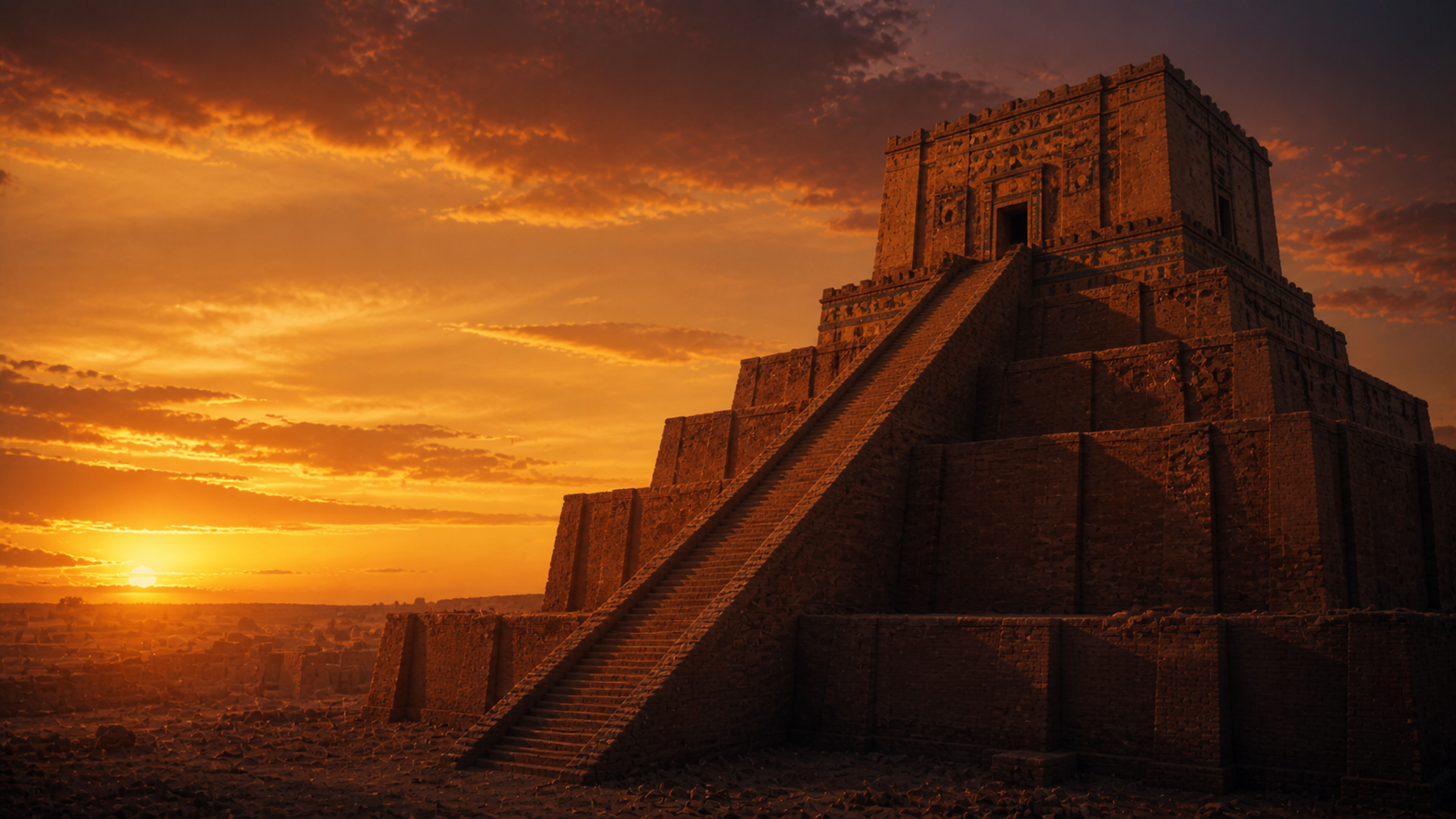
- The dream (verses 12 to 15) is the chapter’s center. The Hebrew word for what he sees is sulam, often translated “ladder” but more accurately rendered “stairway” or “ramp.” The translation matters. ANE ziggurat-temples were built with staircases up their sides; the priests ascended and descended on them; the ziggurat was understood as a connection between heaven and earth, the place where the gods could come down and humans could go up. Jacob’s dream shows a sulam of exactly this type, stretching from earth to heaven, with the angels of God moving on it.
Word study: sulam (סֻלָּם), “stairway, ramp”
The Hebrew word appears only here in the entire Hebrew Bible. Its etymology is debated; the cognate Akkadian word simmiltu refers to a staircase or ramp (especially the kind on a ziggurat). The traditional English translation “ladder” comes from the Septuagint and Vulgate; modern Hebrew lexicography prefers “stairway” or “ramp.” The image is not a wooden ladder leaning against a tree; it is a monumental stone staircase rising from earth to heaven, with divine traffic moving in both directions. ANE peoples knew exactly what this looked like; they had built dozens of them across Mesopotamia.
Influence callout: Tim Mackie
Mackie’s reading of the sulam as a ziggurat-image is one of the chapter’s most important structural moves. Genesis 11 had recorded humanity building a ziggurat (the Tower of Babel) in an attempt to make a name for themselves and reach heaven by their own labor. Genesis 28 records Yahweh giving Jacob a ziggurat-image in a dream, freely, while the patriarch is asleep. The Babel ziggurat was the human attempt to ascend; the Bethel ziggurat is God’s gift of a heaven-and-earth connection that does not require ascent. Mackie reads this as one of Genesis’s deliberate inversions: the chapter that records the deceiver’s flight from his brother is also the chapter that gives the deceiver a vision of what Babel had tried (and failed) to achieve. The connection between heaven and earth is not earned; it is given.
- The angels are ascending first, then descending (verse 12). The detail is unusual. We might expect them to descend first (as if from heaven to earth) and then ascend; the text says they are first going up. Some Jewish commentators have read this as suggesting the angels were already on earth, attending Jacob, ascending to bring his prayers and descending to carry the divine response. Others read the order as simply describing the staircase as a two-way thoroughfare, both directions visible at once. Whatever the precise reading, the picture is of constant divine traffic between heaven and the place where Jacob is sleeping.
- The voice from the top of the staircase (verses 13 to 15) is Yahweh’s. The covenant is renewed in three movements: – I am the LORD, the God of Abraham your father, and the God of Isaac. Self-identification, locating Jacob within the patriarchal line. – The land on which you lie, I will give to you and to your offspring. Your offspring will be as the dust of the earth, and you will spread abroad to the west, and to the east, and to the north, and to the south. In you and in your offspring shall all the families of the earth be blessed. The full Abrahamic blessing, repeated to the third generation. The four directions are new; the dust-of-the-earth image is from Genesis 13:16. – Behold, I am with you, and will keep you, wherever you go, and will bring you again into this land. For I will not leave you, until I have done that which I have spoken of to you. The personal promise. Yahweh is committing to be with Jacob in the journey, to keep him, to bring him back. This is the chapter’s pastoral heart: the fugitive grandson is being told he is not alone.
Influence callout: Walter Brueggemann
Brueggemann’s reading of this scene names it as the chapter’s deepest pastoral move. Jacob has just deceived his father; he is fleeing a brother who wants to kill him; he has no household, no servants, no certainty about what he is walking into. The covenant could have refused him. The chapter could have framed Jacob’s exile as a punishment. Instead, the chapter gives him a theophany. I am with you. I will keep you. I will bring you back. Brueggemann argues that the patriarchal narrative is doing pastoral work for every reader who has ever fled, deceived, run, and been afraid: the covenant God shows up in the wilderness, on the stone, in the night, before the patriarch has done anything to earn the visit. The grace is unearned, and the chapter does not pretend it is earned.
- Jacob’s response (verse 16) is one of the most quoted sentences in Genesis: Surely the LORD is in this place, and I didn’t know it. The Hebrew is akhen yesh Yahweh ba-maqom ha-zeh, ve-anokhi lo yadati. The construction is precise. Yahweh is in this place. Jacob did not know. The verb yada (to know) is the same verb the chapter has used elsewhere for relational knowledge. Jacob has been raised in the patriarchal household; he has been taught the names of God; and yet, in this place where he expected nothing, the divine presence shows up and he names what he had not previously known. The discovery is not new doctrine; it is new realization.
- How awesome this place is! This is none other than God’s house, and this is the gate of heaven (verse 17). The Hebrew names converge: Beit-El, “house of God,” and sha’ar ha-shamayim, “gate of heaven.” The patriarch is, for the first time in his life, naming a real place as the meeting point of heaven and earth. The next verse will give the place its formal name.
C · Genesis 28:18–22 · The pillar and the vow
¹⁸ Jacob rose up early in the morning, and took the stone that he had put under his head, and set it up for a pillar, and poured oil on its top. ¹⁹ He called the name of that place Bethel, but the name of the city was Luz at the first. ²⁰ Jacob vowed a vow, saying, “If God will be with me, and will keep me in this way that I go, and will give me bread to eat, and clothing to put on, ²¹ so that I come again to my father’s house in peace, and the LORD will be my God, ²² then this stone, which I have set up for a pillar, will be God’s house. Of all that you give me I will surely give a tenth to you.” (Genesis 28:18–22, World English Bible)
- The morning ritual is brief but significant. Jacob takes the stone he slept on, sets it up as a matzevah (pillar), and pours oil on it. This is the standard ANE marking of a sacred place. The stone was a pillow at midnight; by morning it is a memorial pillar. The patriarch is doing what his father and grandfather did: marking the place of theophany with a physical landmark that will outlast the moment.
Word study: matzevah (מַצֵּבָה), “pillar”
A standing stone set up to mark a sacred encounter, a covenant, or a tomb. Matzevot (plural) appear repeatedly in the patriarchal narratives, in the conquest narratives (Joshua 4 with the twelve stones at the Jordan), and in covenant ratifications (Exodus 24:4 with the twelve pillars at Sinai). The Mosaic law will later have a complicated relationship with matzevot (Deuteronomy 16:22 prohibits some, but the patriarchal narratives use them freely). The stone Jacob sets up at Bethel will be remembered in the next chapter, in chapter 35, and beyond.
- He called the name of that place Bethel (verse 19). The Hebrew Beit-El means “house of God,” combining the words from verse 17 (“this is none other than God’s house”). The narrator notes that the city had previously been called Luz. The chapter is, again, doing geographic theology. Bethel will become one of the most important cult sites of the patriarchal narratives and of the later northern kingdom of Israel.
- The vow (verses 20 to 22) is the chapter’s most debated passage. Jacob’s vow is conditional. The Hebrew construction is precise: im-yihyeh Elohim immadi, “if God will be with me.” The conditional is real. Jacob is not declaring his faith; he is striking a deal. If God protects me, if God provides for me, if God brings me back, then the LORD will be my God, then this stone will be God’s house, then I will give a tenth.
Pushback note
Some readings have softened the conditional, translating it more like “since God will be with me” rather than “if God will be with me.” The Hebrew supports the harder reading. Jacob is, by every textual indicator, bargaining with the God who has just delivered an unconditional promise. The chapter is honest about this. The patriarchal grandson, who has just received the covenant in the most direct theophanic form available, responds with a vow that hedges. He has heard the promise; he has not yet decided to fully trust it. The chapter is recording, with characteristic honesty, where Jacob actually is in his life with God: at the beginning, with a long road ahead.
Influence callout: Brian Zahnd
Zahnd’s broader reading of the patriarchal narratives often names this kind of moment as the Hebrew Bible’s pastoral honesty about uneven faith. Jacob’s vow is not where his story ends; it is where his story begins. Twenty years later, in chapter 32, he will wrestle with God at Jabbok and emerge limping and renamed. The man who vows conditionally at Bethel becomes the man who refuses to let go of the divine encounter at Peniel. The chapter is patient with the conditional vow because the chapter knows where Jacob is going. Zahnd argues that Genesis 28’s vow is a portrait of beginning faith, faith that hedges, faith that is calculating, faith that needs years of road to grow into the trust the theophany has freely given. The chapter does not rebuke. It records.
- Of all that you give me I will surely give a tenth to you (verse 22). The tenth (Hebrew aser) appears for the second time in Genesis (Abraham gave Melchizedek a tenth in 14:20). Jacob’s vow is the second instance of patriarchal tithing. As with chapter 14, the text is not establishing a universal command; it is recording a specific patriarchal response. The tenth is the patriarch’s freely-chosen proportion of gratitude.
- The chapter ends without follow-up. Jacob takes his pillar, names his place, makes his vow, and walks on toward Haran. The next chapter will pick up at the well outside Haran, where he will meet Rachel. The Bethel theophany will sit, for the next twenty years, as the foundation under everything that happens to him in Laban’s house.
Reflection prompts
- Surely the LORD is in this place, and I did not know it. Jacob discovers the divine presence in a place he expected nothing. Where in your life is there a “stone of the place” you slept on without realizing what was beneath it? What would it look like to name that place, retrospectively, as a Bethel?
- The covenant comes to Jacob freely, on the run, before he has done anything to repair what he did to Esau or to comfort his mother. The chapter does not condition the covenant on his moral state. Where in your life have you been afraid that you have to be in a better place before God will meet you? What does it change if Genesis 28 is right that the meeting can happen exactly where you are?
- Jacob’s vow is famously conditional: if God will… then the LORD will be my God. The chapter records this without rebuke. Faith in Genesis is not always whole faith; sometimes it is hedged faith, faith in formation, faith that has not yet decided to trust fully. Where in your life is your own faith currently a conditional vow? What does it look like to keep walking the road while the conditional becomes, slowly, an unconditional?