
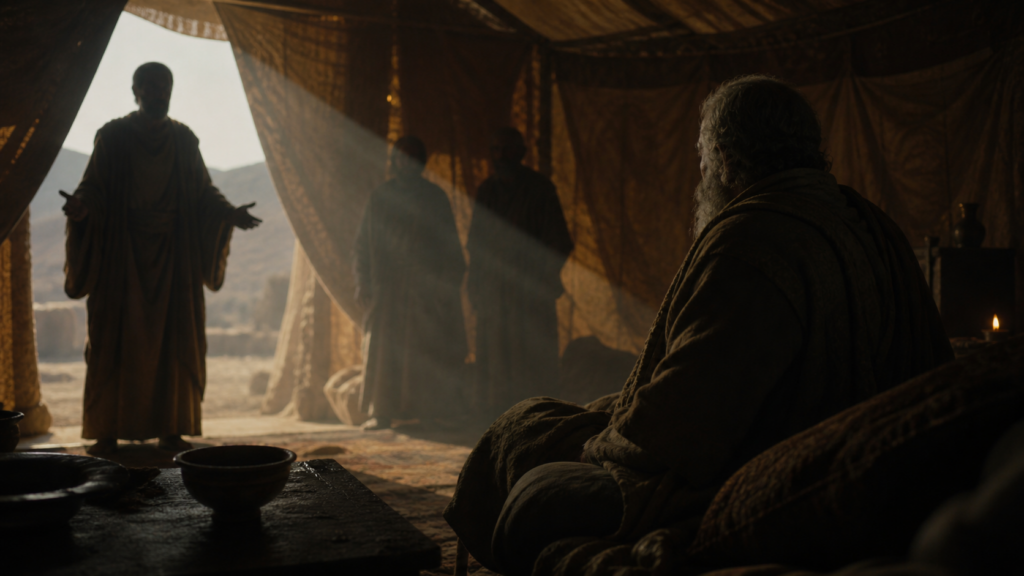
Genesis 27 is the chapter where the patriarchal family pulls itself apart. Isaac is old and blind. He has decided to bless Esau before he dies. Rebekah overhears the plan and schemes with Jacob to intercept the blessing. Jacob, dressed in Esau’s clothes with goatskins on his arms and neck, brings food to his blind father and receives the blessing meant for his brother. Esau returns, finds out, weeps a great and bitter cry, and resolves to kill Jacob after their father dies. Rebekah sends Jacob to her brother Laban in Haran. The chapter ends with the family scattered: Isaac dying, Esau plotting, Rebekah losing the son she loves, Jacob fleeing alone.
The chapter is the patriarchal narrative’s moral low point. Each character is implicated. Isaac is determined to bless Esau despite the oracle Rebekah received before the twins were born (“the elder will serve the younger,” 25:23). Rebekah is willing to deceive her dying husband. Jacob is willing to lie to his father’s face, repeatedly. Esau, having sold his birthright in chapter 25, now claims the blessing as his by right and bears no responsibility for the trade he made.
The chapter is also the chapter through which the covenant continues. Jacob receives the blessing. The line that will become Israel runs through him. The narrator does not soften any of the deception, and also does not undo it. The blessing is given; the blessing stands; the patriarchal covenant is, by the chapter’s end, sitting in the body of the second twin who has just lied to his father to get it.
The honest reader of this chapter has to sit with both halves: the moral darkness and the covenantal continuation. The Hebrew Bible refuses to give us only one.
A · Genesis 27:1–17 · The plan and the disguise
¹ When Isaac was old, and his eyes were dim, so that he could not see, he called Esau his elder son, and said to him, “My son?” He said to him, “Here I am.” ² He said, “See now, I am old. I don’t know the day of my death. ³ Now therefore, please take your weapons, your quiver and your bow, and go out to the field, and take me venison. ⁴ Make me savory food, such as I love, and bring it to me, that I may eat, and that my soul may bless you before I die.” ⁵ Rebekah heard when Isaac spoke to Esau his son. Esau went to the field to hunt for venison, and to bring it. ⁶ Rebekah spoke to Jacob her son, saying, “Behold, I heard your father speak to Esau your brother, saying, ⁷ ‘Bring me venison, and make me savory food, that I may eat, and bless you before Yahweh before my death.’ ⁸ Now therefore, my son, obey my voice according to that which I command you. ⁹ Go now to the flock, and get me from there two good young goats. I will make them savory food for your father, such as he loves. ¹⁰ You shall bring it to your father, that he may eat, so that he may bless you before his death.” ¹¹ Jacob said to Rebekah his mother, “Behold, Esau my brother is a hairy man, and I am a smooth man. ¹² What if my father touches me? I will seem to him as a deceiver, and I would bring a curse on myself, and not a blessing.” ¹³ His mother said to him, “Let the curse be on me, my son. Only obey my voice, and go get them for me.” ¹⁴ He went, and got them, and brought them to his mother. His mother made savory food, such as his father loved. ¹⁵ Rebekah took the good clothes of Esau, her elder son, which were with her in the house, and put them on Jacob, her younger son. ¹⁶ She put the skins of the young goats on his hands, and on the smooth of his neck. ¹⁷ She gave the savory food and the bread, which she had prepared, into the hand of her son Jacob. (Genesis 27:1–17, World English Bible)
- The chapter opens with a quiet, devastating sentence. When Isaac was old, and his eyes were dim, so that he could not see. The patriarch is no longer the one who sees; he is the one who must be told. This will be the chapter’s structural theme. The blind father will be deceived by what he is told; the family will conduct its drama around his diminished perception. The chapter is, among other things, a meditation on what happens when the head of the household can no longer see what is in front of him.
- Isaac’s plan (verses 2 to 4) is private. He calls Esau alone. He gives the instruction; he names the goal (“that my soul may bless you before I die”); he asks for the venison meal he loves. The chapter’s troubling premise is that Isaac is determined to bless Esau despite the oracle Rebekah received before the twins were born. The elder will serve the younger (25:23) is an oracle Isaac knows. The chapter does not record whether Rebekah ever told him; rabbinic tradition has speculated either way. What the chapter does record is that Isaac is moving against the trajectory the oracle named.
- Rebekah overhears (verse 5). The Hebrew construction is precise: Rivkah shoma’at, “and Rebekah was hearing.” The matriarch is positioned, again, behind a wall, listening. The pattern echoes Genesis 18:10 (Sarah listening from the tent door behind Abraham). The patriarchal narratives often place the matriarchs in this listening position; what they do with what they hear shapes what comes next. Rebekah, having heard the oracle in 25:23 and having loved Jacob since the boys were born (25:28), now hears the patriarch about to bless the wrong son.
Influence callout: Walter Brueggemann
Brueggemann’s reading of this scene names the chapter’s moral complexity. Rebekah is not a villain. She is acting on the oracle she received from Yahweh; she is acting against a patriarch whose blindness is moral as well as physical (he is blessing Esau despite Esau’s earlier sale of the birthright and despite his own knowledge of the oracle); and she is acting through a son who is a willing partner. The chapter is not setting up a clean moral contrast between hero and villain. It is showing a family in which every character is doing something wrong, and the covenant survives anyway. Brueggemann argues that the patriarchal narrative is honest about this in ways the modern reader often is not: the covenant family’s dysfunction is the soil through which the covenant keeps moving.
- Rebekah’s plan is brisk and detailed (verses 8 to 10). Two young goats from the flock; she will make them taste like venison; Jacob will bring them; the blessing will be intercepted. The mother is the strategist. She is Rebekah-of-the-camels, the woman whose energy and decisiveness in chapter 24 was the chapter’s own answer to the servant’s prayer. The same energy and decisiveness now run in a different direction.
- Jacob’s first response (verses 11 to 12) is interesting. He does not object to the deception itself. He objects to the risk: “what if my father touches me?” The Hebrew word for the worry, me’ta’tea, “as a mocker” or “as one who deceives,” anticipates what he is about to be. Jacob is calculating, not conscience-stricken. The chapter is not flattering him.
- Rebekah’s reply (verse 13) is the chapter’s most revealing line: let the curse be on me, my son. The matriarch is volunteering to bear the consequence. Some readings see this as a mother’s love for her son; others as the matriarch’s confidence that the oracle will protect her; others as a kind of foreshadowing (Rebekah will, in fact, bear a deep loss in the chapter, since she will never see Jacob again after his flight). Whatever the motivation, the line is stark. She is willing to take the curse on herself.
- Verses 15 to 17 record the disguise in tactile detail. The good clothes of Esau (Esau’s smell, presumably). The skins of the young goats on his hands, and on the smooth of his neck (the touch). The savory food and the bread (the taste). The chapter is preparing four senses for the deception: smell, touch, taste, and (since Isaac is blind) hearing alone for the truth-detection. Three senses will be deceived. One will not.
B · Genesis 27:18–29 · The deception and the blessing
¹⁸ He came to his father, and said, “My father?” He said, “Here I am. Who are you, my son?” ¹⁹ Jacob said to his father, “I am Esau your firstborn. I have done what you asked me to do. Please arise, sit and eat of my venison, that your soul may bless me.” ²⁰ Isaac said to his son, “How is it that you have found it so quickly, my son?” He said, “Because Yahweh your God gave me success.” ²¹ Isaac said to Jacob, “Please come near, that I may feel you, my son, whether you are really my son Esau or not.” ²² Jacob went near to Isaac his father. He felt him, and said, “The voice is Jacob’s voice, but the hands are the hands of Esau.” ²³ He didn’t recognize him, because his hands were hairy, like his brother, Esau’s hands. So he blessed him. ²⁴ He said, “Are you really my son Esau?” He said, “I am.” ²⁵ He said, “Bring it near to me, and I will eat of my son’s venison, that my soul may bless you.” He brought it near to him, and he ate. He brought him wine, and he drank. ²⁶ His father Isaac said to him, “Come near now, and kiss me, my son.” ²⁷ He came near, and kissed him. He smelled the smell of his clothing, and blessed him, and said, “Behold, the smell of my son is as the smell of a field which Yahweh has blessed. ²⁸ God give you of the dew of the sky, of the fatness of the earth, and plenty of grain and new wine. ²⁹ Let peoples serve you, and nations bow down to you. Be lord over your brothers. Let your mother’s sons bow down to you. Cursed be everyone who curses you. Blessed be everyone who blesses you.” (Genesis 27:18–29, World English Bible)
- Verse 19 is the chapter’s most direct lie. Jacob says, in his father’s hearing, “I am Esau your firstborn.” The Hebrew is anokhi Esav bekhorekha, three words of compressed deception. Some Jewish commentators have tried to soften this by reading the Hebrew as “I, [it is]; Esau, your firstborn [is hunting],” parsing the phrase as ambiguous. The text does not support the rescue. Jacob is lying.
- Verse 20 deepens the lie. Isaac asks how the venison came back so quickly. Jacob answers, “Because Yahweh your God gave me success.” The patriarch has now invoked Yahweh’s name in the deception. The chapter is recording Jacob using the divine name to seal his lie. Hebrew narrative does not pause to comment; it just records.
Pushback note
Some readings have tried to defend Jacob on the grounds that he was acting in line with Yahweh’s announced will (the oracle of 25:23). This defense should be resisted. The narrator is not endorsing Jacob’s method; the narrator is recording it. Jacob’s lie is a lie. The covenant moves through it, not because of it. The patriarchal narrative is honest about this, and so should we be. The end (the right son receiving the blessing) does not justify the means (lying to a dying father). The chapter is recording a moral failure that produced a covenantal continuation, not a moral exemplar.
- The detection scene in verses 21 to 23 is the chapter’s most haunting. Isaac, blind, asks Jacob to come close so he can feel him. Jacob goes near. Isaac feels him. The voice is Jacob’s voice, but the hands are the hands of Esau. The patriarch is sensing the disconnect. Three senses say Esau; one sense says Jacob. The voice is the truth-detector that fails. Isaac is given accurate information by his hearing and chooses to trust the touch instead.
Word study: qol (קוֹל), “voice”
The Hebrew word for “voice” used in Isaac’s recognition. Qol is the standard word for the human voice, but it is also the word used for Yahweh’s voice in the garden (Genesis 3:8) and for the divine voice in many later theophanies. The chapter is using the human-voice meaning, but the resonance matters. Isaac’s discernment depends on which voice he believes. He hears Jacob’s voice; he believes Esau’s hands. The patriarch chooses the wrong sense. The chapter is doing pastoral work about how blindness can be moral as well as physical: when we cannot see, we have to choose which kind of evidence we trust, and the choice reveals what we already wanted to believe.
- Verse 24 is the chapter’s second direct lie. Isaac asks again, “Are you really my son Esau?” Jacob answers, “I am.” One word. Ani. The deception is complete.
- The blessing itself (verses 27 to 29) is given in poetic Hebrew. The smell of Esau’s clothing prompts the patriarch’s verse. The blessing has three movements: – The smell of my son is as the smell of a field which Yahweh has blessed. (The patriarch is blessing what he thinks is the man of the field.) – God give you of the dew of the sky, of the fatness of the earth, and plenty of grain and new wine. (Material abundance, agricultural blessing.) – Let peoples serve you, and nations bow down to you. Be lord over your brothers. Let your mother’s sons bow down to you. Cursed be everyone who curses you. Blessed be everyone who blesses you. (Political dominance and the explicit reversal of birth-order: brothers will bow.)
- The closing line (cursed be everyone who curses you, blessed be everyone who blesses you) is a near-direct echo of Genesis 12:3. The Abrahamic blessing is being passed down. The line that began with Abraham, was reaffirmed to Isaac, is now landing on Jacob. The patriarchal covenant has, despite the deception, moved forward.
C · Genesis 27:30–46 · Esau’s discovery and Jacob’s flight
³⁰ As soon as Isaac had finished blessing Jacob, and Jacob had just gone out from the presence of Isaac his father, Esau his brother came in from his hunting. ³¹ He also made savory food, and brought it to his father. He said to his father, “Let my father arise, and eat of his son’s venison, that your soul may bless me.” ³² Isaac his father said to him, “Who are you?” He said, “I am your son, your firstborn, Esau.” ³³ Isaac trembled violently, and said, “Who, then, is he who has taken venison, and brought it to me, and I have eaten of all before you came, and have blessed him? Yes, he will be blessed.” ³⁴ When Esau heard the words of his father, he cried with an exceedingly great and bitter cry, and said to his father, “Bless me, even me also, my father.” ³⁵ He said, “Your brother came with deceit, and has taken away your blessing.” ³⁶ He said, “Isn’t he rightly named Jacob? For he has supplanted me these two times. He took away my birthright. See, now he has taken away my blessing.” He said, “Haven’t you reserved a blessing for me?” ³⁷ Isaac answered Esau, “Behold, I have made him your lord, and all his brothers I have given to him for servants. I have sustained him with grain and new wine. What then will I do for you, my son?” ³⁸ Esau said to his father, “Have you but one blessing, my father? Bless me, even me also, my father.” Esau lifted up his voice, and wept. ³⁹ Isaac his father answered him, “Behold, your dwelling will be of the fatness of the earth, and of the dew of the sky from above. ⁴⁰ You will live by your sword, and you will serve your brother. It will happen, when you will break loose, that you will shake his yoke from off your neck.” ⁴¹ Esau hated Jacob because of the blessing with which his father blessed him. Esau said in his heart, “The days of mourning for my father are at hand. Then I will kill my brother Jacob.” ⁴² The words of Esau, her elder son, were told to Rebekah. She sent and called Jacob her younger son, and said to him, “Behold, your brother Esau comforts himself about you by planning to kill you. ⁴³ Now therefore, my son, obey my voice. Arise, flee to Laban, my brother, in Haran. ⁴⁴ Stay with him a few days, until your brother’s fury turns away; ⁴⁵ until your brother’s anger turn away from you, and he forgets what you have done to him. Then I will send, and get you from there. Why should I be bereaved of you both in one day?” ⁴⁶ Rebekah said to Isaac, “I am weary of my life because of the daughters of Heth. If Jacob takes a wife of the daughters of Heth, such as these, of the daughters of the land, what good will my life do me?” (Genesis 27:30–46, World English Bible)

- Esau’s return is timed with painful precision. As soon as Isaac had finished blessing Jacob, and Jacob had just gone out from the presence of Isaac his father, Esau his brother came in from his hunting. The narrator is making the timing visible. Jacob has barely left when Esau enters. The reader feels the moment.
- The patriarch’s recognition of what has happened (verse 33) is recorded in stark Hebrew. Vayecherad Yitzhak charadah gedolah ad me’od: “and Isaac trembled with a very great trembling.” The doubled construction (charad charadah) intensifies. The blind father, having just blessed his son, now realizes which son he blessed. The text records the body’s response before the words.
- And then the chapter’s most important phrase: Yes, he will be blessed. The Hebrew is gam baruch yihyeh. Isaac, having been deceived, having just realized the deception, confirms the blessing. He does not retract it. He does not curse Jacob. He says: yes, he will be blessed. The patriarchal blessing, in this culture, was understood to be irrevocable once given. Once spoken, it was real. Isaac names the reality: Jacob has the blessing.
Influence callout: Tim Mackie
Mackie’s reading of this verse names it as the chapter’s deepest theological move. The blessing, in Hebrew narrative, is understood as a real spoken-word reality, not just a wish. Once given, it cannot be unspoken. Isaac’s affirmation of the blessing is the chapter’s recognition that the covenant has moved through the deception. The patriarch does not approve of what was done. He recognizes that what was done has, in some way that does not flatter anyone, become real. The covenant continues by its own irrevocable character even when the covenant carriers have failed.
- Esau’s response is one of the most heartbreaking sentences in Genesis. He cried with an exceedingly great and bitter cry, and said to his father, “Bless me, even me also, my father.” The Hebrew is vayitz’aq tze’aqah gedolah u-marah ad me’od. Three modifiers piled up: great, bitter, exceedingly. The narrator wants the reader to feel the cry. Esau, the elder, the hunter, the man of the field, is reduced to a child’s plea. Bless me, my father.
- Verse 36 is Esau’s verbal reckoning. Isn’t he rightly named Jacob? For he has supplanted me these two times. The Hebrew wordplay is sharp. Yaakov (Jacob) and aqav (to supplant, to follow at the heel) share a root. Esau is, in this moment, naming what the chapter has been showing: Jacob has lived up to his name. He took the birthright; he took the blessing. Yaaqov has aqav-ed twice.
Pushback note
Some readings have tried to make Esau the villain of this chapter, citing his sale of the birthright and his violent reaction. The text does not support this. Esau in chapter 25 made a foolish and morally compromised choice (selling his birthright). Esau in chapter 27 is a victim of deception. Both are true. The chapter is honest about both. The bitter cry of verse 34 is not a manipulation; it is the cry of a man who has been wronged by his brother and his mother and is left without recourse. We can hold Esau’s earlier failure and his current grief at the same time. The chapter does.
- Esau’s lesser blessing (verses 39 to 40) is darker than Jacob’s. Your dwelling will be of the fatness of the earth, and of the dew of the sky from above. You will live by your sword, and you will serve your brother. It will happen, when you will break loose, that you will shake his yoke from off your neck. The blessing has agricultural good (the same fatness and dew); also a sword (violence as the means of life); also subordination (you will serve your brother); also future liberation (you will eventually break free). The blessing on Esau is the genealogical seed of Edom, the people who will live alongside, and often in conflict with, Israel for the rest of the Hebrew Bible.
- Esau’s plan (verse 41) is cold and calculating: the days of mourning for my father are at hand. Then I will kill my brother Jacob. The grief over the lost blessing has hardened into murderous intent, with the cold calculation of waiting until Isaac’s death so the household will not be torn during the patriarch’s final days. Genesis 4:8 (Cain killing Abel) hovers behind this resolution. The first murder in the Bible was a brother killing a brother over divine acceptance. The pattern threatens to repeat.
- Rebekah’s intervention (verses 42 to 45) saves Jacob’s life and, in the process, costs her her son. She sends Jacob to Laban in Haran “for a few days.” She tells him: until your brother’s anger turn away from you, and he forgets what you have done to him. The “few days” will become twenty years. Rebekah will never see Jacob again. The chapter does not say so explicitly; the rest of the Genesis narrative makes it clear. The matriarch who said “let the curse be on me” is, by this chapter’s end, paying the price.
Influence callout: Nijay Gupta
The kind of attentive reading Gupta and others have done on women in biblical narratives is helpful here. Rebekah’s loss is real and is the chapter’s quietest grief. She acted on what she believed Yahweh had named (the oracle of 25:23). She bore the curse she said she would bear. Her son Jacob receives the blessing; her son Esau wants to kill him; her son Jacob flees and never returns in her lifetime. The matriarch ends the chapter at the conclusion of her own arc: she has lost both sons, in different ways, on the same day. Genesis 35:8 will record her nurse’s death and burial; Genesis itself never records Rebekah’s death. She fades from the narrative. The cost of her decisive action is, in the long arc of the chapter, her own.
- Verse 46 closes the chapter with Rebekah’s cover story to Isaac. I am weary of my life because of the daughters of Heth. She is using Esau’s Hittite marriages (recorded at the end of chapter 26) as the pretext for sending Jacob away to find a wife. Isaac, in chapter 28, will accept this reasoning and bless Jacob to go. The chapter’s end is also the chapter 28’s setup: Jacob’s flight is now framed (publicly) as a marriage-finding journey, rather than (privately) as an escape from Esau’s murderous intent. The matriarch is even, in her last recorded act, doing strategic family management.
Reflection prompts
- The chapter is honest that the covenant moved through deception. Isaac was determined to bless the wrong son; Rebekah and Jacob deceived him; the blessing landed on the right son anyway. Where in your life have you watched something that should not have happened produce something God still seems to be carrying forward? What does it mean to live with that complicated gratitude?
- Esau’s bitter cry, “Bless me, even me also, my father,” is one of the most heartbreaking sentences in Genesis. The chapter does not soften it. Where in your life have you been on the receiving end of a deception that cost you something, and what does it look like to grieve faithfully without being defined by the loss?
- Rebekah said “let the curse be on me” and bore the cost. Her son lived; she never saw him again. Where in your life have you taken a cost on yourself that you did not realize would be as long-running as it has turned out to be? What does it mean to keep loving the person you protected at that cost?