
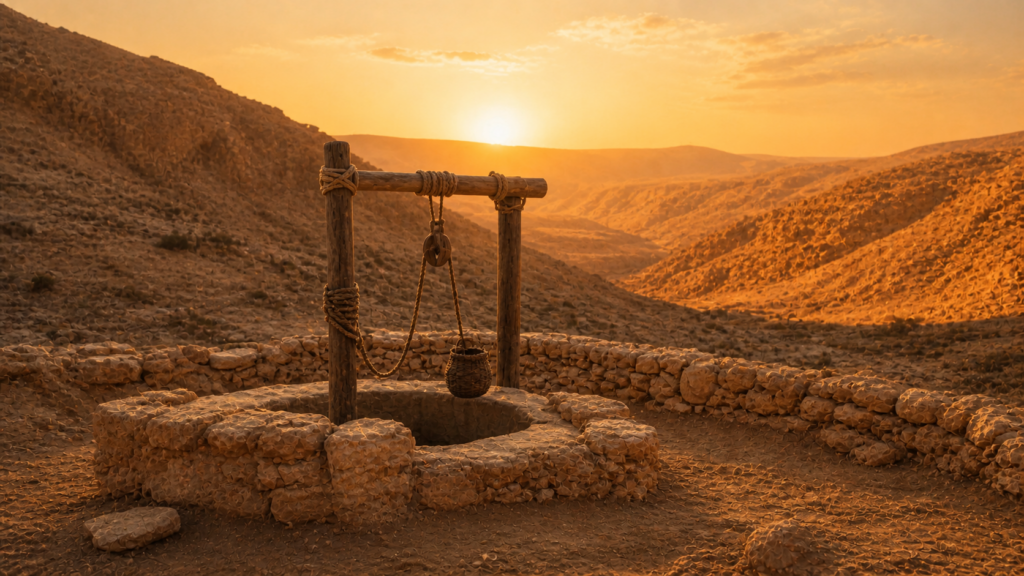
Genesis 26 is Isaac’s chapter. It is the only sustained narrative in Genesis where Isaac is the central figure rather than the son or the father. Abraham is dead. Jacob and Esau are still children. The patriarchal cycle pauses to give Isaac his own arc, and the arc turns out to look almost exactly like his father’s.
A famine drives him toward Egypt. Yahweh tells him to stay in Gerar and renews the Abrahamic covenant directly to him. Isaac, in Gerar, tells the men of the place that Rebekah is his sister, fearing they will kill him for her. Abimelech sees them, figures out the truth, confronts Isaac, and issues a death-decree for anyone who touches them. Isaac sows in the land and reaps a hundredfold, becomes very rich, and the Philistines envy him. They stop up his wells. He moves; he digs new wells; he names them by the conflicts they produce. He arrives at Beer-sheba, where Yahweh appears again with the renewed covenant. Abimelech and his commander come seeking a treaty. Isaac makes the treaty, names the well, and the chapter ends with Esau marrying two Hittite women, a small note that grieves his parents and signals trouble for the next generation.
The chapter is doing several things at once. It is establishing Isaac as a covenant carrier in his own right, with a direct word from Yahweh, a real wealth blessing, and a renewed covenant ratified at Beer-sheba. It is recording, with deliberate doublet structure, the third wife-sister episode (after Abraham’s two), making clear that the patriarch’s fears travel through his sons. It is mapping the wells of the Negev, making the inherited land claim concrete through the labor of digging. And it is closing with a short note that the next generation has its own emerging trouble.
The chapter is short for what it accomplishes. It is also, structurally, a deliberate echo of Genesis 12, 20, and 21. The patterns of the patriarchal narrative are repeating in the second generation. The second patriarch, in his own moment, is doing what his father did, with mixed results, under the same covenant.
A · Genesis 26:1–11 · The famine, the covenant renewal, and the third wife-sister
¹ There was a famine in the land, in addition to the first famine that was in the days of Abraham. Isaac went to Abimelech king of the Philistines, to Gerar. ² Yahweh appeared to him, and said, “Don’t go down into Egypt. Live in the land I will tell you about. ³ Live in this land, and I will be with you, and will bless you. For to you, and to your offspring, I will give all these lands, and I will establish the oath which I swore to Abraham your father. ⁴ I will multiply your offspring as the stars of the sky, and will give all these lands to your offspring. In your offspring all the nations of the earth will be blessed, ⁵ because Abraham obeyed my voice, and kept my requirements, my commandments, my statutes, and my laws.” ⁶ Isaac lived in Gerar. ⁷ The men of the place asked him about his wife. He said, “She is my sister,” for he was afraid to say, “My wife,” lest, he thought, “the men of the place might kill me for Rebekah, because she is beautiful to look at.” ⁸ When he had been there a long time, Abimelech king of the Philistines looked out at a window, and saw, and behold, Isaac was caressing Rebekah, his wife. ⁹ Abimelech called Isaac, and said, “Behold, surely she is your wife. Why did you say, ‘She is my sister?’” Isaac said to him, “Because I said, ‘Lest I die because of her.’” ¹⁰ Abimelech said, “What is this you have done to us? One of the people might easily have lain with your wife, and you would have brought guilt on us!” ¹¹ Abimelech commanded all the people, saying, “He who touches this man or his wife shall surely be put to death.” (Genesis 26:1–11, World English Bible)
- The chapter opens with a famine, “in addition to the first famine that was in the days of Abraham.” The narrator is making the connection to Genesis 12 explicit. Abraham faced a famine; Isaac now faces one. The patriarchal narrative is doing what it does best: the second generation gets the same kind of trial as the first, and the question is whether the second-generation patriarch will navigate it differently.
- Yahweh’s word to Isaac (verses 2 to 5) is crucial. Don’t go down into Egypt. Abraham went down into Egypt under the first famine (12:10), and the trip produced the wife-sister episode and Pharaoh’s plagues. Yahweh is, in effect, saying: do not repeat the descent. Stay in the land. The patriarchal arc is being shaped to keep Isaac in the land of promise even when the famine pressure pushes outward.
- The renewed covenant promise to Isaac (verses 3 to 5) is one of the chapter’s most important moves. The Abrahamic covenant is being directly transmitted to the second generation, in language that explicitly echoes Genesis 12:3 (“in your offspring all the nations of the earth will be blessed”) and Genesis 22:18. The covenant is not Abraham’s alone. It is now Isaac’s. The patriarchal narrative has confirmed the transmission.
- Verse 5 contains an important clause: “because Abraham obeyed my voice, and kept my requirements, my commandments, my statutes, and my laws.” The Hebrew accumulates legal vocabulary: mishmarti, mitzvotai, chuqotai, torotai. The narrator is using language that, by Sinai, will be the standard vocabulary for the Mosaic law. The chapter is signaling, retrospectively, that Abraham’s obedience is being read in the language of Torah-keeping. Some readers see this as anachronistic; others see it as the narrator’s theological framing of Abraham as the prototype of the covenant-keeping life. Either way, the renewed covenant to Isaac is grounded in Abraham’s faithful walk.
Influence callout: N.T. Wright
Wright’s reading of this verse names it as one of the Hebrew Bible’s quiet bridges between the patriarchal and the Sinai material. The covenant promise to Isaac is grounded in Abraham’s obedience-shaped life. The narrator is, in Wright’s reading, arguing that the patriarchal walk was Torah-keeping, even before the Torah was given at Sinai. The covenant family has been shaped, in Abraham’s life, into a way of being that the law will later articulate. The continuity matters.
- The third wife-sister episode (verses 7 to 11) is the chapter’s most uncomfortable move. We have seen this scene twice before: Abraham in Egypt (12:10 to 20) and Abraham in Gerar (chapter 20). Now Isaac, in Gerar, with Abimelech, says exactly what his father said. She is my sister. For exactly the same fear-based reason: he is afraid the men of the place will kill him for Rebekah’s sake.
Influence callout: Tim Mackie
Mackie’s reading of the doublet pattern frames the third wife-sister episode as the chapter’s deliberate argument about inherited fear. The patriarch’s anxieties are not just personal; they travel through the family. Isaac was not present for the Egypt deception; he was likely a small boy during the Gerar deception. He inherits the fear without inheriting the lesson. The chapter is making a point Genesis is honest about: the covenant family carries forward not just the promise but also the dysfunctions. The fear that drove Abraham to deceive Pharaoh is now driving Isaac to deceive Abimelech. The patriarchal narrative refuses to clean up this pattern.
Pushback note
Some readings of this chapter try to soften Isaac’s deception by pointing to a half-truth defense, similar to what Abraham invoked in chapter 20 (Sarah was technically his half-sister). Isaac does not have that defense. Rebekah is his cousin, not his sister. The deception is straightforward. The chapter is not defending Isaac. It is recording the failure as a failure. The patriarch’s son inherits the fear without inheriting any technical excuse for it.
- Abimelech’s response (verses 8 to 11) is, again, that of a pagan king with more moral clarity than the patriarch. He sees Isaac caressing Rebekah at a window, figures out what has happened, confronts Isaac directly, names the moral risk to his people (“you would have brought guilt on us!”), and issues a death-decree to protect them. The pattern from chapter 20 repeats: the pagan king is the moral center; the patriarch is the one being corrected.
Pushback note
Some readers have wondered whether the “Abimelech” of chapter 26 is the same Abimelech as chapter 20. The chapters are separated by at least sixty years (Isaac is now in middle adulthood; the chapter 20 episode happened before Isaac’s birth). Many scholars treat Abimelech (Hebrew Avimelech, “my father is king”) as a Philistine throne-name, similar to Pharaoh. So this Abimelech is likely the dynastic successor or descendant of the chapter 20 figure. The chapter does not specify; it just records that the Philistine king is again named Abimelech and is again the morally upright figure of his exchange with the patriarch.
B · Genesis 26:12–25 · The wealth, the wells, and the second covenant appearance
¹² Isaac sowed in that land, and reaped in the same year one hundred times what he planted. Yahweh blessed him. ¹³ The man grew great, and grew more and more until he became very great. ¹⁴ He had possessions of flocks, possessions of herds, and a great household. The Philistines envied him. ¹⁵ Now all the wells which his father’s servants had dug in the days of Abraham his father, the Philistines had stopped, and filled with earth. ¹⁶ Abimelech said to Isaac, “Go away from us, for you are much mightier than we.” ¹⁷ Isaac departed from there, encamped in the valley of Gerar, and lived there. ¹⁸ Isaac dug again the wells of water, which they had dug in the days of Abraham his father; for the Philistines had stopped them after the death of Abraham. He called their names after the names by which his father had called them. ¹⁹ Isaac’s servants dug in the valley, and found there a well of flowing water. ²⁰ The herdsmen of Gerar argued with Isaac’s herdsmen, saying, “The water is ours.” He called the name of the well Esek, because they contended with him. ²¹ They dug another well, and they argued over that, also. He called its name Sitnah. ²² He left that place, and dug another well. They didn’t argue over that one. He called it Rehoboth. He said, “For now Yahweh has made room for us, and we will be fruitful in the land.” ²³ He went up from there to Beer Sheba. ²⁴ Yahweh appeared to him the same night, and said, “I am the God of Abraham your father. Don’t be afraid, for I am with you, and will bless you, and multiply your offspring for my servant Abraham’s sake.” ²⁵ He built an altar there, and called on Yahweh’s name, and pitched his tent there. There Isaac’s servants dug a well. (Genesis 26:12–25, World English Bible)
- The wealth section (verses 12 to 14) is a small theological statement. Isaac sowed in that land, and reaped in the same year one hundred times what he planted. Isaac, unlike Abraham, is staying in the land of promise during the famine. The chapter is showing that the obedience to Yahweh’s instruction in verse 2 (“don’t go down into Egypt”) produces fruitfulness in the land. The hundredfold harvest is the chapter’s quiet vindication of Isaac’s staying.
- The Philistines’ envy and the stopping of the wells (verses 14 to 16) is the chapter’s main conflict. Wells in the Negev were the difference between life and death; stopping a well was an act of cultural violence. The Philistines, threatened by Isaac’s growing wealth, sabotage the wells Abraham’s servants dug a generation before. Abimelech then asks Isaac to leave: go away from us, for you are much mightier than we. The pagan king’s fear of being displaced by the patriarch’s prosperity drives the next move.
- The well-digging sequence (verses 18 to 22) is one of the chapter’s most distinctive passages. Isaac re-digs his father’s old wells and renames them with the original names. Then he digs new wells and names them by the conflicts they produce: Esek (contention), Sitnah (enmity), and finally Rehoboth (room). The names trace the trajectory of the dispute: contention to enmity to relief.
Word study: well-names Esek, Sitnah, Rehoboth
Three Hebrew well-names mark Isaac’s negotiation of the Philistine conflict. Esek (עֵשֶׂק) means “contention,” from the root asaq, “to dispute, to quarrel.” Sitnah (שִׂטְנָה) means “enmity, accusation,” from a root that will later give the Hebrew Bible the word satan (adversary). Rehoboth (רְחֹבוֹת) means “broad places, room,” from the root rachav, “to be wide, to make room.” The three names trace the patriarch’s path from disputed water to enmity to the place where God has at last made room. The naming pattern is theological: the wells are not just water sources; they are, in their names, the patriarch’s record of his relationship with the people around him.
Influence callout: Ray Vander Laan
Vander Laan’s teaching on the Negev’s water culture brings this section to life. Wells in this region were dug at extraordinary labor, sometimes hundreds of feet down through limestone. The naming of wells was not poetic flourish; it was practical record-keeping. A well’s name signaled its history, its conflicts, its current ownership status, and any treaty obligations attached to it. Isaac’s three names (Esek, Sitnah, Rehoboth) preserved the legal and emotional history of his negotiations with the Philistines for any later traveler who passed through. The chapter is recording, in the well-names, the patriarch’s slow process of carving out room in a contested land.
- Beer-sheba (verse 23) returns. Abraham had named the well Beer-sheba in chapter 21:31 after the treaty with the first Abimelech. Isaac arrives at the same place. The patriarchal cycle is repeating its geographic pattern; the second generation is walking the same ground as the first.
- The covenant appearance (verse 24) is the chapter’s second major moment of direct divine address. Yahweh appears to Isaac the same night he arrives at Beer-sheba and speaks: I am the God of Abraham your father. Don’t be afraid, for I am with you, and will bless you, and multiply your offspring for my servant Abraham’s sake. The covenant is renewed in language that ties Isaac’s blessing to Abraham’s faithfulness. The phrase for my servant Abraham’s sake is not making Isaac a passive beneficiary; it is grounding the second-generation covenant in the first-generation faithfulness. The two patriarchs are bound together in the promise.
- Isaac’s response (verse 25) is straightforward. He built an altar there, and called on Yahweh’s name, and pitched his tent there. The same pattern Abraham followed at Shechem and Bethel (12:7-8) and at Hebron (13:18). The second patriarch, like the first, marks the place of theophany with an altar. The covenant family’s geography is being rebuilt one altar at a time.
C · Genesis 26:26–35 · The treaty and the marriages
²⁶ Then Abimelech went to him from Gerar, and Ahuzzath his friend, and Phicol the captain of his army. ²⁷ Isaac said to them, “Why have you come to me, since you hate me, and have sent me away from you?” ²⁸ They said, “We saw plainly that Yahweh was with you. We said, ‘Let there now be an oath between us, even between us and you, and let us make a covenant with you, ²⁹ that you will do us no harm, as we have not touched you, and as we have done to you nothing but good, and have sent you away in peace.’ You are now the blessed of Yahweh.” ³⁰ He made them a feast, and they ate and drank. ³¹ They rose up some time in the morning, and swore to one another. Isaac sent them away, and they departed from him in peace. ³² The same day, Isaac’s servants came, and told him concerning the well which they had dug, and said to him, “We have found water.” ³³ He called it Shibah. Therefore the name of the city is Beer Sheba to this day. ³⁴ When Esau was forty years old, he took as wife Judith, the daughter of Beeri the Hittite, and Basemath, the daughter of Elon the Hittite. ³⁵ They grieved Isaac’s and Rebekah’s spirits. (Genesis 26:26–35, World English Bible)
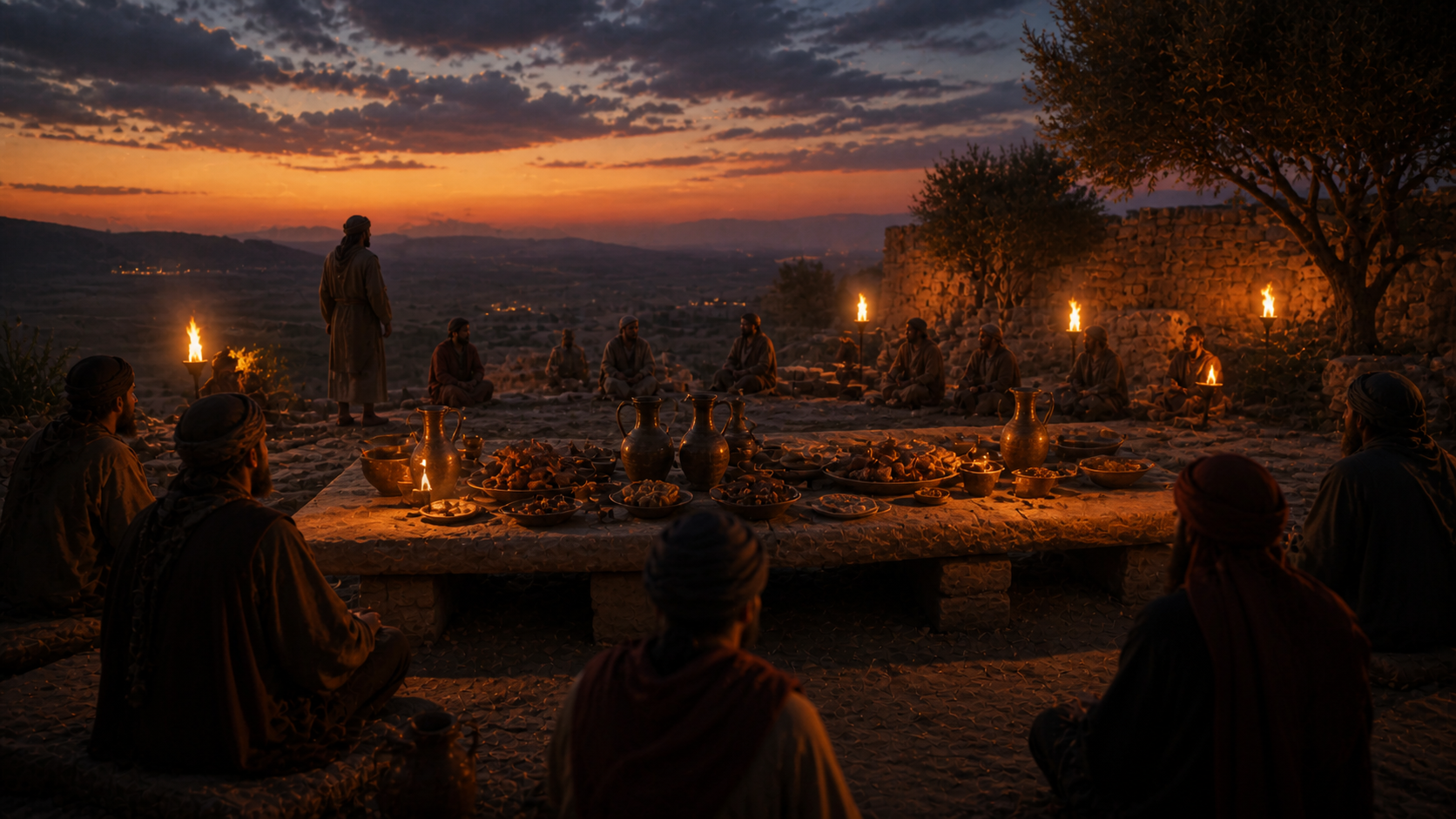
- Abimelech’s return is a deliberate echo of Genesis 21:22-32. The same Philistine king (or his successor), with Phicol the army commander again, comes to make a covenant with the patriarch. Where chapter 21 had Abimelech approaching Abraham; chapter 26 has him approaching Isaac. The pattern is repeating; the second generation is doing what the first generation did. The chapter is making the doublet structure visible.
- Isaac’s question (verse 27) is sharp: why have you come to me, since you hate me, and have sent me away from you? The patriarch is not pretending the conflict didn’t happen. He names the rejection. The honesty is itself a small victory of the chapter; Isaac is conducting himself as the patriarch he is, not as a guest seeking favor.
- The Philistine acknowledgment (verses 28 to 29) is the same pattern as Abimelech to Abraham in 21:22: we saw plainly that Yahweh was with you. The pagan king is, again, reading the patriarch’s life theologically. The blessing on Isaac is conspicuous; the treaty offer is the response. The chapter is recording the same recognition the previous generation received: the world watches the covenant family’s flourishing and seeks treaty rather than conflict.
- The covenant feast (verse 30) seals the agreement in the standard ANE manner. He made them a feast, and they ate and drank. The shared meal is the visible binding of the treaty. Treaties are sworn over food; this is true throughout the ANE and remains, with adjustments, the cultural form of formal agreements long after.
- The well’s name (verse 33) is Shibah, related to sheva (“seven”) and shavua (“oath”). The chapter is connecting Isaac’s well-naming to Abraham’s Beer-sheva in 21:31, where the same wordplay was at work. The two patriarchs’ wells share a name; the second well preserves the memory of the first.
Influence callout: Walter Brueggemann
Brueggemann’s reading of the chapter’s covenant repetitions names them as the Hebrew Bible’s recognition of the patriarchal life as a generational rhythm. The same wells are dug; the same wells are named; the same treaty is struck; the same altar is built; the same covenant is renewed. The covenant family is not novel in the second generation. It is continuous. Brueggemann argues that this is part of the patriarchal narrative’s pastoral theology: faithfulness across generations looks more like rhythm than like innovation. Isaac is not building something different than Abraham. He is building the same things in his own time, with his own conflicts, and the chapter calls that good.
- Verses 34 and 35 close the chapter with a small but ominous note. When Esau was forty years old, he took as wife Judith, the daughter of Beeri the Hittite, and Basemath, the daughter of Elon the Hittite. They grieved Isaac’s and Rebekah’s spirits. The chapter has been about Isaac’s full transmission of the covenant, his second-generation faithfulness, the renewed promise at Beer-sheba. And the closing two verses are about the covenant son’s covenant son marrying outside the covenant family, in two simultaneous marriages, to Hittite women. The narrator does not editorialize beyond the brief note that the marriages grieved his parents.
Influence callout: Tim Mackie
Mackie’s literary reading of the chapter’s closing verses notes their structural function. Genesis 26 has been about Isaac’s covenant transmission; the chapter ends with the next-generation question of who will carry the covenant forward. Esau’s two Hittite marriages are, in the chapter’s framing, the kind of choice Abraham’s servant in chapter 24 was sent abroad specifically to avoid for Isaac. The chapter is, in its closing two verses, beginning to set up the Jacob narrative of the next ten chapters. Esau’s marriages are the seed of the next major patriarchal crisis: which son carries the line, and on what terms?
- The grief of Isaac and Rebekah (verse 35) is recorded simply. The Hebrew morat ruach, “bitterness of spirit,” is unusual; it conveys a deep, sustained pain rather than passing displeasure. The covenant family’s matriarch and patriarch are grieved by their elder son’s marriages. This grief, which the chapter records without commentary, will become one of the seeds of Rebekah’s later willingness to deceive Isaac on Jacob’s behalf in chapter 27. The chapter is, in its quiet closing, planting what the next chapter will harvest.
Reflection prompts
- The chapter records the same patterns repeating across two generations: the famine, the wife-sister fear, the wells, the treaty at Beer-sheba. Where in your own life are you walking patterns your parents walked, with the same kinds of fears and the same kinds of provisions? What does it look like to recognize that you are not original, you are continuous?
- Isaac’s three wells are named Esek (contention), Sitnah (enmity), and Rehoboth (room). The patriarch’s record of his negotiation with the Philistines is preserved in the names of the water sources. What in your life right now would you name Esek? What would you name Sitnah? What is the Rehoboth you are still digging toward, and what would it cost you to keep digging through the first two?
- The chapter ends with the next generation’s marriage choices grieving Isaac and Rebekah. The covenant family is shaped not just by the patriarch’s faithfulness but by the children’s choices. Where in your life are you watching a younger generation make choices that grieve you? What does it look like to grieve faithfully without forcing what is not yours to control?