

Titus 2 is the chapter where the Pastoral Epistles’ household-instruction tradition meets the gospel itself. The first ten verses give the delegate the content of what to teach (as fits sound doctrine, verse 1) to the various household groups: older men, older women, younger women, younger men, and slaves. The next four verses (11-14) are one of the New Testament’s most compressed and theologically rich gospel summaries, with the famous opening for the grace of God has appeared, bringing salvation to all. The closing verse (15) returns to the delegate’s authoritative-speech mandate. The structure is exact: practical instruction, then theological grounding, then mandate to deliver.
The chapter has three movements. The first (verses 1-10) is the household teaching, organized by age and station within the typical Greco-Roman household, with the deliberate addition (the chapter’s signature move) of the gospel as the household’s interpretive horizon: the slave who keeps faith with his master adorns the doctrine of God (verse 10); the household groups whose lives match the gospel teaching make the word of God believable (verse 5). The second (verses 11-14) is the gospel core that grounds the practical teaching: grace has appeared, grace saves, grace trains, grace points forward to the blessed hope of Christ’s appearing, grace is the gift of the Christ who gave himself for us. The third (verse 15) returns to the delegate’s task: say these things, exhort, reprove, with all authority.
The chapter is doing in compressed form what Colossians 3 and Ephesians 5-6 do at length: it joins the Pauline household codes to the gospel’s central announcement. The household teaching is not freestanding moralism. The household teaching is the practical exhibit of what the grace that has appeared makes possible.
A · Titus 2:1-10 · Sound doctrine for the household groups
¹ But say the things which fit sound doctrine, ² that older men should be temperate, sensible, sober minded, sound in faith, in love, and in perseverance, ³ and that older women likewise be reverent in behavior, not slanderers nor enslaved to much wine, teachers of that which is good, ⁴ that they may train the young wives to love their husbands, to love their children, ⁵ to be sober minded, chaste, workers at home, kind, being in subjection to their own husbands, that God’s word may not be blasphemed. ⁶ Likewise, exhort the younger men to be sober minded. ⁷ In all things show yourself an example of good works. In your teaching, show integrity, seriousness, incorruptibility, ⁸ and soundness of speech that can’t be condemned, that he who opposes you may be ashamed, having no evil thing to say about us. ⁹ Exhort servants to be in subjection to their own masters and to be well-pleasing in all things, not contradicting, ¹⁰ not stealing, but showing all good fidelity, that they may adorn the doctrine of God, our Savior, in all things. (Titus 2:1-10, World English Bible)
- But say the things which fit sound doctrine (verse 1). The chapter opens with a deliberate contrast to chapter 1’s false teachers. But you (the Greek Sy de opens emphatically, “but you, by contrast”) names the delegate’s separate task. Say the things which fit sound doctrine (lalei ha prepei tē hygiainousē didaskaliā, “speak the things that befit the healthful teaching”) returns to the Pastorals’ signature hygiainō verb (the same healthful adjective of 1:9 and 1:13). The chapter’s fit (prepei, “is fitting, befits”) names coherence between teaching and the lived practices that flow from it. Sound teaching, on this verse’s terms, is teaching the household groups how to live, not teaching abstract doctrinal propositions to be assented to in the head while the body is left untouched. The verse establishes the chapter’s principle: the content of what Titus teaches is the form of life the household groups are to embody.
- that older men should be temperate, sensible, sober minded, sound in faith, in love, and in perseverance (verse 2). The first household group: older men (presbytas, “older male persons”, not the office-bearing presbyteros of 1:5 but the demographic group). Six virtues stack. Temperate (nēphalious, “sober, abstemious”, originally of wine but extended to general self-mastery). Sensible (semnous, “venerable, dignified”, the bearing of mature masculinity). Sober minded (sōphronas, the same cardinal virtue named throughout the chapter). Sound in faith, in love, in perseverance (hygiainontas tē pistei, tē agapē, tē hypomonē, the same Pauline triad of faith-love-hope-perseverance that appears across the corpus, with the hygiainō “healthful” adjective tying back to verse 1). The portrait is the settled, dignified, faithful, loving, patient older man. The chapter has nothing to say about the older man’s productivity, achievements, ambitions, or success; the virtues are entirely character virtues.
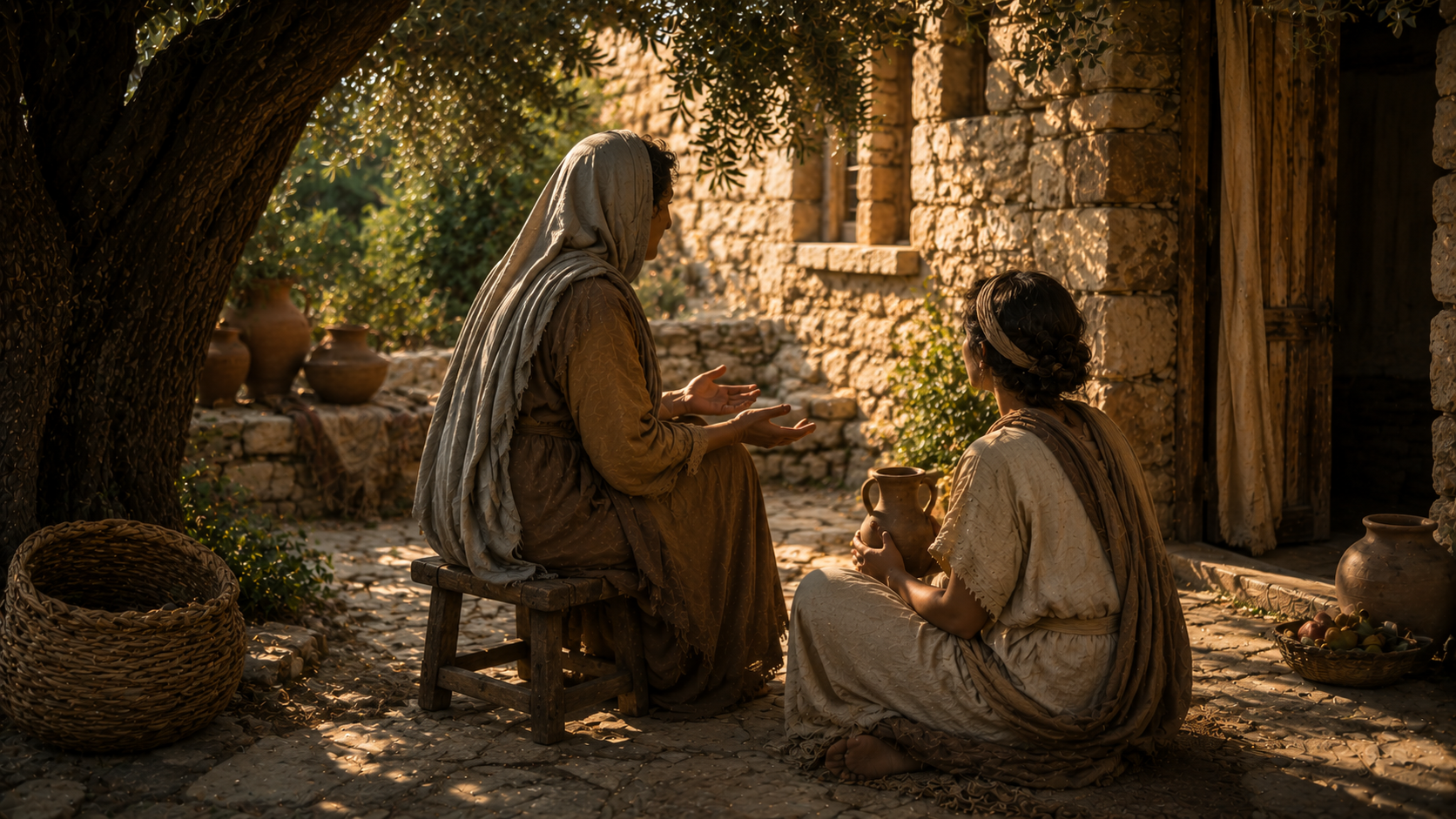
- and that older women likewise be reverent in behavior, not slanderers nor enslaved to much wine, teachers of that which is good (verse 3). The second household group: older women (presbytidas, the demographic group, paralleling presbytas in verse 2). Four traits. Reverent in behavior (hieroprepeis, literally “priest-fitting”, “demeaning fit for sacred persons”, a striking term suggesting that the older woman’s bearing is quasi-priestly). Not slanderers (mē diabolous, the same word used elsewhere of the devil himself, the slanderer; older women whose speech is slanderous are doing the devil’s work). Not enslaved to much wine (mē oinō pollō dedoulōmenas, “not enslaved-to-much-wine”, with the same enslavement verb that names servitude). Teachers of that which is good (kalodidaskalous, “good-teachers”, a hapax legomenon in the New Testament). The fourth trait is the chapter’s most consequential affirmation: older women are teachers. The Greek word combines kalos (“beautiful, noble, good”) with didaskalos (“teacher”) to name a teaching office or function in the church’s life. See women in ministry and leadership for the broader treatment.
- that they may train the young wives to love their husbands, to love their children, to be sober minded, chaste, workers at home, kind, being in subjection to their own husbands, that God’s word may not be blasphemed (verses 4-5). The chapter’s third household group, the young wives, receives instruction through the older women’s training rather than directly from the delegate. The verb train (sōphronizōsin, “make sober-minded, train in self-mastery”, from the same sōphronos root that runs through the chapter) names a teaching-and-formation function. The chapter is structuring the household-instruction through the older women: Titus does not instruct the young wives directly; he instructs the older women who instruct the young wives. The chapter’s content for the young wives is a Greco-Roman household-virtue list: love their husbands (philandrous, “husband-loving”), love their children (philoteknous), sober minded (sōphronas), chaste (hagnas, “pure”), workers at home (oikourgous, “household-workers”, the variant oikourous “household-keepers” is also attested), kind (agathas, “good”), being in subjection to their own husbands (hypotassomenas tois idiois andrasin). The purpose of all this is that the word of God may not be blasphemed (hina mē ho logos tou theou blasphēmētai, “that the word of God may not be slandered”). The verse names the chapter’s missional logic: the Christian household’s visible life is the credibility of the Christian message in its Greco-Roman setting. See the household codes for the framework treatment of these passages.
Word study: kalodidaskalos, the older woman as teacher of the good (Titus 2:3)
The compound word kalodidaskalos in verse 3 (“teachers of what is good”) is a New Testament hapax legomenon, appearing nowhere else in the canon. The compound joins kalos (good, beautiful, noble, the cardinal aesthetic-ethical adjective in Greek moral philosophy) with didaskalos (teacher, the standard term for a public or private instructor). The compound’s lexical force is “teachers of the good thing” or “teachers in beauty/nobility”. The lane reads this term with the Nijay Gupta / Lucy Peppiatt / Aida Spencer school of Pauline women’s-ministry scholarship: the chapter is naming the older women as a recognized teaching function in the church’s life, with the content of their teaching specified in verses 4-5 (the formation of the younger women in the household virtues). Three readings of the term are possible, and they shape the reception. First, the restrictive reading: the older women teach only younger women, and only the household virtues; this is the complementarian reading favored by the Pastorals’ more conservative reception. Second, the exemplary reading: the chapter names one form of women’s teaching (the formation of younger women) without thereby restricting women’s teaching to only this form; women may also teach other groups in other ways, as Priscilla teaches Apollos (Acts 18:26), as Phoebe carries and delivers Romans (Rom 16:1-2), as the women prophesy in the Corinthian assembly (1 Cor 11:5). Third, the trajectory reading: the chapter is naming a culturally appropriate form of women’s teaching for a first-century household setting, with the underlying affirmation (women teach, women have authoritative formative roles in the church) being the load-bearing claim, and the specific form being contingent on the cultural setting. The lane reads with the exemplary and trajectory readings together: the chapter explicitly affirms women’s teaching, names one valued form of it, and does not, on its own terms, restrict women’s teaching to only this form. The relationship between this affirmation and 1 Tim 2:11-15 is treated in the women in ministry and leadership framework.
- Likewise, exhort the younger men to be sober minded. In all things show yourself an example of good works. In your teaching, show integrity, seriousness, incorruptibility, and soundness of speech that can’t be condemned, that he who opposes you may be ashamed, having no evil thing to say about us (verses 6-8). The fourth household group, the younger men, gets a single-verse instruction (be sober minded, the chapter’s signature virtue), and the chapter then pivots to address Titus himself (a younger man in his own right) as the example the younger men are to imitate. Three things in the delegate’s example. Integrity (aphthorian, “incorruption, soundness”), seriousness (semnotēta, “dignity”), incorruptibility (aphtharsian, a variant reading; some texts have only the two terms). The purpose is that the one opposing may be ashamed, having no evil thing to say about us. The verse names the apologetic function of the delegate’s life: the church’s most effective defense against its critics is a credible delegate whose life cannot be reasonably charged with the things the critics try to assign. The same logic operates throughout the household teaching: the lived life of the church closes the mouth of its critics.
- Exhort servants to be in subjection to their own masters and to be well-pleasing in all things, not contradicting, not stealing, but showing all good fidelity, that they may adorn the doctrine of God, our Savior, in all things (verses 9-10). The fifth household group, the slaves (doulous, the same Greek term that designates literal slaves in the Roman institution), receives the longest instruction relative to the brief format of the other groups. Five behaviors. Be in subjection to their own masters (idiois despotais hypotassesthai, with despotēs, “master, lord”, being the term used of literal slave-owners as well as of God himself in some Pauline usage). Be well-pleasing in all things (en pasin euarestous einai). Not contradicting (mē antilegontas, “not talking back”). Not stealing (mē nosphizomenous, “not pilfering”). Showing all good fidelity (pasan pistin endeiknymenous agathēn, “demonstrating all good faith”). The purpose of these behaviors is that they may adorn the doctrine of God, our Savior, in all things (hina tēn didaskalian tēn tou sōtēros hēmōn theou kosmōsin en pasin, “that they may adorn the teaching of our Savior God in all things”). The verb adorn (kosmeō, the same root as “cosmos” and “cosmetic”, to put in order, to make beautiful) names a striking image: the slave’s fidelity is the cosmetic, the adornment, the beautifying of the gospel itself. See slavery and the trajectory for the framework treatment of these instructions in their first-century context and trajectory.
B · Titus 2:11-14 · The grace of God has appeared, bringing salvation to all
¹¹ For the grace of God has appeared, bringing salvation to all men, ¹² instructing us to the intent that, denying ungodliness and worldly lusts, we would live soberly, righteously, and godly in this present age; ¹³ looking for the blessed hope and appearing of the glory of our great God and Savior, Jesus Christ, ¹⁴ who gave himself for us, that he might redeem us from all iniquity and purify for himself a people for his own possession, zealous for good works. (Titus 2:11-14, World English Bible)
- For the grace of God has appeared, bringing salvation to all men (verse 11). The chapter’s gospel core opens with one of the New Testament’s most famous theological statements. For (gar, “because, since”) explicitly grounds the preceding household instruction in what follows. The instruction does not stand on its own; it stands on the grace that has appeared. The Greek epephanē (the aorist of epiphainō, “to manifest, to appear, to come into visibility”) gives the New Testament theological vocabulary the term epiphany. Grace, on this verse’s framing, is not an abstract divine disposition; grace is a historical event, an appearing, the coming-into-visibility of God’s saving disposition in the person of Jesus Christ. Bringing salvation to all men (sōtērios pasin anthrōpois, “salvific to all human persons”) is the verse’s universal scope. The grace is not for the privileged few, the religious insiders, the slave-owners as opposed to slaves, the men as opposed to women, the Jewish believers as opposed to the Gentile Cretans. The grace is for all. The chapter’s careful household-by-household instruction has already prepared the verse: each household group has been addressed, and now each household group is told that the same grace has appeared for all of them.
- instructing us to the intent that, denying ungodliness and worldly lusts, we would live soberly, righteously, and godly in this present age (verse 12). The verse names the training function of grace. The Greek paideuousa (“training, educating, disciplining”, from paideia, the Greek educational ideal) introduces a sharp claim: grace teaches. Grace does not merely accept the believer in his current state; grace forms him toward a different state. Two things grace teaches the believer to renounce (arnēsamenoi, the same verb of “denying” that appeared in 1:16’s false teachers’ denying-by-deeds): ungodliness (asebeia, the opposite of eusebeia) and worldly lusts (tas kosmikas epithymias, the desires shaped by the present-evil-age’s value system). Three things grace teaches the believer to live (zēsōmen, aorist subjunctive, “we might live”): soberly (sōphronōs, the chapter’s signature virtue applied to self), righteously (dikaiōs, applied to neighbor), godly (eusebōs, applied to God). The triad is the threefold ethical orientation the gospel’s training produces: self-mastery, just dealing, devotion to God. In this present age (en tō nyn aiōni) locates the training now, in the time between the first and second appearings, not in some future state.
- looking for the blessed hope and appearing of the glory of our great God and Savior, Jesus Christ (verse 13). The verse names the future horizon toward which grace’s training is oriented. Looking for (prosdechomenoi, “expecting, eagerly awaiting”) names the posture of the trained believer. The blessed hope and appearing of the glory (tēn makarian elpida kai epiphaneian tēs doxēs) combines two terms in the Greek under a single article (the hopendiadys or “Granville Sharp” construction): the blessed hope, which is the appearing of the glory. The Christian’s hope is not abstract; the Christian’s hope is the epiphany (the same verb root as epephanē in verse 11) of the glory of God in Christ at the return. Of our great God and Savior, Jesus Christ (tou megalou theou kai sōtēros hēmōn Iēsou Christou) is one of the New Testament’s clearest grammatical attributions of deity directly to Jesus. The Granville Sharp construction here (single article, two nouns joined by kai, both anarthrous personal terms referring to the same person) is the same construction that drives 2 Pet 1:1’s the righteousness of our God and Savior Jesus Christ. The verse names Jesus as the great God and Savior. Some translations break the phrase into two (the great God, and our Savior Jesus Christ), but the grammar most naturally reads it as a single attribution: Jesus is the great God and Savior whose epiphany is the church’s hope.
- who gave himself for us, that he might redeem us from all iniquity and purify for himself a people for his own possession, zealous for good works (verse 14). The verse closes with the Christological-soteriological core. Who gave himself for us (hos edōken heauton hyper hēmōn) names the substitutionary self-gift of Christ, the same vocabulary that runs through Gal 1:4 (who gave himself for our sins) and Eph 5:25 (Christ also loved the church and gave himself up for it). That he might redeem us from all iniquity (hina lytrōsētai hēmas apo pasēs anomias, “that he might ransom us from all lawlessness”) uses the redemption-vocabulary of Exodus and the Pauline corpus. And purify for himself a people for his own possession (kai katharisē heautō laon periousion, with laon periousion echoing Exodus 19:5’s segullah, “treasured possession”) names the covenantal purpose: Christ’s self-gift creates a people, a covenant-people, his own possession. Zealous for good works (zēlōtēn kalōn ergōn, “zealous for noble works”) names the visible mark of the people Christ has purified. The chapter has just spent ten verses describing what good works look like in each household group; verse 14 names the people zealous for these things as the gospel’s intended outcome.
Influence callout: I. Howard Marshall (ICC Pastoral Epistles)
Marshall’s reading of 2:11-14 names it as the Christological-soteriological summary that grounds the household teaching of the preceding ten verses, and his treatment of the passage as a unit deserves wide reception. Marshall sees the passage operating on a three-tense structure that runs through the Pastorals’ gospel cores: the past appearing (verse 11’s epephanē, the historic event of Christ’s first coming), the present training (verse 12’s paideuousa, the ongoing educational discipline of the present age between the appearings), and the future expectation (verse 13’s prosdechomenoi, the looking-for of the blessed hope). The three tenses operate together to give the chapter’s eschatology its shape: the church lives now, between the appearings, trained by the past grace, oriented toward the future glory. The household teaching of verses 1-10 is therefore not moralistic or static; it is the form of life appropriate to the time between the appearings. The same logic operates at 3:4-7’s parallel gospel core. Marshall reads the Pastorals as a coherent Pauline eschatology adapted for the church’s settled-in-the-world phase, not as a domesticated Christianity that has lost the apocalyptic edge. The household teaching is the Pauline eschatology under historical conditions: Christians waiting for the appearing, formed by the appearing already past, living the form of life the two appearings make possible.
C · Titus 2:15 · The delegate’s authoritative-speech mandate
¹⁵ Say these things and exhort and reprove with all authority. Let no one despise you. (Titus 2:15, World English Bible)
- Say these things and exhort and reprove with all authority. Let no one despise you (verse 15). The chapter closes with the delegate’s threefold speech mandate. Say these things (tauta lalei) names the content: the household instruction and the gospel core of verses 1-14. Exhort (parakalei, the verb of cruciform appeal that runs through Philemon and the Pauline corpus) names one mode of the delegate’s speech: coming alongside the hearer with persuasive encouragement. Reprove (elenche, the dialectical-confronting verb of 1:9 and 1:13) names the other mode: confronting opposition with the corrective word. With all authority (meta pasēs epitagēs, “with all command-authority”, the term epitagē is the most authoritative word for command in Greek officialdom) names the delegate’s standing to deliver both modes. Let no one despise you (mēdeis sou periphroneitō, “let no one think around you”, “let no one disregard you”) closes with a striking pastoral note. Titus is probably the younger man among the elders of Crete; the verse’s caution is similar to 1 Tim 4:12’s let no one despise your youth. The delegate’s authority is real, but it has to be defended against being disregarded. The chapter’s instruction to the delegate has been comprehensive enough that the closing verse can entrust him with the full apostolic episkopē (oversight) of the chapter’s content.
Pre-modern callout: John Chrysostom (Homilies on Titus, c. 390s)
Chrysostom’s six homilies on Titus, preached at Antioch in the late fourth century, contain his characteristic close attention to the household-instruction passages and their pastoral application to his own congregation. Chrysostom’s reading of 2:3-5 (the older women teaching the younger) names the older women as catechists of the younger women, with the older women’s teaching function held as an honored ecclesial role rather than as a domestic relegation. His homily on the passage is striking for its time in its affirmation that Paul recognizes the teaching ministry of women in the church’s household-formation. On the gospel core (2:11-14), Chrysostom’s reading anticipates the paideuousa trajectory the modern commentaries (Marshall, Towner, Knight) develop: grace’s training is not a reduction of grace but its completion, the same grace that saves the sinner is the grace that forms the saved person into Christ’s image. Chrysostom’s reading is foundational for the lane’s exemplary reading of the women’s-teaching verses, and his patristic affirmation gives the modern egalitarian-trajectory reading deep historical roots.
Reflection prompts
- The chapter’s household instruction is grounded in the gospel itself (the for of 2:11 explicitly connects the household teaching to the grace that has appeared). Where in your own life is your household instruction (to children, spouse, congregation, staff) ungrounded from the gospel and floating as freestanding moralism? What would it look like to ground it again?
- The grace of God has appeared, bringing salvation to all (verse 11), and training us (verse 12). Where in your own life is the appearing of grace clearly visible (the past event of the gospel), and where is the training function of grace visible (the present ongoing formation)? Which side feels stronger right now? Which side needs attention?
- Verse 3’s older women, teachers of what is good. Who are the older women in your own life or congregation who currently fill the kalodidaskalos role? If none, why not, and what would it take to recover this teaching function? If many, name them, and let the chapter affirm what they are doing.
- Verse 14’s zealous for good works. The chapter names zeal for good works as the visible mark of Christ’s purified people. Where is your zeal currently directed (status, achievement, security, comfort)? Where would the chapter ask you to redirect it?