
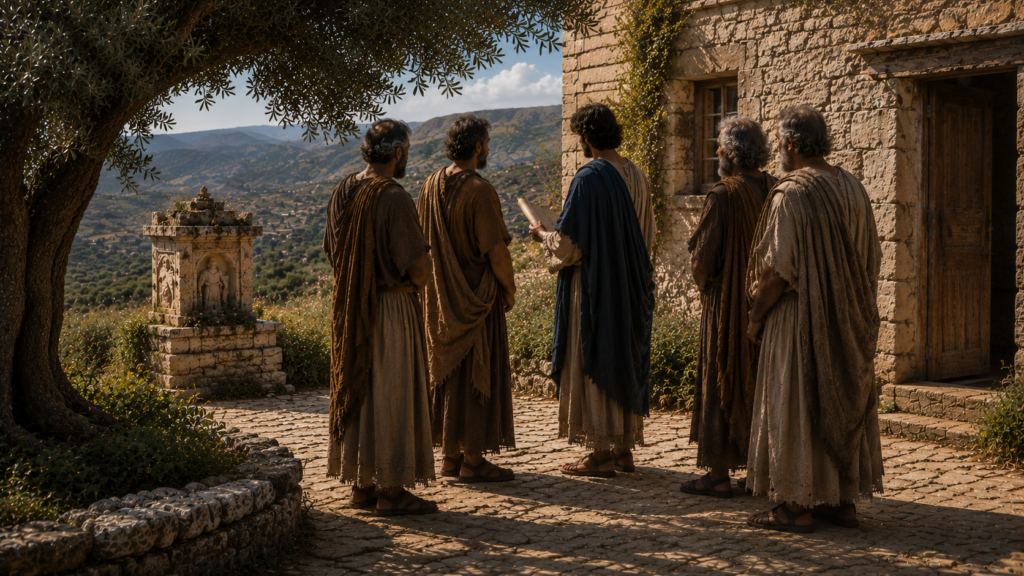
Titus 1 is the delegate’s mandate. The chapter opens with the longest formal salutation in the Pastoral Epistles (1:1-4), explicitly grounding the letter’s authority in the faith of God’s chosen ones and the knowledge of the truth which is according to godliness. It then names the specific charge that brought Titus to Crete (1:5, set in order the things that were lacking, and appoint elders in every city) and gives the qualifications for those elders/overseers (1:6-9), the longest such list in the Pastorals after 1 Tim 3. The remainder of the chapter (1:10-16) confronts the disorder Titus is to address: the circumcision party, the vain talkers and deceivers, the household-disrupting false teachers, and the broader cultural-religious chaos of Cretan civic life captured in the Epimenides quotation at verse 12.
The chapter has three movements. The first (verses 1-4) is the salutation, with the letter’s longest theological introduction in the Pastorals. The second (verses 5-9) is the elder/overseer qualifications, addressed to the delegate as what you are to do on Crete. The third (verses 10-16) is the why: the specific situational disorder that makes the elder-appointment urgent.
The chapter is the New Testament’s most concentrated single-chapter portrait of first-century apostolic delegation: the apostle authorizes the delegate, names what the delegate is to organize (leadership), names what the delegate is to confront (false teaching and household disorder), and grounds both moves in the gospel itself. The lane reads it inside its situation: the early church’s struggle to plant durable leadership in new mission fields, to manage the always-present Judaizing pressure, and to make Christian discipleship visible inside the moral chaos of Greco-Roman civic life.
A · Titus 1:1-4 · The salutation, and the delegate’s commission
¹ Paul, a servant of God and an apostle of Jesus Christ, according to the faith of God’s chosen ones and the knowledge of the truth which is according to godliness, ² in hope of eternal life, which God, who can’t lie, promised before time began; ³ but in his own time revealed his word in the message with which I was entrusted according to the commandment of God our Savior, ⁴ to Titus, my true child according to a common faith: Grace, mercy, and peace from God the Father and the Lord Jesus Christ our Savior. (Titus 1:1-4, World English Bible)
- Paul, a servant of God and an apostle of Jesus Christ (verse 1a). The salutation opens with the Pauline double-naming: servant of God (doulos theou, the same self-designation Paul gives himself only at Rom 1:1 and uses of Christ himself at Phil 2:7) and apostle of Jesus Christ (the standard Pauline opening). The phrase servant of God is striking in this letter because the chapter is about to instruct slaves of human masters (2:9-10); the apostle whose self-identification is slave of God is the one whose later instruction to literal slaves carries the most theological weight. The double-naming establishes the delegate-letter’s apostolic authority: Titus’s mandate on Crete is delegated from Paul, and Paul’s authority comes from his apostolic commission.
- according to the faith of God’s chosen ones and the knowledge of the truth which is according to godliness (verse 1b). The salutation’s first qualifier names the content of the apostolic mission: the faith (pistis) and the knowledge of the truth (epignōsis alētheias). The Greek kat’ epignōsin alētheias tēs kat’ eusebeian (“according to a knowledge of the truth which is according to godliness”) is a Pastorals-characteristic vocabulary. Eusebeia (godliness, devotion, reverent practice) is the Pastorals’ favored term for the Christian’s whole-life response to the gospel. Knowledge that does not produce godliness is, in the Pastorals’ framing, not real knowledge of the gospel. The chapter will return to this point at verse 16’s they profess to know God, but by their deeds deny him.
- in hope of eternal life, which God, who can’t lie, promised before time began (verse 2). The verse contains one of the Pastorals’ most direct theological statements: God who cannot lie (ho apseudēs theos, “the un-lying God”). The phrasing is striking on a Cretan letter; the chapter’s verse 12 will name the Cretan paradox (the locals are reputed liars), and the un-lying God of verse 2 stands in deliberate contrast. Promised before time began (pro chronōn aiōniōn, “before eternal times”) names the promise’s pre-creation anchoring; the gospel is not a recent invention but the manifestation in time of a promise made before time itself. The same vocabulary appears in 2 Tim 1:9 and Eph 1:4. The salutation grounds the Cretan delegate’s work in the eternal counsel of God.
- but in his own time revealed his word in the message with which I was entrusted according to the commandment of God our Savior (verse 3). The verse names the temporal manifestation of the eternal promise: in his own time (kairois idiois, “in his own seasons”, the strategic timing of God) revealed his word in the message (ephanerōsen ton logon autou en kērygmati, “manifested his word in the proclamation”). The verb ephanerōsen (“manifested, made appear”) anticipates the chapter 2 and chapter 3 cores’ epiphany-language. The proclamation has been entrusted (episteuthēn, “I was made trustee of”) to Paul according to the commandment of God our Savior. The word Savior (Sōtēr) appears in this letter ten times, more than any other Pauline letter; the term, in Greco-Roman civic religion, was the imperial title (the emperor was the sōtēr of the empire). The Pastorals’ deliberate transfer of the term to God and Christ is a quiet political-theological move: the real Savior is not on the imperial throne but at the right hand of the Father.
- to Titus, my true child according to a common faith: Grace, mercy, and peace from God the Father and the Lord Jesus Christ our Savior (verse 4). The delegate is named: Titus, my true child according to a common faith. The phrase true child (gnēsiō teknō) is the same intimate kinship-language Paul uses of Timothy (1 Tim 1:2) and of Onesimus (Phlm 10). Titus is Paul’s spiritual son. According to a common faith (kata koinēn pistin) names the shared faith that binds apostle and delegate: this is not a hierarchical command from a distant superior but a working partnership in a common task. The threefold benediction grace, mercy, and peace (instead of the more common Pauline grace and peace) is characteristic of the Pastorals; the mercy component (eleos) is added in delegate-letters where the delegate’s personal pastoral need is in view.
Influence callout: Luke Timothy Johnson (Anchor Bible Letters to Paul’s Delegates)
Johnson reads Titus 1:1-4 inside the Greco-Roman letter-of-delegation genre, comparing it with Cicero’s letters to his lieutenants and Pliny the Younger’s letters to provincial officials. The genre’s structural pattern is: the principal-author identifies himself with his full credentials, names the commission under which he is writing, addresses the delegate by name with relational warmth, and grounds the delegate’s authority on the ground in the principal’s own authority above. Titus 1:1-4 follows this pattern exactly, but with one critical inflection: the commission is not from Caesar or the Senate but from God our Savior, and the delegate’s authority on Crete is not derivative of Roman provincial administration but of the eternal counsel of the un-lying God. The political-theological subtext is real. The Pastoral Epistles are sometimes read as accommodating Roman imperial categories; Johnson reads them as appropriating Roman categories while transferring the underlying authority to a higher throne. The delegate-letter form is recognizable; the underlying claim is anti-imperial.
B · Titus 1:5-9 · The mandate and the overseer qualifications
⁵ I left you in Crete for this reason, that you would set in order the things that were lacking and appoint elders in every city, as I directed you, ⁶ if anyone is blameless, the husband of one wife, having children who believe, who are not accused of loose or unruly behavior. ⁷ For the overseer must be blameless, as God’s steward, not self-pleasing, not easily angered, not given to wine, not violent, not greedy for dishonest gain; ⁸ but given to hospitality, a lover of good, sober minded, fair, holy, self-controlled, ⁹ holding to the faithful word which is according to the teaching, that he may be able to exhort in the sound doctrine, and to convict those who contradict him. (Titus 1:5-9, World English Bible)
- I left you in Crete for this reason, that you would set in order the things that were lacking and appoint elders in every city, as I directed you (verse 5). The mandate is now explicit. I left you in Crete (apelipon se en Krētē) names the specific situation: the delegate is on the ground at the apostle’s deliberate stationing. Set in order the things that were lacking (hina ta leiponta epidiorthōsē, “that you might set right what was wanting”) uses a Greek verb (epidiorthoō) that occurs only here in the New Testament; its medical-rhetorical sense is “to set straight, to put to rights.” The delegate’s task is organizational: a recently planted mission field needs structure, and the structure is to be city by city (kata polin). Appoint elders in every city (katastēsēs presbyterous, “you might establish elders”) uses the same verb (kathistēmi) that names magisterial appointment in Greco-Roman civic life: the elders are established in their offices by the delegate’s authority. See early church leadership: elders and overseers for the full theological treatment of the vocabulary.
- if anyone is blameless, the husband of one wife, having children who believe, who are not accused of loose or unruly behavior (verse 6). The qualifications begin with the household test. Blameless (anenklētos, “without reproach”, “unaccusable”) is the summary term; the rest of the list specifies what blamelessness looks like in practice. Husband of one wife (mias gynaikos anēr, literally “a one-woman man”) is the most debated phrase in the Pastorals’ qualifications lists. The Greek can plausibly mean (a) “married only once” (the man has not divorced and remarried, or has not become a widower and remarried), (b) “monogamously married” (the man is not polygamously partnered), (c) “faithful to one wife” (the man is not sexually unfaithful in his marriage), or (d) “a married man” (only married men qualify). The lane reads the phrase with the broader Pastorals consensus as primarily moral-character language: the man is faithful to his wife, marked by sexual fidelity and household constancy. The phrase does not, on its own, exclude unmarried or remarried candidates, but it does name marital faithfulness as the visible test of overseer character. Having children who believe (tekna echōn pista, “having faithful/believing children”) is debated between “children who are believers” and “children who are trustworthy/well-behaved”; the parallel at 1 Tim 3:4 (keeping his children in subjection with all gravity) supports the second reading, but the Pastorals’ broader vocabulary supports the first.
- For the overseer must be blameless, as God’s steward, not self-pleasing, not easily angered, not given to wine, not violent, not greedy for dishonest gain (verse 7). The chapter shifts in mid-list from presbyteros (“elder”) to episkopos (“overseer”), and the two terms refer to the same office. As God’s steward (hōs theou oikonomon, “as God’s household-manager”) names the overseer’s function in the household of God (cf. 1 Tim 3:15’s the house of God, which is the church of the living God). The first character list is negative: five things the overseer must not be. Self-pleasing (authadē, “self-willed, arrogant”), easily angered (orgilon), given to wine (paroinon, “addicted to wine”), violent (plēktēn, literally “a striker”), greedy for dishonest gain (aischrokerdē, “shameful-gain-loving”). The list reads like a portrait of a bad master: the petty domestic tyrant whose anger, drinking, violence, and greed make him impossible to live under. The overseer of God’s household must not be that man.
- but given to hospitality, a lover of good, sober minded, fair, holy, self-controlled (verse 8). The second character list is positive: six things the overseer must be. Given to hospitality (philoxenon, “stranger-loving”, the welcoming of traveling Christians, missionaries, and the poor into one’s home) is the first positive trait, characteristic of the early church’s missional infrastructure. Lover of good (philagathon, “good-loving”) is general moral orientation. Sober minded (sōphrona, the cardinal Greco-Roman virtue of self-mastery), fair (dikaion, “just”), holy (hosion, “set apart for God”), self-controlled (enkratē, “having power over oneself”). The cumulative portrait is a mature, hospitable, just, settled, self-mastering household head, the kind of person whose own household runs well enough that he can be entrusted with God’s household.
- holding to the faithful word which is according to the teaching, that he may be able to exhort in the sound doctrine, and to convict those who contradict him (verse 9). The list closes with the doctrinal qualification. Holding to the faithful word (antechomenon tou pistou logou, “holding fast to the trustworthy message”) names the overseer’s fidelity to the apostolic tradition. That he may be able to exhort in the sound doctrine (hina dynatos ē parakalein en tē didaskalia tē hygiainousē, “that he may have the power to exhort in the healthful teaching”) names two distinct capacities the overseer must have: exhortation (parakalein, the same verb of cruciform appeal that runs through Philemon and the Pauline corpus) and conviction (elenchein, the verb of dialectical refutation). The overseer must be able both to encourage the church in the teaching and to refute those who oppose it. The Greek hygiainousē (“healthful”, literally “hygiene-giving”) is the Pastorals’ signature adjective for sound doctrine; doctrine is healthful in the way good food is healthful, it nourishes the body of the church. See early church leadership: elders and overseers.
Word study: episkopos and presbyteros (Titus 1:5-7)
The chapter’s slide from elders (presbyteros, plural in 1:5) to the overseer (episkopos, singular in 1:7) inside the same single character-qualification list is the New Testament’s clearest evidence that the two terms refer to the same office in the apostolic period. Presbyteros (literally “elder, older man”) draws on the Jewish synagogue and council vocabulary: the village’s mature, respected men who governed the local assembly. Episkopos (literally “overseer, supervisor”, the same word from which “bishop” eventually develops) draws on Greek civic and associational vocabulary: the appointed administrator of a city department, a financial society, or a temple complex. The early church combines the two vocabularies because its leaders functioned in both registers: they were the mature respected men of the congregation (the Jewish synagogue background) and the appointed administrators of the local church’s life (the Greco-Roman associational background). The later distinction between bishop (a single overseer over multiple congregations) and presbyter (the local council of elders) is a post-apostolic development, emerging in the second century (clearly visible in Ignatius of Antioch, c. 110). In Titus’s apostolic period, elders and the overseer name the same group of men. The chapter’s kata polin (“city by city”) in 1:5 indicates that each city had a plurality of elders/overseers, not a single bishop; the singular in 1:7 is generic, naming the type, not specifying a single office-holder. See early church leadership: elders and overseers for the longer treatment.
C · Titus 1:10-16 · The Cretan disorder and the delegate’s confrontation
¹⁰ For there are also many unruly men, vain talkers and deceivers, especially those of the circumcision, ¹¹ whose mouths must be stopped: men who overthrow whole houses, teaching things which they ought not, for dishonest gain’s sake. ¹² One of them, a prophet of their own, said, “Cretans are always liars, evil beasts, and idle gluttons.” ¹³ This testimony is true. For this cause, reprove them sharply, that they may be sound in the faith, ¹⁴ not paying attention to Jewish fables and commandments of men who turn away from the truth. ¹⁵ To the pure, all things are pure, but to those who are defiled and unbelieving, nothing is pure; but both their mind and their conscience are defiled. ¹⁶ They profess that they know God, but by their deeds they deny him, being abominable, disobedient, and unfit for any good work. (Titus 1:10-16, World English Bible)

- For there are also many unruly men, vain talkers and deceivers, especially those of the circumcision, whose mouths must be stopped: men who overthrow whole houses, teaching things which they ought not, for dishonest gain’s sake (verses 10-11). The chapter names the specific disorder. Unruly men (anypotaktoi, “insubordinate, not subjected”) names those who refuse the apostolic authority. Vain talkers and deceivers (mataiologoi kai phrenapatai, “empty-talkers and mind-deceivers”) names the content of their disorder: empty, deceiving speech. Especially those of the circumcision (malista hoi ek tēs peritomēs) identifies the specific group: Jewish-Christian agitators promoting the same circumcision-and-law program that troubled Galatia. The Cretan diaspora’s significant Jewish population made the island fertile ground for this same disorder. Whose mouths must be stopped (hous dei epistomizein, “whom it is necessary to muzzle”) is striking for its bluntness; the verb’s primary meaning is the literal one of stopping an animal’s mouth with a muzzle. Overthrowing whole houses (holous oikous anatrepousin, “they overturn whole households”) names the scale of the damage: not individual deception but entire household-churches destabilized. For dishonest gain’s sake (aischrou kerdous charin, “for the sake of shameful gain”) names the motive: these are not sincere but mistaken teachers; they are grifters exploiting the credulous for financial advantage. The same word aischrokerdē appeared in verse 7’s negative list of what an overseer must not be. The disorder Titus is to confront is exactly the opposite of the overseer qualifications.
- One of them, a prophet of their own, said, “Cretans are always liars, evil beasts, and idle gluttons.” This testimony is true (verses 12-13a). The chapter quotes the 6th-century BCE Cretan poet-philosopher Epimenides. The line Krētes aei pseustai, kaka thēria, gasteres argai (“Cretans always liars, evil beasts, idle bellies”) was a famous piece of Cretan literary self-criticism. Epimenides was himself a Cretan; Paul calls him a prophet of their own (idios autōn prophētēs, “their own prophet”) in a deliberately ironic appropriation of Cretan religious vocabulary. The endorsement, this testimony is true, follows. The verses raise legitimate pastoral concerns about ethnic stereotyping, treated in the pushback note below. The chapter’s rhetorical move is to quote a Cretan against Cretan religious-cultural pretension in order to deflate the local pride that was likely fueling the circumcision party’s accommodation of Jewish-Greek syncretism.
- For this cause, reprove them sharply, that they may be sound in the faith, not paying attention to Jewish fables and commandments of men who turn away from the truth (verses 13b-14). The delegate’s instruction is sharp reproof (elenche autous apotomōs, “convict them cuttingly”, with the verb apotomōs meaning “abruptly, cuttingly, sharply”). The purpose of the sharp reproof is restoration: that they may be sound (hygiainōsin, the same Pastorals signature verb hygiainō of healthful doctrine). The sharpness is medicinal; it aims at the patient’s health, not at humiliation. The content of what they must turn from is named: Jewish fables (Ioudaikois mythois, “Judaizing myths”, likely a reference to the extra-canonical Jewish mythological elaborations of the Torah that circulated in Second Temple Judaism, the same kinds of teachings 1 Tim 1:4 names) and commandments of men who turn away from the truth (the human-tradition supplements to Torah that were being imposed on Gentile believers as conditions of full membership).
- To the pure, all things are pure, but to those who are defiled and unbelieving, nothing is pure; but both their mind and their conscience are defiled (verse 15). The verse is the chapter’s theological-anthropological hinge. To the pure, all things are pure (panta kathara tois katharois) names the purity-from-the-heart-outward principle that runs from Mark 7:14-23 (“there is nothing from outside the man that going into him can defile him”) through the Pauline corpus (Rom 14:14, I know and am persuaded in the Lord Jesus that nothing is unclean in itself) and culminates in the Apostolic Council’s verdict (Acts 15). The verse opposes the circumcision party’s ritual-purity scheme directly: external purity-rituals (kosher, circumcision, washings) do not produce internal purity. The corruption is inward. Both their mind and their conscience are defiled (memiantai autōn kai ho nous kai hē syneidēsis); the corruption has reached the believer’s interpretive faculty and moral self-witness. The verse is not a license for Christian moral disregard (“everything is pure for me, therefore anything goes”) but a rejection of ritual-purity-as-the-gospel. The pure-of-heart Christian is free with respect to the ritual purity-codes; the defiled-of-heart religious operator is not free even when keeping every ritual code perfectly.
- They profess that they know God, but by their deeds they deny him, being abominable, disobedient, and unfit for any good work (verse 16). The chapter’s closing indictment. They profess that they know God (theon homologousin eidenai, “they confess to know God”) names the verbal claim of the false teachers. But by their deeds they deny him (tois de ergois arnountai) names the contradiction: their works deny what their words confess. The verb arneomai (“to deny, to disown”) is the same verb Peter uses of his three-fold denial of Jesus (Mark 14:30, 68, 70, 72) and the same verb 2 Tim 2:12 uses for if we deny him, he will also deny us. The contradiction between confession and works is the signature mark of the false teacher in the Pastorals’ framing. Being abominable, disobedient, and unfit for any good work (ontes bdeluktoi kai apeitheis kai pros pan ergon agathon adokimoi) is the chapter’s strongest language. Bdeluktoi (“abominable”, the same root as the Septuagint’s bdelygma, “abomination”) names cultic-moral revulsion. Apeitheis (“disobedient”) names the will’s refusal of God’s command. Adokimoi pros pan ergon agathon (“unfit/disqualified for any good work”) inverts the zealous for good works of 2:14 and 3:1, 8, 14; the false teachers are un-zealous, disqualified for the good work the gospel produces.
Pushback note: the Epimenides slur and ethnic stereotyping
Verse 12’s Cretans are always liars, evil beasts, and idle gluttons with verse 13a’s this testimony is true is one of the New Testament’s most uncomfortable rhetorical moves. The verse appears to endorse a negative ethnic stereotype about a whole population. The pastoral reception of the verse has, at multiple points in church history, been used to justify ethnic-racial generalizations about other groups. The lane does not soften the verse’s bluntness, but reads it inside three layers of context. First, the source: the quotation is from a Cretan poet-philosopher (Epimenides, c. 600 BCE), reflecting on his own people; Paul is not innovating a slur about an unfamiliar group, he is quoting a famous local self-criticism. Second, the target: the verse’s they in the chapter’s flow refers specifically to the circumcision party and the vain talkers and deceivers the chapter has named at 1:10-11, not to the entire Cretan population as such. Third, the rhetorical function: the verse is doing the same thing prophetic literature regularly does (compare Isaiah’s Ah, sinful nation, a people laden with iniquity in Isaiah 1:4, said of Israel). It is using a sharply phrased local self-criticism to concentrate the pastoral confrontation, not to license generalized contempt. The pastoral takeaway is sober: reading practices that lift the verse out of its setting (a Cretan letter quoting a Cretan poet about specific Cretan agitators) and apply it to other peoples or as license for racial generalization are exegetically indefensible. The verse is doing local pastoral work. It cannot be made to do generalized racial work without abusing the text. The lane reads this with the broader pushback note about reading practices that license abuse in the the cruciform hermeneutic framework.
Where this lands: leadership the church can survive (Titus 1:5-9)
The chapter’s elder/overseer qualifications read with striking contemporary weight. Five things stand out. First, the qualifications are almost entirely about character, not credentials. There is no mention of education, eloquence, fundraising ability, organizational sophistication, or visionary leadership. The list is composed of household virtues (faithful in marriage, raising believing children, managing his own home well) and interpersonal virtues (not angry, not violent, not greedy, hospitable, just, holy, self-controlled). Second, the doctrinal qualification is one verse (1:9) out of five. The doctrinal anchor matters, but it is the fifth layer of the list, after the character. Third, the qualifications are publicly observable. Blameless (verse 6) is not a private spiritual state; it is the verdict of the man’s neighbors. The chapter assumes the church is choosing elders the whole community can see and assess. Fourth, the disqualifications (verse 7’s not self-pleasing, not angry, not given to wine, not violent, not greedy) are exactly the marks of leadership the contemporary church too often tolerates in its high-performing leaders. Bullying pastors, angry CEO-style church executives, financially compromised leaders, charismatic personalities whose households are quietly in crisis, the chapter names all of these as automatic disqualifications, not as forgivable character flaws to be balanced against ministerial gifts. Fifth, the purpose of leadership the chapter has in view is the church’s survival in chaos. Crete was a hard mission field; the false teachers were overthrowing whole houses; the cultural pressure was real. The chapter wants leaders who can hold the line in difficult places without becoming the people they are opposing. The pastoral question for the contemporary church is direct: are we choosing leaders the chapter would recognize? If not, are we surprised when our churches do not survive the cultural pressures the chapter anticipated?
Reflection prompts
- The chapter’s first qualification for leadership is blameless (verse 6), and the second is the man’s household (faithful marriage, well-formed children, peaceful home). The chapter takes the household as the primary credential for the church. Where, in your current experience of Christian leadership, has this priority order been honored, and where has it been inverted? What has the inversion cost?
- To the pure, all things are pure, but to those who are defiled and unbelieving, nothing is pure (verse 15). Where in your own life are you keeping external religious-cultural codes that the verse would name as substitutes for inner purity? Where, conversely, is the inner purity producing a freedom from external codes that surprises those around you?
- The chapter’s sharp reproof (verse 13) is in the service of restoration (that they may be sound in the faith). Where do you currently avoid the sharp reproof a brother or sister actually needs, in the name of gentleness? Where do you use sharp reproof for its own sake rather than for restoration? What would it look like to recover the restorative purpose of the sharp word?
- They profess that they know God, but by their deeds they deny him (verse 16). Where in your own profession-and-practice life is the verse’s verdict closer to true than you would like to admit? What specific deed, if changed, would close the gap?