
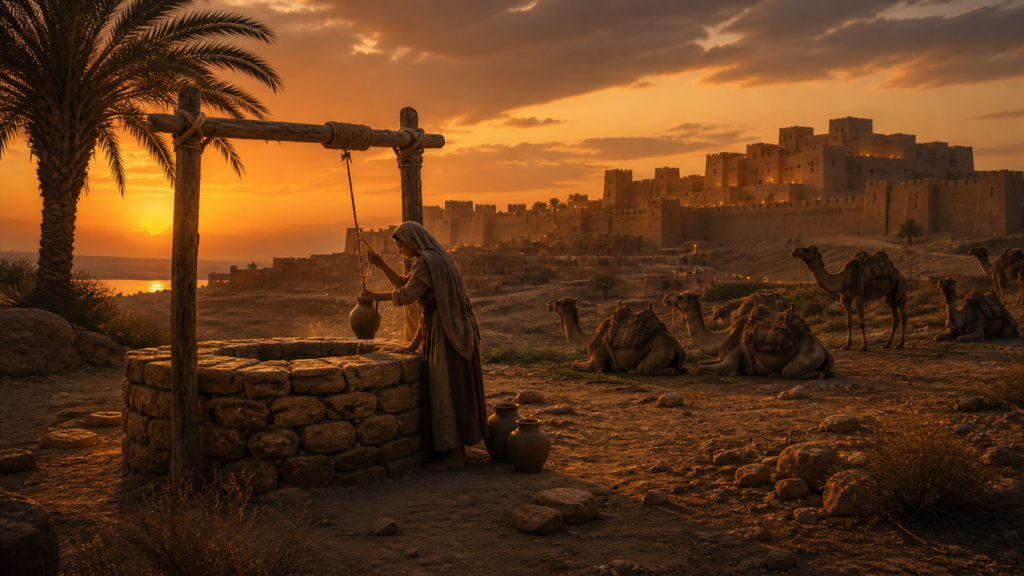
Genesis 24 is the longest chapter in Genesis (67 verses) and one of the most patiently told. Abraham, who has been the central figure of the patriarchal narrative for thirteen chapters, is now old. Sarah is dead. Isaac is unmarried. The covenant family has narrowed to one son, and the son has no wife. The promise of countless descendants needs another body, and another partnership, before it can keep being kept.
Abraham sends his trusted senior servant on a mission. Find a wife for Isaac. Not from the Canaanites among whom they live. From Abraham’s homeland, from the family of his brother Nahor, in Aram-Naharaim. The servant takes ten camels, gifts, and the long road north to a city called Haran. He stops at the well outside the city in the evening, when the women come out to draw water, and he prays a very specific prayer: the woman who offers water to him and to his camels will be the one Yahweh has chosen. Before he has finished praying, Rebekah arrives.
The chapter unfolds slowly because the chapter is doing a slow work. The narrator wants the reader to feel the carefulness of the moment. The servant prays specifically; Yahweh answers specifically. Rebekah’s hospitality is excessive (drawing water for ten camels after a long journey is hours of physical labor). The negotiation with her family is conducted with full ANE protocol. Rebekah herself is asked whether she will go, and she says, in two Hebrew words, “I will go.” The narrator records her assent on her own lips.
The chapter ends with the bride’s arrival in Canaan, Isaac meditating in the field at evening, the meeting at the well of Beer Lahai Roi (the well Hagar named decades earlier), and the closing line: “Isaac brought her into his mother Sarah’s tent, and took Rebekah, and she became his wife. He loved her. So Isaac was comforted after his mother’s death.”
The covenant moves into its next generation by way of a long journey, a specific prayer, an excessive act of hospitality, and a woman’s “I will go.”
A · Genesis 24:1–9 · Abraham’s oath, the servant’s mission
¹ Abraham was old, and well advanced in age. Yahweh had blessed Abraham in all things. ² Abraham said to his servant, the elder of his house, who ruled over all that he had, “Please put your hand under my thigh. ³ I will make you swear by Yahweh, the God of heaven and the God of the earth, that you shall not take a wife for my son of the daughters of the Canaanites, among whom I live. ⁴ But you shall go to my country, and to my relatives, and take a wife for my son Isaac.” ⁵ The servant said to him, “What if the woman isn’t willing to follow me to this land? Must I bring your son again to the land you came from?” ⁶ Abraham said to him, “Beware that you don’t bring my son there again. ⁷ Yahweh, the God of heaven, who took me from my father’s house, and from the land of my birth, who spoke to me, and who swore to me, saying, ‘I will give this land to your offspring,’ he will send his angel before you, and you shall take a wife for my son from there. ⁸ If the woman isn’t willing to follow you, then you shall be clear from this oath to me. Only you shall not bring my son there again.” ⁹ The servant put his hand under the thigh of Abraham his master, and swore to him concerning this matter. (Genesis 24:1–9, World English Bible)
- The chapter opens with two related observations. “Abraham was old, and well advanced in age. Yahweh had blessed Abraham in all things.” The patriarch is at the end of his active life. The covenant has been kept in his time: the son has been born, the land has been walked, the first piece of land has been bought, the covenant treaty at Beer-sheba has been struck. Abraham is, in the narrator’s frame, a man whose life has been answered. What is left is the transmission.
- The servant is unnamed in this chapter (he is sometimes identified with Eliezer of Damascus from Genesis 15:2, but the chapter does not say so). The narrator’s interest is in his role, not his identity. He is “the elder of his house, who ruled over all that he had.” The man Abraham trusts most. The mission requires that level of trust.
- The oath is sworn “under my thigh” (verse 2). This is an ANE legal gesture associated with oaths concerning future generations and matters of life and death. The Hebrew euphemism reaches the patriarch’s reproductive identity; the oath is being sworn in the place that has produced the line. The servant is committing his integrity at the level of the family’s continuation.
- The instruction is unusually specific. “You shall not take a wife for my son of the daughters of the Canaanites” (verse 3). Abraham is concerned about the covenant family’s particular calling. The Canaanites among whom they live are not, in his judgment, suitable for the line. The chapter is not making a racial argument; it is making a covenantal one. The wife Isaac marries will need to be willing to enter the family of promise, willing to leave her own land (the same lech-lecha gesture Abraham made), willing to bind her future to the covenant the patriarch has been carrying for decades. The Canaanites are too embedded in the cultural and religious world Abraham was called out of; the woman must come from somewhere whose religious imagination is more like the patriarch’s.
Pushback note
Some readings of this chapter (and of similar passages in Ezra, Nehemiah, and elsewhere) have used the prohibition against marrying Canaanites as a foundation for ethnic purity arguments in modern Christian theology. The chapter does not make that argument. It records a single patriarch’s concern about his single son’s marriage in a specific cultural moment, and the concern is religious-and-vocational, not racial. The patriarchal narrative includes Hagar (Egyptian) bearing Ishmael, Tamar (Canaanite) carrying the line of Judah, Asenath (Egyptian) marrying Joseph, and many others. Israel will be commanded, in many later texts, to welcome the foreigner. The chapter is doing something specific to Isaac’s moment, not establishing a universal principle.
- “But you shall go to my country, and to my relatives” (verse 4). Abraham’s moledet (kindred, native land) is back in Aram-Naharaim, where he came from in Genesis 11. The patriarch has not been there in over sixty years. The servant is being sent to a place Abraham himself can no longer travel to.
- The servant’s question (verse 5) is reasonable. What if she will not come? Should we bring Isaac back to her? Abraham’s answer is firm: “Beware that you don’t bring my son there again.” Isaac is not to leave the land of promise. The covenant family has been planted. The son does not retrace the father’s lech-lecha. If the bride will not come, the oath is void. But Isaac stays.
Influence callout: N.T. Wright
Wright reads this insistence as one of the patriarchal narrative’s quiet covenantal moves. The land has been promised. The son must remain in the land. The bride must come into the land. The chapter is, in its small geography, performing a theology of the covenant: the family of promise is rooted in the place of promise, even as it draws its partners from outside. Wright argues that this geographic rootedness becomes, by the prophets’ time, a recurring concern of the biblical imagination: where does the covenant family live, and how does the land hold its calling.
B · Genesis 24:10–27 · The well, the prayer, the answer
¹⁰ The servant took ten of his master’s camels, and departed, having a variety of good things of his master’s with him. He arose, and went to Mesopotamia, to the city of Nahor. ¹¹ He made the camels kneel down outside the city by the well of water at the time of evening, the time that women go out to draw water. ¹² He said, “Yahweh, the God of my master Abraham, please give me success today, and show kindness to my master Abraham. ¹³ Behold, I am standing by the spring of water. The daughters of the men of the city are coming out to draw water. ¹⁴ Let it happen, that the young lady to whom I will say, ‘Please let down your pitcher, that I may drink,’ and she will say, ‘Drink, and I will also give your camels a drink,’ let her be the one you have appointed for your servant Isaac. By this I will know that you have shown kindness to my master.” ¹⁵ Before he had finished speaking, behold, Rebekah came out, who was born to Bethuel the son of Milcah, the wife of Nahor, Abraham’s brother, with her pitcher on her shoulder. ¹⁶ The young lady was very beautiful to look at, a virgin. No man had known her. She went down to the spring, filled her pitcher, and came up. ¹⁷ The servant ran to meet her, and said, “Please give me a drink, a little water from your pitcher.” ¹⁸ She said, “Drink, my lord.” She hurried, and let down her pitcher on her hand, and gave him drink. ¹⁹ When she had done giving him drink, she said, “I will also draw for your camels, until they have done drinking.” ²⁰ She hurried, and emptied her pitcher into the trough, and ran again to the well to draw, and drew for all his camels. ²¹ The man looked steadfastly at her, remaining silent, to know whether Yahweh had made his journey prosperous or not. ²² As the camels had done drinking, the man took a golden ring of half a shekel weight, and two bracelets for her hands of ten shekels weight of gold, ²³ and said, “Whose daughter are you? Please tell me. Is there room in your father’s house for us to stay?” ²⁴ She said to him, “I am the daughter of Bethuel the son of Milcah, whom she bore to Nahor.” ²⁵ She said moreover to him, “We have both straw and feed enough, and room to lodge in.” ²⁶ The man bowed his head, and worshiped Yahweh. ²⁷ He said, “Blessed be Yahweh, the God of my master Abraham, who has not forsaken his loving kindness and his truth toward my master. As for me, Yahweh has led me on the way to the house of my master’s relatives.” (Genesis 24:10–27, World English Bible)
- The journey from Hebron to Aram-Naharaim was several hundred miles. Ten camels and an unspecified number of attendants. The narrator does not describe the journey; he places the servant at the well outside Nahor’s city in the evening and lets the scene begin.
- The well at evening (verse 11) is a setting the patriarchal narratives will reuse. Wells are where strangers meet locals; wells are where men and women cross social boundaries; wells are where covenants begin. Jacob will meet Rachel at a well (Genesis 29). Moses will meet Zipporah at a well (Exodus 2). Jesus will meet the Samaritan woman at a well (John 4). The well-meeting is its own type-scene, and Genesis 24 is the foundational instance.
- The servant’s prayer (verses 12 to 14) is one of the most specific prayers in the Hebrew Bible. He does not ask Yahweh for general guidance; he asks for an exact sign. The right woman will be the one who, when asked for a drink, offers water to him and to his camels. Ten camels after a long journey can drink hundreds of liters of water; the request for camel-water is, in effect, hours of physical labor. The servant has set the bar high. Whoever passes the test will not just be hospitable; she will be willing to do exhausting work for an unknown stranger.
Word study: chesed (חֶסֶד), “loving-kindness,” “covenant loyalty”
The Hebrew word chesed runs through this chapter at the level of theological vocabulary. It appears in verses 12 and 14 (the servant’s prayer asking for chesed to be shown), in verse 27 (the servant’s praise: Yahweh has not forsaken his chesed), and in verse 49 (in the conversation with Laban). Chesed is the covenant word for steadfast loyalty, the kind of love that keeps showing up because of the relationship, not because of a contractual obligation. The chapter is asking whether the woman it is looking for has chesed in her bones. Hospitality to a thirsty stranger and his camels is the test.
- “Before he had finished speaking, behold, Rebekah came out” (verse 15). The narrator is doing two things at once. Theologically, the answer arrives before the prayer is finished, signaling Yahweh’s preparation of the moment. Narratively, the chapter is collapsing the gap between request and response so the reader can feel the rightness. There is no waiting period. The woman is already on her way.
- Rebekah’s identity (verse 15) is given in genealogical detail: Bethuel the son of Milcah, the wife of Nahor, Abraham’s brother. She is Abraham’s grandniece. The covenant family is keeping the marriage within the extended kin network without keeping it within the immediate household. The chapter is recording the precise genealogical fit.
- Verses 18 to 20 describe the test being passed in detail. The Hebrew uses repeated verbs of hurrying (tehmaher, “she hastened,” appears twice in two verses). She does not approach the labor reluctantly; she runs to it. Drawing water for ten camels would have taken her hours. The narrator’s pace is deliberate: the servant looks steadfastly at her, remaining silent (verse 21), watching the test become visible in her actions.
- Verses 22 to 23 record the gifts: a half-shekel gold nose ring and two ten-shekel gold bracelets. These are not cheap items. By ANE standards, the gifts are substantial. The servant is signaling, in the gold, that the household behind him is wealthy and that the request he is about to make to her family is a serious one. He does not yet know she is Bethuel’s daughter; the gifts are given before the genealogy is established. The test was about character, not bloodline.
Influence callout: Walter Brueggemann
Brueggemann’s reading of this scene foregrounds the chapter’s quiet emphasis on chesed. The servant prays for chesed to be shown to Abraham; he praises Yahweh for chesed not forsaken; he asks Laban for chesed later in the chapter. The chapter is, in Brueggemann’s reading, a sustained meditation on how the covenant family recognizes one of its own. The recognition is not by ethnicity or lineage; it is by the visible practice of chesed. Rebekah passes the test because she is already, in her actions, the kind of person the covenant family is becoming. Her hospitality is her credentials.
- The servant’s worship in verses 26 to 27 is the chapter’s first response to the answered prayer. He bows his head; he worships Yahweh; he names what has happened. The pattern of the chapter is being established: prayer, recognition, worship. The servant is doing what the patriarch would have done.
C · Genesis 24:28–67 · The negotiation, the assent, the meeting
²⁸ The young lady ran, and told her mother’s house about these words. ²⁹ Rebekah had a brother, and his name was Laban. Laban ran out to the man, to the spring. ³⁰ When he saw the ring, and the bracelets on his sister’s hands, and when he heard the words of Rebekah his sister, saying, “This is what the man said to me,” he came to the man. Behold, he was standing by the camels at the spring. ³¹ He said, “Come in, you blessed of Yahweh. Why do you stand outside? For I have prepared the house, and room for the camels.” (Genesis 24:28–31, World English Bible)

- The chapter then unfolds the negotiation in long detail. Rebekah runs home; her brother Laban runs to meet the servant; the servant is brought into the house; the camels are stabled; food is set before the servant. He refuses to eat until he has told his story. The narrator gives us his entire retelling of the chapter so far (verses 34 to 49), word for word, repeating the prayer, the well scene, the camels, the gifts, the genealogical match. The repetition is not narrative inefficiency; it is ANE oral practice. A binding agreement requires the story be told publicly, in front of the whole household, before the consent is given.
Influence callout: Tim Mackie
Mackie’s literary reading of the chapter notes the deliberate repetition. The same scene is told three times in slightly different forms (the narrator’s account, the servant’s retelling to Laban and Bethuel, and brief recapitulations afterward). Hebrew narrative loves this technique; the variations between the tellings carry meaning. In the servant’s retelling, for instance, he frames the prayer-and-answer slightly differently to emphasize Yahweh’s leading; he downplays his own anxiety about whether the woman would come; he names Rebekah by relationship rather than by name first. The chapter is teaching the reader how to tell the story of Yahweh’s leading in retrospect. The first telling is what happened; the second telling is how it gets remembered.
- Laban’s first appearance (verse 29) is small but worth noticing. Laban will become a major figure in the Jacob narrative (chapters 29 to 31), where he will turn out to be a calculating, sometimes deceptive figure whose hospitality conceals self-interest. In Genesis 24, his hospitality is generous and his cooperation is full. The chapter does not yet tell us what kind of man he will become. The reader encountering Laban for the first time meets a young brother eager to host. The reader returning after Genesis 31 will see the seeds of what is coming.
- The household’s consent (verses 50 to 51) is given in two voices: Laban and Bethuel, the brother and the father, speak together. “The thing proceeds from Yahweh. We can’t speak to you bad or good. Behold, Rebekah is before you. Take her, and go, and let her be your master’s son’s wife, as Yahweh has spoken.” The recognition that the chapter has been narrating Yahweh’s leading is now publicly named by the household.
- The question to Rebekah herself (verse 58) is the chapter’s most striking moment of female agency in the patriarchal narratives. The household had agreed; the servant was eager to leave; the family asked for ten more days; the servant pressed for immediate departure. So the family did something unusual: “they said, ‘We will call the young lady, and ask at her mouth.’” Rebekah is summoned. The question is direct: “Will you go with this man?” Her answer is two Hebrew words: elech, “I will go.”
Influence callout: Nijay Gupta
The kind of attentive reading Gupta and others have done on women’s agency in biblical narratives is helpful here. Many modern translations soften the moment, but the Hebrew is sharp. Rebekah is not asked for permission; she is asked for assent. The household’s agreement is not enough; Rebekah’s own voice is required. And the answer is brief, direct, and on her own initiative. I will go. The chapter is recording a moment in which a woman speaks her own future into the covenant family by her own choice. The patriarchal narratives have not always given women this much room; Genesis 24 makes a point of giving it to Rebekah.
- The journey back to Canaan is summarized briefly. The narrator’s interest is in the meeting that ends the chapter.
⁶² Isaac came from the way of Beer Lahai Roi, for he lived in the land of the South. ⁶³ Isaac went out to meditate in the field at the evening. He lifted up his eyes, and looked. Behold, there were camels coming. ⁶⁴ Rebekah lifted up her eyes, and when she saw Isaac, she got off the camel. ⁶⁵ She said to the servant, “Who is the man who is walking in the field to meet us?” The servant said, “It is my master.” She took her veil, and covered herself. ⁶⁶ The servant told Isaac all the things that he had done. ⁶⁷ Isaac brought her into his mother Sarah’s tent, and took Rebekah, and she became his wife. He loved her. So Isaac was comforted after his mother’s death. (Genesis 24:62–67, World English Bible)
- The geographic detail is loaded. Isaac came from the way of Beer Lahai Roi. The well Hagar named in chapter 16. The chapter is closing the meeting at the place where another woman, decades earlier, had met the God who sees her in extremity. The narrator is not announcing this connection; he is letting it sit in the background. Isaac and Hagar share a geography. The well that named the God who heard the slave woman is the same well near which the chosen son meets his bride.
- “Isaac went out to meditate in the field at the evening” (verse 63). The Hebrew word translated “meditate” (lasuach) is rare. Some scholars read it as “to meditate,” others as “to mourn,” still others as “to pray,” or even “to walk thoughtfully.” The chapter has just named, in verse 67, that Isaac will be comforted after his mother’s death. The walking-and-meditating in the field at evening is, by the chapter’s own framing, the grief-walk of a son whose mother has been gone for some time. The meeting with Rebekah arrives in the middle of his sorrow.
- Verse 64 records Rebekah’s first sight of Isaac. The Hebrew vatipol me’al ha-gamal, “she fell from the camel” (or, more idiomatically, “she got off the camel”), is unusually expressive. Some readers see it as a stumble of recognition; others as a graceful dismount. The veiling that follows is the ANE bridal gesture, signaling that she is approaching her marriage with the cultural seriousness it requires.
- Verse 67 is one of the tenderest closings in the patriarchal narrative. Isaac brought her into his mother Sarah’s tent. The bride enters the household by entering the matriarch’s space, the space the chapter has not described as occupied since Sarah’s death. And took Rebekah, and she became his wife. The marriage is enacted. He loved her. The verb is given without modifier; this is the first time in Genesis a husband is said to love his wife. So Isaac was comforted after his mother’s death. The grief that has shadowed the chapter finds its home in the new partnership. Rebekah enters Sarah’s tent and becomes the matriarch the household has been missing.
Reflection prompts
- The servant prays specifically. He does not ask for general guidance; he asks for a particular sign. Yahweh answers in specifics, in real time, in a person who arrives before the prayer is finished. Where in your life have you defaulted to asking God for general guidance when a more specific request might invite a more specific answer? What would you ask if you trusted that God could answer at the level of detail you are afraid to name?
- Rebekah passes the test by drawing water for ten camels she did not have to serve. Her chesed (covenant kindness) is shown in extra labor for a stranger. Where in your life is the work that does not formally belong to you the work that most reveals who you actually are?
- The chapter ends with a marriage that is, on the surface, a domestic event, and at depth, the transmission of the covenant to a new generation. Isaac is comforted; the household has its matriarch back; the line continues. What ordinary events in your life are doing covenantal work you may not recognize as covenantal? What does it look like to receive marriage, friendship, or partnership not just as personal happiness but as something the larger story is moving through?