
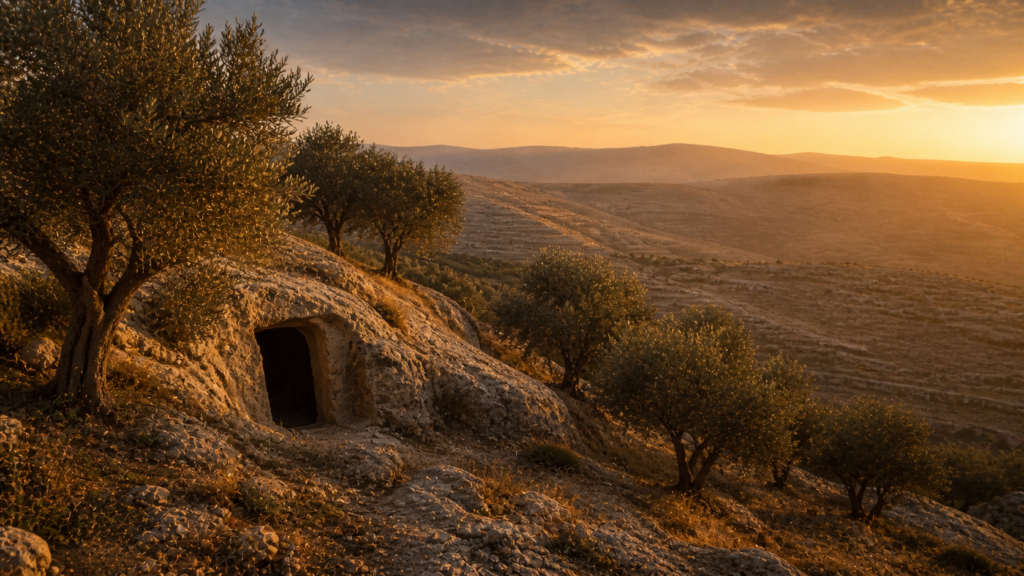
Genesis 23 is one of the patriarchal narratives’ quietest chapters, and one of its most consequential. Sarah dies. Abraham mourns. Then he negotiates, with elaborate ANE protocol, to buy a small piece of land from the local Hittites: the cave of Machpelah, near Hebron, with the field that surrounds it. He pays four hundred shekels of silver. He buries Sarah in the cave. The land transaction is recorded with the precision of a notarial document.
That is what the chapter looks like on the surface. Underneath, the chapter is doing something theologically large. After everything (the call in chapter 12, the journey, the famine, the rescue of Lot, the cutting of the covenant, the long wait, the second Hagar crisis, the binding of Isaac), the patriarch finally owns a piece of the land that was promised to him decades earlier. The first piece. It is a burial cave. The land promise is being kept, and the first installment of the keeping is a grave.
The chapter is deliberately spare. The narrator records the negotiation in slow detail because the negotiation is the point. The cave is purchased legally, with witnesses, at full price, in front of the whole town. The patriarch refuses to accept the land as a gift. He insists on owning it. By the end of the chapter, the deed is unambiguous: Abraham legally owns the cave of Machpelah, the surrounding field, and all its trees. The seed of the land covenant has been planted, in the form of a tomb that will become the patriarchal burial place for the next three generations.
A · Genesis 23:1–4 · The death and the request
¹ Sarah lived one hundred twenty-seven years. This was the length of Sarah’s life. ² Sarah died in Kiriath Arba (also called Hebron), in the land of Canaan. Abraham came to mourn for Sarah, and to weep for her. ³ Abraham rose up from before his dead, and spoke to the children of Heth, saying, ⁴ “I am a stranger and a foreigner living with you. Give me a possession of a burying place with you, that I may bury my dead out of my sight.” (Genesis 23:1–4, World English Bible)
- Sarah is the only woman in the Hebrew Bible whose age at death is recorded. The patriarchs all get age-at-death notices (Abraham 175, Isaac 180, Jacob 147), but the matriarchs do not. Sarah does. The narrator wants the reader to feel the weight of her life as a fully reckoned span. One hundred twenty-seven years. She bore Isaac at ninety; she has lived another thirty-seven years past the birth of the covenant heir; she has been with Abraham since before the call out of Ur. The chapter opens by counting her.
Influence callout: Walter Brueggemann
Brueggemann’s reading of this opening verse names it as a small but significant act of textual honor. Sarah, who has been silent through several of the major scenes of the patriarchal cycle (the wife-sister episodes, the birth announcements, the casting out of Hagar), is given, at her death, a precise reckoning of her life. The narrator could have said simply “Sarah died at Kiriath Arba”; instead the narrator records her years, her place, the geographic specificity of where her life ended. Brueggemann argues that this is the Hebrew Bible’s quiet way of acknowledging the matriarch’s full personhood, even after the recurring narrative tendency to subordinate her voice. The chapter is, among other things, a remembering.
- The geographic detail in verse 2 is loaded. Kiriath Arba (the city of four, or the city of Arba) is the older name for Hebron. The chapter uses both names in the same verse, signaling that the place has multiple identities. Hebron will become one of the most important cities in the patriarchal narratives: David will be anointed king there (2 Samuel 2:4), the patriarchs will all be buried there, and the city will appear repeatedly in the conquest and settlement narratives. Sarah dies in the place that will become the spine of the patriarchal land claim.
- “Abraham came to mourn for Sarah, and to weep for her” (verse 2). The Hebrew verbs are lispod (formal mourning, public ritual) and livkotah (to weep over her). The patriarch performs both the cultural ritual of mourning and the personal act of weeping. The text records both layers without subordinating one to the other. Public ritual and private grief are both real. Abraham does both.
- Verse 3 marks the chapter’s transition. “Abraham rose up from before his dead.” The Hebrew is precise: he rose from in front of her body. The mourning has its time; the negotiation has its time; the chapter is recording the patriarch shifting from grief to action. The body must be buried. The negotiation must begin.
- “I am a stranger and a foreigner living with you” (verse 4). The Hebrew is ger v’toshav anokhi immakhem, “an alien and a sojourner I am with you.” The two words ger (resident alien) and toshav (sojourner, dweller) have specific legal meanings in ANE society. A ger was a foreigner with limited residency rights; a toshav was someone who lived in a place without owning land there. Abraham is naming his legal status precisely. He has been in the land for sixty-plus years; he has wells, treaties, livestock, household. He does not own land. He is, after everything, still a sojourner.
Word study: ger (גֵּר) and toshav (תּוֹשָׁב)
Two ANE legal categories for non-citizen residents. Ger is a resident alien, a foreigner who lives in a place under the protection of the host community but without full citizenship rights. Toshav is a sojourner, a temporary dweller, often used for someone living in a place without owning land. The Hebrew Bible uses both terms repeatedly to describe the patriarchs’ status in Canaan and Israel’s later status in Egypt. The terms become theologically significant: God will instruct Israel to remember that they were gerim in Egypt and to therefore care for the gerim among them (Leviticus 19:34, Deuteronomy 10:19). Abraham’s self-naming in 23:4 is not a humble flourish; it is a precise legal status, and the chapter is going to record his transition from ger to landowner, in the smallest possible way.
- “Give me a possession of a burying place with you, that I may bury my dead out of my sight.” The Hebrew word for “possession” (achuzzah) is the legal term for permanent landed property. Abraham is not asking for a burial spot; he is asking for legal ownership. The word will recur throughout the chapter. The patriarch wants the cave to be his, in legal terms, in front of the witnesses.
B · Genesis 23:5–16 · The negotiation at the gate
⁵ The children of Heth answered Abraham, saying to him, ⁶ “Hear us, my lord. You are a prince of God among us. Bury your dead in the choicest of our tombs. None of us will withhold from you his tomb. Bury your dead.” ⁷ Abraham rose up, and bowed himself to the people of the land, to the children of Heth. ⁸ He talked with them, saying, “If you agree that I should bury my dead out of my sight, hear me, and entreat for me to Ephron the son of Zohar, ⁹ that he may sell me the cave of Machpelah, which he has, which is in the end of his field. For the full price let him sell it to me among you for a possession of a burying place.” ¹⁰ Now Ephron was sitting in the middle of the children of Heth. Ephron the Hittite answered Abraham in the hearing of the children of Heth, even of all who went in at the gate of his city, saying, ¹¹ “No, my lord, hear me. I give you the field, and I give you the cave that is in it. In the presence of the children of my people I give it to you. Bury your dead.” ¹² Abraham bowed himself down before the people of the land. ¹³ He spoke to Ephron in the audience of the people of the land, saying, “But if you will, please hear me. I will give the price of the field. Take it from me, and I will bury my dead there.” ¹⁴ Ephron answered Abraham, saying to him, ¹⁵ “My lord, listen to me. What is a piece of land worth four hundred shekels of silver between me and you? Therefore bury your dead.” ¹⁶ Abraham listened to Ephron. Abraham weighed to Ephron the silver which he had named in the audience of the children of Heth, four hundred shekels of silver, according to the current merchants’ standard. (Genesis 23:5–16, World English Bible)
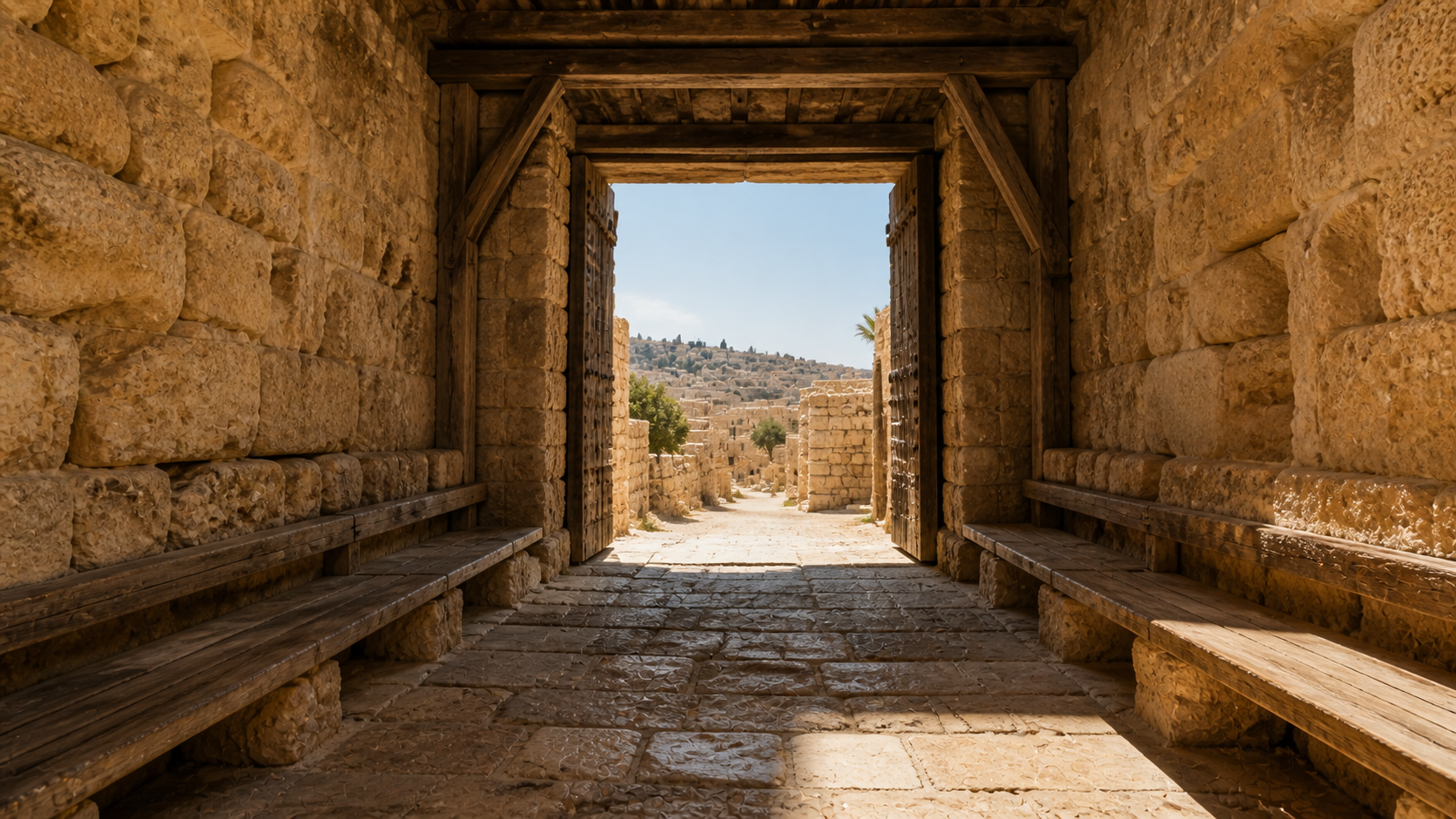
- The negotiation is one of the most carefully recorded transactions in the Hebrew Bible. It unfolds in five stages, each marked by a “hear me” or “hear us” formula. The chapter’s pace is deliberate. The narrator wants the reader to feel each step of the legal procedure.
- The Hittites’ opening offer (verse 6) is honorific and broad. “You are a prince of God among us. Bury your dead in the choicest of our tombs. None of us will withhold from you his tomb.” This is not a literal offer of any random tomb. In ANE protocol, this is the opening generosity that signals respect and invites the negotiation. To say “take any tomb” is to say “we honor you; now name what you want.”
Influence callout: Ray Vander Laan
Vander Laan teaches ANE land-purchase customs as a layered cultural code. The “I give it to you for free” gesture, repeated by Ephron in verses 11 and 15, is not a literal gift offer. It is the standard opening of a negotiation that both parties expect to result in a fair payment. The Hittites’ generosity establishes Abraham’s standing; Abraham’s insistence on paying establishes the legal cleanness of the transaction. Both gestures are required by the cultural protocol. Reading Ephron as a duplicitous merchant, or Abraham as suspicious of a gift, both miss what the text is doing. The dance is the cultural form for closing a clean deal in front of witnesses.
- Abraham’s response (verses 7 to 9) makes the request specific. He does not want any tomb. He wants the cave of Machpelah, owned by Ephron son of Zohar. He wants to pay full price. He wants the transaction conducted publicly, “among you for a possession of a burying place.” The patriarch is asking for clarity: a specific cave, a specific seller, a specific price, a public transaction. He is buying, not receiving.
- Ephron’s offer in verse 11 is again the honorific opening. “I give you the field, and I give you the cave that is in it.” Notice the expansion: Abraham asked for the cave; Ephron offers the cave and the field. This is the standard ANE escalation: the seller widens the gift to widen the eventual price. Abraham accepts the expanded terms but insists again on paying.
- The price comes in verse 15: four hundred shekels of silver. Ephron’s framing is brilliant. “What is a piece of land worth four hundred shekels of silver between me and you?” The number is dropped into the conversation as if it is trivial. By ANE standards, four hundred shekels was a substantial sum. Comparable land transactions recorded in extant Mesopotamian and Hittite tablets typically run in the tens of shekels. Four hundred is high. Some commentators read this as Ephron quietly extracting a premium price from the wealthy alien. Others read it as a normal price for premium land. Either way, Abraham pays without bargaining.
Influence callout: John Walton
Walton’s ANE work compares this transaction to extant Hittite land-purchase records. The chapter’s procedural detail (the witnesses at the gate, the public weighing of silver, the precise enumeration of trees and boundaries) matches the legal forms preserved in cuneiform tablets. Walton argues that the chapter is recording the transaction in the formal style of an ANE deed, almost word for word what would have been preserved in clay. The patriarch’s refusal to bargain on price is not naivete; it is a legal move that ensures the transaction can never be challenged later as having been inadequately compensated. By paying full price (or above), Abraham is securing the unchallengeable legal title of the land for his descendants.
- “Abraham weighed to Ephron the silver which he had named in the audience of the children of Heth, four hundred shekels of silver, according to the current merchants’ standard” (verse 16). Each phrase is doing legal work. Weighed to Ephron (silver was bullion in this period; payment was by weight). In the audience of the children of Heth (public witnesses). Four hundred shekels (the named price). According to the current merchants’ standard (using the recognized weight standard, not a manipulated one). The transaction is, by every contemporary standard, ironclad.
C · Genesis 23:17–20 · The deed and the burial
¹⁷ So the field of Ephron, which was in Machpelah, which was before Mamre, the field, the cave which was in it, and all the trees that were in the field, that were in all of its borders, were deeded ¹⁸ to Abraham for a possession in the presence of the children of Heth, before all who went in at the gate of his city. ¹⁹ After this, Abraham buried Sarah his wife in the cave of the field of Machpelah before Mamre (that is, Hebron), in the land of Canaan. ²⁰ The field, and the cave that is in it, were deeded to Abraham as a possession of a burying place by the children of Heth. (Genesis 23:17–20, World English Bible)
- Verses 17 and 18 read like a notarial summary. The narrator records the property in legal description: the field of Ephron, in Machpelah, before Mamre, the field itself, the cave in it, all the trees, all the borders. The repeated phrase “before Mamre” anchors the property geographically (Mamre being the location of Abraham’s tent and altar since chapter 13). The phrase “deeded to Abraham as a possession” (la-Avraham le-miqnah) uses the technical legal term for property transfer. The chapter is producing, in narrative form, the equivalent of a deed.
Influence callout: N.T. Wright
Wright’s reading of Genesis 23 as the seed of the land covenant is one of the chapter’s most theologically attentive moves. The patriarch has been promised the land for sixty-plus years and has owned none of it. The first piece he owns is a burial cave. The land promise begins to be kept, in the patriarch’s lifetime, by way of a grave. Wright argues that this is one of the Hebrew Bible’s most patient theological moves: the keeping of the promise will not look like military conquest in Abraham’s lifetime; it will look like a tomb, a name on a deed, a stake driven into a piece of ground that the patriarch can never live to see fully claimed. The seed is small. The seed is real.
- “After this, Abraham buried Sarah his wife in the cave of the field of Machpelah” (verse 19). The chapter ends with the burial it began with. Sarah is laid to rest in the first piece of land the covenant family will ever own. The cave will become the patriarchal burial place: Abraham (Genesis 25:9), Isaac (35:29), Rebekah, Leah (49:31), Jacob (50:13), all will be buried at Machpelah. The land promise will, for these generations, take the form of a shared grave. The first installment of the inheritance is the place where the family lays its dead.
Influence callout: Tim Mackie
Mackie’s literary reading of the patriarchal burial pattern frames Machpelah as the seed of the land claim that the rest of the Pentateuch will keep growing. By Genesis 50, when Jacob is brought back from Egypt to be buried at Machpelah, the cave has become the gravitational center of the patriarchal family’s identification with the land. The land they do not yet rule is the land where their dead are buried. Mackie reads this as one of the deepest patterns in the Hebrew Bible: the people of God claim a land first by burying their dead in it, only later by living on it. The bones in the cave are the down payment on the inheritance.
- The closing verse repeats the legal language one more time: “The field, and the cave that is in it, were deeded to Abraham as a possession of a burying place by the children of Heth.” The chapter ends as a deed. The narrator could have ended with the burial, or with a description of the family’s grief, or with a note about Abraham’s response. Instead the chapter ends with the legal title being made clear, one more time, in the formula of recorded property. The patriarch owns the cave. The promise has, in the smallest possible form, begun to come true.
Reflection prompts
- The first piece of the promised land Abraham owns is a burial cave. The covenant inheritance begins with a grave. Where in your life is something God has promised showing up, in its first installment, in a form much smaller and quieter than you imagined it would?
- Abraham insists on paying full price for the land, refusing it as a gift. The legal cleanness of the transaction is itself an act of faith: he is securing for his descendants something he himself will never live to fully see. Where in your life are you doing the slow, careful work that benefits a generation you will not be around to watch grow up?
- The matriarch is finally given a precise reckoning of her life at her death (one hundred twenty-seven years), having been silent through many of the chapters that featured her. What people in your life have done their work in quieter registers than the public narrative has noticed? What would it look like to count them carefully now?