
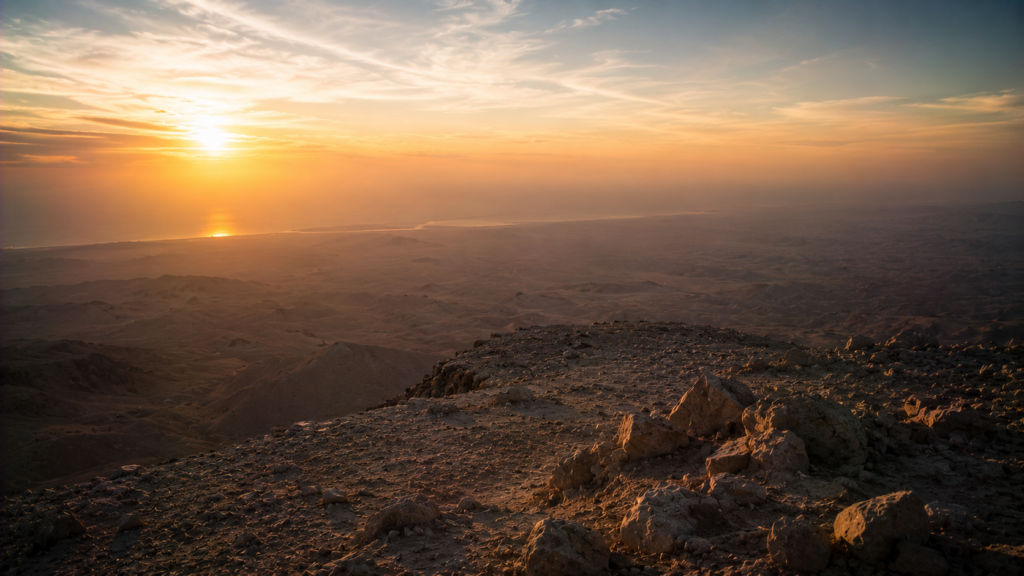
The Torah ends on a mountaintop, with a death. Moses climbs Nebo, and Yahweh shows him the whole land, north to south, near to far, the gift he has labored toward across forty years of wilderness. And then comes the word he has known was coming: “I have caused you to see it with your eyes, but you shall not go over there” (34:4). So Moses, “the servant of Yahweh,” dies in the land of Moab, and God himself buries him, in a grave “no man knows… to this day.” Israel weeps thirty days. The five books of Moses close not in the Promised Land but on its threshold, with their greatest figure laid in an unmarked grave just outside.
It is a deliberately unfinished ending, and the book’s final epitaph tells us why: “there has not arisen a prophet in Israel like Moses, whom Yahweh knew face to face” (34:10). That sentence looks backward in awe (no one has matched him) and forward in longing (the promised “prophet like me” of 18:15 has not yet come). The Torah ends with its hope still open, the people on the edge of the land, the great mediator gone, and a prophet still awaited (see the new Moses). The Gospels will answer that longing on another mountain, where Moses at last appears inside the land, beside the One the Father tells us to “listen to.”
A · Deuteronomy 34:1-8 · He sees the land he cannot enter
¹ Moses went up from the plains of Moab to Mount Nebo, to the top of Pisgah, that is opposite Jericho. Yahweh showed him all the land of Gilead to Dan, ² and all Naphtali, and the land of Ephraim and Manasseh, and all the land of Judah, to the Western Sea, ³ and the south, and the Plain of the valley of Jericho the city of palm trees, to Zoar. ⁴ Yahweh said to him, “This is the land which I swore to Abraham, to Isaac, and to Jacob, saying, ‘I will give it to your offspring.’ I have caused you to see it with your eyes, but you shall not go over there.” ⁵ So Moses the servant of Yahweh died there in the land of Moab, according to Yahweh’s word. ⁶ He buried him in the valley in the land of Moab opposite Beth Peor, but no man knows where his tomb is to this day. ⁷ Moses was one hundred twenty years old when he died. His eye was not dim, nor his strength gone. ⁸ The children of Israel wept for Moses in the plains of Moab thirty days, until the days of weeping in the mourning for Moses were ended. (Deuteronomy 34:1–8, World English Bible)

- Yahweh showed him all the land… “but you shall not go over there” (verses 1-5). God grants Moses a final mercy and a final sorrow in the same moment: the whole land, spread before his eyes, the fulfillment of the promise to Abraham, and the word that he will not set foot in it. There is a tender detail in verse 7, “his eye was not dim, nor his strength gone”, Moses does not die worn out and failing; he dies still vigorous, his death an act of obedience rather than decline. He climbs the mountain to die because God says to. The mediator who carried the people from Egypt to the Jordan stops at the river (see the new Moses, and the discussion at 3:23-27).
Influence callout: the servant buried by God, and the body that reappears
Two strange and beautiful details surround Moses’ death. First, God himself buries him: “he buried him in the valley… but no man knows where his tomb is to this day” (verse 6). The greatest figure in Israel’s history gets no shrine, no pilgrimage site, no relic, God hides the grave. The likely reason is mercy and protection: a known tomb of Moses would have become an object of veneration, even worship, and the God who has spent a whole book warning against idolatry will not let his servant’s grave become a rival altar. Even in death, Moses points away from himself to God. Second, the New Testament twice reopens this scene. Jude 9 alludes to a dispute between Michael and the devil “about the body of Moses”, an echo of traditions that the hidden grave was contested. And most movingly, at the Transfiguration, Moses appears, alive, on a mountain inside the land, talking with Jesus (Matt 17:3; Luke 9:30-31, where they speak of Jesus’ coming “exodus”). The man who was barred from the land in life is brought into it in glory, beside the Messiah, the deepest sign that his exclusion was never the end of his story. The buried servant is not forgotten by the God who buried him.
B · Deuteronomy 34:9-12 · No prophet like Moses
⁹ Joshua the son of Nun was full of the spirit of wisdom, for Moses had laid his hands on him. The children of Israel listened to him, and did as Yahweh commanded Moses. ¹⁰ Since then, there has not arisen a prophet in Israel like Moses, whom Yahweh knew face to face, ¹¹ in all the signs and the wonders which Yahweh sent him to do in the land of Egypt, to Pharaoh, and to all his servants, and to all his land, ¹² and in all the mighty hand, and in all the awesome deeds, which Moses did in the sight of all Israel. (Deuteronomy 34:9–12, World English Bible)
- Joshua… full of the spirit of wisdom, for Moses had laid his hands on him (verse 9). The work goes on. Joshua, commissioned by the laying on of hands (the first “ordination” in Scripture), is “full of the spirit of wisdom,” and the people follow him. Leadership in Israel is not a personal possession that dies with the leader but a gift passed on, the same Spirit-empowered handoff the church will later practice. The mediator dies; the mission continues, because it was always God’s and not Moses’.
Influence callout: “no prophet like Moses”, the Torah’s forward-leaning end (34:10-12)
The Torah’s closing sentence is one of the most theologically charged in the Bible: “Since then, there has not arisen a prophet in Israel like Moses, whom Yahweh knew face to face” (verse 10). It is, at once, a tribute and an ache (see the new Moses). A tribute: no one has equaled Moses, the unique mediator who knew God “face to face,” who performed the signs of the exodus, who received and taught the law. But also an ache, because back in 18:15 God promised “a prophet like me… you shall listen to him,” and this epitaph quietly admits that, generations on, he has not yet come. The five books of Moses thus end leaning forward: the people poised on the edge of the land, the great prophet buried, and the promise of a greater one still unfulfilled. The whole Hebrew Bible will carry that expectation (“are you the Prophet?”, John 1:21), until the Gospels answer it. At the Transfiguration, Moses himself stands on the mountain beside Jesus, and the Father’s voice deliberately echoes Deuteronomy 18:15, “This is my beloved Son… listen to him” (Mark 9:7), and then Moses fades, leaving Jesus alone. The prophet greater than Moses has come, the one who not only knew God face to face but is God’s face turned toward us (John 1:18; Heb 1:1-3). Deuteronomy ends with a hope it cannot fulfill, and hands that hope to the gospel. The Torah’s last word is, in effect, not yet, but he is coming.
Where this lands: finishing what you cannot finish
Moses dies on a mountain in sight of work he will not get to do. The detail in 34:7 is unsparing and beautiful: his eye was not dim, nor his strength gone. He did not fail; he was not spent; he simply was not the one who would cross. The Torah ends with its greatest figure laid in an unmarked grave just outside the gift. This is the chapter for anyone who has ever poured their life into something whose completion they will not see. The startup whose harvest will come after you. The kids you are raising into a world you will leave them in. The institution you are pulling forward whose flowering belongs to someone else. The book you began that someone you have not yet met will finish. The recovery that will keep mattering for your descendants. The reform you are starting that will outrun your lifetime. Deuteronomy 34 is permission for that to be enough. Moses does not get the land. He gets the mountain, the view, and the LORD’s own hand to bury him. The work continues without him; the LORD continues with the work. The faithfulness that finishes what it could not finish is the faithfulness that knows the work was never ours to complete. “I have caused you to see it with your eyes” (34:4) is not the consolation prize. It is the whole gift. To climb your own Nebo, see the country you were laboring toward, and let the LORD bury you well, is the shape of a finished life.
Reflection prompts
- Moses saw the promise “with his eyes” but did not enter it, and died with his strength undimmed, in obedience. Have you ever poured your life into something whose fulfillment you won’t live to see? What would it mean to climb that mountain faithfully, trusting the God who finishes what you can’t?
- God hid Moses’ grave so it could never become a shrine, even his greatest servant points away from himself to God. Where are you tempted to venerate a leader, a hero, or your own legacy, in a way that quietly competes with God?
- The Torah ends unfinished, on the threshold, with a hope still open: a prophet greater than Moses, still to come. The Gospels say he has. As you finish Deuteronomy, what does it mean that all this law, longing, and “not yet” was leading to the One the Father says to “listen to”?
Frameworks at play in this chapter: the new Moses, the exodus pattern, the two generations.