
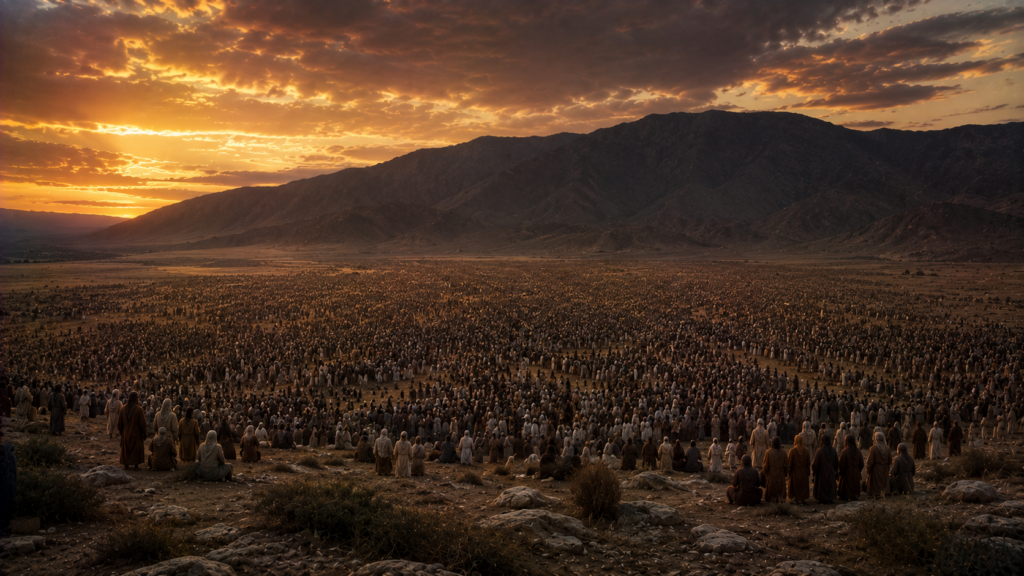
Chapter 29 opens Moses’s third and final address: the covenant renewal in Moab, made “in addition to the covenant… in Horeb” (29:1). The whole people is gathered to enter the oath, and the guest list is pointedly total, leaders and elders, “your little ones, your wives, and the foreigners… from the one who cuts your wood to the one who draws your water” (29:11), and even, explicitly, “those who are not here with us today” (29:15), the generations not yet born. No one is too small, too foreign, or too future to be bound into the covenant of grace.
But at the center of the chapter sits one of the most startling admissions in the Torah. After rehearsing all that Israel has seen, the exodus, the wilderness, forty years of provision, Moses says: “Yahweh has not given you a heart to know, eyes to see, and ears to hear, to this day” (29:4). The problem was never a shortage of evidence; it was a heart that could not truly perceive, the same stiff neck the whole book has diagnosed (9:6). That confession is the hinge that swings open chapter 30, where God will at last circumcise the heart (30:6). And the chapter ends with one of Scripture’s wisest lines about the boundary of human knowing: “the secret things belong to Yahweh our God; but the things that are revealed belong to us.”
A · Deuteronomy 29:1-9 · A heart not yet given
¹ These are the words of the covenant which Yahweh commanded Moses to make with the children of Israel in the land of Moab, in addition to the covenant which he made with them in Horeb. ² Moses called to all Israel, and said to them: Your eyes have seen all that Yahweh did in the land of Egypt to Pharaoh, and to all his servants, and to all his land; ³ the great trials which your eyes saw, the signs, and those great wonders. ⁴ But Yahweh has not given you a heart to know, eyes to see, and ears to hear, to this day. ⁵ I have led you forty years in the wilderness. Your clothes have not grown old on you, and your sandals have not grown old on your feet. ⁶ You have not eaten bread, neither have you drunk wine or strong drink, that you may know that I am Yahweh your God. ⁷ When you came to this place, Sihon the king of Heshbon and Og the king of Bashan came out against us to battle, and we struck them. ⁸ We took their land, and gave it for an inheritance to the Reubenites, and to the Gadites, and to the half-tribe of the Manassites. ⁹ Therefore keep the words of this covenant and do them, that you may prosper in all that you do. (Deuteronomy 29:1–9, World English Bible)
- Your eyes have seen all that Yahweh did… but Yahweh has not given you a heart to know (verses 2-4). The juxtaposition is the whole point. Israel has seen everything, plagues, sea, manna, victories, and still does not truly perceive. Why? Because seeing is not the same as understanding, and understanding requires a heart God must give.
Influence callout: “a heart to know, not yet given” (29:4 → 30:6)
Verse 4 is one of the most theologically loaded sentences in Deuteronomy: “Yahweh has not given you a heart to know, eyes to see, and ears to hear, to this day.” It is a confession of the book’s deepest problem. The issue with Israel has never been a lack of evidence (they have seen more of God’s power than any people in history) but a lack of capacity, the “stiff neck” of chapter 9, the heart that will not perceive or bend. And notice the grammar: a heart to know is something that must be given. Israel cannot manufacture it; it is grace or it is nothing. This is exactly why the command of 10:16 (“circumcise your own heart”) gives way to the promise of 30:6 (“Yahweh will circumcise your heart”), the human cannot do it, so God will (see circumcision of the heart). Paul reaches for this very verse to describe Israel’s hardening in his own day (Rom 11:8, “God gave them a spirit of stupor, eyes that they should not see”), and the whole new-covenant hope, a new heart, the law written within, the Spirit poured out, is the answer to the gap verse 4 names. Deuteronomy is honest enough to admit that its own commands cannot finally produce the obedience they require. Only a gift can. That admission is not despair; it is the doorway to grace.
B · Deuteronomy 29:10-21 · All of you stand today, and the secret heart that turns away
¹⁰ All of you stand today in the presence of Yahweh your God: your heads, your tribes, your elders, and your officers, even all the men of Israel, ¹¹ your little ones, your wives, and the foreigners who are in the middle of your camps, from the one who cuts your wood to the one who draws your water, ¹² that you may enter into the covenant of Yahweh your God, and into his oath, which Yahweh your God makes with you today, ¹³ that he may establish you today as his people, and that he may be your God, as he spoke to you and as he swore to your fathers, to Abraham, to Isaac, and to Jacob. ¹⁴ Neither do I make this covenant and this oath with you only, ¹⁵ but with those who stand here with us today before Yahweh our God, and also with those who are not here with us today ¹⁶ (for you know how we lived in the land of Egypt, and how we came through the middle of the nations through which you passed; ¹⁷ and you have seen their abominations and their idols of wood, stone, silver, and gold, which were among them); ¹⁸ lest there should be among you man, woman, family, or tribe whose heart turns away today from Yahweh our God, to go to serve the gods of those nations; lest there should be among you a root that produces bitter poison; ¹⁹ and it happen, when he hears the words of this curse, that he bless himself in his heart, saying, “I shall have peace, though I walk in the stubbornness of my heart,” to destroy the moist with the dry. ²⁰ Yahweh will not pardon him, but then Yahweh’s anger and his jealousy will smoke against that man, and all the curse that is written in this book will fall on him, and Yahweh will blot out his name from under the sky. ²¹ Yahweh will set him apart for evil out of all the tribes of Israel, according to all the curses of the covenant written in this book of the law. (Deuteronomy 29:10–21, World English Bible)
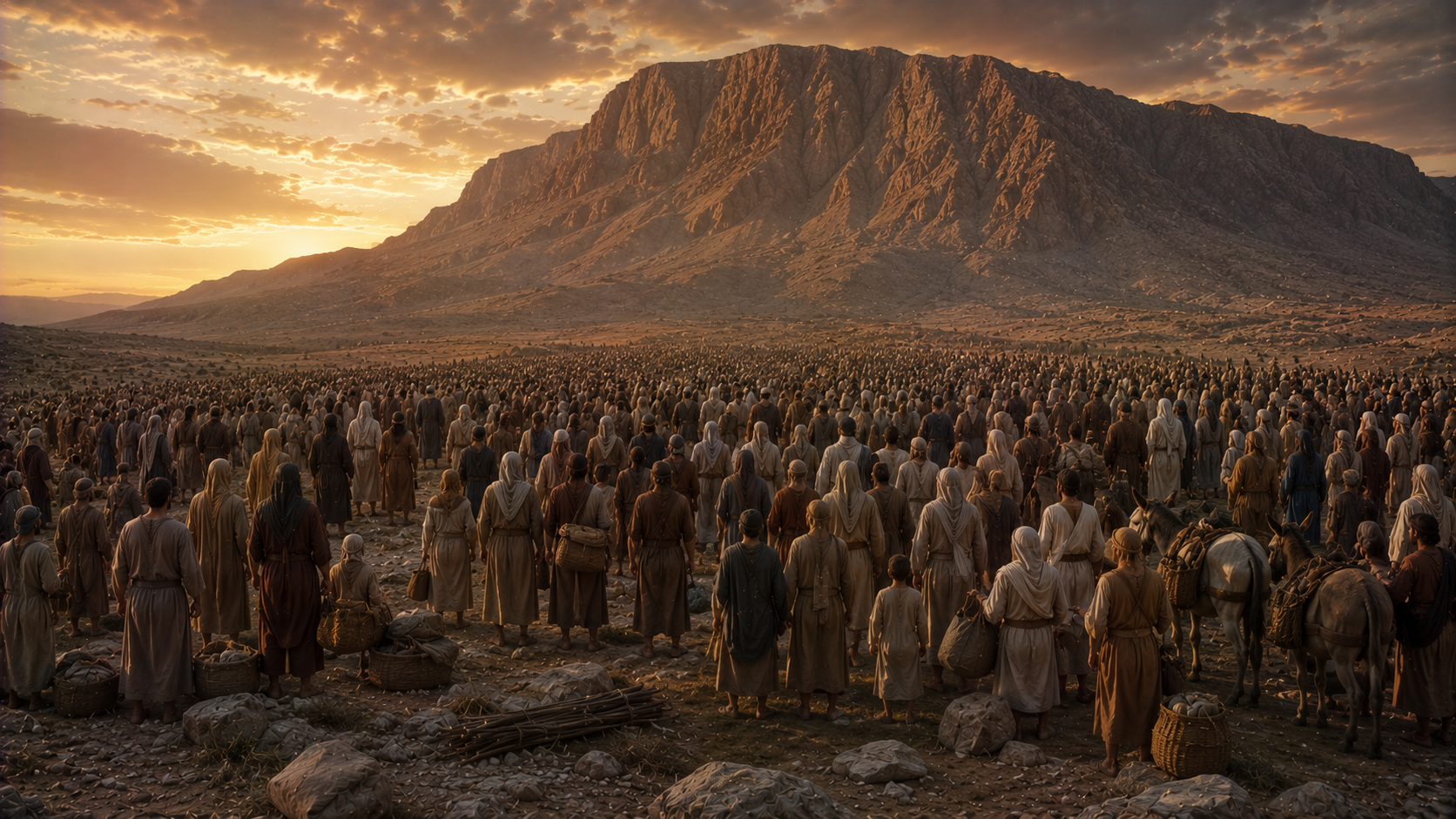
- All of you stand today… also with those who are not here (verses 10-15). The covenant is breathtakingly inclusive and breathtakingly extended. Everyone stands, the powerful and the little ones, the wives, the resident foreigners, the lowest laborers (the woodcutter and the water-carrier). And the oath binds not only those present but “those who are not here”, future generations, you and me, reading now. This is the same actualizing logic as 5:3 and 26:17: the covenant is never merely an ancestral artifact; it reaches forward to every generation that takes it up.
- A root that produces bitter poison… “I shall have peace, though I walk in stubbornness” (verses 16-21). The danger Moses fears most is secret defection, the individual “whose heart turns away today,” the hidden “root that produces bitter poison” (a phrase Hebrews 12:15 borrows to warn the church). Its inner monologue is chilling in its self-deception: “I shall have peace, though I walk in the stubbornness of my heart”, the presumption that one can quietly serve other gods and still be fine. Deuteronomy names this as the most corrosive sin precisely because it hides inside an outwardly conforming community. It is the inverse of the circumcised heart, a heart that blesses itself while turning away.
Influence callout: Dennis T. Olson on Deuteronomy as catechesis and the live “today”
Dennis Olson’s Deuteronomy and the Death of Moses reads the book as catechesis, the formation of a community’s identity through repeated, generational instruction. Chapter 29 is one of his showpieces. “All of you stand today before Yahweh your God” (29:10), and the list that follows is exhaustively inclusive: your heads, your tribes, your elders, your officers, all the men of Israel, your little ones, your wives, the foreigner who is in your camp, the one who chops your wood and the one who draws your water (29:10-11). The covenant is not for the powerful; it is for the whole assembly, woodcutters and water-carriers included. And then 29:14-15: “I am making this covenant… not with you only, but also with him who is not here with us today.” That sentence is the catechetical key. Olson reads it alongside the rabbinic line, “every Jew was at Sinai” (cf. Tanchuma, Nitzavim 3): the live “today” of Deuteronomy refuses to stay in the plains of Moab. The covenant reaches forward into every generation that hears the book read. The reader is also one of those “not yet here today.” This is why Deuteronomy, more than any other Torah book, addresses the listener in the second person and in the present tense. To read Deut 29 well is to feel oneself addressed by it. The “you” of “all of you stand today” is not just ancient Israel on the plains of Moab; it is, in the catechetical chain Olson describes, you.
C · Deuteronomy 29:22-29 · The secret things belong to the Lord
²² The generation to come—your children who will rise up after you, and the foreigner who will come from a far land—will say, when they see the plagues of that land, and the sicknesses with which Yahweh has made it sick, ²³ that all of its land is sulfur, salt, and burning, that it is not sown, doesn’t produce, nor does any grass grow in it, like the overthrow of Sodom, Gomorrah, Admah, and Zeboiim, which Yahweh overthrew in his anger, and in his wrath. ²⁴ Even all the nations will say, “Why has Yahweh done this to this land? What does the heat of this great anger mean?” ²⁵ Then men will say, “Because they abandoned the covenant of Yahweh, the God of their fathers, which he made with them when he brought them out of the land of Egypt, ²⁶ and went and served other gods and worshiped them, gods that they didn’t know and that he had not given to them. ²⁷ Therefore Yahweh’s anger burned against this land, to bring on it all the curses that are written in this book. ²⁸ Yahweh rooted them out of their land in anger, in wrath, and in great indignation, and thrust them into another land, as it is today.” ²⁹ The secret things belong to Yahweh our God; but the things that are revealed belong to us and to our children forever, that we may do all the words of this law. (Deuteronomy 29:22–29, World English Bible)
- “Why has Yahweh done this to this land?” (verses 22-28). Moses imagines a future scene: descendants and foreign travelers surveying a ruined, salted, sulfurous land “like the overthrow of Sodom,” asking why. And the answer they give is the prophetic interpretation of the exile in advance: “because they abandoned the covenant… and served other gods.” The devastation will not be random or meaningless; it will be legible as covenant consequence, the same reading Kings and the prophets will give to 586 BC.
Word study: “the secret things belong to Yahweh” (ha-nistarot, 29:29)
The chapter, having gazed at the terrible future, closes with one of the wisest sentences in the Bible: *”The secret things (ha-nistarot) belong to Yahweh our God; but the things that are revealed belong to us and to our children forever, that we may do all the words of this law.”* It draws a line between two domains. There is much that God has not disclosed, the hidden purposes, the unsearchable depths, the why behind events we cannot finally explain (see the divine council, the unseen realm we are not given to chart). Those belong to God, and Deuteronomy counsels a humble refusal to speculate about them. But the things God has revealed, the covenant, the law, the way of life, belong to us, and the purpose of revelation is not satisfied curiosity but obedience: “that we may do all the words of this law.” It is a profound discipline for faith: don’t exhaust yourself trying to decode the hidden mind of God or the mystery of every catastrophe; do the revealed will of God that is right in front of you. The text marks the boundary between reverent trust and presumptuous prying, and locates the believer firmly on the side of doing what is known rather than demanding what is hidden.
Reflection prompts
- Israel had seen everything and still lacked “a heart to know.” Where in your own life has more information or experience failed to produce real change, and what does it mean that the heart to truly perceive is something God gives rather than something you generate?
- The most dangerous person in the chapter is the one who “blesses himself in his heart,” quietly assuming, “I’ll be fine, though I walk in my own stubbornness.” Is there a place where you’ve made that secret peace with something you know turns you from God?
- The secret things belong to the Lord; the revealed things belong to us, that we may do them. Where are you stuck demanding answers to the hidden “why” of a hard situation, when faithfulness might mean simply doing the revealed thing in front of you and trusting God with the rest?
Frameworks at play in this chapter: the Sinai covenant, circumcision of the heart, two ways, the divine council.