
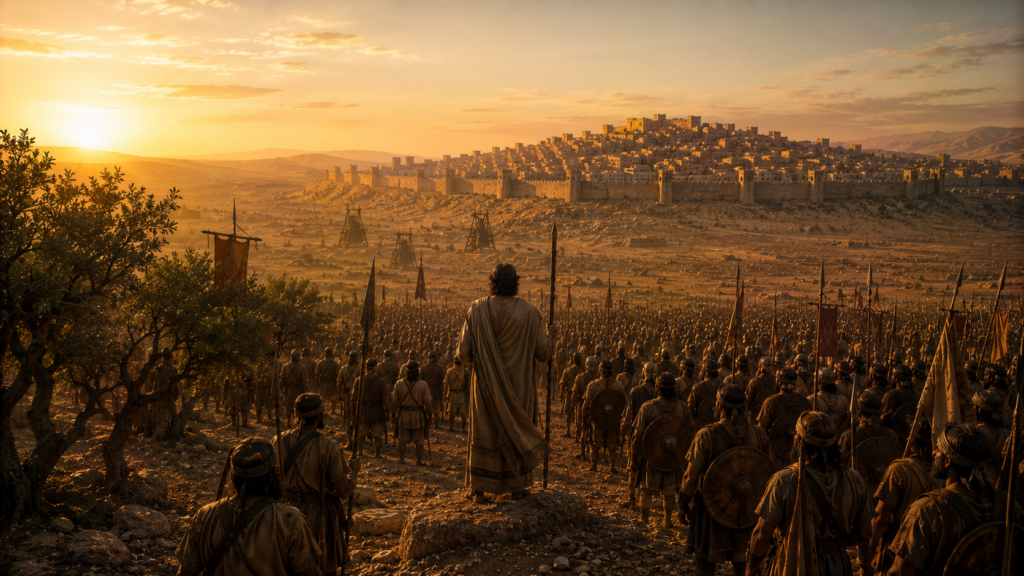
Chapter 20 is Israel’s law of war, and what is striking about it, set against the brutal norms of ancient warfare, is how much it restrains war. Before any battle, a priest steps forward to tell a frightened army don’t be afraid; Yahweh your God… fights for you. Then officers send home everyone with an unfinished life: the man with a new house not yet lived in, a vineyard not yet enjoyed, a fiancée not yet married, and, remarkably, anyone who is simply afraid. The army left standing is small, willing, and unencumbered, the opposite of a conscripted imperial war machine.
The chapter’s hardest material is the distinction it draws between distant cities (which must be offered peace first, and whose women and children are spared even in war) and the Canaanite cities under herem (see holy war and herem, where these texts are treated at length). The site reads that honestly, without softening or weaponizing it. And the chapter ends on one of the most humane notes in any ancient war code: even in a prolonged siege, Israel may not cut down the enemy’s fruit trees, “for is the tree of the field a man?” Total war still has a limit, and the limit is mercy toward the living world.
A · Deuteronomy 20:1-9 · Do not be afraid, and the exemptions
¹ When you go out to battle against your enemies, and see horses, chariots, and a people more numerous than you, you shall not be afraid of them; for Yahweh your God, who brought you up out of the land of Egypt, is with you. ² It shall be, when you draw near to the battle, that the priest shall approach and speak to the people, ³ and shall tell them, “Hear, Israel, you draw near today to battle against your enemies. Don’t let your heart faint! Don’t be afraid, nor tremble, neither be scared of them; ⁴ for Yahweh your God is he who goes with you, to fight for you against your enemies, to save you.” ⁵ The officers shall speak to the people, saying, “What man is there who has built a new house, and has not dedicated it? Let him go and return to his house, lest he die in the battle, and another man dedicate it. ⁶ What man is there who has planted a vineyard, and has not used its fruit? Let him go and return to his house, lest he die in the battle, and another man use its fruit. ⁷ What man is there who has pledged to be married to a wife, and has not taken her? Let him go and return to his house, lest he die in the battle, and another man take her.” ⁸ The officers shall speak further to the people, and they shall say, “What man is there who is fearful and faint-hearted? Let him go and return to his house, lest his brother’s heart melt as his heart.” ⁹ It shall be, when the officers have finished speaking to the people, that they shall appoint captains of armies at the head of the people. (Deuteronomy 20:1–9, World English Bible)
- You shall not be afraid… Yahweh your God… fights for you (verses 1-4). Even outnumbered and out-armed (horses and chariots, the tanks of the ancient world), Israel is told don’t be afraid. The reason is the refrain of the whole book: God goes with them, and he fights. A priest, not a general, gives the pre-battle speech, framing war as something God does for a trusting people, not something a powerful army wins by its own strength. This is the same lesson the first generation failed at Kadesh (1:30) and the second is meant to learn.
- The exemptions: a new house, a vineyard, a bride… and the fearful (verses 5-8). The exemptions are astonishing for an ancient army. Anyone who has begun something but not yet enjoyed it, a house not lived in, a vineyard not harvested, a marriage not consummated, is sent home. Life takes priority over the war machine; unfinished joys are protected. And then the most surprising release of all: whoever is fearful and faint-hearted may simply go home, “lest his brother’s heart melt as his heart.” Fear is not punished; it is dismissed with dignity, and it is treated as contagious, so the willing are not undermined by the unwilling. The army God wants is not the largest but the freest, men who are there because they trust and choose to be.
Where this lands: the fearful sent home, the trees spared
Deut 20 has at least two restraints in it that almost no modern reader knows are there. First: anyone who has just built a house, planted a vineyard, married a wife, or is simply afraid, is sent home (20:5-8). The army shrinks before a single sword is drawn. The Deuteronomic text values the everyday goods of life (a finished house, a first vintage, a marriage) more highly than military success. And it refuses to force the fearful into the line. The chapter’s underlying premise is that the LORD fights for Israel (20:1, 4), so the army does not need numbers; it needs presence. Second: the besieged city’s fruit trees are spared (20:19-20). The siege ends; the trees outlive the war. The provision is one of the earliest written prohibitions of scorched-earth warfare in human history. Both restraints are gone from how American Christianity (and American politics) typically talks about war and conflict; the modern instinct is to maximize force, shame fear, and consume the enemy’s resources. The Deuteronomic text is going the other direction. The restraints that ANE warriors did not have are baked into Israel’s law. We don’t have to be at war to ask the question this raises: what does it look like, in any conflict we are in, to send the fearful home, to spare the trees?
B · Deuteronomy 20:10-18 · Peace offered first, and the Canaanite ban
¹⁰ When you draw near to a city to fight against it, then proclaim peace to it. ¹¹ It shall be, if it gives you answer of peace and opens to you, then it shall be that all the people who are found therein shall become forced laborers to you, and shall serve you. ¹² If it will make no peace with you, but will make war against you, then you shall besiege it. ¹³ When Yahweh your God delivers it into your hand, you shall strike every male of it with the edge of the sword; ¹⁴ but the women, the little ones, the livestock, and all that is in the city, even all its plunder, you shall take for plunder for yourself. You may use the plunder of your enemies, which Yahweh your God has given you. ¹⁵ Thus you shall do to all the cities which are very far off from you, which are not of the cities of these nations. ¹⁶ But of the cities of these peoples that Yahweh your God gives you for an inheritance, you shall save alive nothing that breathes; ¹⁷ but you shall utterly destroy them: the Hittite, the Amorite, the Canaanite, the Perizzite, the Hivite, and the Jebusite, as Yahweh your God has commanded you; ¹⁸ that they not teach you to follow all their abominations, which they have done for their gods; so would you sin against Yahweh your God. (Deuteronomy 20:10–18, World English Bible)
- When you draw near to a city… then proclaim peace to it (verses 10-15). For cities far off (outside Canaan), the first move is required to be an offer of peace. War is the second resort, not the first. If the city accepts, no one is killed (though they become subject labor, harsh, but not slaughter); only if it chooses war is it besieged, and even then the women and children are spared. By the standards of ancient warfare, where surrender often meant annihilation anyway, this is a notable restraint.
Pushback note: the Canaanite cities and the herem (20:16-18)
Verses 16-18 are the hard exception: the cities of these nations, the Canaanite peoples inside the land, are placed under herem, “save alive nothing that breathes.” The site does not soften this (see holy war and herem, which treats these texts fully). Several things have to be held together honestly. The text itself frames it as bounded and exceptional: it applies only to the seven Canaanite nations in a specific moment (verse 15 explicitly contrasts “all the cities very far off,” which get the peace-first rule), not as a general law of war. The stated reason is religious contagion, “that they not teach you to follow all their abominations” (verse 18), the child-burning worship of 12:31, not ethnic hatred. And the “leave nothing that breathes” language belongs to the hyperbolic conventions of ancient war-reporting, the same Joshua who “left no survivors” keeps meeting Canaanite survivors (Rahab, the Gibeonites, the nations “left to test Israel,” Judg 3). None of that makes the texts gentle. They remain a one-time, geographically limited judgment within the story, never a template, and the canon’s trajectory runs toward a Messiah who told his followers to love their enemies and conquered not by killing but by being killed. We read the hard verses without flinching, and we read them in the light of the cross.
Influence callout: Christopher J. H. Wright on YHWH war in OT ethics
Wright’s treatment of conquest in Old Testament Ethics for the People of God refuses both common modern reactions to chapters like Deut 20: he refuses the crusading reading (which extracts the conquest as a template for modern violence in God’s name) and refuses the embarrassed reading (which simply expunges these chapters as morally inert). Wright’s argument is more interesting. First, the conquest is bounded: one moment, one land, one window of judicial response to centuries of Canaanite violation (Gen 15:16). It is not a perpetual permission slip; the Deuteronomic text itself ends the program at the borders of the land and forbids the kind of expansionism Israel’s neighbors normalized. Second, the conquest is paradigmatically re-read by the New Testament. The “wars of the LORD” become spiritual warfare against the powers (Eph 6:10-18; 2 Cor 10:3-5), and the Messiah who fulfills the conquest does so by being killed rather than by killing. Third, the moral weight Wright keeps insisting on: the language is hyperbolic ANE warfare rhetoric (compare Egyptian and Assyrian inscriptions; “utter destruction” was a standard literary convention, not a literal description of total annihilation), and Israel’s own historical narrative shows the herem was never fully executed. None of that makes the text easy. But it does refuse to let Deut 20 be read as a generic Christian war-manual. The text is a very specific divine-judicial moment, taken up at the cross and turned outward into a very different kind of warfare.
C · Deuteronomy 20:19-20 · The trees that must be spared
¹⁹ When you shall besiege a city a long time, in making war against it to take it, you shall not destroy its trees by wielding an ax against them; for you may eat of them. You shall not cut them down, for is the tree of the field man, that it should be besieged by you? ²⁰ Only the trees that you know are not trees for food, you shall destroy and cut them down. You shall build bulwarks against the city that makes war with you, until it falls. (Deuteronomy 20:19–20, World English Bible)
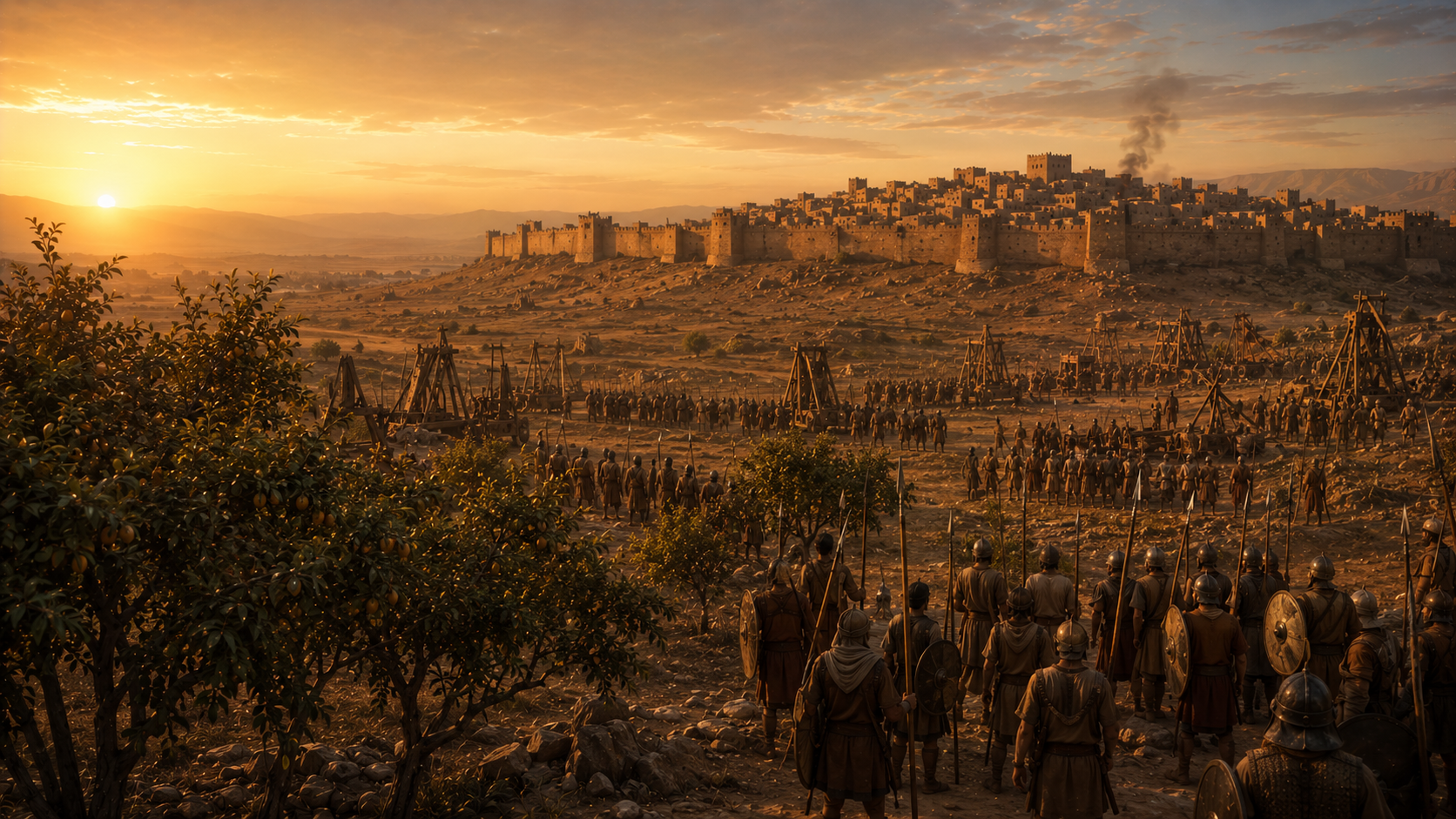
- You shall not destroy its trees… for is the tree of the field a man? (verses 19-20). The chapter ends with a law that has shaped environmental ethics for millennia. Besieging armies routinely stripped the land bare, cutting orchards for siege-works and to starve and demoralize the enemy. Deuteronomy forbids it: the fruit trees must be left standing, because you may eat of them, and because, in the haunting rhetorical question, is the tree of the field a man, that it should be besieged by you? The tree is not your enemy.
Word study: “is the tree of the field a man?” and bal tashchit
The Hebrew of verse 19 is famously ambiguous and the translations split: most read the rhetorical question, are the trees people, that you should besiege them? (NIV), is the tree of the field a human? (NASB, CSB, NRSVue), while a few read it as a statement (“the tree of the field is man’s life,” KJV tradition). Either way the force is the same: the orchard is non-combatant, and a war that turns its axe on the innocent living world has lost its bearings. From this single verse the rabbis derived the sweeping principle of bal tashchit, “do not destroy”, a prohibition against all wanton waste and needless destruction, of trees, food, resources, anything useful. It became Judaism’s foundational text for environmental responsibility and restraint. Notice what it does inside a war chapter: even in the most destructive human activity there is a line that mercy draws, and creation itself falls under God’s protection. The God who “cares for the land” and keeps “his eyes always on it” (11:12) will not let even a justified siege become an excuse to ravage what feeds and sustains life. War may be permitted; vandalism of the good creation is not.
Reflection prompts
- The army God wanted was not the biggest but the freest, men unencumbered by unfinished joys and undivided by fear, there because they trusted and chose to be. Where are you trying to fight a battle while distracted by unfinished life or driven by fear God would rather release you from?
- Even hard war began with a required offer of peace. Where do you move to “besiege” a conflict, at work, in a relationship, online, when Deuteronomy would have you proclaim peace first?
- Is the tree of the field a man? Even in war, the innocent living world was off-limits to the axe. Where might you be treating as an enemy, or as collateral damage, something (or someone) that is simply not your enemy, caught in the crossfire of a fight that isn’t theirs?
Frameworks at play in this chapter: holy war and herem, the cruciform hermeneutic.