

Chapter 8 is a sustained meditation on memory and money. It looks backward at the wilderness, the hunger, the manna, the humbling, and forward at the good land, full barns and fine houses and multiplied silver, and it makes a claim that runs against every instinct: the second is more spiritually dangerous than the first. The wilderness taught Israel that man does not live by bread only (8:3); plenty will tempt Israel to believe it never needed to be taught anything at all. The chapter’s whole burden is to inoculate a soon-to-be-comfortable people against the amnesia that comfort breeds.
Its most famous line, man does not live by bread only, but by every word that proceeds out of Yahweh’s mouth (8:3), is the very verse Jesus throws back at the tempter when he is hungry in his own wilderness (Matt 4:4). Its sharpest warning, “my power and the might of my hand has gotten me this wealth” (8:17), names the self-made delusion as precisely as anything in Scripture. Between them sits the lesson the wilderness was for: dependence is not a phase to outgrow but the truth of the creature, in the desert and in the penthouse alike (see wilderness and liminality).
A · Deuteronomy 8:1-6 · Remember the wilderness: humbled, tested, and fed
¹ You shall observe to do all the commandments which I command you today, that you may live, and multiply, and go in and possess the land which Yahweh swore to your fathers. ² You shall remember all the way which Yahweh your God has led you these forty years in the wilderness, that he might humble you, to test you, to know what was in your heart, whether you would keep his commandments or not. ³ He humbled you, allowed you to be hungry, and fed you with manna, which you didn’t know, neither did your fathers know, that he might teach you that man does not live by bread only, but man lives by every word that proceeds out of Yahweh’s mouth. ⁴ Your clothing didn’t grow old on you, neither did your foot swell, these forty years. ⁵ You shall consider in your heart that as a man disciplines his son, so Yahweh your God disciplines you. ⁶ You shall keep the commandments of Yahweh your God, to walk in his ways, and to fear him. (Deuteronomy 8:1–6, World English Bible)
- Remember all the way Yahweh led you these forty years… to humble you, to test you (verses 1-2). The command is remember, and the object is the whole wilderness, reframed not as punishment but as curriculum. God led them there to humble and to test, “to know what was in your heart.” The wilderness was a long examination, designed to surface what was really there (see wilderness and liminality).
- Man does not live by bread only (verse 3). The lesson of the manna is dependence.
Word study: “not by bread alone” (8:3), and the manna lesson
The verse turns the manna into a parable. God humbled Israel by letting them go hungry, then fed them with a bread they could neither produce nor store (it spoiled overnight; they had to gather it fresh each morning), that he might teach you that man does not live by bread only, but man lives by every word that proceeds out of Yahweh’s mouth. The point is not that food is unimportant but that food is not the foundation; the One who speaks the world into being is. The translations agree closely (“does not live on bread alone,” CSB/NIV/NLT), and all hold the two halves together: not bread alone, but bread and the word that gives it. When Jesus, fasting and hungry, is told to turn stones into bread, he answers with this verse (Matt 4:4): the true Son will not break the manna logic of dependence even when he could. Israel grumbled for bread in the desert; Jesus trusts the Father’s word in his.
- As a man disciplines his son, so Yahweh your God disciplines you (verses 4-6). The wilderness was musar, fatherly discipline, the formative training a parent gives a beloved child (NLT: as a parent disciplines a child… for your own good). The detail that your clothing didn’t grow old, neither did your foot swell (verse 4) is tender: even in the testing, they were sustained. Discipline, in Deuteronomy, is not the opposite of love but one of its forms.
B · Deuteronomy 8:7-10 · A good land, and the grace of being full
⁷ For Yahweh your God brings you into a good land, a land of brooks of water, of springs, and underground water flowing into valleys and hills; ⁸ a land of wheat, barley, vines, fig trees, and pomegranates; a land of olive trees and honey; ⁹ a land in which you shall eat bread without scarcity, you shall not lack anything in it; a land whose stones are iron, and out of whose hills you may dig copper. ¹⁰ You shall eat and be full, and you shall bless Yahweh your God for the good land which he has given you. (Deuteronomy 8:7–10, World English Bible)
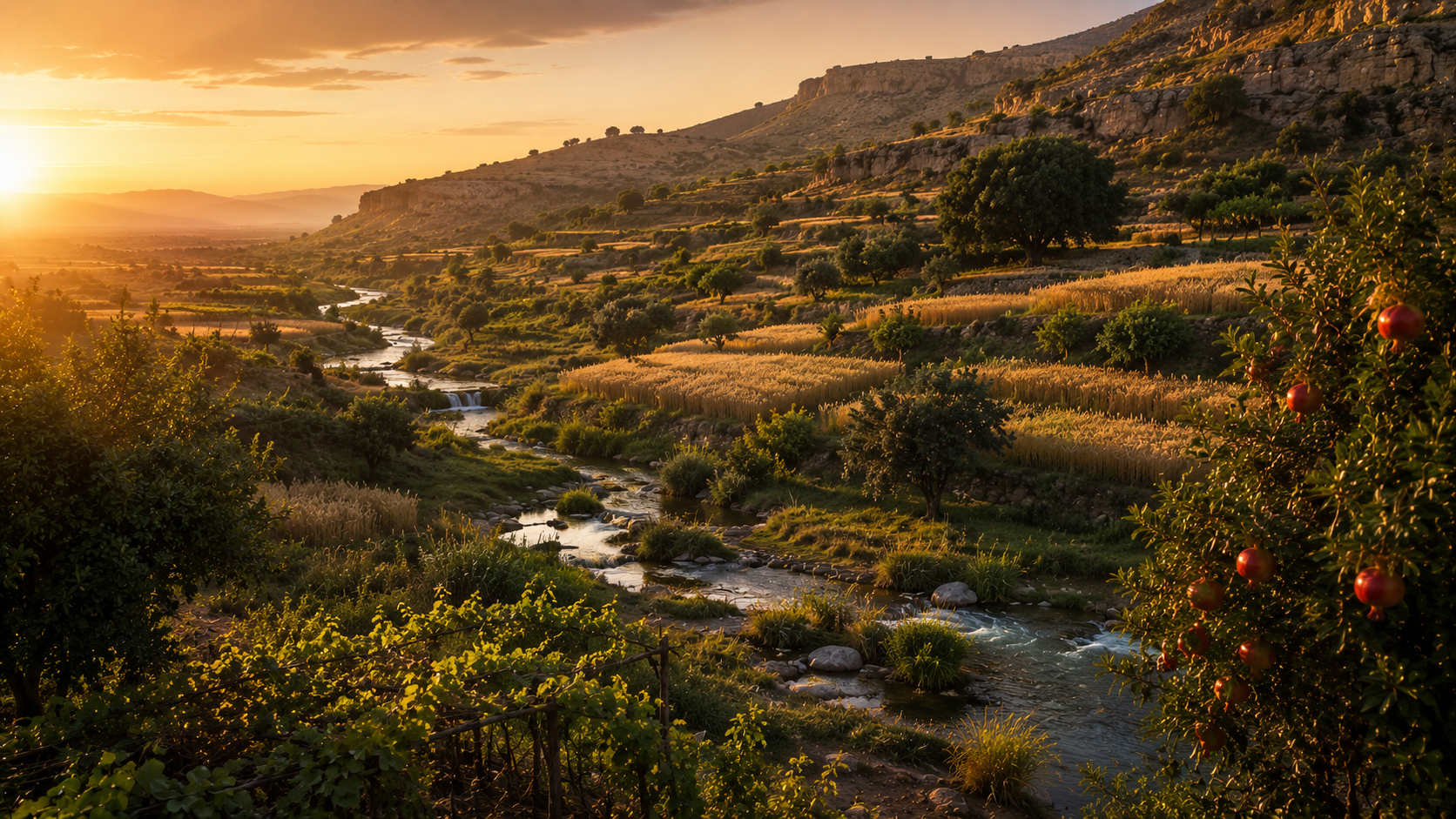
- A good land… a land of wheat, barley, vines, fig trees, and pomegranates (verses 7-9). Moses lavishes description on the land: brooks and springs, the seven species, bread without scarcity, even iron and copper in the hills. After forty years of manna, the abundance is staggering. The land is sheer gift, which he has given you, not earned.
- You shall eat and be full, and you shall bless Yahweh your God (verse 10). The right response to abundance is named in advance: bless the Giver. This single verse became the scriptural anchor for the Jewish Birkat Hamazon, the grace recited after meals, gratitude offered once you are full, precisely the moment the next verses identify as most dangerous. To bless God when you are satisfied is the trained habit that guards against forgetting him.
Influence callout: Christopher J. H. Wright on memory as resistance
Christopher Wright, whose work on OT ethics has become a touchstone for missional readings of the Hebrew Bible, names Deuteronomy 8 as the engine room of biblical memory. The Deuteronomic verb zakar (“remember”; 8:2, 8:18; cf. 5:15, 7:18, 9:7, 15:15, 16:3, 24:9, 24:18, 24:22, 25:17, 32:7) is doing political work as much as devotional work. To remember the wilderness is to refuse the ideology of self-made success that always threatens prosperous peoples (“my power and the strength of my hand got me this,” 8:17). Memory is the practice by which a people that has been hungry stays sane when it is full. Wright’s point is that forgetting is not a passive lapse; it is the active condition of empire, every dominant culture survives by un-remembering. Deuteronomy plants the counter-practice at the kitchen table: every harvest, every feast, every recitation, remember. You were nothing. You were slaves. The God who fed you fed you. A church that loses the practice of memory will eventually mistake its own power for its own righteousness.
C · Deuteronomy 8:11-20 · The peril of plenty: “my power got me this”
¹¹ Beware lest you forget Yahweh your God, in not keeping his commandments, his ordinances, and his statutes, which I command you today; ¹² lest, when you have eaten and are full, and have built fine houses and lived in them; ¹³ and when your herds and your flocks multiply, and your silver and your gold is multiplied, and all that you have is multiplied; ¹⁴ then your heart might be lifted up, and you forget Yahweh your God, who brought you out of the land of Egypt, out of the house of bondage; ¹⁵ who led you through the great and terrible wilderness, with venomous snakes and scorpions, and thirsty ground where there was no water; who poured water for you out of the rock of flint; ¹⁶ who fed you in the wilderness with manna, which your fathers didn’t know, that he might humble you, and that he might prove you, to do you good at your latter end; ¹⁷ and lest you say in your heart, “My power and the might of my hand has gotten me this wealth.” ¹⁸ But you shall remember Yahweh your God, for it is he who gives you power to get wealth, that he may establish his covenant which he swore to your fathers, as it is today. ¹⁹ It shall be, if you shall forget Yahweh your God, and walk after other gods, and serve them and worship them, I testify against you today that you shall surely perish. ²⁰ As the nations that Yahweh makes to perish before you, so you shall perish, because you wouldn’t listen to Yahweh your God’s voice. (Deuteronomy 8:11–20, World English Bible)
- When you have eaten and are full… then your heart might be lifted up, and you forget Yahweh (verses 11-16). Here is the chapter’s central warning, and it is psychologically precise. The danger sequence is: eat, be full, build, multiply, and then the heart is “lifted up” and forgets. Prosperity erodes memory. The God who “led you through the great and terrible wilderness… who poured water for you out of the rock of flint” is exactly the God a comfortable person stops thinking about. Verse 16 adds a piercing note: even the humbling was to do you good at your latter end, the discipline was always aimed at blessing.
- “My power and the might of my hand has gotten me this wealth” (verses 17-18). The self-made delusion gets quoted out loud so Israel can hear how it sounds. The translations sharpen it (“my own ability has gained this,” CSB; “I have achieved this wealth with my own strength,” NLT). It is the lie at the bottom of forgetting: that I am the source of what I have. Against it stands the corrective: you shall remember Yahweh your God, for it is he who gives you power to get wealth. Even the capacity to produce is a gift; the self-made man is a fiction.
- If you forget… you shall surely perish, like the nations (verses 19-20). The chapter ends with the stark fork of the road (see two ways): remember God and live, or forget him, chase other gods, and perish like the nations. Forgetting is not a harmless lapse; it is the road that ends where the dispossessed nations ended. Memory, in Deuteronomy, is a matter of life and death.
Pushback note: prosperity-gospel readings of Deuteronomy 8
Few chapters in the Hebrew Bible are more often inverted in popular American Christian teaching than Deuteronomy 8. The prosperity preacher reads the promise of “a good land,” “wheat and barley and vines,” “eating and being full,” and frames it as God’s contract with the faithful individual: be obedient and be blessed, and “blessed” means stuff. Deuteronomy 8 says almost the exact opposite. The chapter’s whole rhetorical thrust is that plenty is the spiritual danger. The wilderness humbled you and taught you (8:2-3); the land will fill you and threaten to make you forget (8:11-14); the lie you will be tempted to tell is “my power and the strength of my hand got me this wealth” (8:17). The chapter’s blessing is the very thing the prosperity gospel makes its proof; the chapter’s warning is precisely the spiritual posture the prosperity gospel cultivates. To read Deut 8 as a wealth contract you have to skip half its sentences. The chapter is not against the good land. It is for remembering who fed you in the wilderness, when the bread no longer comes down from the sky and your fields are doing the work. A Christianity that loses Deut 8’s diagnosis loses its ability to tell the difference between gratitude and arrogance about the same harvest.
Reflection prompts
- The wilderness taught that man does not live by bread alone, that dependence is the truth of being a creature. Where has a season of “hunger” in your own life taught you a dependence that your seasons of plenty quickly made you forget?
- Deuteronomy says the moment of greatest danger is when you are full and your heart is lifted up. Is there an area where your success has quietly convinced you that “my power and the might of my hand” produced it?
- The trained antidote is to bless God when you are full. Do you have a practice of gratitude that kicks in precisely at the moment of satisfaction, not just in need? What would it look like to build one?
Frameworks at play in this chapter: wilderness and liminality, Torah as gift, two ways.