

After the Ten Words comes the sentence that became the heartbeat of Israel’s faith and the most-recited verse in Judaism: Hear, Israel: Yahweh is our God. Yahweh is one (6:4). The Shema, named for its first Hebrew word, “hear.” It is not merely a creed to believe but the first and greatest commandment to obey: you shall love Yahweh your God with all your heart, with all your soul, and with all your might (6:5). When a scribe later asks Jesus for the greatest commandment in the whole Torah, this is what he recites (Mark 12:29-30). Everything Deuteronomy commands is, at bottom, commentary on these two verses (see the Shema).
Chapter 6 gives the creed, and then its method and its danger. The method: take these words into your own heart first, then teach them relentlessly to your children, talk them into the rhythm of ordinary days, bind them on your body, write them on your house. The danger: that once Israel is settled in a land full of good things it did not build or plant, it will grow comfortable and forget. The chapter ends by handing parents a script for the day a child asks what all of this is for, and the answer is not a rule but a rescue story.
A · Deuteronomy 6:1-9 · The Shema: hear, love, and never stop teaching
¹ Now these are the commandments, the statutes, and the ordinances, which Yahweh your God commanded to teach you, that you might do them in the land that you go over to possess; ² that you might fear Yahweh your God, to keep all his statutes and his commandments, which I command you—you, your son, and your son’s son, all the days of your life; and that your days may be prolonged. ³ Hear therefore, Israel, and observe to do it, that it may be well with you, and that you may increase mightily, as Yahweh, the God of your fathers, has promised to you, in a land flowing with milk and honey. ⁴ Hear, Israel: Yahweh is our God. Yahweh is one. ⁵ You shall love Yahweh your God with all your heart, with all your soul, and with all your might. ⁶ These words, which I command you today, shall be on your heart; ⁷ and you shall teach them diligently to your children, and shall talk of them when you sit in your house, and when you walk by the way, and when you lie down, and when you rise up. ⁸ You shall bind them for a sign on your hand, and they shall be for frontlets between your eyes. ⁹ You shall write them on the door posts of your house and on your gates. (Deuteronomy 6:1–9, World English Bible)
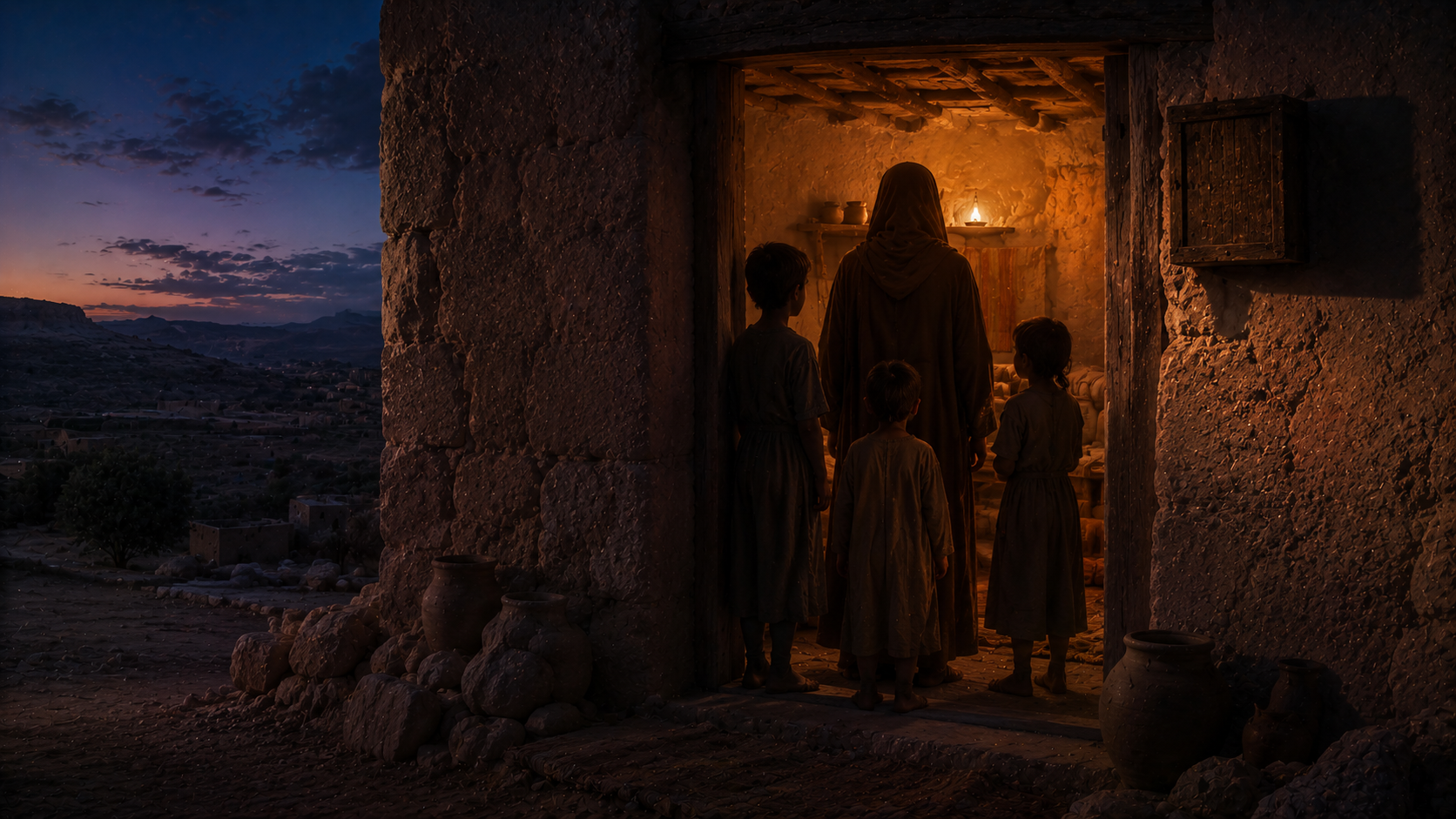
- Hear, Israel: Yahweh is our God. Yahweh is one (verses 4-5). The most consequential sentence in the book, and one of the hardest to translate.
Word study: shema and the four ways to read “YHWH is one” (6:4)
The verb shema fuses hearing and doing; to truly hear is to heed. But the famous difficulty is the second half. The four Hebrew words (YHWH eloheinu YHWH echad) have no verbs, so translators must supply them, and they split four ways: “the LORD our God, the LORD is one” (CSB, NIV), “the LORD is our God, the LORD is one” (NASB; WEB’s “Yahweh is our God. Yahweh is one”), and “the LORD is our God, the LORD alone” (NLT, NRSVue). The differences are real but they converge on one point. Daniel Block argues echad (“one”) here is not a lesson in arithmetic but a claim of exclusivity: of all the gods the nations serve, this God alone is Israel’s, and he is to be served with undivided loyalty. The rabbinic tradition called reciting the Shema “taking on the yoke of the kingdom of heaven”, a daily renewal of allegiance to the one King. “One” means: not divided, not one-among-many for you, the sole object of your love (see the Shema).
- Love Yahweh your God with all your heart, with all your soul, and with all your might (verse 5). The first commandment is to love, and in the covenant world that word carries weight modern ears miss.
Influence callout: love as covenant loyalty (Moran), and the greatest commandment
William Moran’s classic study showed that in ancient Near Eastern treaties a vassal is commanded to love the great king, language for wholehearted, demonstrated loyalty, not warm feeling alone. Deuteronomy keeps both registers: the love commanded is fierce allegiance and genuine affection. The triad “heart, soul, and might” (levav, nephesh, me’od) is not a psychology of three faculties but a Hebrew way of saying everything you are and have; the rabbis read me’od (“muchness”) as “with all your resources,” even your possessions and your very life. When Jesus is asked for the greatest commandment, he recites this verse and binds it to “love your neighbor as yourself” (Lev 19:18; Mark 12:29-31), affirming the Shema as the center of the law, not replacing it. Paul will even fold Jesus into its “one”: for us there is one God, the Father… and one Lord, Jesus Christ (1 Cor 8:6). The earliest Christology is written in the grammar of Israel’s creed (see the Shema).
- These words… shall be on your heart… teach them diligently to your children… bind them… write them (verses 6-9). The creed is designed to be embodied and transmitted. It goes first into the parent’s own heart (you cannot hand on what you do not hold), then into the children by relentless, ordinary repetition, sitting, walking, lying down, rising, then onto the body (tefillin, the bound words) and the house (mezuzah, the written words on the doorpost). Faith in Deuteronomy is always one generation from being lost, and the antidote is never a program but a household saturated with the words.
Influence callout: Rashi on the Shema (Deut 6:4)
Rashi, the eleventh-century French rabbi whose commentary became the standard Jewish reading of the text, hears 6:4 as a confession with a horizon. The Hebrew, Shema Yisrael, YHWH eloheinu, YHWH echad, is most naturally read not as “the LORD our God is one (as opposed to many gods)” but as “the LORD our God, the LORD alone is ours”, and one day will be one for all the nations. Rashi: “The LORD our God, God who is now our God and not the God of the nations, is destined to be the one LORD, as it is said, ‘For then I will turn to the peoples a pure speech, that they may all call upon the name of the LORD’ (Zeph 3:9), and it is said, ‘On that day the LORD shall be one and his name one’ (Zech 14:9).” The Shema is, on this reading, a missional confession: Israel knows the One the nations do not yet know, and confesses him now against the day his name is known everywhere. The line is not just an article of belief; it is a posture of waiting. The New Testament’s confession that “Jesus is Lord,” which sends the church to every nation, walks straight out of Rashi’s reading.
Word study: me’od, “with all your very-ness”
The third member of the great triad in 6:5, “with all your me’od“, is the strangest of the three. Lev (heart, the center of will and thought) and nephesh (soul, the whole self, the breath of life) are normal nouns; me’od is normally an adverb meaning “very” or “exceedingly.” Here it is forced into noun service: love the LORD with all your “very-ness.” The rabbinic tradition reads this in several ways: with all your means (the Targum, then the rabbis: with all your money), with all your strength or capacity, even with all your measure, however the LORD apportions to you (m. Berakhot 9:5, even when his measure is hard, love him with that very thing). What the strange word does is make the love commanded concrete. Whatever it is in you that is most yours, your bank account, your craft, your time, your stubborn personality, the very muchness of you, that is what is to love the LORD. The Shema’s hardest word is the one we like least to translate, because it asks for the part of us we usually keep back.
B · Deuteronomy 6:10-19 · When you are full: the danger of forgetting
¹⁰ It shall be, when Yahweh your God brings you into the land which he swore to your fathers, to Abraham, to Isaac, and to Jacob, to give you, great and goodly cities which you didn’t build, ¹¹ and houses full of all good things which you didn’t fill, and cisterns dug out which you didn’t dig, vineyards and olive trees which you didn’t plant, and you shall eat and be full; ¹² then beware lest you forget Yahweh, who brought you out of the land of Egypt, out of the house of bondage. ¹³ You shall fear Yahweh your God; and you shall serve him, and shall swear by his name. ¹⁴ You shall not go after other gods, of the gods of the peoples who are around you, ¹⁵ for Yahweh your God among you is a jealous God, lest the anger of Yahweh your God be kindled against you, and he destroy you from off the face of the earth. ¹⁶ You shall not tempt Yahweh your God, as you tempted him in Massah. ¹⁷ You shall diligently keep the commandments of Yahweh your God, and his testimonies, and his statutes, which he has commanded you. ¹⁸ You shall do that which is right and good in Yahweh’s sight, that it may be well with you and that you may go in and possess the good land which Yahweh swore to your fathers, ¹⁹ to thrust out all your enemies from before you, as Yahweh has spoken. (Deuteronomy 6:10–19, World English Bible)
- Houses full of good things which you didn’t fill… then beware lest you forget (verses 10-15). Here is one of Deuteronomy’s deepest spiritual insights: the gravest danger is not the wilderness but the good land. When Israel inherits cities it didn’t build and vineyards it didn’t plant and eats and is full, the temptation will be to forget the Giver and imagine the gift was earned. Prosperity is more spiritually dangerous than hardship, because it whispers that you did this yourself. The jealous love of God (verse 15; see 4:24) is the fierce response of a spouse to a heart that wanders once it is comfortable.
- You shall not tempt Yahweh… as you tempted him in Massah (verse 16). The warning recalls the wilderness test where Israel demanded water and asked “is Yahweh among us or not?” (Ex 17:7). To “test” God is to make your trust conditional on his proving himself on your terms. This is the second of three verses from Deuteronomy 6-8 that Jesus quotes to the tempter in the wilderness, “you shall not put the Lord your God to the test” (Matt 4:7). Where Israel tested God in the desert, the true Son trusts him there.
C · Deuteronomy 6:20-25 · “When your son asks”: the catechism of grace
²⁰ When your son asks you in time to come, saying, “What do the testimonies, the statutes, and the ordinances, which Yahweh our God has commanded you mean?” ²¹ then you shall tell your son, “We were Pharaoh’s slaves in Egypt. Yahweh brought us out of Egypt with a mighty hand; ²² and Yahweh showed great and awesome signs and wonders on Egypt, on Pharaoh, and on all his house, before our eyes; ²³ and he brought us out from there, that he might bring us in, to give us the land which he swore to our fathers. ²⁴ Yahweh commanded us to do all these statutes, to fear Yahweh our God, for our good always, that he might preserve us alive, as we are today. ²⁵ It shall be righteousness to us, if we observe to do all these commandments before Yahweh our God, as he has commanded us.” (Deuteronomy 6:20–25, World English Bible)
- When your son asks… “What do the testimonies… mean?” (verses 20-25). The chapter ends with a model for passing on the faith, and it is quietly revolutionary. When a child asks what all the commandments are for, the parent does not answer with a rule or a principle. The answer is a story: we were Pharaoh’s slaves in Egypt, and Yahweh brought us out. The meaning of the law is the narrative of rescue that stands behind it.
Influence callout: the catechism answers a “what” with a “story” (Torah as gift)
Notice the shape of the answer in verses 21-24 (see Torah as gift). The child asks about statutes; the parent recounts the exodus. Law is explained by gospel. The commandments are not free-floating rules to be obeyed because God said so; they are the grateful response of a people who were slaves and were brought out. This is the order Deuteronomy never reverses: rescue first, then the life that fits it (the same order as the Decalogue’s preamble, 5:6). And verse 24 names the purpose of the whole law in three words, for our good always. Even the closing line, that keeping the commandments “shall be righteousness to us” (verse 25), sits inside this grace: it describes the life of a people already redeemed, walking in the way that leads to life, not earning a standing they do not yet have. The Passover Haggadah still answers a child’s question exactly this way, with the story, because in Deuteronomy the story is the answer.
Reflection prompts
- YHWH is one, meaning, for you, undivided. Where is your loyalty actually divided, your love for God competing with a rival you would not name as a “god” but that quietly runs your life?
- Deuteronomy warns that fullness, not hardship, is the great threat to faith: comfortable people forget. Where has a season of having “enough” made you more forgetful of God than a season of need ever did?
- When a child (or anyone) asks why you live the way you do, Deuteronomy says: tell the rescue story, not the rulebook. Could you tell your “we were slaves and were brought out” story? What is it?
Frameworks at play in this chapter: the Shema, Torah as gift, the Sinai covenant.