

Genesis 20 reads, on first encounter, like the narrator stuttering. We have already read this story. In Genesis 12, Abram traveled to Egypt during a famine and told Pharaoh that Sarai was his sister, and Pharaoh took her into his household, and Yahweh afflicted Pharaoh, and Pharaoh sent them away. Now, eight chapters and many years later, the patriarch travels to Gerar, a Philistine city in the Negev, and tells King Abimelech that Sarah is his sister, and Abimelech takes her, and God comes to Abimelech in a dream, and Abimelech sends them away with restitution. Same pattern. Same patriarch. Almost the same outcome.
But the second telling reframes the first. The narrator is not stuttering. The doublet is doing theological and characterological work. We learn things in chapter 20 that chapter 12 left out. We meet a pagan king who, unlike Pharaoh, gets a speaking part and turns out to be morally serious. We hear God’s reasoning aloud, in dialogue with a non-Israelite, in a way the patriarchal narratives do not often record. And we watch Abraham, more than two decades into his covenant journey, repeat exactly the same fearful deception he committed when he first entered the land.
The chapter is honest about what the covenant does and does not do. It does not produce moral perfection. The man who, in chapter 18, interceded for the strangers in Sodom is, in chapter 20, the man who deceives a stranger king to save his own neck. The chapter ends with Abraham praying for Abimelech, and the prayer being effective. But the chapter has shown us, again, that the patriarch is being formed slowly, with relapses, and that his old fears have not yet been worked all the way through him.
The chapter is also one of the patriarchal narratives’ clearest statements that pagan kings can be morally upright. Abimelech is, in this chapter, more obviously honorable than Abraham. The covenant’s reach into the world includes the ways God works through non-covenant figures who are doing their best.
A · Genesis 20:1–7 · The deception and the dream
¹ Abraham traveled from there toward the land of the South, and lived between Kadesh and Shur. He lived as a foreigner in Gerar. ² Abraham said about Sarah his wife, “She is my sister.” Abimelech king of Gerar sent, and took Sarah. ³ But God came to Abimelech in a dream of the night, and said to him, “Behold, you are a dead man, because of the woman whom you have taken; for she is a man’s wife.” ⁴ Now Abimelech had not come near her. He said, “Lord, will you kill even a righteous nation? ⁵ Didn’t he tell me, ‘She is my sister’? She, even she herself, said, ‘He is my brother.’ In the integrity of my heart and the innocence of my hands, I have done this.” ⁶ God said to him in the dream, “Yes, I know that in the integrity of your heart you have done this, and I also withheld you from sinning against me. Therefore I didn’t allow you to touch her. ⁷ Now therefore, restore the man’s wife. For he is a prophet, and he will pray for you, and you will live. If you don’t restore her, know for sure that you will die, you, and all who are yours.” (Genesis 20:1–7, World English Bible)
- The chapter opens with Abraham relocating. Genesis 18 had him at Mamre near Hebron; Genesis 19 had Abraham looking toward the cities from the same area; Genesis 20 has him moving south, into the Negev, between Kadesh and Shur, then settling in Gerar. The geographic shift is unexplained. We are not told why he moves. Perhaps the destruction of Sodom has unsettled the area; perhaps he is following grazing land; perhaps the patriarch is simply restless. The narrator records the move and lets us draw our own conclusions.
- Gerar is a Philistine city in the Negev. The “Philistines” of the patriarchal narratives are not the same group as the Philistines of the David and Goliath era; they are an earlier Aegean-influenced people group along the southern coast of the land. Abraham is, again, traveling into a foreign king’s territory.
- Verse 2 is, by every indicator, a verbatim repetition of Abraham’s earlier deception in chapter 12. “Abraham said about Sarah his wife, ‘She is my sister.’” The Hebrew is even more compact than the English. Five words. The patriarch has resolved nothing in the intervening years. The fear that drove him in chapter 12 (that the local king would kill him to take his beautiful wife) drives him here too. Sarah is now ninety, and the text tells us in chapter 18 that she is “old, advanced in age,” and yet the deception unfolds the same way it did in chapter 12.
Pushback note
Some readings of this chapter try to soften Abraham’s deception by noting (per his own defense in verse 12) that Sarah was technically his half-sister, sharing the same father but not the same mother. Even if true, the half-sister fact does not turn the statement into a frank disclosure. Abraham is, both in chapter 12 and here, deliberately omitting the marriage. The text knows this. The text has Abimelech treat the deception as a deception. We should not work harder than the text to defend the patriarch.
- Abimelech “sent, and took Sarah.” The taking is not described in detail, but ANE conventions for a king receiving a foreign woman into his household would have included her being placed in his harem, possibly as a primary wife. The narrator gives us nothing about Sarah’s response. Like in chapter 12, Sarah does not speak in this scene. She is acted upon.
- Verses 3 to 7 contain the chapter’s first surprise: God comes to Abimelech in a dream. The dream theophany is a recurring biblical pattern (Jacob in chapter 28, Joseph in chapter 37, Pharaoh in chapter 41, Solomon in 1 Kings 3), but it is striking here because the recipient is a pagan king. God speaks directly to a non-covenant figure, in dialogue, with full theological content. Abimelech is treated, in this scene, as someone capable of receiving and responding to divine communication.
Word study: halom (חֲלוֹם), “dream”
The Hebrew word for “dream,” used here for the first time in Scripture in a theophanic sense. Halom will recur throughout the patriarchal narratives, particularly in the Joseph cycle, where dreams will be the means God uses to communicate with both Hebrews (Joseph) and pagans (Pharaoh, the cupbearer, the baker). The dream theophany is, throughout the Hebrew Bible, one of the ways God reaches outside the covenant family to communicate with foreign rulers. Genesis 20:3 is the first instance, and it sets the pattern: God speaks to whom he chooses to speak, and his choices include kings of cities the patriarch has reason to fear.
- God’s opening line is striking. “Behold, you are a dead man, because of the woman whom you have taken; for she is a man’s wife.” The pronouncement is uncompromising. Abimelech is told he stands under a death sentence for an act he committed unknowingly. The chapter is not soft about culpability. Even unintentional sin produces consequence in the moral world the chapter inhabits.
- Abimelech’s response (verses 4 to 5) is one of the most theologically interesting protests in the Hebrew Bible. “Lord, will you kill even a righteous nation? Didn’t he tell me, ‘She is my sister’? She, even she herself, said, ‘He is my brother.’ In the integrity of my heart and the innocence of my hands, I have done this.” The pagan king is appealing to divine justice in the same way Abraham appealed to it in chapter 18:25 (“shall not the Judge of all the earth do right?”). The vocabulary is different but the theological move is the same. Abimelech assumes that a just God would not kill a man who acted in good faith on the information he had been given.
Influence callout: Walter Brueggemann
Brueggemann reads Abimelech’s protest as the chapter’s quiet inversion. The pagan king is, in this scene, a more credible ethical figure than the patriarch. He pleads for the integrity of his heart and the innocence of his hands. He has acted in good faith. He has been deceived by the man God elsewhere calls his prophet. Brueggemann argues that the chapter is making a sustained point: covenant faithfulness is not the same as moral faithfulness, and pagan moral seriousness is not absent from God’s awareness. The Hebrew Bible’s later prophetic tradition, which often holds Israel and Judah to a higher standard than their pagan neighbors precisely because of their covenant calling, has its first whisper here. Abimelech is doing the right thing while the patriarch is not.
- God’s response (verse 6) confirms Abimelech’s defense. “Yes, I know that in the integrity of your heart you have done this, and I also withheld you from sinning against me.” God explicitly acknowledges Abimelech’s good faith. He explicitly takes credit for preventing the sin from being completed (Abimelech “had not come near her,” verse 4). The chapter is doing theological work that will recur throughout the Bible: God’s providence reaches into the moral lives of non-covenant people, restraining them from harm they have not yet committed, working alongside their integrity to prevent damage.
- Verse 7 shifts. “Now therefore, restore the man’s wife.” The instruction is direct. But then comes a remarkable sentence: “For he is a prophet, and he will pray for you, and you will live.” This is the first time in Scripture the word navi, “prophet,” is used. The first person to receive that title is Abraham, in this chapter, in the very moment when Abraham is being least prophetic by every behavioral measure. The chapter is treating prophecy as a vocational role, not a moral status. Abraham is a prophet because of his covenant calling, not because of his current behavior. His prayer will be effective because of who God is, not because of who Abraham is being.
Word study: navi (נָבִיא), “prophet”
Navi is the Hebrew word for prophet. Its etymology is debated; the Akkadian cognate nabu means “to call” or “to name,” which would yield “the called one” or “the spokesman.” Whatever the etymology, the prophetic vocation in the Hebrew Bible is to speak God’s word to the people and intercede for the people before God. Abraham is given this title in 20:7, but the function (intercession in particular) was already on display in chapter 18:23 to 32 with his bargain for Sodom. The chapter is naming what Abraham has been becoming. The title fits even though the surrounding behavior does not.
B · Genesis 20:8–13 · The confrontation
⁸ Abimelech rose early in the morning, and called all his servants, and told all these things in their ear. The men were very afraid. ⁹ Then Abimelech called Abraham, and said to him, “What have you done to us? How have I sinned against you, that you have brought on me and on my kingdom a great sin? You have done deeds to me that ought not to be done!” ¹⁰ Abimelech said to Abraham, “What did you see, that you have done this thing?” ¹¹ Abraham said, “Because I thought, ‘Surely the fear of God is not in this place. They will kill me for my wife’s sake.’ ¹² Besides, she is indeed my sister, the daughter of my father, but not the daughter of my mother; and she became my wife. ¹³ When God caused me to wander from my father’s house, I said to her, ‘This is your kindness which you shall show to me. Everywhere that we go, say of me, “He is my brother.”‘” (Genesis 20:8–13, World English Bible)
- Abimelech responds with appropriate urgency. He rises early, gathers his servants, tells them what has happened. The court is afraid. The Hebrew word yire’u me’od, “very afraid,” signals the seriousness of the situation. They are not afraid of Abraham; they are afraid of what God might do to them because of what their king has unknowingly done. The chapter is showing us a pagan court that takes divine retribution as a real possibility.
- The confrontation between Abimelech and Abraham (verses 9 to 10) is direct. “What have you done to us? How have I sinned against you, that you have brought on me and on my kingdom a great sin?” Abimelech asks the right question. He has been wronged, in his integrity, by a man who claimed righteousness. He demands an account.
Influence callout: Tim Mackie
Mackie’s reading of the doublet pattern between chapter 12 and chapter 20 emphasizes how the second telling fills in what the first omitted. In chapter 12, Pharaoh confronted Abraham briefly (“What is this that you have done to me?” 12:18), but Abraham did not respond. In chapter 20, the confrontation is fuller, the king’s questions are more probing, and Abraham is required to answer. The narrator is, in Mackie’s reading, returning to the same scenario to do moral work the first telling had bracketed. Abraham must defend himself, and the defense is going to expose the chapter’s central irony.
- Abraham’s defense has three parts.
- First (verse 11): “I thought, ‘Surely the fear of God is not in this place. They will kill me for my wife’s sake.’” Abraham assumed that Gerar was a place without moral foundation, where a foreign sojourner would be expendable. He has been disastrously wrong. The chapter has just shown us a king who has the fear of God, who responds to a dream theophany with theological seriousness, who confronts the patriarch on grounds of justice. The fear of God is in this place. Abraham assumed it wasn’t. The chapter is openly mocking the patriarch’s prejudice.
- Second (verse 12): “Besides, she is indeed my sister, the daughter of my father, but not the daughter of my mother; and she became my wife.” Abraham appeals to the half-sister technicality. This is, by ANE legal standards, half a defense. Sarah was, in fact, his half-sister. But the omission of the marriage was deliberate, and Abraham is using the partial truth to evade full responsibility. The defense is weaker than it looks.
- Third (verse 13): “When God caused me to wander from my father’s house, I said to her, ‘This is your kindness which you shall show to me. Everywhere that we go, say of me, “He is my brother.”‘” The patriarch reveals that the wife-sister deception was a long-standing arrangement, in place since he left Haran decades ago. Sarah’s kindness (Hebrew chesed, the strong covenantal word) toward him was, by Abraham’s account, to participate in this deception in every place they went. The plural “everywhere” suggests there may have been many such episodes, of which Genesis records only the two that produced significant consequences (chapter 12 and chapter 20).
Pushback note
The third part of Abraham’s defense is, in some ways, the most damning. He blames the deception on God’s instruction to wander, framing his dishonesty as a survival adaptation he and Sarah agreed to long ago. He invokes Sarah’s chesed (kindness, covenant loyalty) as a partner in his fear-driven strategy. The text records all of this without softening. Abraham is not being framed as a villain, but he is being shown as a man whose long fearful pattern has been baked into his marriage, his strategy, and his way of moving through the world. The chapter is honest. The patriarch is not a moral exemplar. He is a covenant carrier whose moral life is still being formed.
C · Genesis 20:14–18 · The restoration and the prayer
¹⁴ Abimelech took sheep and cattle, male servants and female servants, and gave them to Abraham, and restored Sarah, his wife, to him. ¹⁵ Abimelech said, “Behold, my land is before you. Dwell where it pleases you.” ¹⁶ To Sarah he said, “Behold, I have given your brother a thousand pieces of silver. Behold, it is for you a covering of the eyes to all that are with you. In front of all you are vindicated.” ¹⁷ Abraham prayed to God. God healed Abimelech, and his wife, and his female servants, and they bore children. ¹⁸ For Yahweh had closed up tight all the wombs of the house of Abimelech, because of Sarah, Abraham’s wife. (Genesis 20:14–18, World English Bible)
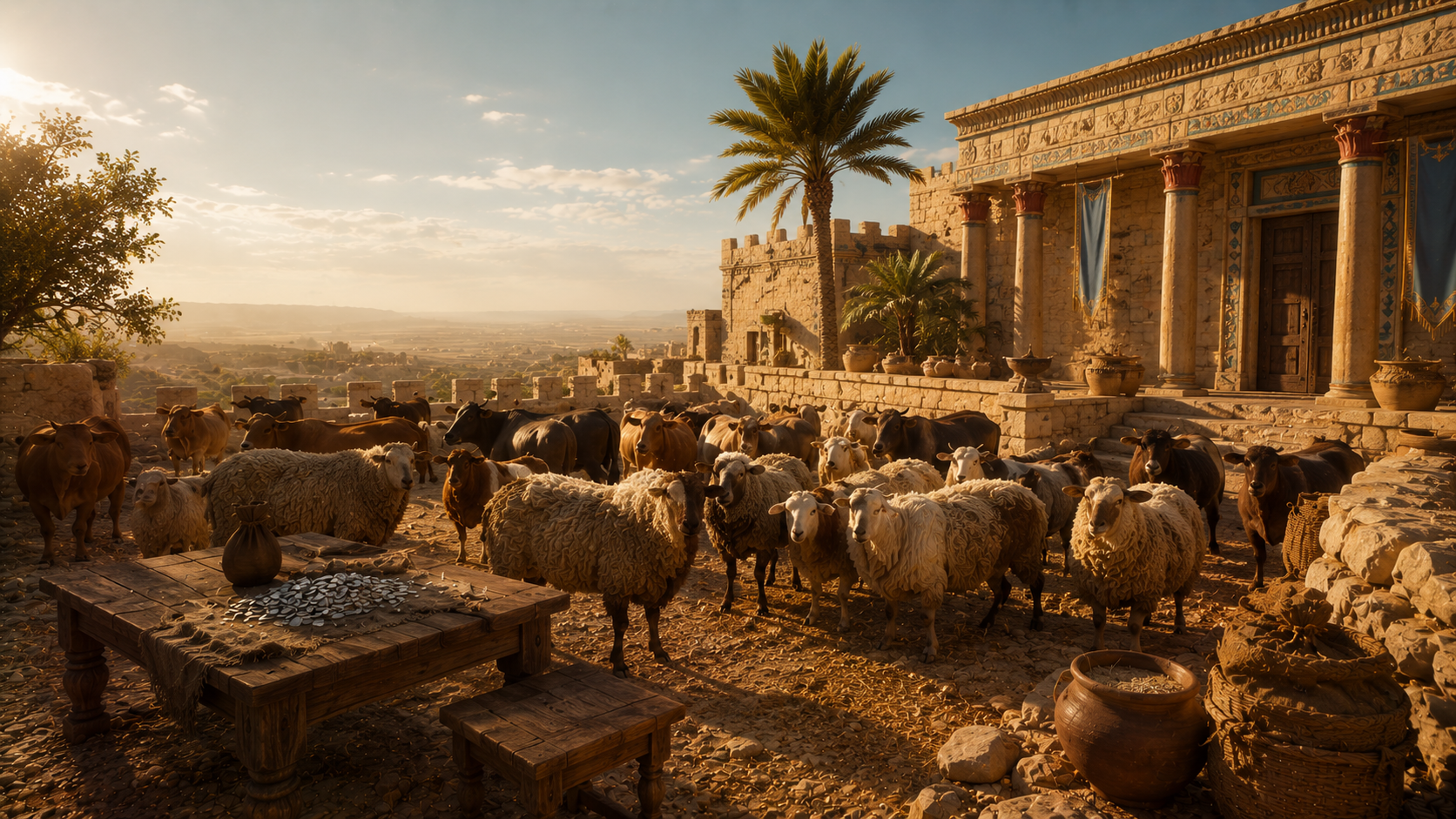
- Abimelech’s restoration is generous. Sheep, cattle, male and female servants, the freedom to settle anywhere in the kingdom. The pagan king, having been deceived by the patriarch, responds to the deception by overpaying. The contrast with Abraham’s behavior in chapter 14 (where he refused so much as a thread from the king of Sodom) is sharp. Sodom was a city the patriarch wanted to keep his distance from; Gerar is a kingdom the patriarch had imagined was beneath him morally. The patriarch’s read on Gerar has turned out to be wrong.
- Verse 16 contains the chapter’s most carefully constructed sentence. To Sarah, Abimelech says: “Behold, I have given your brother a thousand pieces of silver. Behold, it is for you a covering of the eyes to all that are with you. In front of all you are vindicated.” The Hebrew is dense and somewhat opaque, and translations vary. The phrase “covering of the eyes” (kesut einayim) has been read as: a public vindication of Sarah’s honor; a payment that “covers” the embarrassment of those who saw her taken; or a financial settlement that closes the case publicly. Whatever the precise meaning, the function is clear: Abimelech is, in front of his court and Abraham’s household, restoring Sarah’s social standing in a public, witnessed, documented way.
Influence callout: Nijay Gupta
The kind of reading Nijay Gupta and others have done on women in biblical narratives is helpful here. Sarah, in chapter 12 and chapter 20, has been silent. Her body has been taken; her marriage has been concealed; her honor has been compromised by her husband’s deception. In this verse, for the only time in the patriarchal cycle, a man (and not her husband) speaks directly to her, addresses her by acknowledging the wrong she has been subjected to, and uses public language to restore her social standing. The pagan king, in this brief sentence, does what Abraham did not do. He does not just return her; he names her vindication, in front of witnesses, and pays a settlement that publicly closes the case. Sarah’s honor is restored not by the covenant carrier but by the king he had despised.
- Verses 17 to 18 contain the chapter’s quiet conclusion. Abraham prays. God heals Abimelech, his wife, and his servants, and they bear children. The closing verse fills in a detail the chapter had not previously revealed: Yahweh had closed all the wombs in Abimelech’s house because of Sarah. The whole episode took place under divine fertility-judgment that the inhabitants of Abimelech’s court did not initially know about. Once Sarah is restored, the wombs are reopened.
- The detail about closed wombs is theological. In chapter 12, the affliction on Pharaoh’s house was unspecified (“plagues,” 12:17). In chapter 20, the affliction is specifically reproductive. The next chapter (Genesis 21) will open with Sarah finally conceiving Isaac. The narrator is preparing the contrast: Abraham’s deception in chapter 20 closed Abimelech’s wombs; God’s promise in chapter 21 opens Sarah’s. The covenant heir is being born into a chapter where reproduction has just been the locus of divine judgment.
Influence callout: Tim Mackie
Mackie’s literary reading sees the placement of Genesis 20 immediately before Genesis 21 as deliberate. The chapter that closes wombs (because of the patriarch’s failure) immediately precedes the chapter that opens Sarah’s womb (because of God’s faithfulness). The juxtaposition is the narrator’s argument: God’s covenant promise will be fulfilled despite the patriarch’s repeated moral failures, and the very issue at the heart of the failure (fertility, reproduction, the future of the household) is what God is about to deliver in the next chapter. Genesis 20 is the moral low point on the way to the covenant high point. The narrator wants you to feel both, side by side.
- Abraham prays, and the prayer is effective. The chapter ends with the patriarch performing the prophetic function God named for him in verse 7. The covenant carrier, in his weakness and his deception and his moral inconsistency, intercedes for the king he wronged, and God responds. The patriarchal vocation is not contingent on the patriarch’s moral perfection. The chapter is grimly honest about that, and quietly merciful about it at the same time.
Reflection prompts
- Abimelech is the moral center of the chapter. The pagan king takes God seriously, acts on integrity, and confronts the patriarch with the right question. Where in your life have you assumed that someone outside your tradition could not have integrity, only to discover that they were the one acting with the most clarity?
- Abraham is called a prophet (the first time the word appears in the Bible) in the very moment he is behaving the least prophetically. The vocational title is given regardless of his current state. What does it mean for the calling on your life to remain in place even when you are failing it? What does that change about how you respond to your own failure?
- The chapter ends with Abraham praying for Abimelech, and the prayer being effective. The patriarch does not pray because he has earned the right; he prays because the calling, even after his failure, has not been withdrawn. Where in your life is God asking you to pray for someone you have wronged, and what would it mean to do that not from a position of moral strength but from a position of forgiven failure?