
Genesis 19 is the chapter that follows Abraham’s bargain. Abraham asked: would Yahweh spare the city for the sake of fifty righteous? Forty? Ten? The previous chapter ended with the assurance that, for the sake of ten, the city would not be destroyed. Genesis 19 is what happens when the city does not have ten.
The chapter is also one of the most unsettling in the Hebrew Bible. It contains a violent gang assault by the men of Sodom, an attempted male-on-male rape of the angelic visitors, Lot offering his own daughters to the mob, the destruction of the cities of the plain by sulfur and fire, the death of Lot’s wife as a pillar of salt, and a closing scene in a cave in which Lot’s daughters get him drunk and conceive sons by him (the eponymous ancestors of Moab and Ammon, the cousin-nations Israel will live alongside throughout its history).
The chapter is doing several things at once. It is bringing Abraham’s bargain to its tragic conclusion. It is showing what kind of city Sodom actually was, in moral and behavioral terms, beyond the abstract “outcry.” It is tracing what becomes of Lot, who in chapter 13 chose the well-watered plain because it was like the garden of Yahweh and like the land of Egypt, and who has now, twenty years later, ended up huddled in a cave with two daughters and no future. And it is establishing the genealogical origins of Moab and Ammon, peoples who will reappear throughout the rest of the Bible.
The chapter requires careful reading. Some of the popular Christian readings of Sodom have, historically, read it primarily as a text about consensual sexual ethics. The Hebrew Bible itself reads it as a text about the betrayal of hospitality, the violation of strangers, and the moral collapse of a city that had grown wealthy and indifferent. We will follow the Hebrew Bible’s own reading.
A note on what we are about to read. Genesis 19 contains attempted gang rape, the offering of women to a violent mob by their father, the destruction of cities, and the conception of children through paternal incest. The text records these events without celebrating them and without softening them. We will not soften them either. If you are reading with someone for whom these elements are pastorally heavy, take the chapter slowly, and feel free to skip sections. The chapter is doing real moral work, but it is doing it in unflinching language.
A · Genesis 19:1–11 · The arrival, the mob, the offering
¹ The two angels came to Sodom at evening. Lot sat in the gate of Sodom. Lot saw them, and rose up to meet them. He bowed himself with his face to the earth, ² and he said, “See now, my lords, please come into your servant’s house, stay all night, wash your feet, and you can rise up early, and go on your way.” They said, “No, but we will stay in the street all night.” ³ He urged them greatly, and they came in with him, and entered into his house. He made them a feast, and baked unleavened bread, and they ate. ⁴ But before they lay down, the men of the city, the men of Sodom, surrounded the house, both young and old, all the people from every quarter. ⁵ They called to Lot, and said to him, “Where are the men who came in to you this night? Bring them out to us, that we may have sex with them.” ⁶ Lot went out to them through the door, and shut the door after him. ⁷ He said, “Please, my brothers, don’t act so wickedly. ⁸ See now, I have two virgin daughters. Please let me bring them out to you, and you may do to them what seems good to you. Only don’t do anything to these men, because they have come under the shadow of my roof.” ⁹ They said, “Stand back!” Then they said, “This one fellow came in to live as a foreigner, and he appoints himself a judge. Now we will deal worse with you than with them!” They pressed hard on the man Lot, and came near to break the door. ¹⁰ But the men reached out their hand, and brought Lot into the house to them, and shut the door. ¹¹ They struck the men who were at the door of the house with blindness, both small and great, so that they wearied themselves to find the door. (Genesis 19:1–11, World English Bible)
- The chapter opens with a precise number. “The two angels came to Sodom at evening.” Two, not three. Yahweh remained behind with Abraham for the bargain (chapter 18); the two angelic figures continued on toward the city. The Hebrew word for “angel” is malakh, “messenger,” and the text uses it freely now that Abraham is no longer in the scene. The narrator’s earlier ambiguity (three “men,” one of whom was Yahweh) has resolved into clarity.
- Lot is “sitting in the gate” (verse 1). In ANE cities, the gate was the place of business, judgment, and civic affairs. Sitting in the gate was the position of the elders, the ones who decided cases and conducted public business. Lot, in chapter 13 a tent-dweller drifting toward Sodom, has now become, in chapter 19, a fully embedded resident, integrated into the city’s civic life. His arc has continued in the direction the narrator quietly named years before.
- Lot’s first response is the right one. He rises, bows, and offers hospitality with the same vocabulary Abraham used in chapter 18: come in, stay the night, wash your feet, rise early in the morning. He has not lost the patriarchal hospitality reflex. The chapter is going to show us what hospitality looks like in a city that does not honor it.
- The visitors decline, intending to spend the night in the street (verse 2). Lot insists. The city’s reputation makes this insistence necessary. To leave a stranger in the open square in Sodom, after dark, was not a casual choice. Lot knows what kind of place he lives in, and his urgent hospitality is, in part, an attempt to protect the visitors from the city he has chosen to call home.
Influence callout: Ray Vander Laan
Vander Laan’s teaching on this scene foregrounds the ANE hospitality code. In a culture without inns, taverns, or hotels, the stranger lived or died by the host. The host was responsible for the safety of the guest with their own life. The mob’s demand to bring the visitors out is, in this cultural framework, not a request for sex; it is a demand for the right to violate strangers in a way that the entire moral world of the ancient Near East condemned. Sodom is being shown, in the most concentrated way the narrator can manage, as the city that has rejected the most basic human moral framework of its time.
- Verses 4 to 5 are the moment the chapter pivots. The men of the city, “both young and old, all the people from every quarter,” surround the house. The narrator’s emphasis on inclusivity (“from every quarter”) is doing the work of indictment. This is not a few outliers. The mob is the city.
- The mob’s demand: “Bring them out to us, that we may have sex with them.” The Hebrew verb is yada, “to know,” which can carry a range of meanings from acquaintance to sexual intimacy. In context (the angry mob, the surrounded house, the night, the male-on-male framing, the violent escalation), the verb is functioning as a euphemism for forced sexual violation. The narrator is recording an attempted gang rape.
Pushback note
The traditional Christian reading of Sodom as a text primarily about consensual same-sex relationships is a misreading. The text is recording violent attempted male-on-male rape, by an entire male mob, against unknown strangers, with the intent to humiliate. The closest moral parallel in the Hebrew Bible is Judges 19, which records an almost identical scene that the narrator clearly frames as the worst kind of moral collapse, and which does not implicate sexual orientation in any modern sense. The sin of Sodom that the rest of the Hebrew Bible names is not consensual sexuality but pride, indifference to the poor, betrayal of strangers, and predatory violence. Reading the chapter as a generic argument about same-sex relationships imposes a category onto the text that the text itself does not authorize, and produces pastoral harm that the chapter does not deserve.
- Lot’s response (verses 6 to 8) is one of the most disturbing moments in the patriarchal narratives. He goes out, shuts the door behind him, and offers his own daughters to the mob. “I have two virgin daughters. Please let me bring them out to you, and you may do to them what seems good to you. Only don’t do anything to these men.” The text records this without softening. Lot is, in this moment, willing to trade his daughters’ bodies for the safety of the strangers in his home.
Pushback note
Some commentators have tried to read Lot’s offer as a desperate negotiating tactic, designed to shame the mob into backing down. The text does not support this reading. Lot is not bluffing. He is making a real offer. He is, in this moment, performing the worst possible inversion of the patriarchal protective role. The same daughters he is willing to surrender to the mob will, by the end of the chapter, be the ones who get him drunk and conceive children by him. The chapter is not flattering Lot. The chapter is showing what twenty years in Sodom have made of him. We do not need to defend Lot to read his story; we need to read his story to see what the city has cost his moral life.
- The mob refuses. Their response is telling: “This one fellow came in to live as a foreigner, and he appoints himself a judge” (verse 9). Lot is, in their eyes, an outsider trying to impose moral standards on the city. The irony is sharp. Lot has been integrated into Sodom for years; he sits in the gate; he has married daughters into the city. But to the mob, he is still the ger, the resident alien, and his moral protest is illegitimate. The man who has chosen Sodom by sight in chapter 13 is, in chapter 19, treated by Sodom as a stranger.
- The angels intervene (verses 10 to 11). They pull Lot back into the house, shut the door, and strike the men outside with blindness. The Hebrew word sanverim is unusual; it appears only one other time in the Hebrew Bible (2 Kings 6:18, when Elisha asks God to strike the Aramean army with the same blindness). It is a divine, disorienting blindness, not a permanent ophthalmic one. The mob “wearied themselves to find the door.” They cannot stop trying. The pattern of compulsive violation continues even when the immediate target has been shielded.
B · Genesis 19:12–29 · The flight and the destruction
¹² The men said to Lot, “Do you have anybody else here? Sons-in-law, your sons, your daughters, and whomever you have in the city, bring them out of the place: ¹³ for we will destroy this place, because the outcry against them has grown great before Yahweh. Yahweh has sent us to destroy it.” ¹⁴ Lot went out, and spoke to his sons-in-law, who were pledged to marry his daughters, and said, “Get up! Get out of this place, for Yahweh will destroy the city!” But he seemed to his sons-in-law to be joking. ¹⁵ When the morning came, then the angels hurried Lot, saying, “Get up! Take your wife and your two daughters who are here, lest you be consumed in the iniquity of the city.” ¹⁶ But he lingered; and the men grabbed his hand, his wife’s hand, and his two daughters’ hands, Yahweh being merciful to him; and they took him out, and set him outside of the city. ¹⁷ It came to pass, when they had taken them out, that he said, “Escape for your life! Don’t look behind you, and don’t stay anywhere in the plain. Escape to the mountains, lest you be consumed!” ¹⁸ Lot said to them, “Oh, not so, my lord. ¹⁹ See now, your servant has found favor in your sight, and you have magnified your loving kindness, which you have shown to me in saving my life. I can’t escape to the mountains, lest evil overtake me, and I die. ²⁰ See now, this city is near to flee to, and it is a little one. Oh let me escape there (isn’t it a little one?), and my soul will live.” ²¹ He said to him, “Behold, I have granted your request concerning this thing also, that I will not overthrow the city of which you have spoken. ²² Hurry, escape there, for I can’t do anything until you get there.” Therefore the name of the city was called Zoar. ²³ The sun had risen on the earth when Lot came to Zoar. ²⁴ Then Yahweh rained on Sodom and on Gomorrah sulfur and fire from Yahweh out of the sky. ²⁵ He overthrew those cities, all the plain, all the inhabitants of the cities, and that which grew on the ground. ²⁶ But his wife looked back from behind him, and she became a pillar of salt. ²⁷ Abraham went up early in the morning to the place where he had stood before Yahweh. ²⁸ He looked toward Sodom and Gomorrah, and toward all the land of the plain, and looked, and saw that the smoke of the land went up as the smoke of a furnace. ²⁹ When God destroyed the cities of the plain, God remembered Abraham, and sent Lot out of the middle of the overthrow, when he overthrew the cities in which Lot lived. (Genesis 19:12–29, World English Bible)
- The angels’ first move, after rescuing Lot from the mob, is to give him a chance to save his family. “Do you have anybody else here?” (verse 12). The judgment is coming. Lot has hours. He has the chance, granted by the angelic visitors, to extract his entire household before the city falls.
- He goes to his sons-in-law (verse 14), who are pledged to marry his daughters but have not yet completed the marriage. Lot warns them. They think he is joking. The Hebrew word metsacheq, “to be jesting,” is the same root we have been tracking through the Isaac narrative (chapter 17, chapter 18, chapter 21). Here it is being used differently. The sons-in-law do not believe the warning. The man who once lifted his eyes and chose by sight (13:10) cannot persuade his own future sons-in-law to leave a doomed city. His credibility in Sodom is, by this point, zero.
- Verses 15 to 16 record one of the most pastorally moving moments in the chapter. Lot lingers. The angels grab him by the hand, his wife’s hand, and his two daughters’ hands. The narrator’s small note: “Yahweh being merciful to him.” The man cannot save himself. He has to be physically pulled out of the city he has spent twenty years choosing. The covenant family’s mercy is being extended to him because of Abraham, and the chapter records the rescue as something that happens to Lot, not something he accomplishes.
Influence callout: Walter Brueggemann
Brueggemann’s reading of this rescue scene presses what the text quietly says: “Yahweh being merciful to him.” The mercy is not earned. Lot does not respond to the warning with faith. He hesitates. He is grabbed by the hand. The chapter is not telling us a story about a righteous man being saved because of his righteousness; it is telling us a story about a compromised man being saved because of God’s mercy and Abraham’s prayers. Brueggemann argues that this is the chapter’s quiet theology. The covenant family’s intercession for Lot (which we saw beginning in chapter 14, chapter 18) reaches Lot whether or not Lot is reaching back.
- The instruction is severe (verse 17). Flee. Don’t look back. Don’t stop in the plain. Get to the mountains. The instruction echoes ANE flight conventions (don’t look back at a curse) and theological conventions (the mountain as the place of refuge, the place where God meets people). Lot, predictably, asks to negotiate. He doesn’t want the mountains; he wants a small city, Zoar. The angels grant the request (verses 21 to 22). Even in the rescue, Lot is bargaining for less rigor.
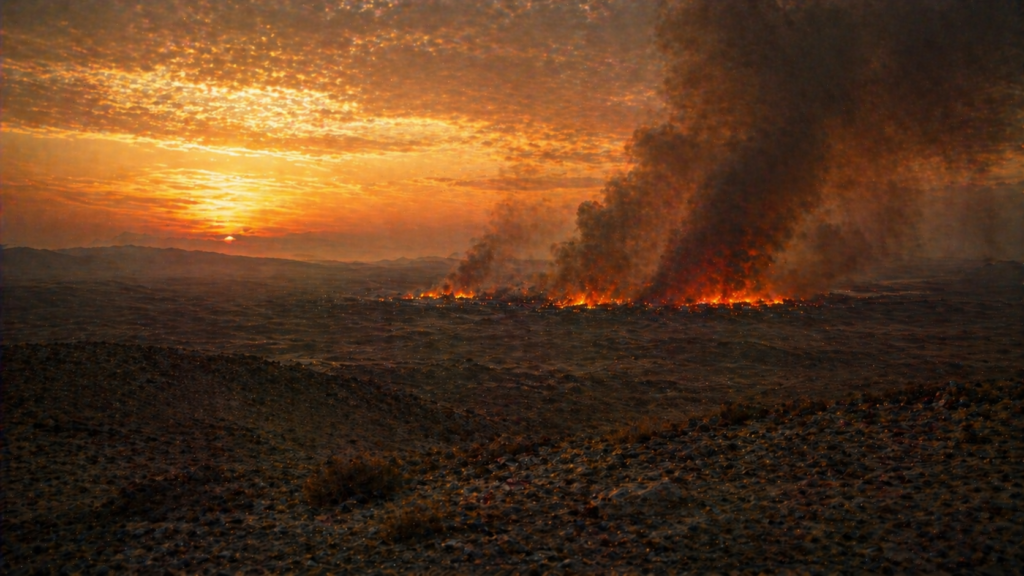
- The destruction (verses 24 to 25). “Yahweh rained on Sodom and on Gomorrah sulfur and fire from Yahweh out of the sky.” The repeated divine name is unusual; some Jewish commentators read it as emphasizing the unilateral nature of the judgment. The destruction is total: the cities, all the plain, all the inhabitants, and the vegetation. The Hebrew verb vayahafok, “and he overthrew,” will be the rest of the Bible’s standard verb for the destruction of Sodom (used in Deuteronomy 29:23, Isaiah 13:19, Jeremiah 49:18, Amos 4:11, and Lamentations 4:6). Sodom becomes the recurring biblical type for the destroyed city of injustice.
Influence callout: Tim Mackie
Mackie’s reading of the destruction emphasizes the de-creation imagery. Genesis 1 had separated the waters above from the waters below, the dry land from the sea, the day from the night. The flood narrative in chapters 6 to 9 had reversed all of those separations. Genesis 19 does something similar to a smaller scale: fire and sulfur from above, the destruction of the plain below, the inversion of the city’s life-giving order. Sodom’s destruction is small de-creation, the flood narrative scaled down to a city. Mackie reads the literary echoes as the narrator’s way of telling us what Sodom’s sin had been: a return, in miniature, to pre-creation chaos.
- Lot’s wife (verse 26). The text gives us the briefest of notes. “His wife looked back from behind him, and she became a pillar of salt.” She is not even named in the chapter. Her death is recorded with three Hebrew words. She has been read variously by interpreters: as the woman who could not let go of Sodom, as the woman who turned back to look for the daughters who stayed (the sons-in-law’s intended brides), as the woman who simply paused too long in the destruction zone. The text does not tell us why she looked. It just tells us the cost.
A note on the science
The Dead Sea region is geologically unstable, sitting along a fault line, with naturally occurring sulfur and bitumen seeps (recall the “tar pits” of chapter 14). Salt formations are also natural to the area. Some readers have located Lot’s wife’s “pillar of salt” in the salt formations on Mount Sodom, southwest of the Dead Sea, where erosion produces vertical pillars of halite that local guides have for centuries identified with this story. The text is not interested in the geology, only in the moral image. We mention the geology only to note that the chapter’s setting is real and the destruction’s mechanism is recognizable.
- Verses 27 to 29 close the destruction scene with a return to Abraham. The patriarch goes up early in the morning to the place where he had stood before Yahweh (the bargain spot, chapter 18:22). He looks toward the cities. The smoke goes up “as the smoke of a furnace.” The Hebrew word for furnace is kivshan, the same word used for the brick-kiln Israel will be enslaved to make in Exodus 1:14, and for the burning Sinai in Exodus 19:18. Sodom’s smoke prefigures Sinai’s smoke. The God who destroys here is the God who will appear there. Abraham, having interceded for the cities, watches them burn from the distance.
- “When God destroyed the cities of the plain, God remembered Abraham, and sent Lot out of the middle of the overthrow” (verse 29). This is the chapter’s quiet theological clincher. Lot was saved because God remembered Abraham. The intercession in chapter 18 reached its conclusion not in the sparing of Sodom (the city did not have ten righteous) but in the sparing of Lot. Abraham’s prayer succeeded, but in a smaller and more painful way than he had hoped. The covenant carrier’s intercession does not always save the city; it sometimes saves the one nephew the patriarch is bound to.
C · Genesis 19:30–38 · The cave and the cousin-nations
³⁰ Lot went up out of Zoar, and lived in the mountain, and his two daughters with him, for he was afraid to live in Zoar. He lived in a cave with his two daughters. ³¹ The firstborn said to the younger, “Our father is old, and there is not a man in the earth to come in to us in the way of all the earth. ³² Come, let us make our father drink wine, and we will lie with him, that we may preserve our father’s family line.” ³³ They made their father drink wine that night, and the firstborn went in, and lay with her father. He didn’t know when she lay down, nor when she arose. ³⁴ It came to pass on the next day, that the firstborn said to the younger, “Behold, I lay last night with my father. Let us make him drink wine again tonight. You go in, and lie with him, that we may preserve our father’s family line.” ³⁵ They made their father drink wine that night also. The younger went and lay with him. He didn’t know when she lay down, nor when she arose. ³⁶ Thus both of Lot’s daughters were with child by their father. ³⁷ The firstborn bore a son, and named him Moab. He is the father of the Moabites to this day. ³⁸ The younger also bore a son, and called his name Ben Ammi. He is the father of the children of Ammon to this day. (Genesis 19:30–38, World English Bible)
- The chapter does not end at the destruction. It has one more scene to deliver, and the scene is grim. Lot, having been granted Zoar, does not stay there. He is “afraid to live in Zoar” (verse 30). Even the city he negotiated for, he cannot trust. He goes up to the mountains, the place the angels originally told him to flee to, and ends up in a cave with his two daughters.
- The geographic detail is theological. Lot started this section as the man who chose the well-watered plain because it was lush and looked like Egypt (13:10). He ends it in a cave in the mountains, with no city, no servants, no son-in-law, no wife. The man who chose by sight has lost everything he chose by sight. The chapter is grimly recording the long arc of Lot’s choices. Sodom did not just destroy Sodom; it destroyed Lot’s whole future as he had imagined it.
- The daughters’ speech (verse 31) is, by ANE convention, both pragmatic and desperate. “Our father is old, and there is not a man in the earth to come in to us in the way of all the earth.” They believe, after the destruction, that they may be the last fertile women alive. The reasoning is exaggerated, but the sense of cosmic loss is real. They have just watched their city destroyed, their mother turned to salt, their fiancés killed in the city. Their grasp on the world has been shaken to the point that they can rationalize what follows.
- The plan (verses 32 to 35) is incest by intoxication. The daughters get their father drunk on consecutive nights and conceive children by him. The text uses repeated, almost ritualistic phrasing: “He didn’t know when she lay down, nor when she arose.” The repetition is the narrator’s way of recording the plan as a deliberate, executed act. Lot is intoxicated; he has no agency in the conception; the daughters are the actors.
A note on reading this scene
The text is recording something deeply troubling, and the moral framework of the modern reader will not match the moral framework of the ancient narrator on every point. What the narrator does not do is celebrate the daughters’ actions. He records them. The repetition of “he didn’t know” is not exoneration of Lot; it is identification of where the moral agency lay. The daughters initiated; the daughters executed; the daughters bore the children. The text makes no comment about consent, abuse, or the moral status of what happened, but it also makes no excuse for it. The chapter is honest about the disturbing dynamics of a family that has been pulverized by trauma and isolation.
Pushback note
Some readings have tried to make the daughters villainesses, framing this scene as Moab and Ammon being founded in moral monstrosity. Others have tried to make Lot the only victim, framing him as a pure innocent. Neither does justice to the text. The chapter is showing us a family that has been destroyed by Lot’s choice in chapter 13 and by Sodom’s collapse in chapter 19. The daughters’ actions are not defensible, but they are recorded as the actions of women who have lost everything and are rationalizing in extremity. Lot’s drunkenness is not blamed, but it is not minimized either. The chapter does not need a clear villain because it is telling us about a family that has been broken in ways that produce moral failures on every side.
- Verses 37 to 38 give the children’s names. The firstborn bears a son and names him Moab (Hebrew Mo’av, conventionally read as “from the father,” a folk etymology that openly names the conception). The younger bears a son and names him Ben Ammi (“son of my people”), the eponymous ancestor of Ammon. The naming is the narrator’s quiet indictment: these peoples carry, in their very name, the family’s incestuous origin.
- The two nations born in this cave will run as cousin-peoples to Israel throughout the rest of the Hebrew Bible. Moab will be where Naomi and her husband flee during the famine in Ruth 1. Ruth herself will be a Moabite, the great-grandmother of David, and through David, an ancestor of Jesus. Ammon and Moab will both be enemies of Israel at points (the Moabite oppressors in Judges, the Ammonite kings of 2 Samuel and 1 Chronicles), and trading partners at others. Deuteronomy 23:3 will exclude Moabites and Ammonites from the assembly. Isaiah and Jeremiah will pronounce judgment oracles against them. They are the almost-family, the cousin-peoples Israel cannot quite shake off.
Influence callout: N.T. Wright
Wright’s broader reading of these patriarchal genealogies emphasizes that Genesis is honest about the family’s tangled origins. The covenant line will run through Sarah and Isaac, but the wider Genesis family includes Ishmael (chapter 16), Esau (chapters 25, 36), Moab and Ammon (chapter 19). All of these are cousin-peoples, all of them are recorded with their problematic origins, and all of them remain in God’s care according to chapters like Deuteronomy 2:9 (“do not harass Moab… I have given Ar to the descendants of Lot for a possession”) and Deuteronomy 2:19 (similar for Ammon). The Hebrew Bible does not erase the cousin-peoples; it locates them in the wider story. Even the most disturbing patriarchal scene contributes to the genealogy that will eventually produce Ruth, and through Ruth, David, and through David, the Messiah. The chapter is recording origins that the rest of the canon will keep working with, not throwing away.
- The chapter ends here. Lot, his daughters, and the two infant sons in a cave in the mountains. Abraham, last seen looking at the smoke from a distance, is twenty miles away. The two arcs of the patriarchal narrative (Abraham at Mamre, Lot in the cave) will not cross again. Lot disappears from the story. His descendants will reappear throughout the rest of the Bible. But the man himself is finished. The patriarch’s nephew, who once chose the well-watered plain, ends his story as the unwitting drunken father of two cousin-nations, in a cave he cannot leave.
Reflection prompts
- Lot was rescued because God remembered Abraham. He did not pull himself out of the city; he was pulled out by hand. Where in your life have you been pulled out of something by mercy you did not earn, and how does it shape what you owe the people who interceded for you?
- The chapter’s record of Sodom’s sin is not what popular Christian preaching has often made it. Pride, indifference to the poor, and the predatory violation of strangers are at the center of how the Hebrew Bible names this city’s collapse. Where in your own moral imagination have you held a flattened version of biblical evil, and what would it mean to let the prophets’ definition reshape the way you see your own city?
- The Lot narrative ends not in repentance or restoration but in a cave, an intoxication, and the conception of cousin-nations. The Bible is grimly honest about the long downstream cost of choices the patriarchs made decades earlier. Where in your life are you still living with the consequences of choices that, at the time, looked like the well-watered plain?