

Chapter 8 brings the dwelling fully online with two acts. First the lampstand is lit, so that light shines in the holy place. Then the Levites are formally cleansed, presented to God, and set to their work. Together the two pieces complete the picture the previous chapters have been assembling: a dwelling at the center of the camp, lit and tended, served by a tribe wholly given to God.
The Levites’ consecration restates the great exchange of chapter 3 and deepens it. They are given, the chapter’s key word, wholly handed over to God in place of Israel’s firstborn, and then given again by God to Aaron as helpers. They are presented before YHWH as a kind of living offering, and their service is described as a buffer that keeps wrath from breaking out when the people draw near the holy. The chapter is about belonging: who the Levites belong to, what they are for, and how a life given to God is structured, including how it changes as a person ages.
A · Numbers 8:1-4 · Light before the dwelling
² “Speak to Aaron, and tell him, ‘When you light the lamps, the seven lamps shall give light in front of the lampstand.’” … ⁴ This was the workmanship of the lampstand, beaten work of gold. From its base to its flowers, it was beaten work. According to the pattern which Yahweh had shown Moses, so he made the lampstand.
- The seven lamps shall give light in front of the lampstand (v. 2). The first task is light. The seven-branched lampstand, the menorah, is to be tended so its lamps shine outward into the holy place. A dwelling needs light, and the light of the sanctuary is no accident of décor; it is part of what makes the space habitable for worship and service.
- Beaten work of gold… its base to its flowers (v. 4). The lampstand is hammered from a single piece of gold and shaped like a flowering tree, with branches, buds, and blossoms (Exodus 25:31-40). It is a stylized tree of light standing in the holy place. Read alongside the cosmic temple and the garden-sanctuary, the menorah evokes the tree of life in Eden: a golden tree, blossoming and luminous, in the inner sanctuary of the world. The sanctuary is a garden in miniature, and the lampstand is its tree.
- According to the pattern which Yahweh had shown Moses (v. 4). The note that the lampstand follows the heavenly pattern (the same word, tavnit, used in Exodus 25:9, 40) keeps the whole sanctuary tethered to its model: the earthly dwelling images a heavenly reality. Hebrews will later make much of this, the earthly tabernacle as a copy and shadow of the heavenly things (Hebrews 8:5, citing this very instruction). The light that shines here is a reflection of a greater light.
B · Numbers 8:5-19 · The Levites cleansed and given
¹⁴ “Thus you shall separate the Levites from among the children of Israel, and the Levites shall be mine. … ¹⁶ For they are wholly given to me from among the children of Israel; instead of all who open the womb, even the firstborn of all the children of Israel, I have taken them for myself.”
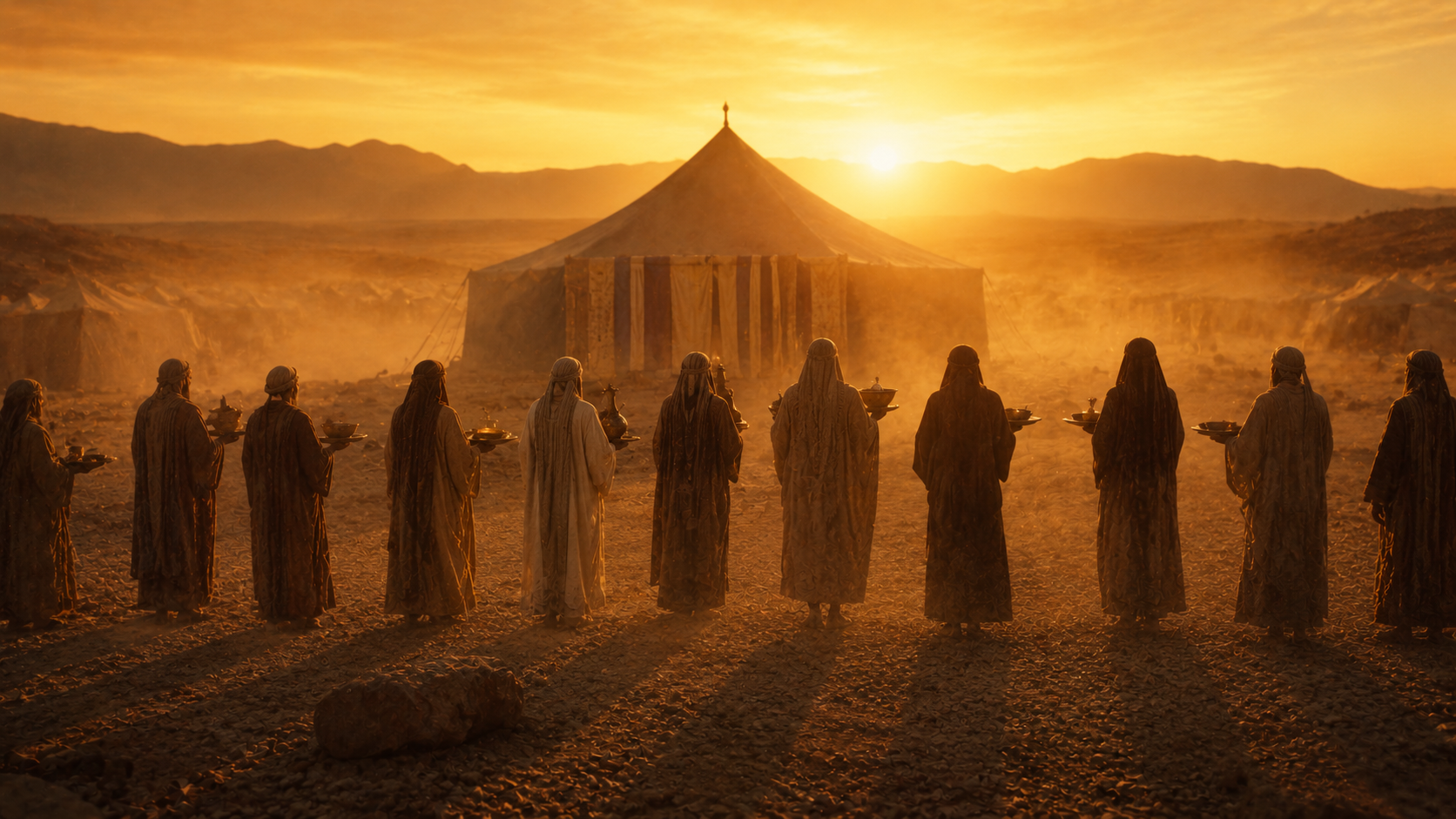
- Cleansed and presented (vv. 5-13). The Levites are sprinkled with the water of cleansing, shave their whole bodies, wash their clothes, and are then presented before YHWH. Aaron offers them as a tenufah, a wave offering, the gesture used to present a gift to God and receive it back for sacred use. The striking image is that the Levites themselves are the offering: a tribe lifted up before God as Israel’s living gift.
- The Levites shall be mine (v. 14). The refrain of chapter 3 returns. The Levites belong to YHWH, separated out from the rest of Israel for him. Belonging is the chapter’s center of gravity, and it is stated as God’s own claim: mine.
- Instead of all who open the womb (v. 16). Again the substitution: the Levites stand in place of the firstborn whom God claimed on Passover night (see the firstborn / bechor). The chapter layers a second sense of gift onto the first. The Levites are given by Israel to God in place of the firstborn, and then (v. 19) given by God to Aaron as helpers. They are twice-given, handed up and handed back, which is what consecrated life always is.
- To make atonement… that there be no plague (v. 19). The Levites’ service is described as protective, exactly as in 1:53. By doing the dangerous work of tending the holy on the people’s behalf, they keep the people safe when they come near the sanctuary. Their given life is a buffer that lets the whole camp live near a holy God (see outside the camp). To be given to God turns out to mean being spent for the safety and nearness of others.
Word study: netunim (נְתוּנִים), “given ones”
Verse 16 says the Levites are netunim netunim, a doubled form usually rendered “wholly given” or “given, given” to YHWH, and verse 19 says God in turn has given them to Aaron. The root is natan, “to give,” the most ordinary verb in Hebrew, here freighted with vocation. The Levites are defined by being given. The term later hardens into a title: the Nethinim (the “given ones”) are a class of temple servants in Ezra and Nehemiah (Ezra 8:20). To belong to God in this book is to be a gift, handed over for his use and handed on for the good of others. The same logic surfaces in the New Testament when Paul says the Macedonians gave themselves first to the Lord (2 Corinthians 8:5) and when believers are urged to present their bodies as a living sacrifice (Romans 12:1). The Levite is the Old Testament’s clearest picture of a life that is, simply, given.
Influence callout: Jay Sklar (Story of God; given in order to give)
Sklar highlights the double movement of the Levites’ giving and its purpose. They are given to God, then given by God to serve, and the service exists for the people: to do the heavy and dangerous work of the sanctuary so that ordinary Israelites can draw near and live. Sklar’s pastoral reading is that consecration in Scripture is never a private elevation; it is always for the sake of the community. The Levite’s whole identity is to be spent on behalf of others’ access to God. This anticipates the New Testament’s vision of every believer as a living offering and a royal priest (Romans 12:1; 1 Peter 2:9), set apart not to be served but to serve. To be wholly given to God, in this book’s grammar, is to be wholly given for the people.
C · Numbers 8:23-26 · A life of service, and its retirement
²⁵ “and at the age of fifty years they shall retire from doing the work, and shall serve no more, ²⁶ but shall assist their brothers in the Tent of Meeting, to fulfill responsibilities, and they shall do no regular service.’”
- From twenty-five years old… they shall enter to perform the service (vv. 24). The Levite’s working life has a beginning and an end. Full service runs from age twenty-five (in chapter 4 the active corps for carrying is counted from thirty; the ages frame different aspects of the work) to fifty.
- At the age of fifty they shall retire from the work (v. 25). The chapter builds in retirement. At fifty, the Levite steps back from the heavy labor. This is a humane and realistic note: the carrying of the tabernacle is physically demanding, and the law does not pretend bodies last forever. The vocation honors the limits of the worker.
- But shall assist their brothers (v. 26). Retirement is not discard. The older Levites assist and keep responsibility even when they no longer do the regular labor. Their role changes from carrying to guarding, from doing to overseeing. The chapter models a theology of vocation across a whole lifespan: there is honored work for the strong years and honored work for the later ones, and the community needs both. Few ancient texts think this carefully about the worker who has aged out of the heaviest tasks, and the care is itself a kind of dignity.
Reflection prompts
- The Levites are wholly given, handed up to God and handed back for the good of others. What would it mean for your own life to be genuinely “given,” not just busy or religious, but spent for others’ nearness to God?
- The lampstand is a tree of light tended daily in the holy place. Light has to be kept burning, not lit once. What practice in your life keeps the light tended rather than assuming it will stay lit on its own?
- The Levite’s role changes at fifty, from carrying to assisting, without losing its honor. How do you (or your community) treat the season when someone shifts from doing the heavy work to mentoring and overseeing it? Is that transition honored or quietly devalued?
Frameworks at play in this chapter: the firstborn / bechor, outside the camp, the tabernacle as cosmic temple.