
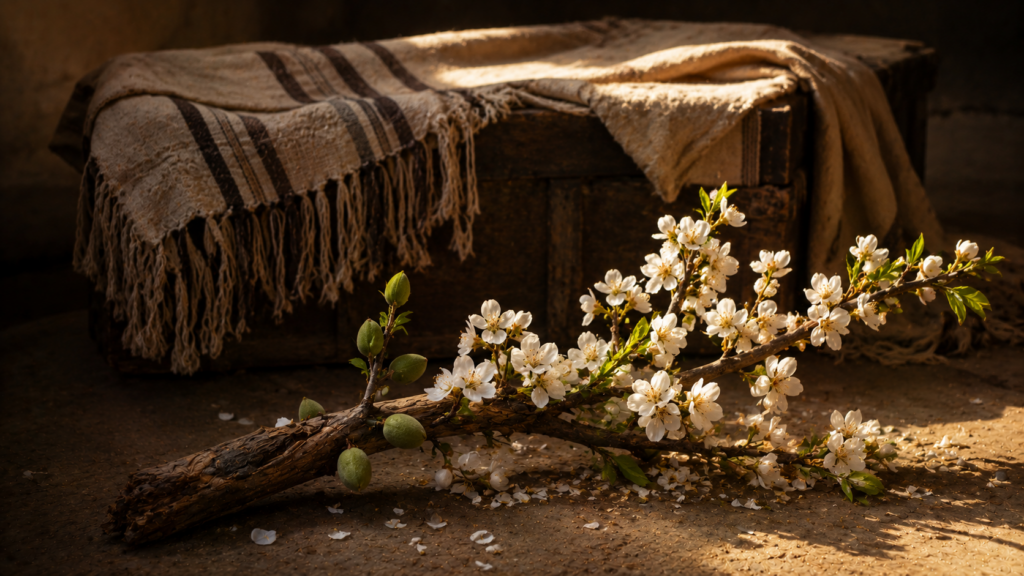
After the deaths of chapter 16, the priesthood question still festers, and God settles it in a way that could not be more different from the earthquake and the fire. He asks each tribe to bring a staff inscribed with its leader’s name, Aaron’s for the tribe of Levi, and to leave them overnight before the ark. In the morning, Aaron’s staff alone has sprouted, budded, blossomed, and borne ripe almonds. A dead piece of wood has burst into life. God vindicates his chosen priest not with another judgment but with a miracle of life: dry wood blooming and bearing fruit.
The contrast with chapter 16 is the whole point. The grasp for the priesthood ended in death; the confirmation of the priesthood comes through life. God could have settled the dispute with more fire. Instead he settled it with blossoms. The chapter quietly teaches that God’s preferred way of establishing his chosen one is not by destroying rivals but by making dead things live, a pattern that runs all the way to an empty tomb.
A · Numbers 17:1-9 · The rod that came back to life
⁸ On the next day Moses went into the Tent of the Testimony; and behold, Aaron’s rod for the house of Levi had sprouted, budded, produced blossoms, and bore ripe almonds.
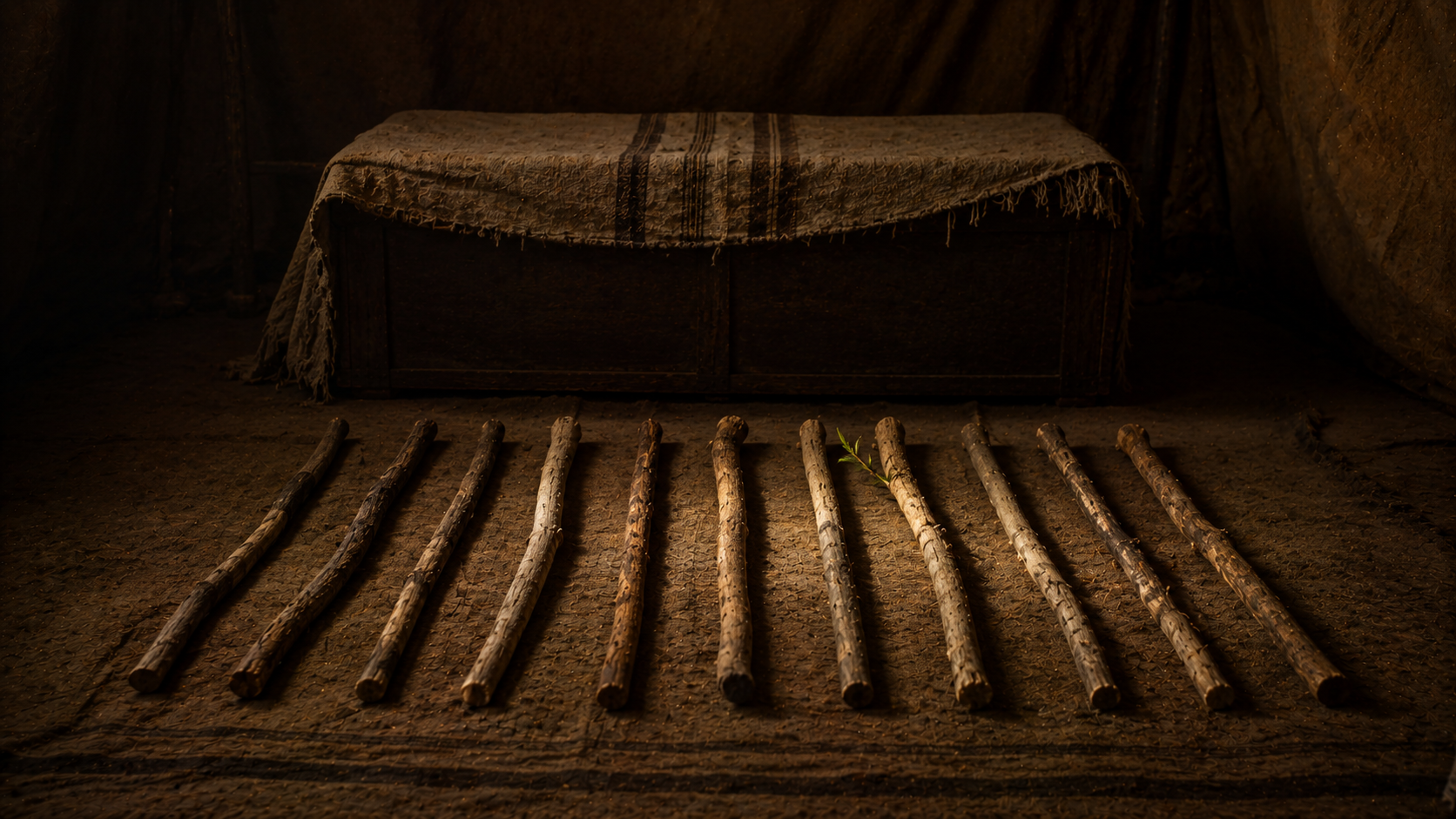
- Twelve staffs, one per tribe (vv. 1-7). Each leader brings a staff with his name written on it, Aaron’s name on Levi’s. The staffs are placed before the testimony, in front of the ark, overnight. A staff is the perfect object for the test: it is a cut piece of wood, dead, incapable of producing anything. Whatever happens to it can only come from God.
- Sprouted, budded, blossomed, bore ripe almonds (v. 8). The text lists four stages of growth, the entire life-cycle of a fruiting branch, compressed into a single night on Aaron’s staff alone. This is not merely a sprout; it is the full arc from bud to blossom to ripe fruit. The dead wood does in one night what a living almond tree does across a whole spring. The sign is unmistakable and gentle: no one else dies, and the chosen priesthood is declared by abundance of life.
- Vindication by life, not by force. The chapter’s theology is in the contrast with what came before. Korah’s rebellion was answered by the earth swallowing and fire consuming; the lingering question is now answered by a branch in bloom. God can settle a dispute by killing, and in chapter 16 he did; but his chosen way of confirming his servant is to make dead wood live. The pattern points forward. The New Testament will declare Jesus the true high priest after the order of Melchizedek (see the Melchizedek priesthood), and the proof of his priesthood is not the destruction of his rivals but his resurrection, life bursting from a sealed tomb. Aaron’s rod, kept in the ark (Hebrews 9:4), is a small wooden prophecy of it.
Word study: shaqed (שָׁקֵד), “almond,” and shoqed, “watching”
The fruit on Aaron’s rod is the shaqed, the almond, and the Hebrew hides a pun the prophets loved. The almond is the first tree to bloom in the land, flowering while everything else is still bare, so it was called the “waker” or “watcher.” The verb shaqad means “to watch, to be wakeful, to hasten.” When God shows Jeremiah an almond branch (shaqed) and asks what he sees, the answer unlocks a pun: you have seen well, for I am watching (shoqed) over my word to perform it (Jeremiah 1:11-12). The almond is the tree of God’s wakeful, hastening faithfulness, the first to bloom, the sign that life is coming. It is no accident that the lampstand in the holy place is shaped with almond blossoms (Exodus 25:33-34): the sanctuary’s tree of light bears the same flower as the rod that proves the priesthood. Aaron’s almond-bearing staff says, in the language of the first spring tree, that God is awake, watching over his promise, and bringing life where there was only dead wood.
B · Numbers 17:10-13 · A sign kept, and a people afraid
¹² The children of Israel spoke to Moses, saying, “Behold, we perish! We are undone! We are all undone! ¹³ Everyone who keeps approaching Yahweh’s tabernacle dies! Will we all perish?”
- Kept… for a sign against the rebels (v. 10). The budded rod is placed permanently before the ark, to be kept for a token against the children of rebellion, that you may make an end of their complaining. The miracle becomes a monument. Where the censers of chapter 16 plated the altar as a warning, the living rod stands inside the ark as a standing answer to the question of who God has chosen. The sign of life is meant to silence the grumbling that the signs of death could not.
- Behold, we perish! (vv. 12-13). The people’s response is raw terror. Having watched the earth swallow rebels and a plague sweep the camp, they now panic at the holiness in their midst: everyone who approaches the tabernacle dies; will we all perish? The fear is not baseless. They have grasped, finally, what the book has been teaching, that a holy God dwelling in the camp is genuinely dangerous (see outside the camp). But fear is not the same as faith, and terror alone cannot solve the problem of how to live near God.
- The chapter ends on an unresolved cry, and it is meant to. The people’s question, how can we possibly survive this nearness?, is exactly the question chapter 18 will answer. The priesthood that Korah grasped for and that Aaron’s rod confirmed exists precisely to solve this terror: the priests will bear the iniquity of the sanctuary so that the people can live near God and not perish. The fear at the end of chapter 17 is the setup for the gift at the start of chapter 18.
Reflection prompts
- God settles the dispute not with more fire but with a branch in bloom. Where are you waiting for God to vindicate something by force, when his way might be to bring quiet, undeniable life instead?
- The almond is the first tree to bloom, the sign that God is “watching over his word.” Where do you need to trust that God is awake and bringing life to something that currently looks like dead wood?
- The people’s terror at God’s holiness is real but not yet faith. Have you ever been so aware of God’s holiness that it became only fear? What would it take to move from “we all perish” to a reverent, trusting nearness?
Frameworks at play in this chapter: the tabernacle as cosmic temple, the Melchizedek priesthood, outside the camp.