
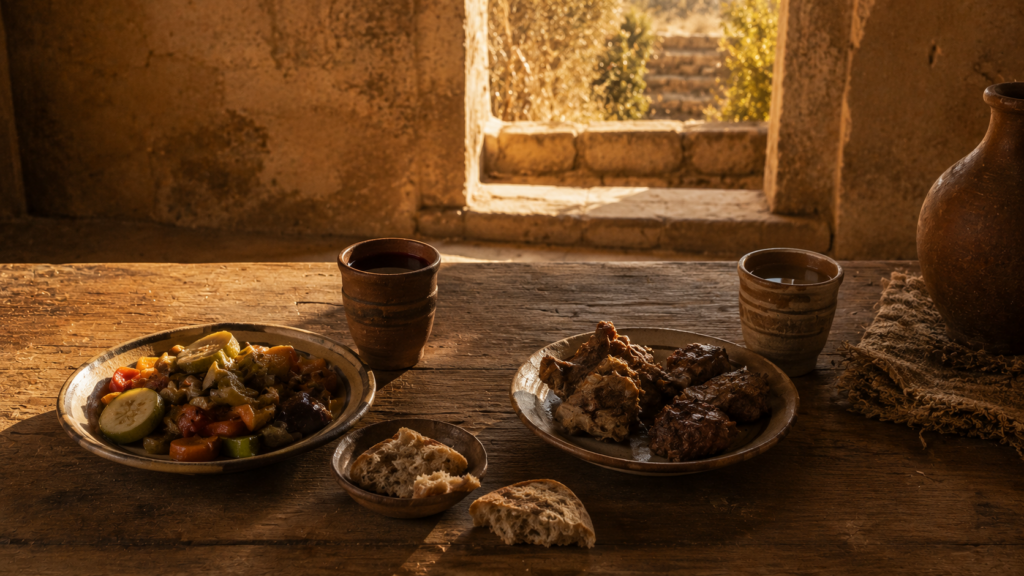
Romans 14 is the chapter where Paul finally addresses the actual community problem that has been driving the entire letter. Scot McKnight’s backward-read thesis names this chapter, with 15:1-13, as the pastoral target the previous thirteen chapters have been preparing for. The chapter addresses the Strong and the Weak in the Roman house churches: believers who eat anything and believers who eat only vegetables; believers who esteem all days alike and believers who esteem one day above another. The chapter does not resolve the practical question of who is right about food and days; it resolves the relational question of how the community welcomes both groups: the strong are not to despise the weak; the weak are not to condemn the strong; each will give account to God; the kingdom of God is not eating and drinking.
The chapter divides into two clear movements. Verses 1-12 address the basic call to mutual welcome and the warning against judging another’s servant. Verses 13-23 develop the cruciform-ethic application: do not put a stumbling block in your brother’s way; do not destroy the work of God for the sake of food; the kingdom of God is righteousness, peace, and joy in the Holy Spirit.
Reading the chapter requires the audience-reconstruction question to be in view. On McKnight’s mixed-audience reading, the Weak are mostly Jewish believers maintaining ancestral Torah practice (kashrut, Sabbath, festival observance) and the Strong are mostly gentile believers (and some Jewish believers) who have relaxed those practices. On Gombis’s all-gentile-with-Judaizers reading, the Weak are gentile Judaizers (gentiles who have taken on Jewish boundary-marker practices) and the Strong are gentile believers who have not Judaized. Either reading fits the chapter’s welcome-across-difference logic. The chapter does not depend on resolving the audience question; it depends on both groups welcoming the other without contempt or condemnation.
A · Romans 14:1-12 · Welcome the weak
¹ Now accept one who is weak in faith, but not for disputes over opinions. ² One man has faith to eat all things, but he who is weak eats only vegetables. ³ Don’t let him who eats despise him who doesn’t eat. Don’t let him who doesn’t eat judge him who eats, for God has accepted him. ⁴ Who are you who judge another’s servant? To his own lord he stands or falls. Yes, he will be made to stand, for God has power to make him stand. ⁵ One man esteems one day as more important. Another esteems every day alike. Let each man be fully assured in his own mind. ⁶ He who observes the day, observes it to the Lord; and he who does not observe the day, to the Lord he does not observe it. He who eats, eats to the Lord, for he gives God thanks. He who doesn’t eat, to the Lord he doesn’t eat, and gives God thanks. ⁷ For none of us lives to himself, and none dies to himself. ⁸ For if we live, we live to the Lord. Or if we die, we die to the Lord. If therefore we live or die, we are the Lord’s. ⁹ For to this end Christ died, rose, and lived again, that he might be Lord of both the dead and the living. ¹⁰ But you, why do you judge your brother? Or you again, why do you despise your brother? For we will all stand before the judgment seat of Christ. ¹¹ For it is written, “‘As I live,’ says the Lord, ‘to me every knee will bow. Every tongue will confess to God.’” ¹² So then each one of us will give account of himself to God.
- Accept one who is weak in faith, but not for disputes over opinions (v. 1). The Greek ton de asthenounta tē pistei proslambanesthe, mē eis diakriseis dialogismōn. The verb proslambanō (to take to oneself, to welcome) names active reception into the community. Welcome is not tolerance; it is full inclusion. The qualification (not for disputes over opinions) names the wrong purpose: welcoming someone so as to argue them out of their position is not welcome. The verse is the chapter’s structural opening.
Influence callout: Scot McKnight (Reading Romans Backwards, ch 3 Strong and Weak)
McKnight’s Reading Romans Backwards names Romans 14-15 as the pastoral center of the whole letter. On McKnight’s reading, the Strong (mostly gentile believers, with some Jewish believers) and the Weak (mostly Jewish believers maintaining ancestral Torah practice) were in significant conflict in the Roman house churches following Claudius’s expulsion of the Jews (49 CE), the gentile-dominant church culture that developed during the expulsion years, and the Jewish believers’ return after Claudius’s death (54 CE). McKnight’s pastoral payoff: the entire theological argument of Romans 1-11 exists to serve the practical welcome the chapter now commands. Without chapter 14’s actual community problem, the whole letter is a treatise rather than a pastoral letter; with chapter 14 in view, the whole letter is a sustained intervention into a real community’s actual conflict.
- One man has faith to eat all things, but he who is weak eats only vegetables (v. 2). The Greek ho asthenōn lachana esthiei. The specific practical dispute: meat vs vegetables. Two backgrounds are operative. First, kashrut: Jewish believers maintaining the Torah’s food laws might avoid meat sold in the Roman markets because they could not verify the meat’s slaughter according to kosher practice. Second, meat sacrificed to idols: meat in the Roman markets had often passed through pagan temple sacrifice before sale (cf. 1 Cor 8 and 10 on the same problem in Corinth). The vegetable-only practice avoided both problems. The dispute is not about vegetarianism as such; it is about Torah-observance and avoidance of idol-tainted food.
- Don’t let him who eats despise him who doesn’t eat. Don’t let him who doesn’t eat judge him who eats (v. 3). The Greek exoutheneitō (despise) and krinetō (judge) name two different sins. The Strong’s sin is despising (the condescending dismissal of the weak’s scruple as superstition). The Weak’s sin is judging (the moralistic verdict against the strong’s freedom as worldliness). Each group has its own characteristic temptation; the chapter addresses both.
- Who are you who judge another’s servant? (v. 4). The Greek sy tis ei ho krinōn allotrion oiketēn. The verse names the chain of authority: each believer is Christ’s servant; judging another’s servant is taking on a role that is not yours. The verse is one of the New Testament’s most concentrated single-line warnings against Christian mutual judgment. The verse does not foreclose all moral discernment; it forecloses the act of standing in Christ’s place to issue verdicts on other believers’ Christian faithfulness.
- One man esteems one day as more important. Another esteems every day alike. Let each man be fully assured in his own mind (v. 5). The second specific dispute: days. The background is the Jewish festival calendar: Sabbath, Passover, Pentecost, Day of Atonement, Sukkot, and the new moon observances. Some believers (the Weak) observed the days as part of ancestral Torah practice; other believers (the Strong) did not specifically observe them. The verse names the chapter’s posture: each believer’s conviction (Greek plērophoreisthō en tō idiō noi, fully assured in their own mind) is to be respected; each believer’s practice is to be received as worship to the Lord.
- He who observes the day, observes it to the Lord; and he who does not observe the day, to the Lord he does not observe it (v. 6). The Greek ho phronōn tēn hēmeran, kyriō phronei. The verse is theologically remarkable. Both the day-observer and the day-non-observer are acting “to the Lord”. The Christian community is not uniform in practice; both practices are received as worship. The verse is consistent with Paul Within Judaism: Jewish believers who continue Torah-observance (including festival observance) are acting to the Lord; gentile believers who do not adopt the Jewish festival calendar are also acting to the Lord; neither group is wrong.
- None of us lives to himself, and none dies to himself (v. 7). The Greek oudeis gar hēmōn heautō zē. The chapter’s deepest structural claim. The Christian’s life is not autonomous; it is Christ’s. The verse is the radical refusal of autonomous individualism that the modern Western Christian tradition has often forgotten. Living and dying are both Christ’s. The whole later Christian theology of belonging to the Lord reads forward from this verse.
- Christ died, rose, and lived again, that he might be Lord of both the dead and the living (v. 9). The Greek eis touto gar Christos apethanen kai ezēsen, hina kai nekrōn kai zōntōn kyrieusē. The verse names the purpose of the death-and-resurrection: the Lordship over both dead and living. The verse is Christological: Christ’s lordship is not optional. The verse undergirds the chapter’s welcome-one-another command by naming the criterion: whoever is Christ’s, is welcomed.
- Why do you judge your brother? Or why do you despise your brother? (v. 10). The verse returns to the chapter’s two-direction warning. Judging (the Weak’s temptation) and despising (the Strong’s temptation) are both forbidden. Both groups will stand before the judgment seat of Christ; that judgment is not your job to perform in advance.
- We will all stand before the judgment seat of Christ (v. 10). The Greek bēma tou theou (variant: Christou, judgment seat of Christ). The bēma was the elevated platform on which Roman magistrates pronounced judgment. The image is judicial-civic: every believer will appear before Christ’s tribunal. The verse picks up the judgment-according-to-works theme of Romans 2:6-11 and 2 Corinthians 5:10. Each one will give account (Greek hekastos peri heautou logon dōsei). The chapter forecloses any cheap-grace reading of grace-and-works: the believer’s life will be evaluated by Christ; the believer is responsible.

B · Romans 14:13-23 · The cruciform application
¹³ Therefore let’s not judge one another any more, but judge this rather, that no man put a stumbling block in his brother’s way, or an occasion for falling. ¹⁴ I know, and am persuaded in the Lord Jesus, that nothing is unclean of itself; except that to him who considers anything to be unclean, to him it is unclean. ¹⁵ Yet if because of food your brother is grieved, you walk no longer in love. Don’t destroy with your food him for whom Christ died. ¹⁶ Then don’t let your good be slandered, ¹⁷ for the Kingdom of God is not eating and drinking, but righteousness, peace, and joy in the Holy Spirit. ¹⁸ For he who serves Christ in these things is acceptable to God and approved by men. ¹⁹ So then, let’s follow after things which make for peace, and things by which we may build one another up. ²⁰ Don’t overthrow God’s work for food’s sake. All things indeed are clean, however it is evil for that man who creates a stumbling block by eating. ²¹ It is good to not eat meat, drink wine, nor do anything by which your brother stumbles, is offended, or is made weak. ²² Do you have faith? Have it to yourself before God. Happy is he who doesn’t judge himself in that which he approves. ²³ But he who doubts is condemned if he eats, because it isn’t of faith; and whatever is not of faith is sin.
- Let’s not judge one another any more (v. 13). The chapter shifts from the basic call to the cruciform application. The community is to stop judging one another. The verse echoes Christ’s teaching (Mt 7:1: do not judge, that you be not judged). The verb krinō (to judge) is the same verb used at 2:1 (you who judge are without excuse) and 14:3-4. The chapter’s anti-judgment theme is consistent across the letter.
- That no man put a stumbling block in his brother’s way (v. 13). The Greek to mē tithenai proskomma tō adelphō ē skandalon. The stumbling block (Greek proskomma) and snare (Greek skandalon) are images of causing another to fall. The verse forecloses the strong’s freedom being exercised at the weak’s expense. The strong’s freedom is real; the strong’s responsibility to the weak’s conscience is also real. The two must be held together.
- Nothing is unclean of itself; except that to him who considers anything to be unclean, to him it is unclean (v. 14). The Greek ouden koinon di’ heautou, ei mē tō logizomenō ti koinon einai, ekeinō koinon. The verse is one of the chapter’s most-debated single lines. Paul acknowledges (with the Strong) that no food is intrinsically unclean. The verse echoes Mark 7:19 (Jesus declared all foods clean). But Paul immediately qualifies: to the one who considers something unclean, to that person it is unclean. Subjective conscience is real; what one believes is sin is sin for one. The verse names the principle of conscience-respect: the Strong’s freedom does not override the Weak’s conscience. The verse is consistent with Paul Within Judaism: Jewish believers who keep kashrut are not wrong to do so; their conscience requires the practice; the practice is real worship to the Lord.
- Don’t destroy with your food him for whom Christ died (v. 15). The Greek mē tō brōmati sou ekeinon apollue hyper hou Christos apethanen. The verse is the chapter’s cruciform climax. Christ died for the weak brother; the strong’s insistence on freedom-over-conscience would destroy (Greek apollue) the work of Christ in that brother. The verse names the moral weight of cruciform community: Christ’s death is the measure of how seriously to take the weak brother’s conscience.
- The Kingdom of God is not eating and drinking, but righteousness, peace, and joy in the Holy Spirit (v. 17). The chapter’s most-quoted single verse. The Greek ou gar estin hē basileia tou theou brōsis kai posis, alla dikaiosynē kai eirēnē kai chara en pneumati hagiō. The verse names the kingdom’s substance: righteousness, peace, joy in the Spirit, not food-and-drink debates. The verse refuses the wrong-question of whose food practice is right; it redirects to what actually matters: cruciform-community-life animated by the Spirit. The whole later Christian kingdom-of-God theology reads forward from this verse.
- Let’s follow after things which make for peace, and things by which we may build one another up (v. 19). The Greek ta tēs eirēnēs diōkōmen kai ta tēs oikodomēs tēs eis allēlous. The verse names the constructive pursuit: peace and mutual edification. The community is not to pursue its own preferences; it is to pursue what makes for peace and builds one another up. The verse is the practical-pastoral guide for every food-and-day decision the community will make.
- Whatever is not of faith is sin (v. 23). The chapter’s closing line. The Greek pan de ho ouk ek pisteōs hamartia estin. The verse names the conscience-criterion: what is not done from pistis is sin. Acting against your conscience is sin, regardless of whether the action would be sin if performed in faith. The verse is one of the chapter’s most important pastoral guidelines: follow your conscience, even when others’ consciences differ. The verse does not abolish objective moral norms; it names the believer’s responsibility to act with integrity according to the conscience the Spirit forms.
Influence callout: Marty Solomon (Bema podcast, Romans series)
Solomon’s Hebrew-context reading of Romans 14 aligns with the Paul Within Judaism framework. Solomon insists: the chapter is not abolishing kashrut for Jewish believers. Jewish believers in Messiah continue Torah-observance; gentile believers do not need to adopt the Jewish boundary-markers; both practices are real worship to the Lord. Solomon’s pastoral payoff: the chapter is the most important New Testament text for how the modern Christian community engages with the ongoing practice of Messianic Jewish congregations and with the wider Jewish community’s ongoing covenant practice. Christians should not assume that Jewish believers’ Torah-observance is legalism to be corrected; Christians should not assume that Jewish observance is somehow obsolete. The chapter calls both groups to mutual respect and welcome across the difference. The chapter’s do not despise and do not judge commands apply directly to the modern Christian engagement with Jewish believers in Messiah and with the Jewish people.
Reflection prompts
- The chapter’s core command is welcome (14:1). The strong welcomes the weak; the weak welcomes the strong; each gives account to God. Where in your own faith community is welcome currently contingent on the other’s conformity to your practice? What would welcome-without-conformity require of you?
- None of us lives to himself, and none dies to himself (14:7). The verse refuses autonomous individual Christianity. The believer belongs to Christ. Where in your own discipleship has the assumption of autonomous personal Christianity gone unexamined? What would belonging to Christ require of how you make your decisions?
- The kingdom of God is not eating and drinking, but righteousness, peace, and joy in the Holy Spirit (14:17). The verse redirects the wrong question (whose practice is right?) to the right question (what actually constitutes the kingdom?). Where in your own church life are food-and-drink-equivalent debates (worship style, theological vocabulary, political alignment) crowding out the righteousness-peace-and-joy substance? What would the redirection look like?
- Don’t destroy with your food him for whom Christ died (14:15). The verse names the cruciform measure: Christ died for the brother whose conscience your freedom may wound. Where in your own life has your freedom been exercised at the cost of someone else’s conscience? What would measuring your freedom by Christ’s cruciform love for the wounded brother require?
Frameworks at play in this chapter: Paul Within Judaism · the cruciform hermeneutic · gospel allegiance · the new covenant · works of the law