

Romans 5 is the bridge between the justification argument of chapters 1-4 and the new-life-in-the-Spirit argument of chapters 6-8. The chapter opens with peace with God (5:1) and closes with the Adam-Christ contrast (5:12-21) that anchors all the chapters that follow. The first half (5:1-11) is the New Testament’s most concentrated paragraph on Christian assurance: while we were weak, ungodly, sinners, enemies, Christ died for us, and much more will we now be reconciled, saved, brought into the divine life. The second half (5:12-21) introduces the Adam Christology framework that the rest of Romans 6-8 will develop: humanity is in Adam, under sin and death; humanity is now also offered to be in Christ, under righteousness and life.
The chapter divides into two clear halves. Verses 1-11 develop the therefore of justification: being justified, we have peace. The argument climbs through rejoicing in hope (v. 2), rejoicing in tribulations (v. 3), the love of God poured out (v. 5), and the while we were still sinners assurance (vv. 6-8) to the much more logic of present-and-future salvation (vv. 9-11). Verses 12-21 then turn to the Adam-Christ typology: sin entered through one man; grace abounds through one man. The structure is type and antitype (Greek typos, v. 14): Adam prefigures Christ, and Christ climactically fulfills what the Adam-pattern began.
The chapter is one of the historically most-debated in the Pauline corpus. Augustine’s reading of 5:12 (in whom all sinned) became the foundational text for the Western tradition’s doctrine of original sin. The Reformation’s federal headship tradition reads 5:12-21 as the cornerstone of imputation. The site holds the Adam-Christology framework that names both the Augustinian-Western reading and the patristic-Eastern recapitulation reading as historic articulations, with the Greek of 5:12 (eph hō pantes hēmarton, because all sinned) read as most naturally rendered in the contextual sense, not in Augustine’s in whom (in quo) Latin-grammatical sense.
A · Romans 5:1-5 · Peace with God
¹ Being therefore justified by faith, we have peace with God through our Lord Jesus Christ; ² through whom we also have our access by faith into this grace in which we stand. We rejoice in hope of the glory of God. ³ Not only this, but we also rejoice in our sufferings, knowing that suffering produces perseverance; ⁴ and perseverance, proven character; and proven character, hope; ⁵ and hope doesn’t disappoint us, because God’s love has been poured into our hearts through the Holy Spirit who was given to us.
- Being therefore justified by faith, we have peace with God (v. 1). The Greek eirēnēn echomen pros ton theon (we have peace toward God) is the chapter’s structural opening. The aorist participle dikaiōthentes (having been justified) names the completed act of justification (Rom 3:21-26; 4:1-25) as the premise of what follows. Peace (Greek eirēnē, the Hebrew shalom) is not merely the cessation of hostility; it is the wholeness of the covenant relationship. The verse names the peace the gospel produces both vertically (with God) and horizontally (the peace among the Strong and Weak that chs 14-15 will develop). The peace at 5:1 anticipates the peace at 15:33 (the God of peace be with you all) and 16:20 (the God of peace will soon crush Satan under your feet).
- Through whom we also have our access by faith into this grace in which we stand (v. 2). The Greek prosagōgē (access) names entry into the royal presence. The image is court ceremonial: the believer is brought in by the mediator (Christ) into the presence of the king. The standing (Greek hestēkamen, we stand) names the believer’s ongoing position in grace. The verse is one of the New Testament’s deepest pastoral assurance passages.
- We rejoice in hope of the glory of God (v. 2). The Greek kauchōmetha ep’ elpidi tēs doxēs tou theou. The verb kauchaomai (boast, glory in, rejoice exultantly) is exactly the verb Paul excluded at 3:27 (where then is boasting? It is excluded). The exclusion was of human-achievement boasting; the embrace here is of boasting in God’s promised glory. The verse repurposes the boasting vocabulary: boasting is excluded in the sense of self-credit; boasting is embraced in the sense of exultant rejoicing in the divine gift.
- We also rejoice in our sufferings (v. 3). The chapter’s surprising turn. Sufferings (Greek thlipsesin, afflictions, pressures) are not the contradiction of the gospel’s peace; they are the context in which the gospel’s full grammar is learned. The chapter develops a four-step sequence: suffering produces perseverance (Greek hypomonē, patient endurance); perseverance produces proven character (Greek dokimē, the result of testing, tested-and-found-genuine quality); proven character produces hope; hope does not disappoint because the Spirit has poured out God’s love into our hearts. The sequence is not moralistic grin-and-bear-it; it is the gospel-shaped reading of how suffering trains the disciple toward hope.
- God’s love has been poured into our hearts through the Holy Spirit (v. 5). The chapter’s first mention of the Spirit. The Greek ekkechytai (has been poured out, perfect passive) names the permanent state of the believer: God’s love has been poured out and stands poured out in the hearts of those who belong to Christ. The whole later Romans 8 life-in-the-Spirit argument reads forward from this verse. The Spirit’s outpouring of love is the internal dimension of new covenant (see the new covenant).
B · Romans 5:6-11 · While we were still sinners
⁶ For while we were yet weak, at the right time Christ died for the ungodly. ⁷ For one will hardly die for a righteous man. Yet perhaps for a righteous person someone would even dare to die. ⁸ But God commends his own love toward us, in that while we were yet sinners, Christ died for us. ⁹ Much more then, being now justified by his blood, we will be saved from God’s wrath through him. ¹⁰ For if while we were enemies, we were reconciled to God through the death of his Son, much more, being reconciled, we will be saved by his life. ¹¹ Not only so, but we also rejoice in God through our Lord Jesus Christ, through whom we have now received the reconciliation.
- While we were yet weak, at the right time Christ died for the ungodly (v. 6). The chapter’s most quoted single verse, alongside v. 8. The Greek eti gar Christos, ontōn hēmōn asthenōn eti, kata kairon hyper asebōn apethanen names the timing: at the right time (Greek kata kairon) Christ died. Kairos is the appointed eschatological moment, not random chronology. The Christ-event is God’s chosen moment of intervention into the human condition. The verb apethanen (died) is aorist: the once-for-all death of Romans 6 will develop the same point.
- One will hardly die for a righteous man. Yet perhaps for a righteous person someone would even dare to die (v. 7). The Greco-Roman philosophical commonplace: dying for one’s friends, for one’s city, for a worthy cause is the highest moral action a mortal can perform. Paul’s argument is a fortiori: if Christ had died for the worthy, that would have been remarkable; but Christ died for the unworthy, which is beyond the philosophical commonplace.
- But God commends his own love toward us, in that while we were yet sinners, Christ died for us (v. 8). The chapter’s theological climax for the assurance argument. God commends (Greek synistēsin, publicly demonstrates, presents, establishes the credentials of) his own love (Greek tēn heautou agapēn). The genitive heautou (his own) is emphatic. God’s love is not abstract; it is demonstrated by the cross when humanity was not yet reconciled. The verse is the Pauline foundation for the demonstration theory of atonement and the most direct statement of God’s prevenient grace in the New Testament.
- Much more then, being now justified by his blood, we will be saved from God’s wrath through him (v. 9). The chapter’s structural much more (Greek pollō mallon, also at v. 10, 15, 17) is the chapter’s most repeated rhetorical phrase. The argument is from the harder to the easier: if God reconciled us while we were enemies, much more will he complete the salvation now that we are reconciled. The verb sōthēsometha (we shall be saved) is future: salvation has a not-yet dimension. The cross deals with sin (justification, past); the ongoing salvation extends to the day of wrath (future).
- If while we were enemies, we were reconciled to God through the death of his Son, much more, being reconciled, we will be saved by his life (v. 10). The chapter’s two-stage salvation logic. Reconciliation is through the death of the Son; the ongoing salvation is by his life. The resurrection’s role in salvation (cf. 4:25) is named again. The whole later Hebrews 7:25 (he always lives to make intercession for them) reads forward from this verse: the resurrected Christ’s ongoing life is as much a means of salvation as his death.
- We also rejoice in God through our Lord Jesus Christ, through whom we have now received the reconciliation (v. 11). The chapter’s first half ends with rejoicing. The aorist elabomen (we received) names the completed gift of katallagē (reconciliation, restoration of relationship). The verse closes the first half by gathering its themes: rejoicing, Christ, reconciliation. The second half will turn to the cosmic dimensions of what this rejoicing rests on.
Word study: katallagē (καταλλαγή), “reconciliation, exchange, restoration”
The Greek katallagē is built on katallassō (to exchange, to reconcile). The word comes from the commerce-and-diplomatic domain: katallagē originally named the exchange of currency, then the diplomatic restoration of relationship between enemies. Paul uses the word four times in this chapter (5:10 twice, 5:11; with the cognate verb at 5:10) and develops it most fully at 2 Cor 5:18-21 (God has given us the ministry of reconciliation). The word names the restoration of broken relationship, not the mere cessation of hostility. In Paul’s usage, the initiative is God’s: God reconciles us to himself, not we reconcile ourselves to God. The verse is categorically asymmetric: God is not the obstacle to be appeased; God is the active reconciler who brings the alienated party back. The whole later Christian theology of the atonement as God’s initiative reads forward from this verse.
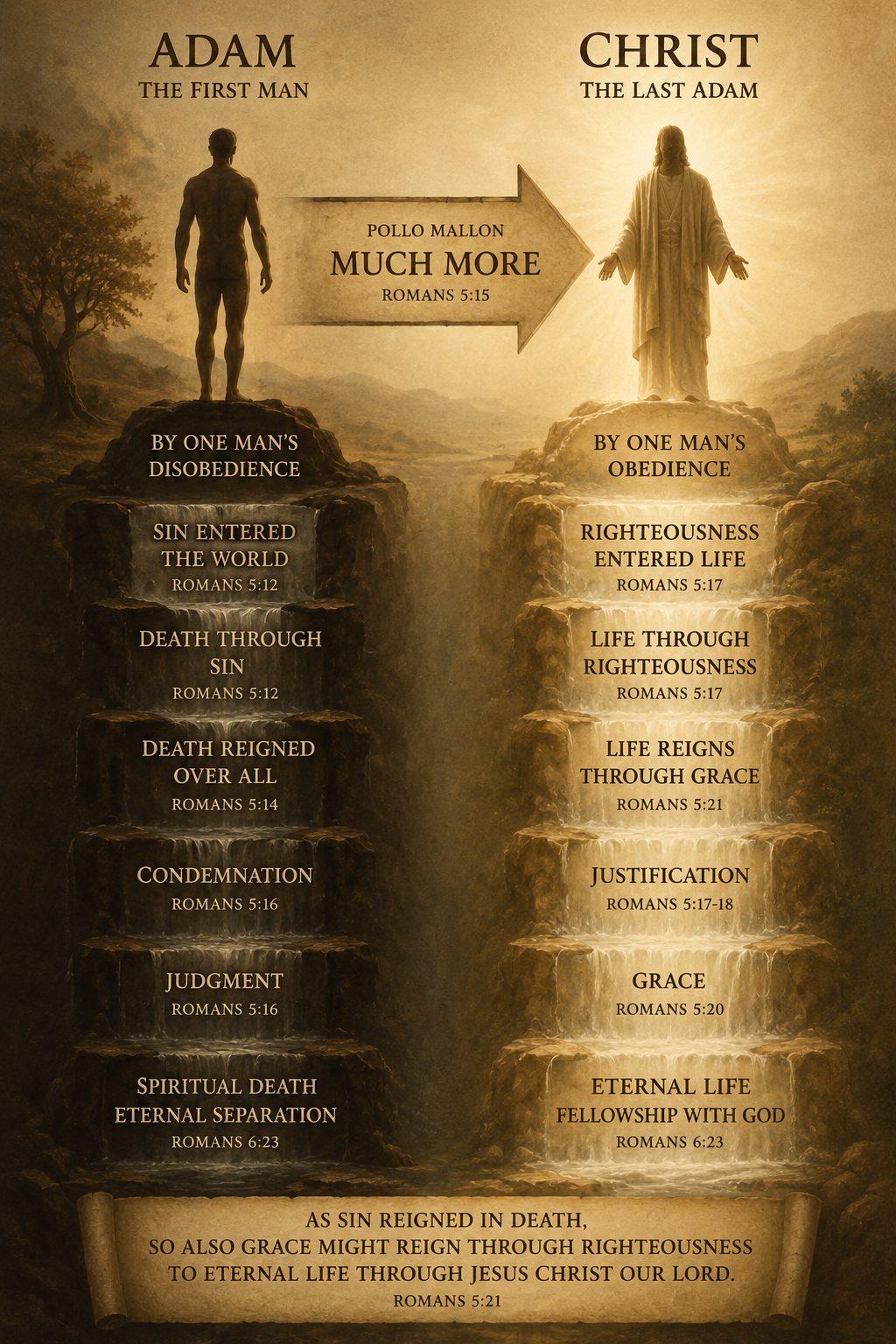
C · Romans 5:12-14 · Sin entered through one man
¹² Therefore, as sin entered into the world through one man, and death through sin; so death passed to all men, because all sinned. ¹³ For until the law, sin was in the world; but sin is not charged when there is no law. ¹⁴ Nevertheless death reigned from Adam until Moses, even over those whose sins weren’t like Adam’s disobedience, who is a foreshadowing of him who was to come.
- Therefore, as sin entered into the world through one man (v. 12). The chapter’s pivot to the Adam-Christ argument. The Greek di’ henos anthrōpou (through one man) names Adam as the corporate-representative through whom sin entered the world. The Greek noun hamartia (sin) appears here for the first time in Romans in the singular, personified sense: sin as a power, not merely a behavior. The chapter’s anthropology names sin as a structural condition that entered through one man and spread to all.
- Death through sin; so death passed to all men, because all sinned (v. 12). The single most-debated phrase in the chapter, possibly in the New Testament. The Greek eph’ hō pantes hēmarton has been translated three ways across Christian history: – In whom (Adam) all sinned (Augustine, the Vulgate’s in quo, the Reformed federal-headship tradition). The reading underwrites inherited guilt: all humans actually sinned in Adam at the moment of his transgression. – Because all sinned (the standard modern Greek-scholarship rendering; eph’ hō = because). The reading underwrites inherited mortality and corruption without inherited guilt: Adam’s sin opened the door; each human is morally responsible for their own sin. – On the basis of which (death) all sinned (a minority reading; eph’ hō = on the condition that). The reading underwrites death-as-the-condition-of-sinning rather than the reverse.
The Greek grammar strongly favors the because all sinned reading. The Augustinian in whom depends on the Latin Vulgate’s in quo, which is one possible rendering of the Greek phrase but not the most natural. The site holds the because all sinned reading as primary while recognizing Augustine’s in whom reading as one historic articulation whose theological substance (humanity’s corporate solidarity in Adam’s vocational failure) survives in different vocabulary. See Adam Christology for the full discussion.
- Sin was in the world; but sin is not charged when there is no law (v. 13). The argument’s interim parenthesis. Sin existed between Adam and Moses, before the Torah was given. But sin was not charged (Greek ouk ellogeitai, not counted, not put on the account) because there was no Torah to violate. The Pauline argument: death reigned from Adam to Moses (v. 14) even though the Torah had not yet defined the boundary. The reign of death is not contingent on Torah; it is the structural consequence of Adam’s primordial vocational failure.
- Adam, who is a foreshadowing of him who was to come (v. 14). The Greek typos tou mellontos (a type of the one to come). The word typos (impression, mark, pattern) is the Pauline word for prefiguration. Adam prefigures Christ. The relationship is typological: Adam is the pattern of the corporate-representative figure; Christ is the antitype, the climactic fulfillment of the corporate-representative role. The Hebrew Bible’s adam (the human, the earthling, the image-bearer) finds its eschatological fulfillment in the second Adam who is the image of the invisible God (Col 1:15).
Word study: typos (τύπος), “type, pattern, imprint, foreshadowing”
The Greek typos names the mark made by a blow, then the pattern the mark conforms to, then by extension the prefiguration an earlier figure provides for a later one. Paul uses the word at Rom 5:14 to name Adam as the typos of the one to come: Adam is the pattern the later figure (Christ) fulfills. The vocabulary became foundational for the Christian tradition of typological reading (see the cruciform hermeneutic): persons, events, and institutions in the Hebrew Bible are read as types that prefigure Christ. The typological reading is not allegorical (the historical reality of the type is preserved); it is figural (the type’s historical existence points beyond itself to the antitype). Irenaeus developed the typological reading most fully in the patristic period: Christ recapitulates Adam, reversing the first Adam’s vocational failure as the last Adam (see Adam Christology). The whole later Christian tradition’s reading of the Hebrew Bible as pointing to Christ reads forward from Paul’s typos vocabulary here and at 1 Cor 10:6, 11.
Influence callout: Augustine (City of God, Books 13-14; On Marriage and Concupiscence; commentary on Romans 5)
Augustine’s reading of Romans 5:12-21 is the most influential pre-modern Western reading of the chapter and the foundational text for the doctrine of original sin. Augustine reads the Greek eph’ hō pantes hēmarton through the Latin Vulgate’s in quo omnes peccaverunt (in whom all sinned), concluding that all humanity sinned in Adam at the moment of his transgression. The result is the doctrine of inherited guilt: every human being is born already guilty of Adam’s sin, transmitted through biological generation. Augustine’s framework underwrites the Western traditions of infant baptism for the remission of original sin, the Anselmian satisfaction atonement theory, and the Reformed federal headship doctrine. The site honors Augustine’s reading as the foundational pre-modern Western articulation of humanity’s corporate solidarity in Adam’s vocational failure. The site also notes that the Greek grammar of 5:12 favors the “because all sinned” reading, that the Eastern Orthodox tradition has never received Augustine’s inherited-guilt formulation, and that the patristic-Irenaean recapitulation reading predates Augustine by two centuries. Augustine’s reading is one venerable historic articulation, not the only Christian reading possible. The chapter’s theological substance (humanity is corporately bound to Adam’s failure; Christ is the new corporate head; the believer is included in Christ’s new humanity) holds across the readings, even where the inherited-guilt mechanism is differently described. See Adam Christology and How We Read.
D · Romans 5:15-21 · The greater contrast of grace
¹⁵ But the free gift isn’t like the trespass. For if by the trespass of the one the many died, much more did the grace of God, and the gift by the grace of the one man, Jesus Christ, abound to the many. ¹⁶ The gift is not as through one who sinned; for the judgment came by one to condemnation, but the free gift came of many trespasses to justification. ¹⁷ For if by the trespass of the one, death reigned through the one; so much more will those who receive the abundance of grace and of the gift of righteousness reign in life through the one, Jesus Christ. ¹⁸ So then as through one trespass, all men were condemned; even so through one act of righteousness, all men were justified to life. ¹⁹ For as through the one man’s disobedience many were made sinners, even so through the obedience of the one, many will be made righteous. ²⁰ The law came in besides, that the trespass might abound; but where sin abounded, grace abounded more exceedingly; ²¹ that as sin reigned in death, even so grace might reign through righteousness to eternal life through Jesus Christ our Lord.
- But the free gift isn’t like the trespass (v. 15). The chapter’s central argument. The trespass and the gift are not symmetrical. The gift exceeds the trespass at every point. The Greek pollō mallon (much more) returns: the abundance of grace (Greek hē perisseia tēs charitos) is greater than the abundance of sin. The whole second half of the chapter (vv. 15-21) is not a balanced Adam-Christ contrast but a much-more argument in Christ’s favor.
- The judgment came by one to condemnation, but the free gift came of many trespasses to justification (v. 16). The asymmetry continues. One trespass (Adam’s) led to condemnation; many trespasses (the human history of sin) are answered by one act of grace (Christ’s) leading to justification. The one-and-many logic is structured to favor the gift: grace addresses more than the original trespass; it addresses the entire accumulated weight of human history’s wrongdoing.
- Through one act of righteousness, all men were justified to life (v. 18). The chapter’s most controversial verse. The Greek eis pantas anthrōpous eis dikaiōsin zōēs (toward all human beings into justification of life) has carried universalist readings in some Christian traditions (Origen, the early Eastern fathers in part, the modern Karl Barth tradition, the radical-grace tradition). The site does not commit to a universalist reading; the verse is Paul’s grand cosmic claim about the scope of Christ’s act, parallel to all sinned (5:12) and all have sinned and fall short of the glory of God (3:23). The all-in-Adam / all-in-Christ parallel is structural; how the parallel resolves in individual eschatology (universal salvation, individual response of pistis, double-outcome judgment) is a separate question the verse does not by itself settle.
- Through the obedience of the one, many will be made righteous (v. 19). The Greek dia tēs hypakoēs tou henos names Christ’s obedience (his faithful endurance unto death, cf. Phil 2:8: obedient even unto death, the death of the cross) as the means of making many righteous. The Greek katastathēsontai dikaioi (future passive, will be constituted righteous) names a real change of standing. The verse is one of the Pauline corpus’s clearest articulations of Christ’s active obedience as the substance of justification’s gift. The Reformation tradition has rightly built its imputation of Christ’s active righteousness doctrine on this verse, though the covenant-faithfulness dimension (Christ’s pistis in the sense of faithful allegiance to the Father’s commission, see gospel allegiance) is the same substance read in a richer register.
Pushback note: federal headship and inherited guilt at Romans 5:12-21
The Reformed federal-theology tradition (Cocceius, Witsius, Owen, the Westminster Confession) reads Romans 5:12-21 as the foundational text for federal headship: Adam stood as the legal representative of all humanity; his act of disobedience legally bound all his posterity in imputed guilt; Christ stands as the legal representative of his elect; his act of obedience legally credits his elect with imputed righteousness. The doctrine has been carried by the Reformed and Presbyterian traditions for four centuries and remains influential in popular American evangelicalism. The site names the doctrine as one historic articulation. Three contextual concerns argue for nuance. First, the Greek of 5:12 does not require the inherited-guilt reading; the because all sinned rendering is the more natural Greek and is held by the modern scholarly consensus. Second, the Eastern Orthodox tradition has never received the inherited-guilt formulation; the Eastern reading holds inherited mortality and vocational corruption without inherited guilt. Third, the Irenaean recapitulation reading (c. 180 CE), which predates Augustine by two centuries, develops the chapter as Christ retracing and reversing Adam’s path, restoring the vocational image, without the inherited-guilt mechanism. Where the Reformed insight remains valid: humanity is corporately bound to Adam’s vocational failure; Christ is the new corporate head; the believer’s standing in Christ is a gift, not an achievement; the one-act / one-act parallel of 5:18-19 is the New Testament’s clearest articulation of corporate-representative atonement. The site preserves these substantive insights while holding the mechanism of transmission as a historic theological development, not as the necessary reading of the Greek text. See Adam Christology.
- The law came in besides, that the trespass might abound (v. 20). The chapter’s hardest single line for the Paul-Within-Judaism reading. The law came in besides (Greek nomos de pareisēlthen) sounds like the Torah is a parenthetical insertion in the divine plan. The verse must be read contextually: Paul is not arguing that the Torah is bad; he is arguing that the Torah’s diagnostic function (cf. 3:20: through the law comes knowledge of sin; 7:7-13: the law itself is holy, righteous, and good) makes sin visible and therefore named. The verb pleonasē (might abound) is not causal in the sense of the Torah produces sin; it is epistemological in the sense of the Torah brings sin into the daylight where it can be addressed. The verse pairs with 7:13 (sin, that it might be shown to be sin, produced death in me through that which is good): the Torah’s good function is naming sin so grace’s response becomes visible. The verse must not be read in the Marcionite direction of Torah-as-opponent-of-grace; the Torah and grace are cooperating in making the covenant story fully legible.
- Where sin abounded, grace abounded more exceedingly (v. 20). The chapter’s most-beloved final claim. The Greek hyperperisseuō (super-abound, exceed in abundance) is a Pauline coinage (it appears here and at 2 Cor 7:4). Grace is not equal to sin; grace exceeds sin. The verse is the foundation of the cheap-grace warning Paul will immediately address at 6:1 (shall we continue in sin that grace may abound?); the verse is not an invitation to moral laxity; it is the cosmic assurance that no amount of human sin can outpace divine grace.
- That as sin reigned in death, even so grace might reign through righteousness to eternal life (v. 21). The chapter’s closing claim. The verbs ebasileusen (reigned, past) and basileusē (might reign, future subjunctive) name the change of reigning power. Sin reigned through death; grace reigns through righteousness leading to eternal life. The whole later Romans 6:11-14 (sin will not have dominion over you, for you are not under law, but under grace) reads forward from this verse.
Reflection prompts
- The chapter teaches that we have peace with God (5:1) while we were still weak (5:6), while we were still sinners (5:8), while we were enemies (5:10). The initiative is God’s. Where in your own discipleship have you been operating on the opposite assumption, that you must somehow approach God first and then peace will follow?
- Paul names a four-step sequence: suffering produces perseverance, perseverance produces proven character, proven character produces hope (5:3-4). The sequence is not about enduring suffering with stoic resignation; it is about the gospel-shaped trajectory by which suffering trains the disciple. Where in your current life is suffering present? What would it look like to receive that suffering as the trainer of hope rather than as the enemy of faith?
- The chapter’s Adam-Christ contrast (5:12-21) names humanity’s corporate condition: in Adam, we are bound to the vocational failure; in Christ, we are offered the new humanity. The reading is cosmic, not just individual. Where in your own theology has salvation been individualistic (my soul, my forgiveness, my heaven), with the corporate-cosmic dimensions of Adam and Christ missing? What changes if humanity itself is the subject of the gospel, with you included in that humanity?
- Where sin abounded, grace abounded more exceedingly (5:20). The verse is not an invitation to moral laxity; it is the cosmic assurance that no amount of human failure can outpace divine grace. Where in your own life has the sense of your own failure shut down your capacity to receive grace? What would receiving grace as exceeding the failure actually look like?
Frameworks at play in this chapter: Adam Christology · justification · the new covenant · gospel allegiance · the cruciform hermeneutic · exile and return