
Hebrews 7 is the structural backbone of the book’s Christological argument. The chapter develops the Melchizedek priesthood framework at length: walking through Genesis 14’s brief narrative, reading Psalm 110:4’s priest forever after the order of Melchizedek into Christ, and concluding that Christ’s priesthood is older, higher, permanent, and outside the Levitical succession. Without this chapter, the book’s argument about Christ as priest is theologically incoherent. With this chapter, the argument becomes structurally clear.
The chapter must be read carefully on the question of what is “set aside” at v. 18 (the former commandment is set aside because of its weakness and uselessness). The standard supersessionist reading takes this verse as evidence that the Torah as a whole was weak and useless. The chapter’s actual argument is more precise: what is set aside is the Levitical priestly succession requirement, the rule that priests had to descend from Aaron’s line. Christ comes from Judah (the Davidic line), not Levi (the priestly line); the Aaronic requirement cannot apply to him. The chapter is therefore making a narrow argument about who can be a priest, not a broad argument about Torah’s value. The site reads this carefully with Marty Solomon’s lane: the chapter honors Torah while arguing that the Levitical priesthood was always a temporary administration awaiting the Melchizedek priest the Hebrew Bible itself preserved.
The chapter’s deepest pastoral move is at vv. 24-25: Christ holds his priesthood permanently (Greek aparabatos, unchangeable, not-transferable), and therefore he is able to save to the uttermost those who draw near to God through him, since he always lives to make intercession for them. The high priest is always at the throne, always interceding, the audience is never without their advocate. The whole later Christian theology of Christ’s continuing intercession (Rom 8:34; 1 Jn 2:1) reads forward from this verse.
A · Hebrews 7:1-10 · Melchizedek introduced
¹ For this Melchizedek, king of Salem, priest of God Most High, who met Abraham returning from the slaughter of the kings and blessed him, ² to whom also Abraham divided a tenth part of all (being first, by interpretation, “king of righteousness”, and then also “king of Salem”, which means “king of peace”; ³ without father, without mother, without genealogy, having neither beginning of days nor end of life, but made like the Son of God), remains a priest continually. ⁴ Now consider how great this man was, to whom even Abraham, the patriarch, gave a tenth out of the best plunder. ⁵ They indeed of the sons of Levi who receive the priest’s office have a commandment to take tithes of the people according to the law, that is, of their brothers, though these have come out of the body of Abraham, ⁶ but he whose genealogy is not counted from them has accepted tithes from Abraham, and has blessed him who has the promises. ⁷ But without any dispute the lesser is blessed by the greater. ⁸ Here people who die receive tithes, but there one receives tithes of whom it is testified that he lives. ⁹ We can say that through Abraham even Levi, who receives tithes, has paid tithes, ¹⁰ for he was yet in the body of his father when Melchizedek met him.
- For this Melchizedek, king of Salem, priest of God Most High (v. 1). The chapter opens with the Genesis 14:18 description. Melchizedek is king of Salem (Hebrew Shalem, traditionally identified as Jerusalem, cf. Ps 76:2) and priest of God Most High (Hebrew El Elyon). He is both king and priest, the Hebrew Bible’s first such combined figure (anticipated by Psalm 110:4’s coronation of the Davidic king as priest, but realized only in Melchizedek in narrative form).
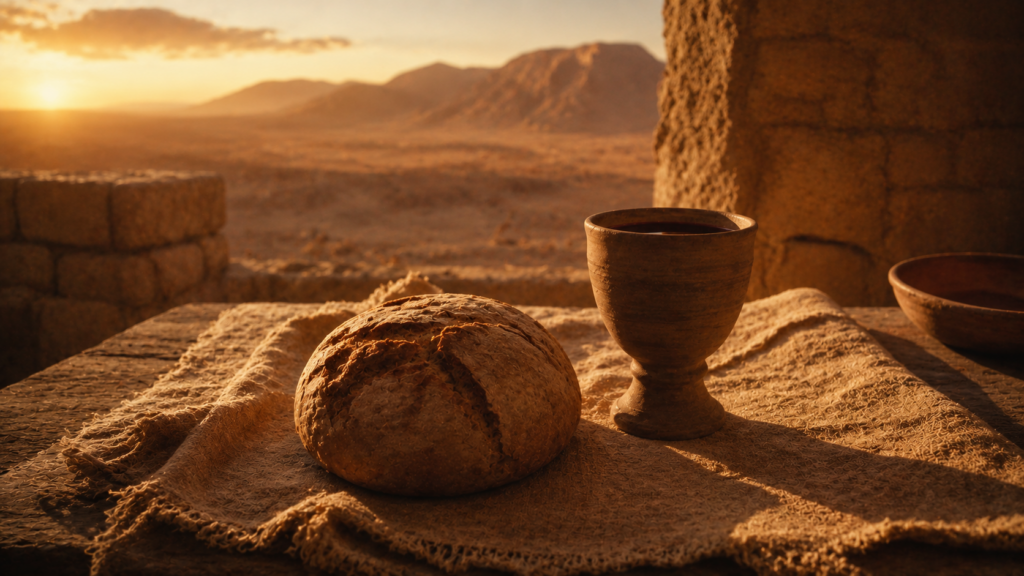
- Who met Abraham returning from the slaughter of the kings and blessed him (v. 1). The chapter cites Genesis 14:18-20. After Abraham’s rescue of Lot from the four eastern kings, Melchizedek meets him with bread and wine (the chapter does not quote this detail, but the patristic tradition develops it Eucharistically) and blesses him. The chapter is using the Genesis narrative as the foundation of the argument.
- To whom also Abraham divided a tenth part of all (v. 2). Genesis 14:20: Abraham gave Melchizedek a tenth of everything, the first tithe in the Hebrew Bible. The author’s argument turns on this detail: Abraham, the patriarch, paid tithe to Melchizedek, establishing Melchizedek’s superior position relative to Abraham (since the lesser is blessed by the greater, v. 7).
- Being first, by interpretation, “king of righteousness”, and then also “king of Salem”, which means “king of peace” (v. 2). The chapter interprets the name Melchi-tzedek etymologically: melek (king) + tzedek (righteousness) = king of righteousness. And Salem is interpreted as shalom (peace), king of peace. The double interpretation names Melchizedek as the embodiment of two of the Hebrew Bible’s most important theological categories: tzedek (righteousness) and shalom (peace). The whole later prophetic vision of righteousness and peace kissing each other (Ps 85:10) and the messianic Prince of Peace (Isa 9:6) reads forward from this verse.
- Without father, without mother, without genealogy, having neither beginning of days nor end of life, but made like the Son of God (v. 3). The chapter’s most theologically loaded interpretive move. The Genesis narrative is silent about Melchizedek’s parents, his lineage, his birth, and his death. The author of Hebrews reads these silences as theologically intentional: the silences make Melchizedek resemble the Son of God by not having the genealogical embedding that defines the Levitical priesthood. The phrase made like the Son of God (Greek aphōmoiōmenos tō huiō tou theou) is crucial: Melchizedek is not the Son of God; he is made to resemble the Son. The chapter is using the type / antitype logic (Melchizedek is the type; Christ is the antitype) carefully. (See the Melchizedek priesthood framework for the full development.)
- Now consider how great this man was, to whom even Abraham, the patriarch, gave a tenth out of the best plunder (v. 4). The chapter’s first argumentative move. The audience must consider (Greek theōreō, to see, to look at carefully) the greatness of Melchizedek. Even Abraham, the patriarch, the founder of Israel, gave a tenth to Melchizedek. The implication: Melchizedek’s office is higher than Abraham’s status.
- They indeed of the sons of Levi who receive the priest’s office have a commandment to take tithes of the people according to the law (v. 5). The chapter contrasts the Levitical tithe (which Levi-descendants receive from their fellow Israelites) with the Melchizedek tithe (which Abraham, and through him, Levi, gave to Melchizedek). The verse names the Levitical priesthood’s circumscribed authority (taking tithe from brothers) and prepares the next move.
- But he whose genealogy is not counted from them has accepted tithes from Abraham, and has blessed him who has the promises (v. 6). Melchizedek, having no Levitical descent, received tithes from Abraham, and blessed the patriarch who held the promises. The chapter is teaching that the promises (Abraham’s covenant blessings) flow through a man who blessed Abraham, implying that the blesser is greater than the one who has the promises. Melchizedek’s office operates above even the patriarch’s status.
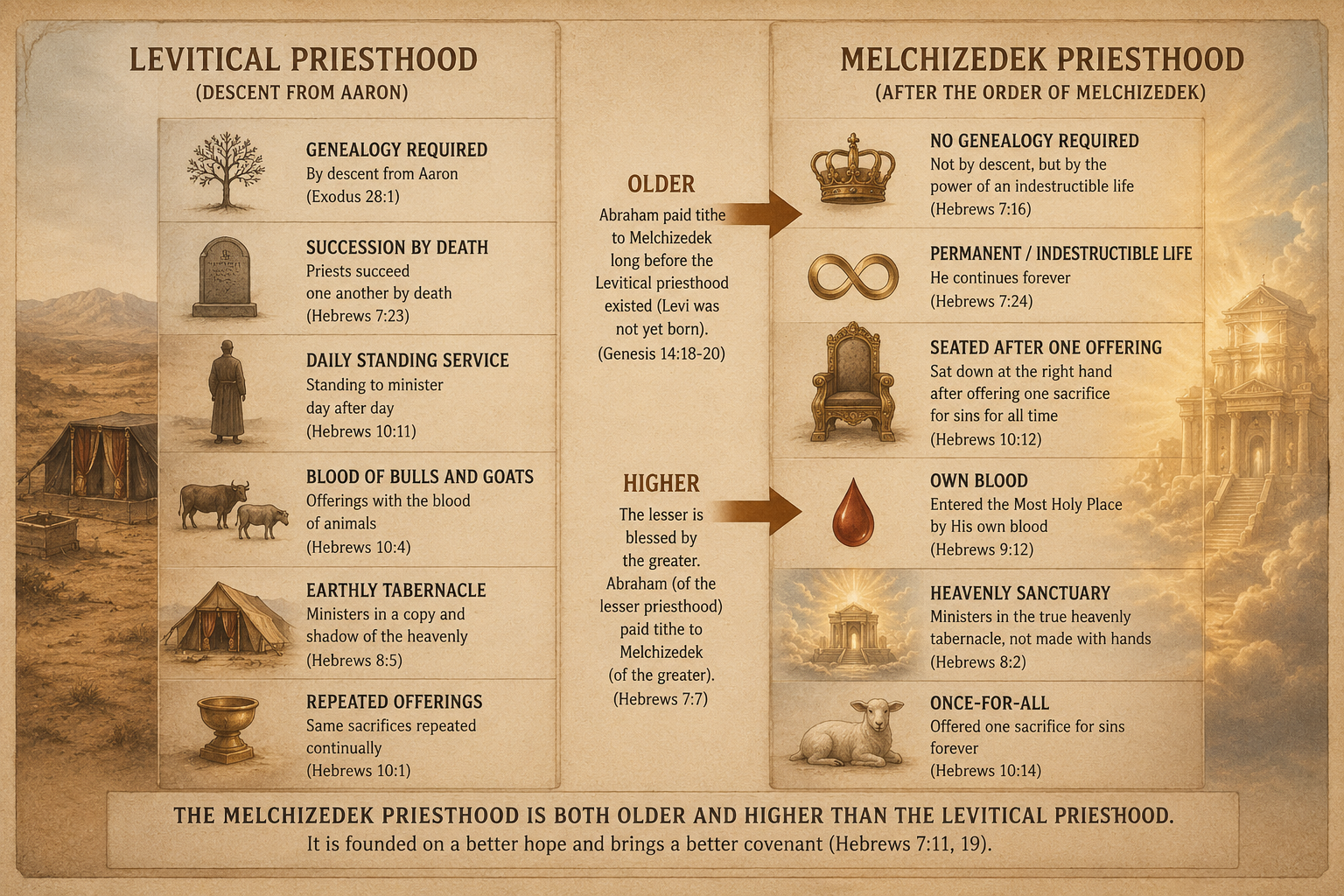
- Here people who die receive tithes, but there one receives tithes of whom it is testified that he lives (v. 8). The chapter contrasts the Levitical priests (who die and must be succeeded) with Melchizedek (who, in the Hebrew Bible’s narrative, has no recorded death, the silence is taken as a witness to ongoing life). The verse is preparing the argument that Christ’s priesthood, like Melchizedek’s, is permanent (because Christ’s life, like Melchizedek’s, is not ended by death).
- We can say that through Abraham even Levi, who receives tithes, has paid tithes, for he was yet in the body of his father when Melchizedek met him (vv. 9-10). The chapter’s most rhetorically bold argument. Levi was in Abraham’s loins when Abraham paid tithe to Melchizedek. Therefore Levi himself (through his ancestor) paid tithe to Melchizedek. The argument is a corporate-representation move (one consistent with the Hebrew Bible’s broader theology of the ancestor representing the descendants; cf. Heb 7:5’s similar logic). The implication: even the Levitical priesthood, in the person of Levi, acknowledged Melchizedek’s superior position.
B · Hebrews 7:11-19 · A change of priesthood
¹¹ Now if perfection were through the Levitical priesthood (for under it the people have received the law), what further need was there for another priest to arise after the order of Melchizedek, and not be called after the order of Aaron? ¹² For the priesthood being changed, there is of necessity a change made also in the law. ¹³ For he of whom these things are said belongs to another tribe, from which no one has officiated at the altar. ¹⁴ For it is evident that our Lord has sprung out of Judah, about which tribe Moses spoke nothing concerning priesthood. ¹⁵ This is yet more abundantly evident, if after the likeness of Melchizedek there arises another priest, ¹⁶ who has been made, not after the law of a fleshly commandment, but after the power of an endless life: ¹⁷ for it is testified, “You are a priest forever, according to the order of Melchizedek.” ¹⁸ For there is an annulling of a foregoing commandment because of its weakness and uselessness ¹⁹ (for the law made nothing perfect), and a bringing in of a better hope, through which we draw near to God.
- Now if perfection were through the Levitical priesthood, what further need was there for another priest to arise after the order of Melchizedek (v. 11). The chapter’s central argumentative question. If the Levitical priesthood had achieved perfection (Greek teleiōsis, completion / vocational fulfillment), then no further priest would be needed. But Psalm 110:4 announces another priest (Christ, after Melchizedek), which means the Levitical priesthood had not achieved final completion. The author is not arguing that the Levitical priesthood was wrong; he is arguing that it was temporary, awaiting the priest the Hebrew Bible itself promised would come.
- For the priesthood being changed, there is of necessity a change made also in the law (v. 12). The chapter’s key transitional verse. Priesthood and law are linked. A change in who exercises the priesthood requires some adjustment in the legal-administrative framework governing it. The Greek nomou metathesis (a change of law) names a specific legal adjustment, not an abolition of the whole Torah, but a change in the legal administration of the priesthood. The careful reading matters: the chapter is not arguing for the abolition of Torah; it is arguing for the necessary adjustment of the priestly-administrative law because the priest now comes from Judah, not Levi.
- For he of whom these things are said belongs to another tribe, from which no one has officiated at the altar (v. 13). The chapter’s specific historical claim. Christ comes from Judah (Mt 1:2-3; Lk 3:33; Rev 5:5), not Levi. The Levitical priesthood was defined by tribal descent. Christ cannot be a Levitical priest because he is not from the right tribe. But the Hebrew Bible itself preserved Psalm 110:4, a priesthood not after the order of Aaron but after the order of Melchizedek, which allows a priest from outside the Levitical line.
- For it is evident that our Lord has sprung out of Judah, about which tribe Moses spoke nothing concerning priesthood (v. 14). The chapter makes the genealogical fact explicit. Moses never legislated priesthood for the tribe of Judah. If Christ were claiming a Levitical office, the claim would fail at the threshold. But Christ does not claim a Levitical office; he claims the Melchizedek office, which the Hebrew Bible itself opens up outside the Levitical line.
- Who has been made, not after the law of a fleshly commandment, but after the power of an endless life (v. 16). The chapter’s contrast. The Levitical priesthood is after the law of a fleshly commandment (Greek kata nomon entolēs sarkikēs), a law tied to physical descent (genealogy, lineage, the body’s biological succession). The Melchizedek priesthood is after the power of an endless life (Greek kata dynamin zōēs akatalytou), a priestly office grounded in indestructible life. The chapter is teaching that Christ’s priesthood is not vulnerable to the succession-by-death that defined the Levitical office.
- For it is testified, “You are a priest forever, according to the order of Melchizedek” (v. 17). The chapter cites Psalm 110:4 again. The Hebrew Bible itself testifies that the priest will be forever (Greek eis ton aiōna), not a single-generation office, not a tribal-succession office, not a body-dependent office. The Hebrew Bible has already promised exactly this kind of priesthood.
- For there is an annulling of a foregoing commandment because of its weakness and uselessness (for the law made nothing perfect), and a bringing in of a better hope, through which we draw near to God (vv. 18-19). The chapter’s most often-misread verses. The Greek athetēsis … ginetai progoousēs entolēs, there is an annulling of a preceding commandment. The commandment in question is not Torah as a whole but the specific commandment requiring Levitical descent for priesthood. The Levitical succession requirement cannot deliver the perfect priestly office; it was always a temporary administration. The law made nothing perfect (Greek ouden gar eteleiōsen ho nomos), the law in question is, in context, the priestly-administrative law, not the Torah’s whole content. The chapter is not declaring the Torah weak and useless; it is declaring the specific Levitical-priesthood requirement unable to achieve the eschatological priestly completion that Christ now embodies.
Word study: athetēsis (ἀθέτησις), “annulling, setting aside, abrogation”
The Greek noun athetēsis names the official annulment of a prior commandment or covenant. The word is rare in the New Testament. The author of Hebrews uses it precisely: he names what is being annulled with care. In context, the preceding commandment (Greek progoousēs entolēs) is the Levitical priestly succession requirement, the rule that priests must descend from Aaron. This is not the same as Torah as a whole. The author is performing a careful legal-administrative argument: when who is the priest changes, the specific legal mechanism governing priesthood must change. The Solomon-lane and Paul Within Judaism reading: the chapter is not arguing that Torah is weak or that Judaism is being abolished. The chapter is arguing that the specific priestly-administration of Aaron’s line cannot deliver the eschatological priestly office that Psalm 110:4 always promised would arrive. To read the verse as a general abolition of Torah is to read against the chapter’s actual specificity.
C · Hebrews 7:20-28 · The oath, the permanence, the once-for-all
²⁰ Inasmuch as he is not made priest without the taking of an oath ²¹ (for they indeed have been made priests without an oath), but he with an oath by him that says of him, “The Lord swore and will not change his mind, ‘You are a priest forever, according to the order of Melchizedek’”; ²² by so much, Jesus has become the collateral of a better covenant. ²³ Many, indeed, have been made priests, because they are hindered from continuing by death. ²⁴ But he, because he lives forever, has his priesthood unchangeable. ²⁵ Therefore he is also able to save to the uttermost those who draw near to God through him, seeing that he lives forever to make intercession for them. ²⁶ For such a high priest was fitting for us: holy, guiltless, undefiled, separated from sinners, and made higher than the heavens; ²⁷ who doesn’t need, like those high priests, to offer up sacrifices daily, first for his own sins, and then for the sins of the people. For he did this once for all, when he offered up himself. ²⁸ For the law appoints men as high priests who have weakness, but the word of the oath which came after the law appoints a Son forever who has been perfected.
- Inasmuch as he is not made priest without the taking of an oath (v. 20). The chapter’s transition to the oath argument. The Levitical priests received their office without an oath, they were appointed by legal procedure (Lev 8). Christ, by contrast, was appointed with an oath: YHWH has sworn, and will not change his mind, “You are a priest forever, after the order of Melchizedek” (Ps 110:4, cited at v. 21). The oath language echoes chapter 6:13-18’s argument about God’s two unchangeable things.
- Jesus has become the collateral of a better covenant (v. 22). The chapter introduces the better covenant (Greek kreittonos diathēkēs) language that will dominate chapter 8. Christ is the guarantee (Greek engyos, surety, collateral), the one whose person secures the validity of the covenant. The Greek engyos is rare and theologically loaded: it names the one who stands as personal security for the obligation. Christ’s person is the covenant’s guarantee. The whole later new covenant framework reads forward from this verse.
- Many, indeed, have been made priests, because they are hindered from continuing by death (v. 23). The chapter names the Levitical priesthood’s succession problem. Levitical priests died; their offices required succession. The multiplicity of Levitical priests is itself a sign of the office’s mortality.
- But he, because he lives forever, has his priesthood unchangeable (v. 24). The Greek aparabaton (unchangeable, untransferable, that-which-does-not-pass-away) is one of the chapter’s most theologically loaded single words. Christ’s priesthood is not transferable, it does not pass from him to a successor. He holds it permanently. The verb menein (to remain) names the continuing reality of Christ’s priestly office.
- Therefore he is also able to save to the uttermost those who draw near to God through him, seeing that he lives forever to make intercession for them (v. 25). The chapter’s most pastorally important single verse. The Greek sōzein eis to panteles dynatai, he is able to save to the uttermost (or completely, forever, to the end). The phrase eis to panteles is rich: it can mean completely (in degree), forever (in time), or all the way (in extent). All three senses are likely operative. Christ’s priesthood is able to save completely, forever, and all the way. The verse adds the basis: he lives forever to make intercession for them. Christ’s continuing intercession is the active form of his priestly office. The whole later Christian theology of Christ at the right hand interceding (Rom 8:34; 1 Jn 2:1) reads forward from this verse.
- For such a high priest was fitting for us: holy, guiltless, undefiled, separated from sinners, and made higher than the heavens (v. 26). The chapter’s portrait of Christ’s priestly character. Five descriptors: holy (Greek hosios, devoted to God), guiltless (akakos, without malice), undefiled (amiantos, ritually pure), separated from sinners (kechōrismenos apo tōn hamartōlōn, set apart in his moral character), and made higher than the heavens (hypsēloteros tōn ouranōn genomenos, exalted above the heavenly realms). The five together name a priestly profile no Levitical priest could claim.
- Who doesn’t need, like those high priests, to offer up sacrifices daily, first for his own sins, and then for the sins of the people. For he did this once for all, when he offered up himself (v. 27). The chapter’s once for all (Greek ephapax) statement. The Levitical high priests had to offer daily sacrifices, first for themselves and then for the people. Christ, by contrast, offered himself once for all. The whole later book’s argument about the once-for-all sufficiency of Christ’s offering (Heb 9:25-28; 10:11-14) is anchored in this verse.
- For the law appoints men as high priests who have weakness, but the word of the oath which came after the law appoints a Son forever who has been perfected (v. 28). The chapter closes with the contrast. The law (the Mosaic legal administration) appoints weak humans as high priests. The oath (Ps 110:4, which came after the law) appoints a Son, forever, who has been perfected (Greek teteleiōmenon, the same verb as 5:9, brought to completion). The chapter is teaching that the priestly office YHWH always wanted is now in place, and that the Levitical office served, faithfully, as the temporary administration awaiting this completion.
Influence callout: David Moffitt (Rethinking the Atonement; the chapter’s “once for all” is at the ascension)
Moffitt’s reading of Hebrews 7:27 in Rethinking the Atonement (Baker Academic, 2022) develops the once for all (Greek ephapax) language carefully. The standard modern Christian reading locates the once for all at the cross: Jesus dies once, and that single death is sufficient. Moffitt argues that the chapter’s structural argument requires a different location for the once for all moment. The Levitical priest’s daily sacrifices were offerings inside the sanctuary, what made them daily was that they were repeatedly performed there. The chapter’s contrast is not between Christ’s one death and the Levitical priests’ many deaths (the priests did not die in sacrificing); it is between Christ’s one priestly entry into the heavenly Most Holy Place and the Levitical priests’ repeated entries (and the daily tamid-offerings at the outer altar). Moffitt’s reading places the once for all at the ascension, the moment Christ entered the heavenly sanctuary with his own life, rather than at the cross alone. The chapter does say when he offered up himself (v. 27), but the offering in question is the priestly self-offering that occurs when Christ presents his life in the heavenly Most Holy Place. The cross provides the blood; the kipper-making itself happens when the risen high priest enters with that blood. Moffitt’s pastoral payoff: the once for all is not just what happened in the past on Golgotha; it is what is permanently true in the heavenly sanctuary right now. Christ is currently the priest who has offered himself once for all, and the offering is eternally present before the Father, not temporally past. The whole later book of Hebrews’s argument that Christ continually lives to make intercession (7:25) and that the perfected priestly office endures permanently (7:24, aparabaton) is grounded in this verse and only makes sense when Moffitt’s atonement-at-ascension framing is held.
Reflection prompts
- The chapter teaches that what is set aside is specifically the Levitical priestly succession requirement, not Torah as a whole. The change is administrative, not moral. Where in your own reading of Hebrews have you been hearing a general retirement of the Old Testament when the chapter is actually making a precise priestly-office argument?
- Christ’s priesthood is unchangeable (Greek aparabaton, v. 24), it does not pass to a successor; it does not expire. He is always the priest. Where in your own life have you been imagining a Christ who was a priest at some past moment, rather than a Christ who is the priest right now, currently interceding?
- Christ is able to save to the uttermost (Greek eis to panteles, v. 25), completely, forever, all the way. The promise is comprehensive. Where in your own life have you been operating with a partial salvation assumption, holding back some area as too far, too long, or too deep for the chapter’s uttermost?
Frameworks at play in this chapter: the Melchizedek priesthood, the kipper / atonement framework, the new covenant, Paul within Judaism, the five offerings, gospel allegiance.