
Leviticus 27 closes the book with a chapter on voluntary commitments: vows, dedications, and tithes. The chapter sits as a kind of appendix to the Holiness Code. Where chapter 26 set out the required covenant blessings and curses, chapter 27 sets out the voluntary economic gestures by which an Israelite might consecrate persons, animals, houses, or fields to YHWH. The chapter is structured by progressively easier-to-redeem categories: persons (vv. 1-8, most flexible), animals (vv. 9-13), houses (vv. 14-15), inherited land (vv. 16-21), purchased land (vv. 22-25), the firstborn (vv. 26-27), the cherem / devoted thing (vv. 28-29, irrevocable), and tithes (vv. 30-33). The chapter ends with the book’s closing colophon (v. 34).
The chapter raises real questions for modern readers, particularly at the valuation table of vv. 3-7. The table assigns different shekel values to vowed persons by age and gender. A male between twenty and sixty is valued at fifty shekels; a female of the same age at thirty. The numbers can sound, on a first reading, like the Hebrew Bible saying women are worth less than men. They do not say this. The chapter is establishing economic vow-redemption values in an ancient labor economy where adult male workers commanded higher market rates than adult female workers — a practical economic measurement of the historical period’s labor market. The chapter is not establishing inherent worth of persons. The Hebrew Bible’s deeper anthropology (Gen 1:27, in the image of God he created them, male and female he created them) is unaffected by this chapter’s vow-table.
The chapter’s deeper theological move: voluntary commitments create real obligations. A vow made aloud is not later softened by changing one’s mind. The vow can be redeemed (the chapter’s provisions show how), but it cannot simply be ignored. The whole later Hebrew Bible’s vocabulary of do not be quick with your mouth … when you make a vow to God, do not delay to fulfill it (Eccl 5:2-7; Ps 50:14; Deut 23:21-23) reads forward from this chapter.
A · Leviticus 27:1-8 · Vow valuations
¹ Yahweh spoke to Moses, saying, ² “Speak to the children of Israel, and say to them, ‘When a man consecrates a person to Yahweh in a vow, according to your valuation, ³ your valuation of a male from twenty years old to sixty years old shall be fifty shekels of silver, according to the shekel of the sanctuary. ⁴ If she is a female, then your valuation shall be thirty shekels. ⁵ If the person is from five years old to twenty years old, then your valuation shall be for a male twenty shekels, and for a female ten shekels. ⁶ If the person is from a month old to five years old, then your valuation shall be for a male five shekels of silver, and for a female your valuation shall be three shekels of silver. ⁷ If the person is from sixty years old and upward; if he is a male, then your valuation shall be fifteen shekels, and for a female ten shekels. ⁸ But if he is poorer than your valuation, then he shall be set before the priest, and the priest shall assign a value to him. The priest shall assign a value according to his ability to pay.
- When a man consecrates a person to Yahweh in a vow, according to your valuation (v. 2). The chapter’s opening scenario. An Israelite vows to dedicate a person to YHWH — most commonly himself or a member of his household — and now needs to redeem the vow by paying its established price. The Hebrew Bible’s narrative tradition records examples: Hannah’s vow at 1 Sam 1:11 (if you give your maidservant a son, then I will give him to YHWH all the days of his life); Jephthah’s catastrophic vow at Judg 11:30-40 (the daughter’s life as the cost of the vow); Samson’s pre-natal Nazirite vow (Judg 13:5).
- Your valuation of a male from twenty years old to sixty years old shall be fifty shekels of silver, according to the shekel of the sanctuary (v. 3). The chapter’s primary tier. Fifty shekels is a significant sum (cf. Ex 30:13, the half-shekel sanctuary tax; the fifty shekels here is the equivalent of one hundred half-shekel payments — a substantial economic commitment). The age range (twenty to sixty) corresponds to the prime labor years in the ancient economy. The valuation is not a statement of personal worth; it is the vow-redemption price set by the chapter for that demographic.
- If she is a female, then your valuation shall be thirty shekels (v. 4). The female valuation in the prime-labor years is thirty shekels. The valuation difference between male and female in this category (fifty vs. thirty) reflects the ancient labor market’s actual differentials, not a theological judgment about inherent worth. The valuation table is practical-economic, not anthropological. The chapter is establishing what the household must pay to release the vow, given the historical-economic context.
- If he is poorer than your valuation, then he shall be set before the priest, and the priest shall assign a value to him. The priest shall assign a value according to his ability to pay (v. 8). The chapter’s economic-graduation provision, parallel to similar provisions throughout the book (cf. Lev 1:14-17 for the bird-offering; Lev 5:7, 11 for the graduated chatta’t; Lev 12:8 for the poor mother’s bird-offering; Lev 14:21-22 for the poor leper). The chapter is preserving its consistent pattern: the system adapts to the household’s actual capacity. No vow is ineligible to be redeemed because of the household’s poverty. The priest assigns a value according to what the household can pay. The whole later Hebrew Bible’s economic egalitarianism (the rich do not get more access; the poor do not get less) is preserved at the chapter’s most technical level.
B · Leviticus 27:9-25 · Vowed animals, houses, and land
⁹ “‘If it is an animal, of which men offer an offering to Yahweh, all that any man gives of such to Yahweh becomes holy. ¹⁰ He shall not alter it, nor exchange it, a good for a bad, or a bad for a good: and if he shall at all exchange animal for animal, then both it and that for which it is exchanged shall be holy. ¹¹ If it is any unclean animal, of which they do not offer as an offering to Yahweh, then he shall set the animal before the priest; ¹² and the priest shall value it, whether it is good or bad. As you the priest values it, so shall it be. ¹³ But if he will indeed redeem it, then he shall add the fifth part of it to its valuation. ¹⁴ “‘When a man dedicates his house to be holy to Yahweh, then the priest shall evaluate it, whether it is good or bad: as the priest shall evaluate it, so shall it stand. ¹⁵ If he who dedicates it will redeem his house, then he shall add the fifth part of the money of your valuation to it, and it shall be his. ¹⁶ “‘If a man dedicates to Yahweh part of the field of his possession, then your valuation shall be according to the seed for it: the sowing of a homer of barley shall be valued at fifty shekels of silver. ¹⁷ If he dedicates his field from the Year of Jubilee, according to your valuation it shall stand. ¹⁸ But if he dedicates his field after the Jubilee, then the priest shall reckon to him the money according to the years that remain to the Year of Jubilee; and an abatement shall be made from your valuation. ¹⁹ If he who dedicated the field will indeed redeem it, then he shall add the fifth part of the money of your valuation to it, and it shall be assured to him. ²⁰ If he will not redeem the field, or if he has sold the field to another man, it shall not be redeemed any more; ²¹ but the field, when it goes out in the Jubilee, shall be holy to Yahweh, as a field devoted; it shall be owned by the priests. ²² “‘If he dedicates to Yahweh a field which he has bought, which is not of the field of his possession, ²³ then the priest shall reckon to him the worth of your valuation up to the Year of Jubilee; and he shall give your valuation on that day, as a holy thing to Yahweh. ²⁴ In the Year of Jubilee the field shall return to him from whom it was bought, even to him to whom the possession of the land belongs. ²⁵ All your valuations shall be according to the shekel of the sanctuary: twenty gerahs to the shekel.
- If it is an animal, of which men offer an offering to Yahweh, all that any man gives of such to Yahweh becomes holy (v. 9). The chapter’s animal-vow provision. A vowed sacrificial animal is immediately holy and cannot be exchanged. The chapter is preserving the seriousness of the vow: once the animal is named for YHWH, the household cannot change its mind and substitute a different animal.
- And if he shall at all exchange animal for animal, then both it and that for which it is exchanged shall be holy (v. 10). The chapter’s anti-substitution rule. If the household does try to swap the vowed animal for another, both animals become holy. The household has doubled its obligation, not reduced it. The chapter is teaching that trying to game the vow makes things worse, not better.
- Then he shall add the fifth part of it to its valuation (vv. 13, 15, 19). The chapter’s recurring redemption-plus-twenty-percent formula. The same formula from the asham offering (Lev 5:14-19; 6:1-7; see the kipper / atonement framework). To redeem a vow is not just to pay the original value; it is to pay the value plus the twenty percent surcharge. The chapter is consistent across the book’s economic-restitution mechanics.
- If a man dedicates to Yahweh part of the field of his possession, then your valuation shall be according to the seed for it … If he dedicates his field from the Year of Jubilee, according to your valuation it shall stand. But if he dedicates his field after the Jubilee, then the priest shall reckon to him the money according to the years that remain to the Year of Jubilee (vv. 16-18). The chapter’s land-vow valuation is time-prorated against the Jubilee cycle. A field vowed just after the Jubilee carries the full price; a field vowed just before the Jubilee carries a reduced price (since the field will return to its original family at the Jubilee anyway). The chapter is teaching that land vows operate inside the Jubilee framework: no field can be permanently transferred even through a vow. The chapter and Leviticus 25’s Jubilee provision are integrated; the chapter is the economic implementation of the Jubilee principle for vowed property.
- If he will not redeem the field, or if he has sold the field to another man, it shall not be redeemed any more; but the field, when it goes out in the Jubilee, shall be holy to Yahweh, as a field devoted; it shall be owned by the priests (vv. 20-21). The chapter’s edge case. If the household fails to redeem the vowed field before the Jubilee, the field becomes the priests’ property at the Jubilee. The chapter is teaching that vows have consequences in the absence of redemption. The household cannot simply let the vow lapse; the field is transferred to the sanctuary’s permanent holdings.
C · Leviticus 27:26-34 · The firstborn, the cherem, the tithe, and the closing colophon
²⁶ “‘However the firstborn among animals, which belongs to Yahweh as a firstborn, no man may dedicate; whether an ox or sheep. It is Yahweh’s. ²⁷ If it is an unclean animal, then he shall buy it back according to your valuation, and shall add to it the fifth part of it: or if it isn’t redeemed, then it shall be sold according to your valuation. ²⁸ “‘Notwithstanding, no devoted thing, that a man shall devote to Yahweh of all that he has, whether of man or animal, or of the field of his possession, shall be sold or redeemed. Everything that is permanently devoted is most holy to Yahweh. ²⁹ “‘No one devoted, who shall be devoted from among men, shall be ransomed; he shall surely be put to death. ³⁰ “‘All the tithe of the land, whether of the seed of the land or of the fruit of the trees, is Yahweh’s. It is holy to Yahweh. ³¹ If a man redeems anything of his tithe, he shall add a fifth part to it. ³² All the tithe of the herds or the flocks, whatever passes under the rod, the tenth shall be holy to Yahweh. ³³ He shall not search whether it is good or bad, neither shall he change it: and if he changes it at all, then both it and that for which it is changed shall be holy. It shall not be redeemed.’” ³⁴ These are the commandments, which Yahweh commanded Moses for the children of Israel on Mount Sinai.
- However the firstborn among animals, which belongs to Yahweh as a firstborn, no man may dedicate; whether an ox or sheep. It is Yahweh’s (v. 26). The chapter’s firstborn note. The firstborn animal already belongs to YHWH (Ex 13:2, 12; cf. the firstborn / bechor framework). It cannot be vowed (because it is not the household’s to give); it can only be brought. The chapter is preserving the firstborn’s non-vowable status.
- No devoted thing, that a man shall devote to Yahweh of all that he has, whether of man or animal, or of the field of his possession, shall be sold or redeemed. Everything that is permanently devoted is most holy to Yahweh (v. 28). The chapter’s cherem provision. The Hebrew word cherem (devoted thing, that-which-is-permanently-set-apart) names the most absolute form of consecration. A cherem cannot be redeemed: once devoted, it is permanently YHWH’s. The whole later Hebrew Bible’s narrative of cherem-warfare (Josh 6-7, the cherem of Jericho; 1 Sam 15, Saul’s failure to execute cherem on Amalek) operates on this chapter’s grammar.
- No one devoted, who shall be devoted from among men, shall be ransomed; he shall surely be put to death (v. 29). The chapter’s most uncomfortable verse for modern readers. A human placed under cherem is to be killed. This verse has been read in several ways by Jewish and Christian commentators: – As a reference to capital criminals: the verse refers to those who have been judicially condemned under the chapter 20-style penalties; their cherem is the lawful execution of the sentence. – As a reference to enemies under cherem-warfare: the verse describes the cherem-warfare situation, in which an enemy nation has been placed under cherem (cf. Joshua 6). – As an unintended consequence of casually-spoken vows: Jephthah’s daughter (Judg 11) is the chapter’s most haunting case study — though the rabbinic tradition has long debated whether Jephthah’s vow was actually carried out as literal sacrifice or as a different kind of consecration. The verse functions, on this reading, as a severe warning against casually-spoken vows whose fulfillment the household cannot bear. The chapter is not permitting modern human sacrifice or modern war crimes; the cherem category is specific to the ancient covenantal-legal community and has not been operative since the second-temple period.
- All the tithe of the land, whether of the seed of the land or of the fruit of the trees, is Yahweh’s. It is holy to Yahweh (v. 30). The chapter’s tithe provision. The Hebrew is ma’aser (tenth). The tithe is not voluntary in the chapter’s framing; it belongs to YHWH automatically. The same tithe-grammar runs through the Hebrew Bible (Gen 14:20, Abraham’s tithe to Melchizedek; Gen 28:22, Jacob’s tithe-vow at Bethel; Deut 14:22-29; Mal 3:8-10). The chapter is teaching that the tenth is not the household’s to keep. The whole later Christian tradition’s tithing practice (varied in degrees of literalness but consistent in its theological logic) reads forward from this verse.
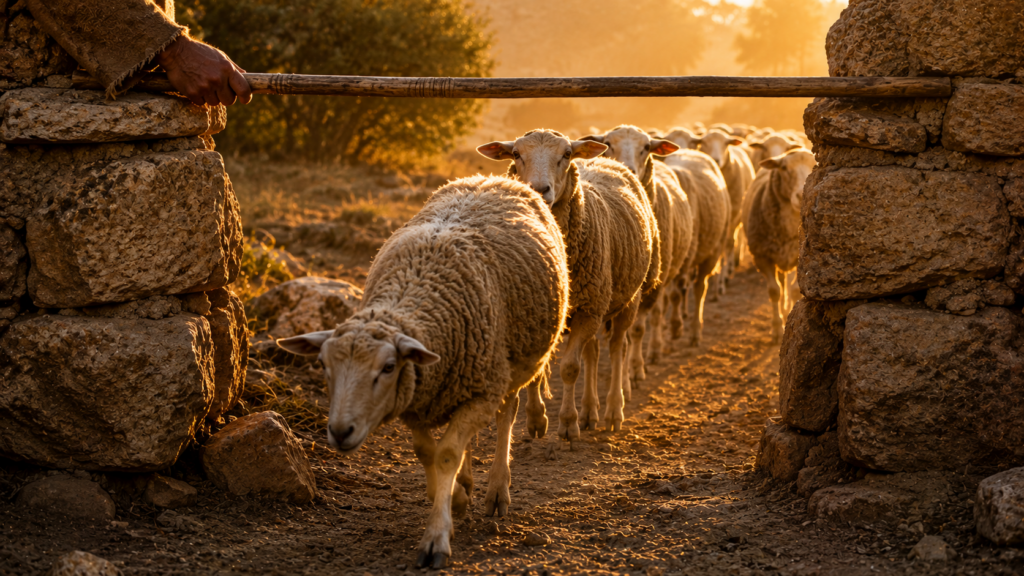
- All the tithe of the herds or the flocks, whatever passes under the rod, the tenth shall be holy to Yahweh (v. 32). The chapter’s image of the passing under the rod. The shepherd counts his animals as they pass through a narrow gate, touching each tenth animal with a rod to mark it as YHWH’s. The chapter is preserving the physical concreteness of the tithe. The whole later Hebrew Bible’s poetic image of YHWH as the shepherd whose rod and staff comfort the sheep (Ps 23:4) reads forward from this verse.
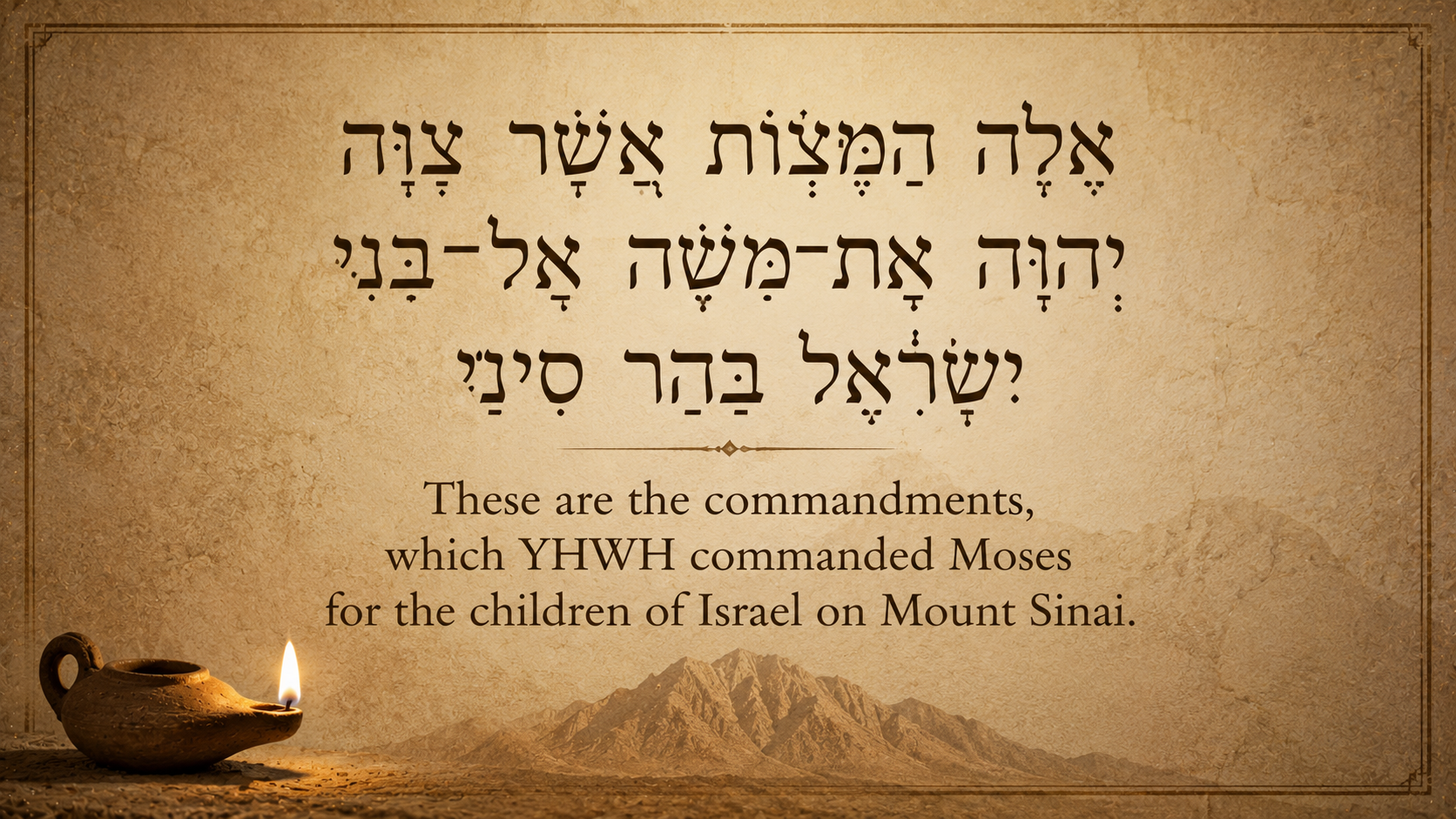
- These are the commandments, which Yahweh commanded Moses for the children of Israel on Mount Sinai (v. 34). The book’s closing colophon. The Hebrew is elleh ha-mitzvot asher tzivvah YHWH et-mosheh el-bnei yisrael be-har sinai. The book ends as it began (Lev 1:1, Yahweh called to Moses), with the location (Mount Sinai) and the relationship (to Moses, for the children of Israel) intact. The whole book is, by this final verse, named as a Sinai-given torah. The whole later Hebrew Bible’s reading of Leviticus as the foundational priestly torah takes its weight from this closing.
Where this lands: The vow you actually made
Most modern Christians do not make formal vows. The Hebrew Bible’s vow-categories — consecrating a person, dedicating a field, devoting an animal — do not have direct modern parallels for most readers. But the chapter’s deeper teaching does have a modern parallel: the spoken commitment that you have made and now find inconvenient.
The chapter is unflinching about this. Once a vow is named aloud, it is real. The household cannot quietly change its mind. The vow can be redeemed (the chapter shows how — with a payment that always includes the twenty percent surcharge), but it cannot simply lapse. If the household does try to substitute or game the vow, the consequences escalate (v. 10, both animals become holy; v. 20, the unredeemed field permanently transfers to the priests).
Modern Christians often live as if our spoken commitments are aspirational rather than binding. I’ll show up Sunday — and we do not. I’ll pray for you — and we do not. I’ll be there for them — and we do not. We’re going to handle this together — and the months pass. The chapter is asking what would happen if we treated each of these spoken commitments with the Levitical seriousness: named aloud, real, redeemable but not ignorable.
Whether or not you keep tithing in the literal one-tenth-of-everything sense, whether or not the formal vow-categories of the chapter apply to your life — the chapter’s underlying principle does. A spoken commitment has weight. The whole later Sermon on the Mount’s let your yes be yes and your no be no (Mt 5:33-37) reads forward from this chapter exactly. Mean what you say. If you cannot mean it, do not say it. If you have said it and cannot keep it, redeem it with deliberate cost — but do not pretend you did not say it.
Influence callout: Sandra Richter (the chapter as the book’s economic capstone)
Richter’s reading of Leviticus 27 in The Epic of Eden (2008) names the chapter as the book’s economic capstone. After chapters of required obligations (sacrifices, tithes, festival observances), the chapter sets out the voluntary dimensions of the economic relationship with YHWH. The vow-categories are not coerced; they are the household’s free choice. But once chosen, they are real. Richter’s pastoral payoff: the chapter’s voluntary commitments are the theological mirror of YHWH’s voluntary commitment in the chapter 26 covenant. YHWH has freely committed himself to Israel; Israel responds with freely committed gifts. The whole later New Testament theology of cheerful giving (2 Cor 9:7, God loves a cheerful giver) and of the church’s free commitments to one another (2 Cor 8:1-15, the Macedonian churches’ generosity) reads forward from this chapter. The chapter teaches that the voluntary commitments of the worshipping community are taken seriously by the same God who takes seriously his own voluntary covenant commitments. The relationship is mutual, freely entered, and structurally consequential on both sides.
Reflection prompts
- The chapter teaches that vows have weight. A spoken commitment is real; it can be redeemed but not ignored. Where in your own life have you spoken commitments that you have not kept and have not deliberately redeemed? What would the chapter ask of you in each case?
- The chapter’s valuation table for vowed persons (vv. 3-7) reflects the ancient labor market, not anthropology. Where in your own community have economic measurements (salary, market value, productivity scores) been allowed to become anthropological judgments (worth, dignity, belonging)? What disentangles them?
- The book ends where it began: on Sinai, with Moses, before the people. The whole book of Leviticus is one extended Sinai instruction. After twenty-seven chapters, what does the book want from its reader? What is the one practice this book is asking you to take up?
Frameworks at play in this chapter: the jubilee year, the kipper / atonement framework, the firstborn / bechor, gospel allegiance.