

Leviticus 14 is the cleansing counterpart to chapter 13’s diagnosis. Where chapter 13 set out the priest’s procedure for examining a suspicious skin or fabric condition, chapter 14 sets out the procedure for restoring the person (or house) once the condition has passed. The chapter is the Hebrew Bible’s most extended re-entry ritual: the diagnosed person, who has been dwelling alone, outside the camp (13:46), now follows a multi-stage protocol to come back inside the community and the sanctuary.
The chapter’s structure is a careful three-part progression. Stage one: the priest comes out to the patient (the patient cannot yet come in), performs a two-bird ritual outside the camp, washes the patient, shaves the patient, and waits seven days while the patient camps just outside the family’s tent (vv. 1-9). Stage two: on the eighth day, the patient comes to the door of the Tent of Meeting and undergoes a full sanctuary ritual including a guilt offering (asham), a sin offering (chatta’t), and a burnt offering (olah), with blood and oil applied to the right ear, the right thumb, and the right great toe (vv. 10-20). Stage three: if the patient cannot afford the standard offerings, a graduated version of the ritual is provided for the poor (vv. 21-32). The chapter then extends the same logic to houses with suspicious wall stains (vv. 33-57).
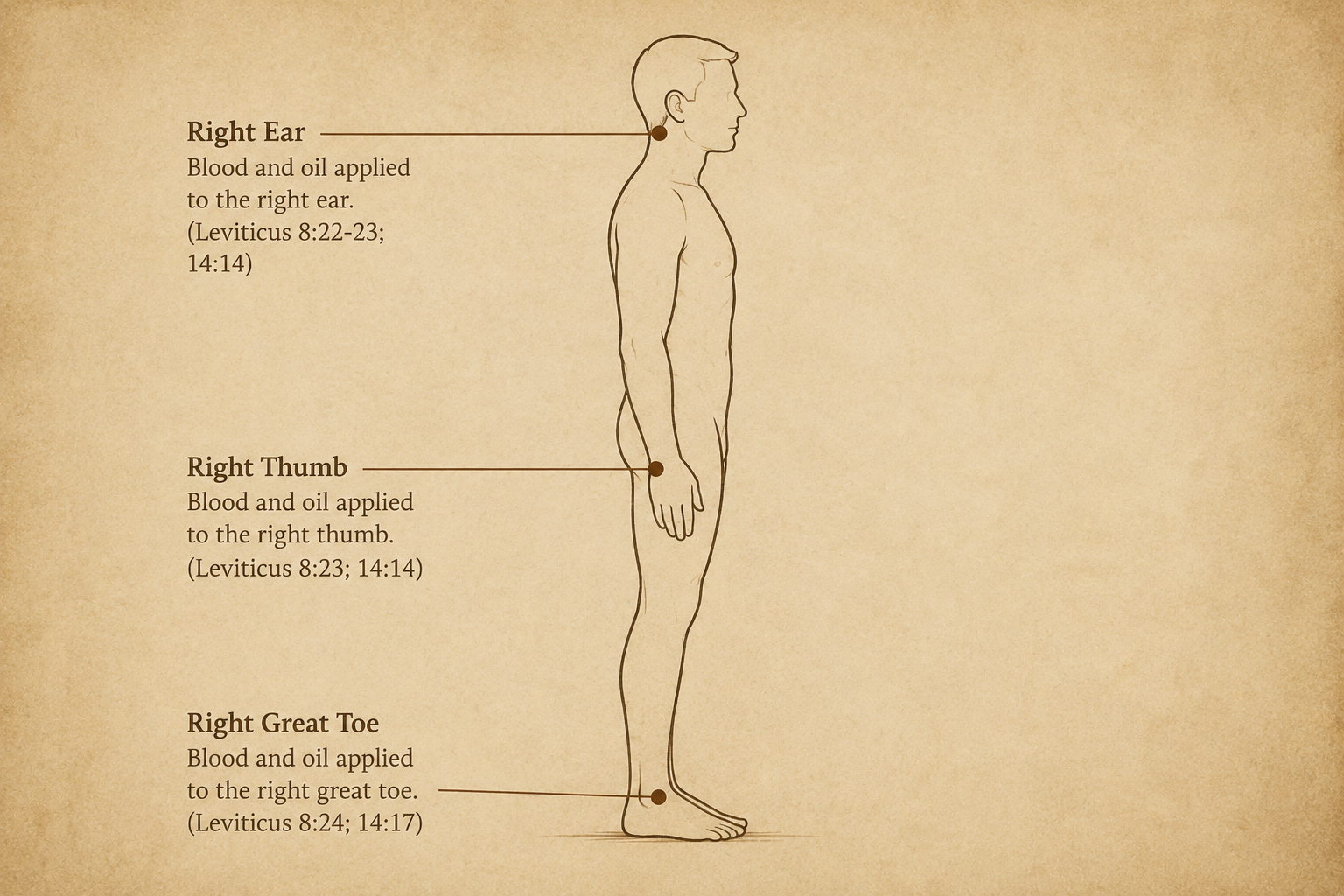
The chapter’s deepest theological move is its parallel to the priestly ordination of chapter 8. The cleansed person is anointed with blood and oil on the right ear, right thumb, right great toe — the exact same protocol used to ordain Aaron and his sons (Lev 8:22-24). The chapter is teaching that the person returning from tzaraat exile is being re-installed into the community with the same kind of ritual care that installed the priesthood. The cleansed person is not just let back in; they are consecratorily welcomed. The whole later prophetic vision of the redeemed coming home with singing (Isa 35:10; 51:11) reads forward from this chapter.
A · Leviticus 14:1-9 · The two-bird ritual outside the camp
¹ Yahweh spoke to Moses, saying, ² “This shall be the law of the leper in the day of his cleansing. He shall be brought to the priest, ³ and the priest shall go out of the camp. The priest shall examine him. Behold, if the plague of leprosy is healed in the leper, ⁴ then the priest shall command them to take for him who is to be cleansed two living clean birds, cedar wood, scarlet, and hyssop. ⁵ The priest shall command them to kill one of the birds in an earthen vessel over running water. ⁶ As for the living bird, he shall take it, and the cedar wood, and the scarlet, and the hyssop, and shall dip them and the living bird in the blood of the bird that was killed over the running water. ⁷ He shall sprinkle on him who is to be cleansed from the leprosy seven times, and shall pronounce him clean, and shall let the living bird go into the open field. ⁸ “He who is to be cleansed shall wash his clothes, and shave off all his hair, and bathe himself in water; and he shall be clean. After that he shall come into the camp, but shall dwell outside his tent seven days. ⁹ It shall be on the seventh day, that he shall shave all his hair off his head and his beard and his eyebrows, even all his hair he shall shave off. He shall wash his clothes, and he shall bathe his body in water, then he shall be clean.
- The priest shall go out of the camp (v. 3). The chapter’s first surprising move. The Hebrew is veyatsa hakohen el-michutz lammachaneh. The priest leaves the sanctuary precinct, leaves the camp, and goes out to the patient. The patient cannot yet enter the camp; the priest must come to them. The chapter is teaching that the priest’s first move toward restoration is to leave his sanctuary. The Hebrew Bible’s deepest pastoral note about ministry to the suffering is hidden here: the priest goes out. The whole later New Testament theology of the Word made flesh who came to his own (Jn 1:11-14), of the Lord who emptied himself (Phil 2:6-7), and of the good shepherd who leaves the ninety-nine to find the one (Mt 18:12-14) reads forward from this verse.
- If the plague of leprosy is healed (v. 3). The chapter is honest about its scope: the cleansing ritual is for the patient whose condition has resolved. The chapter does not promise healing. Healing, when it comes, comes from YHWH directly. The chapter handles what to do after healing has occurred. This is an important pastoral distinction: the chapter is not a magic-healing manual; it is a re-entry manual.
- Two living clean birds, cedar wood, scarlet, and hyssop (v. 4). The ritual materials are the chapter’s most distinctive feature. Four elements: two living clean birds (sparrows or doves, the small birds available at any household), cedar wood (a fragrant durable wood symbolizing endurance and the lebanon of the patriarchs), scarlet (the red dye from the tola worm, the same dye used in the high priest’s garments and in the temple curtains), and hyssop (the small bushy herb used at Passover to apply the blood to the doorposts, Ex 12:22). The combination — wood, herb, and red yarn — will recur at Num 19:6 in the red heifer ritual and Heb 9:19 in the writer’s summary of Sinai’s covenant ratification. The chapter is treating tzaraat-cleansing as a major Hebrew Bible ritual gesture, linked materially to Passover and to the broader purification system.
- Kill one of the birds in an earthen vessel over running water (v. 5). The Hebrew is al-mayim chayyim, “over living waters.” Fresh-flowing water, not stagnant water, must be used (cf. the principle at Lev 11:36; the same mayim chayyim will run through Jn 4:10-14 and Jn 7:38 in transformed form). One bird is killed; its blood is collected in the running water; the blood-water mixture is the ritual cleansing agent.
- He shall dip them and the living bird in the blood … and shall let the living bird go into the open field (vv. 6-7). The chapter’s most striking gesture. The second bird, the living one, is dipped (along with the cedar, scarlet, and hyssop) in the blood-water mixture, then released alive into the open field. The chapter is performing a two-fold symbolic action: one bird absorbs the death, the other carries the release away. The same two-fold structure runs through the Day of Atonement (Lev 16, the two goats: one killed, one sent to Azazel; see the kipper / atonement framework). The chapter is teaching that real restoration involves both an absorbing-death and a flying-release.
- Sprinkle on him who is to be cleansed seven times (v. 7). The seven-fold sprinkling enacts the same numerical key the book uses throughout (cf. 4:6, 17; 8:11; 16:14, 19). Seven is the chapter’s signature of completeness: the cleansing must reach every direction.
- Wash his clothes, and shave off all his hair, and bathe himself in water (v. 8). The patient’s body is radically reset: clothes washed, hair shaved, body bathed. Then seven days of camping just outside the family’s tent. On the seventh day, the same triple action repeats: wash, shave, bathe (v. 9). The chapter is doubling the reset: the body is being prepared for re-entry the way Aaron’s body was prepared for ordination (Lev 8:6, Moses … washed them with water).
B · Leviticus 14:10-20 · The eighth-day sanctuary ritual
¹⁰ “On the eighth day he shall take two male lambs without defect, and one ewe lamb a year old without defect, and three tenths of an ephah of fine flour for a meal offering, mixed with oil, and one log of oil. ¹¹ The priest who cleanses him shall set the man who is to be cleansed, and those things, before Yahweh, at the door of the Tent of Meeting. ¹² “The priest shall take one of the male lambs, and offer him for a trespass offering, with the log of oil, and wave them for a wave offering before Yahweh. ¹³ He shall kill the male lamb in the place where they kill the sin offering and the burnt offering, in the place of the sanctuary; for as the sin offering is the priest’s, so is the trespass offering. It is most holy. ¹⁴ The priest shall take some of the blood of the trespass offering, and the priest shall put it on the tip of the right ear of him who is to be cleansed, and on the thumb of his right hand, and on the big toe of his right foot. ¹⁵ The priest shall take some of the log of oil, and pour it into the palm of his own left hand. ¹⁶ The priest shall dip his right finger in the oil that is in his left hand, and shall sprinkle some of the oil with his finger seven times before Yahweh. ¹⁷ The priest shall put some of the rest of the oil that is in his hand on the tip of the right ear of him who is to be cleansed, and on the thumb of his right hand, and on the big toe of his right foot, upon the blood of the trespass offering. ¹⁸ The rest of the oil that is in the priest’s hand he shall put on the head of him who is to be cleansed: and the priest shall make atonement for him before Yahweh. ¹⁹ “The priest shall offer the sin offering, and make atonement for him who is to be cleansed because of his uncleanness: and afterward he shall kill the burnt offering; ²⁰ and the priest shall offer the burnt offering and the meal offering on the altar. The priest shall make atonement for him, and he shall be clean.
- On the eighth day (v. 10). The chapter’s most theologically loaded temporal marker. The eighth day, the day of new creation, the day Aaron began his ministry (Lev 9:1), the day a newborn boy is circumcised into the covenant (Lev 12:3), the day the cleansed patient re-enters the sanctuary. The chapter is teaching that the cleansing person’s return is its own eighth-day inauguration. (See the festival calendar framework for the broader eighth-day pattern.)
- Two male lambs … one ewe lamb … three tenths of an ephah of fine flour … one log of oil (v. 10). The chapter requires the most expansive set of offerings yet seen in the book for a single ritual: an asham (the trespass offering, ch. 5), a chatta’t (the sin offering, ch. 4), an olah (the burnt offering, ch. 1), and a minchah (the grain offering, ch. 2). Four of the five offerings are brought together. Only the shelamim (peace offering) is not specifically required — though the chapter does not forbid one. The chapter is treating the cleansed patient’s return as requiring the entire sacrificial machinery.
- The priest shall take some of the blood of the trespass offering … and put it on the tip of the right ear … and on the thumb of his right hand, and on the big toe of his right foot (v. 14). The chapter’s most striking single moment. The cleansed person receives the exact same blood-application that Aaron and his sons received at their ordination (Lev 8:22-24). Right ear, right thumb, right great toe. The chapter is teaching that the patient returning from tzaraat exile is being re-consecrated with the same liturgical care that installed the priesthood. The Hebrew Bible’s deepest pastoral move: the cleansed person is welcomed back as if they were being ordained.
- The priest shall take some of the log of oil … and sprinkle some of the oil with his finger seven times before Yahweh … and put some of the rest of the oil on the tip of the right ear … and on the thumb of his right hand, and on the big toe of his right foot, upon the blood (vv. 15-17). The oil follows the blood in the same triple-place pattern. The patient is anointed on top of the blood. The combination of blood-then-oil on the priestly extremities (ear-thumb-toe) is unique to this chapter and to Lev 8:22-30. The chapter is liturgically equating the cleansed person’s return with the priesthood’s inauguration.
- The rest of the oil that is in the priest’s hand he shall put on the head of him who is to be cleansed (v. 18). The closing anointing. The cleansed person’s head is anointed with the remaining oil. The same gesture anointed Aaron’s head at his ordination (Lev 8:12). The chapter is making the parallel as explicit as possible without naming it. The cleansed patient is not just allowed back; they are anointed back.
Word study: taher (טָהֵר) — “to be clean, to be pure, to be re-integrated”
The Hebrew verb taher (the verbal root underlying the adjective tahor, “clean,” and the verb vetaher, “and he shall be cleansed”) names the transition from impurity to ritual cleanness. The verb appears more than thirty times in chapters 13-14 alone. Its semantic core is not moral improvement but re-integration into normal life-with-God. To be tahor is to be fit to enter sacred space and engage in the community’s normal rhythms; to be cleansed is to cross the threshold back into that fitness. The whole later Hebrew Bible vocabulary of purification — Ps 51:7 (purge me with hyssop and I shall be clean; the same hyssop of Lev 14:4), Ezek 36:25 (I will sprinkle clean water on you and you shall be clean), and the New Testament’s katharidzo (cleanse) verbs (Mt 8:3, I will; be cleansed; 1 Jn 1:7, the blood of Jesus cleanses us from all sin) — takes its texture from this Hebrew root. The chapter is teaching that taher is a real condition, with a real liturgical path back, available regardless of what initially put the person outside. The path is detailed; the path is performed; the path arrives.
C · Leviticus 14:21-32 · The graduated offering for the poor
²¹ “If he is poor, and can’t afford so much, then he shall take one male lamb for a trespass offering to be waved, to make atonement for him, and one tenth of an ephah of fine flour mingled with oil for a meal offering, and a log of oil; ²² and two turtledoves, or two young pigeons, such as he is able to afford; and the one shall be a sin offering, and the other a burnt offering. ²³ “On the eighth day he shall bring them for his cleansing to the priest, to the door of the Tent of Meeting, before Yahweh. ²⁴ The priest shall take the lamb of the trespass offering, and the log of oil, and the priest shall wave them for a wave offering before Yahweh. ²⁵ He shall kill the lamb of the trespass offering. The priest shall take some of the blood of the trespass offering and put it on the tip of the right ear of him who is to be cleansed, and on the thumb of his right hand, and on the big toe of his right foot. ²⁶ The priest shall pour some of the oil into the palm of his own left hand; ²⁷ and the priest shall sprinkle with his right finger some of the oil that is in his left hand seven times before Yahweh. ²⁸ Then the priest shall put some of the oil that is in his hand on the tip of the right ear of him who is to be cleansed, and on the thumb of his right hand, and on the big toe of his right foot, on the place of the blood of the trespass offering. ²⁹ The rest of the oil that is in the priest’s hand he shall put on the head of him who is to be cleansed, to make atonement for him before Yahweh. ³⁰ He shall offer one of the turtledoves, or of the young pigeons, such as he is able to afford, ³¹ even such as he is able to afford, the one for a sin offering, and the other for a burnt offering, with the meal offering. The priest shall make atonement for him who is to be cleansed before Yahweh.” ³² This is the law for him in whom is the plague of leprosy, who is not able to afford the sacrifice for his cleansing.
- If he is poor, and can’t afford so much (v. 21). The chapter’s familiar economic graduation. The full ritual of vv. 10-20 requires three lambs; the chapter recognizes that not every Israelite household can afford that. The chapter therefore provides a reduced form: one lamb (the asham) plus two birds (one chatta’t, one olah). The grain offering is reduced from three-tenths of an ephah to one-tenth.
- The priest shall take some of the blood of the trespass offering, and put it on the tip of the right ear (v. 25). Crucially, the blood-and-oil-on-ear-thumb-toe ritual is not reduced. The poor patient receives the exact same consecratory anointing as the wealthy patient. The chapter is teaching that the cleansing’s theological substance does not scale with wealth. The poor patient’s restoration is equally complete. The whole chapter’s economic graduation honors the household’s actual capacity while preserving the ritual’s deepest meaning intact.
D · Leviticus 14:33-57 · Tzaraat in houses
³³ Yahweh spoke to Moses and to Aaron, saying, ³⁴ “When you have come into the land of Canaan, which I give to you for a possession, and I put a spreading mildew in a house in the land of your possession; ³⁵ then he who owns the house shall come and tell the priest, saying, ‘There seems to me to be some sort of plague in the house.’ ³⁶ The priest shall command that they empty the house, before the priest goes in to examine the plague, that all that is in the house not be made unclean. Afterward the priest shall go in to inspect the house. ³⁷ He shall examine the plague; and behold, if the plague is in the walls of the house with hollow streaks, greenish or reddish, and it appears to be deeper than the wall; ³⁸ then the priest shall go out of the house to the door of the house, and shut up the house seven days. ³⁹ The priest shall come again on the seventh day, and look. If the plague has spread in the walls of the house, ⁴⁰ then the priest shall command that they take out the stones in which is the plague, and cast them into an unclean place outside of the city: ⁴¹ and he shall cause the inside of the house to be scraped all around, and they shall pour out the mortar that they scraped off outside of the city into an unclean place. ⁴² They shall take other stones, and put them in the place of those stones; and he shall take other mortar, and shall plaster the house. ⁴³ “If the plague comes again, and breaks out in the house, after he has taken out the stones, and after he has scraped the house, and after it was plastered; ⁴⁴ then the priest shall come in and look; and behold, if the plague has spread in the house, it is a destructive mildew in the house. It is unclean. ⁴⁵ He shall break down the house, its stones, and its timber, and all the house’s mortar. He shall carry them out of the city into an unclean place. ⁴⁶ “Moreover he who goes into the house while it is shut up shall be unclean until the evening. ⁴⁷ He who lies down in the house shall wash his clothes; and he who eats in the house shall wash his clothes. ⁴⁸ “If the priest shall come in, and examine it, and behold, the plague hasn’t spread in the house, after the house was plastered, then the priest shall pronounce the house clean, because the plague is healed. ⁴⁹ To cleanse the house he shall take two birds, and cedar wood, and scarlet, and hyssop. ⁵⁰ He shall kill one of the birds in an earthen vessel over running water. ⁵¹ He shall take the cedar wood, the hyssop, the scarlet, and the living bird, and dip them in the blood of the slain bird, and in the running water, and sprinkle the house seven times. ⁵² He shall cleanse the house with the blood of the bird, and with the running water, with the living bird, with the cedar wood, with the hyssop, and with the scarlet; ⁵³ but he shall let the living bird go out of the city into the open field. So shall he make atonement for the house: and it shall be clean.” ⁵⁴ This is the law for any plague of leprosy, and for a scall, ⁵⁵ and for the destructive mildew of a garment, and for a house, ⁵⁶ and for a rising, and for a scab, and for a bright spot; ⁵⁷ to teach when it is unclean, and when it is clean. This is the law of leprosy.
- When you have come into the land of Canaan … I put a spreading mildew in a house (v. 34). The chapter is forward-pointing: the house-cleansing ritual is for after Israel’s settlement. The Hebrew is striking: and I put a spreading mildew in a house — the chapter treats the wall-stain as YHWH’s placement, not as random misfortune. Whatever the modern medical reading of the condition (mold? fungal growth? mineral leaching?), the chapter’s theological grammar treats it as a sign sent by YHWH that requires response.
- The priest shall command that they empty the house, before the priest goes in to examine (v. 36). A pragmatic detail: empty the house first, so that the priest’s examining-presence (which makes things temporarily unclean during the diagnosis) does not contaminate the household’s possessions. The chapter is materially attentive.
- Take out the stones … scrape the inside … take other stones, and put them in the place (vv. 40-42). The chapter performs a partial demolition and replacement. The affected stones are removed and disposed of outside the city; the wall is scraped clean; new stones and new mortar are installed. The chapter is preserving the principle from 13:56: whatever can be saved, is saved. The whole house is not destroyed unless the contamination returns (vv. 43-45) after the partial repair has been attempted.
- The same two-bird ritual (vv. 49-53). The chapter cleanses the house with the same two-bird rite that cleansed the person in vv. 4-7. The bird-killing, the cedar-and-scarlet-and-hyssop, the seven-fold sprinkling, the release of the living bird out of the city into the open field: each step parallels the cleansing of the human patient. The chapter is again teaching that the same theological vocabulary applies to bodies, garments, and houses. The category tzaraat and the category cleansing are consistent across all three.
Where this lands: Welcome them back like a priest
The chapter’s most overlooked move is the parallel between the cleansed patient and the ordained priest. The blood on the right ear, the right thumb, the right great toe. The oil on top of the blood, in the same three places. The oil poured on the head. These are not cleansing rituals in the generic sense. These are the exact same gestures Moses performed when he installed Aaron and his sons as priests in chapter 8.
The chapter is teaching that the person returning from tzaraat exile is welcomed back the way a new priest is ordained. Not as if the exile never happened. Not with embarrassed silence. Not with let’s just move on. The chapter performs a multi-day liturgy of consecratory return.
Most modern communities, when someone comes back from a hard season — addiction recovery, mental health crisis, an exit from a marriage that didn’t survive, a stretch of unemployment, a faith-deconstruction-and-return, an extended grief — have nothing like this. The person is either quietly slipped back in (as if nothing happened) or kept at arm’s length (as if too much happened). Neither is what Leviticus 14 does. The chapter performs a full ritual return that names the exile, marks the body, and treats the returning person as if they were being installed in office. You belong here again, the chapter says, and we are going to do this with the same care we used to install the high priest.
The application is uncomfortable. If you have someone in your life who has just come back, are you welcoming them like a priest? If you are the one coming back, are you letting yourself be welcomed that way, or are you trying to slip in unnoticed? Leviticus 14 is the chapter that asks the question.
Influence callout: Marty Solomon (Bema; the chapter as parallel to the priestly ordination)
Solomon’s reading of Leviticus 14 in the Bema podcast’s Leviticus series highlights the precise structural parallel between the *cleansing of the m’tzora (the person being restored from tzaraat) and the milluim of Aaron and his sons in chapter 8. The blood on right ear, thumb, toe — identical. The oil over the blood — identical. The oil on the head — identical. The seven-fold sprinkling — identical. Solomon’s pastoral payoff: the chapter is teaching that the person returning from exile is not just allowed back; they are re-consecrated. The Hebrew Bible is using the priestly-ordination vocabulary, deliberately, for the cleansing of the leper. The whole later New Testament theology of the cleansed person becoming a priest (1 Pet 2:9, you are a chosen race, a royal priesthood; Rev 5:10, you have made them a kingdom and priests) reads forward from this chapter’s ritual grammar. Solomon’s reading is consistent with the broader Paul Within Judaism lane: the Hebrew Bible’s covenant categories are not retired when the messianic age dawns; they are expanded outward. The cleansing of the leper in Lev 14 is the foreshadow of the priestly identity of the whole church in the New Testament.
Reflection prompts
- The priest goes out of the camp to the patient before the patient can come back in. The first move toward restoration is the priest’s coming out. Where in your own community is there someone outside the camp whose restoration is waiting on someone going out to them?
- The chapter performs a multi-day, multi-stage return ritual: outside-the-camp bird rite, seven-day waiting, second wash, eighth-day sanctuary ritual, blood and oil on ear and thumb and toe, oil on the head. The cleansing takes time and ceremony. Where in your own life have you tried to rush a return that the chapter’s wisdom would have you do more slowly and more deliberately?
- The chapter uses the same gestures to consecrate a returning patient that it used to install the priesthood. The returning person is welcomed as if they were being ordained. If someone in your life is currently returning from a hard season, what would welcome them like a priest look like in practice?
Frameworks at play in this chapter: the clean and unclean, the kipper / atonement framework, the five offerings, the festival calendar, Paul Within Judaism.