

Leviticus 13 is the book’s longest single chapter on a single subject: the examination of tzaraat, a category of visible skin and fabric conditions that the standard English Bibles translate leprosy but that almost certainly does not correspond to what modern medicine calls leprosy (Hansen’s disease). The chapter sets out the priest’s procedure for examining a person who has developed a suspicious skin condition (vv. 1-46) and then, in a remarkable extension, applies the same procedural logic to garments and fabrics that have developed a suspicious mark (vv. 47-59). The chapter’s later companion (ch. 14) will extend the same logic to houses with suspicious wall-stains. The whole unit (chs. 13-14) is the book’s most sustained treatment of what to do when visible signs of disorder appear on bodies, clothes, and dwellings.
The chapter is not, primarily, about medicine. It is not, primarily, about contagion in the modern epidemiological sense. It is about the visible signs of life-going-wrong and the liturgical-communal response to those signs. The condition the chapter calls tzaraat is, in the Hebrew Bible’s grammar, a visible sign of categorical breakdown on a body, a garment, or a house. The skin’s normal smooth surface develops white-or-raised spots, hair turns white in the spot (a sign the living follicle is dying), raw flesh appears (a sign the protective surface has failed). The chapter is responding to bodily signs that something has gone wrong with the equivalent of an early-warning system: examine, isolate temporarily, observe, decide.
The most important interpretive note: the priest in this chapter is not the healer. He does not anoint, treat, or pray over the condition. He examines it. He is, in modern terms, the diagnostic officer. He makes one of three pronouncements: clean (no disease, return to ordinary life), unclean (a confirmed case, move outside the camp until the condition resolves and chapter 14’s cleansing ritual can be performed), or quarantine for further observation (seven days, then re-examine). The chapter is a diagnostic manual, not a healing manual. Healing, when it comes, comes from YHWH directly (Num 12:13-15, Moses prays for Miriam’s healing from tzaraat; 2 Kings 5, Naaman is healed through Elisha’s instruction).
A · Leviticus 13:1-46 · The examination of tzaraat on persons
¹ Yahweh spoke to Moses and to Aaron, saying, ² “When a man shall have a rising in his skin, or a scab, or a bright spot, and it becomes in the skin of his body the plague of leprosy, then he shall be brought to Aaron the priest, or to one of his sons, the priests: ³ and the priest shall examine the plague in the skin of the body: and if the hair in the plague has turned white, and the appearance of the plague is deeper than the body’s skin, it is the plague of leprosy; and the priest shall examine him, and pronounce him unclean. ⁴ If the bright spot is white in the skin of his body, and its appearance isn’t deeper than the skin, and its hair hasn’t turned white, then the priest shall isolate the infected person for seven days. ⁵ The priest shall examine him on the seventh day, and, behold, if in his eyes the plague is arrested, and the plague hasn’t spread in the skin, then the priest shall isolate him for seven more days. ⁶ The priest shall examine him again on the seventh day; and behold, if the plague has faded, and the plague hasn’t spread in the skin, then the priest shall pronounce him clean. It is a scab. He shall wash his clothes, and be clean. ⁷ But if the scab spreads on the skin, after he has shown himself to the priest for his cleansing, he shall show himself to the priest again. ⁸ The priest shall examine him; and behold, if the scab has spread on the skin, then the priest shall pronounce him unclean. It is leprosy.
[Continuing through verse 46 — the chapter’s detailed examination protocols cover raw flesh (vv. 9-17), boils (vv. 18-23), burns (vv. 24-28), scalp and beard infections (vv. 29-37), bright spots that are not disease (vv. 38-39), bald-head conditions (vv. 40-44), and the closing instruction at vv. 45-46.]
⁴⁵ “The leper in whom the plague is shall wear torn clothes, and the hair of his head shall hang loose. He shall cover his upper lip, and shall cry, ‘Unclean! Unclean!’ ⁴⁶ All the days in which the plague is in him he shall be unclean. He is unclean. He shall dwell alone. Outside of the camp shall be his dwelling.
- The priest shall examine the plague in the skin of the body (v. 3). The chapter’s primary verb is ra’ah (to see, to examine, to look at carefully). The priest’s diagnostic work is patient looking. The chapter is teaching, by structural repetition (the verb ra’ah appears more than thirty times in the chapter), that attentive observation is the priest’s discipline. He does not rush. He does not declare on the basis of one look. He returns, looks again, returns again, looks again.
- The hair has turned white … the appearance is deeper than the skin (v. 3). The chapter’s first-pass diagnostic markers. White hair signals that the living follicle is dying (hair pigment is produced by living melanocytes; dying tissue loses pigment). Depth below the skin surface signals that the condition has penetrated, not merely surfaced. The chapter is using bodily indicators that modern dermatology would recognize as the basis for its diagnostic call. The chapter is not medieval superstition; it is trained observation, formalized.
- The priest shall isolate the infected person for seven days (v. 4). When the markers are ambiguous, the chapter requires quarantine. The Hebrew is vehisggir (and he shall shut up). The same verb will recur throughout the chapter: when the priest cannot tell, he waits. Seven days. Then he looks again. If the condition has stabilized, seven more days (v. 5). If the condition has faded, clean (v. 6). If the condition has spread, unclean (v. 7-8). The chapter’s diagnostic patience is its most countercultural feature: in a system that has the priest’s authority to declare unclean and send a person outside the camp, the chapter builds in fourteen days of careful observation before the call is made.
- He shall wash his clothes, and be clean (v. 6). When the seven-day observation concludes with clean, the person performs a ritual washing and returns to ordinary life. The chapter is preserving an exit ramp: not every suspicious mark turns out to be tzaraat. The chapter’s mechanism protects both the community (from undetected spread) and the suspect (from over-hasty banishment).
- The leper in whom the plague is (v. 45). The chapter’s closing instruction for the confirmed case. The diagnosed person wears the same gestures of mourning (torn clothes, loose hair, covered upper lip, the cry unclean! unclean!) that the Hebrew Bible elsewhere uses for grief over a death (cf. 2 Sam 15:30; Ezek 24:17). The chapter is treating the diagnosed person as symbolically dead: outside the camp, marked by mourning, separated. The pastoral note is sober — this is the Hebrew Bible’s most isolating diagnosis — but also honest: the chapter is not pretending the condition is small.
- He shall dwell alone. Outside of the camp shall be his dwelling (v. 46). The diagnosed person lives alone, outside the camp. The Hebrew Bible’s later narratives will feature this exile (Num 12:14-15, Miriam’s seven days outside the camp after her tzaraat; 2 Kings 7:3-10, the four lepers at the gate of Samaria; Lk 17:11-19, the ten lepers who stand at a distance and cry to Jesus). The chapter is establishing the spatial logic that the Gospels will reverse: Jesus enters the leprous space, touches the leper, and the leper is restored back into the camp. (See the clean and unclean framework for the asymmetric-contagion theology this presupposes.)
Word study: tzaraat (צָרַעַת) — “the visible skin/fabric condition”
The Hebrew tzaraat names a category of visible conditions on skin, hair, fabric, or wall surfaces. The chapter uses the same word for a human skin disease (vv. 1-46), a garment mildew or rot (vv. 47-59), and (in ch. 14) a wall stain in a house. The fact that tzaraat applies equally to fabrics and walls demonstrates that the word cannot primarily mean a contagious human disease. The Septuagint translates tzaraat as lepra, and the English translations have followed: leprosy. But the Greek and Latin lepra is itself a broad word that covers any scaly or flaking skin condition; it is not the same as modern medical leprosy (Hansen’s disease, caused by Mycobacterium leprae, which was unknown in the ancient world by that name and which produces a distinctive set of symptoms the chapter’s descriptions do not match). Modern scholarly consensus: tzaraat refers to a category of visible skin conditions (psoriasis, vitiligo, eczema, fungal infections, possibly some autoimmune conditions, and yes, possibly some early-stage Hansen’s-style diseases) that share the feature of visible breakdown of the body’s surface. The whole later New Testament word leprosy (Mt 8:1-4; Mk 1:40-45; Lk 5:12-16; 17:11-19) inherits this same broad Septuagint-Greek category. The Gospels’ lepers are people with visible skin conditions of various medical kinds, not necessarily people with the specific disease modern medicine calls leprosy. The chapter is teaching, again, that the Hebrew Bible’s vocabulary does not map cleanly onto modern medical categories.
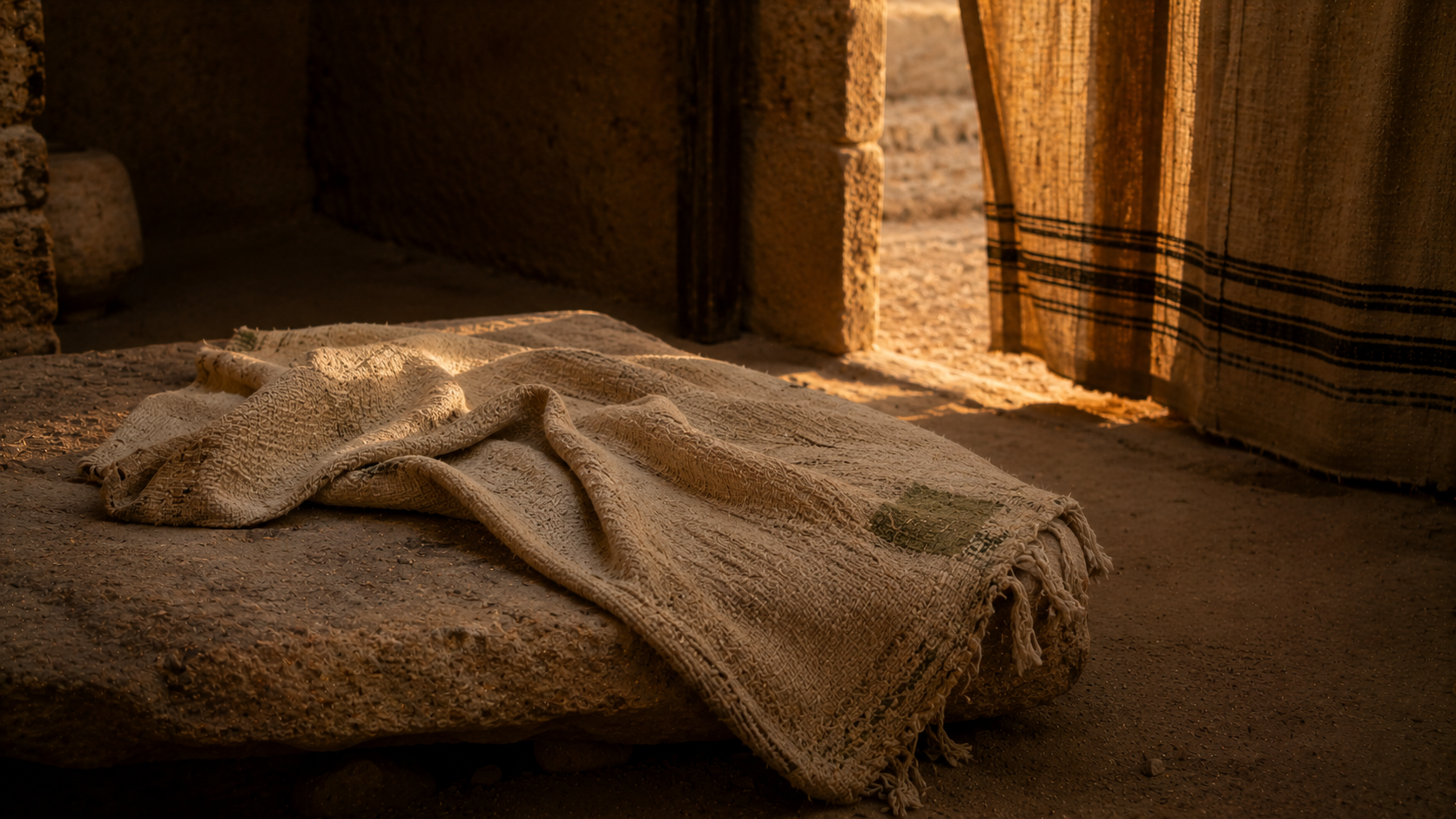
B · Leviticus 13:47-59 · Tzaraat on garments
⁴⁷ “The garment also that the plague of leprosy is in, whether it is a woolen garment, or a linen garment; ⁴⁸ whether it is in warp, or woof; of linen, or of wool; whether in a leather, or in anything made of leather; ⁴⁹ if the plague is greenish or reddish in the garment, or in the leather, or in the warp, or in the woof, or in any thing of leather; it is the plague of leprosy, and shall be shown to the priest. ⁵⁰ The priest shall examine the plague, and isolate the plague seven days. ⁵¹ He shall examine the plague on the seventh day. If the plague has spread in the garment, either in the warp, or in the woof, or in the skin, whatever use the skin is put to, the plague is a destructive mildew. It is unclean. ⁵² He shall burn the garment, whether the warp or the woof, in wool or in linen, or anything of leather, in which the plague is: for it is a destructive mildew. It shall be burned in the fire. ⁵³ “If the priest examines it, and behold, the plague hasn’t spread in the garment, either in the warp, or in the woof, or in anything of skin; ⁵⁴ then the priest shall command that they wash the thing in which the plague is, and he shall isolate it seven more days. ⁵⁵ The priest shall examine it, after the plague is washed; and behold, if the plague hasn’t changed its color, and the plague hasn’t spread, it is unclean; you shall burn it in the fire. It is a mildewed spot, whether the bareness is inside or outside. ⁵⁶ If the priest looks, and behold, the plague has faded after it is washed, then he shall tear it out of the garment, or out of the skin, or out of the warp, or out of the woof: ⁵⁷ and if it appears still in the garment, either in the warp, or in the woof, or in anything of skin, it is spreading. You shall burn what the plague is in with fire. ⁵⁸ The garment, either the warp, or the woof, or whatever thing of skin it is, which you shall wash, if the plague has departed from them, then it shall be washed the second time, and it shall be clean.” ⁵⁹ This is the law of the plague of mildew in a garment of wool or linen, either in the warp, or the woof, or in anything of skin, to pronounce it clean, or to pronounce it unclean.
- The garment also that the plague of leprosy is in (v. 47). The chapter applies the same tzaraat category to fabrics. The Hebrew is vehabeged ki-yihyeh bo nega tzaraat. The same word nega (plague, affliction) the chapter has used for the human skin condition (vv. 2-46) now names the fabric condition. The chapter is teaching, by deliberate extension, that tzaraat is a category that includes both bodies and objects. This is the chapter’s most important theological clue: the condition cannot be moral failure, because fabrics do not sin.
- Whether it is a woolen garment, or a linen garment … or a leather (vv. 47-48). The chapter is materially precise. Wool (animal-source fiber), linen (plant-source fiber), and leather (animal-skin) are the major textiles of the Hebrew Bible’s economy. Each can develop the greenish or reddish (v. 49) staining that signals destructive mildew (Hebrew tzaraat mam-eret). The chapter is responding to a real material problem: in a humid storage environment, fabrics can develop fungal or bacterial growth that damages the fiber and spreads to adjacent items.
- Isolate the plague seven days (v. 50). The same seven-day observation protocol the chapter applied to skin diseases (v. 4) now applies to fabrics. The priest waits, then re-examines. The Hebrew Bible’s diagnostic patience does not relax just because the patient is a tunic.
- He shall burn the garment (v. 52). The disposal protocol is fire. The fabric cannot be cleansed and re-used the way a person can be (after chapter 14’s cleansing ritual). Materially, the fabric is gone; the fiber has been damaged irreversibly. The chapter is honest about the cost: confirmed tzaraat on a fabric means the loss of the garment.
- If the plague has faded after it is washed, then he shall tear it out (v. 56). The chapter offers a partial restoration option: if the spot has faded but not vanished, the damaged section can be cut out and the rest of the garment retained. The chapter is preserving the salvageable. Whatever can be saved, is saved.
Where this lands: The patient priest
The priest in Leviticus 13 does not declare on day one. He looks, isolates the patient for seven days, comes back, looks again, isolates for another seven days, looks a third time, and only then makes a final call. He is allowed to say I don’t know yet. He is allowed to say we need to wait. The chapter is honest that some conditions need fourteen days of careful observation before a verdict can be reached.
In a culture that diagnoses on a six-second video clip, that judges on the basis of one screenshot, that issues a verdict before all the facts are in — Leviticus 13’s diagnostic patience is countercultural to a degree the modern reader sometimes does not catch on first reading. The chapter is teaching that some calls cannot be made fast. Wait. Watch. Come back. Watch again. This is the priest’s discipline, and it is offered as a model.
The application is uncomfortable. Most of us are not making medical-grade diagnoses about skin conditions; we are making social-grade diagnoses about people. That person is selfish. That coworker is incompetent. That family member is bitter. That leader is corrupt. Sometimes we are right. But Leviticus 13 is suggesting that even when we might be right, the call should not be made on the basis of one look. Isolate the patient for seven days, the chapter says. Watch how the situation develops. Come back. Watch again. The fourteen-day discipline of attentive observation, before any verdict, is the chapter’s gift to communities that are tempted by the speed of judgment.
The chapter does not abolish the verdict. If the tzaraat spreads, the priest does pronounce unclean. There are real conditions, and real responses to those conditions. The chapter is not naive about that. But the verdict comes after the patience, not before it. The priest’s longest discipline is waiting.
Influence callout: Jacob Milgrom (Leviticus 1-16; tzaraat as visible disorder, not contagious sin)
Milgrom’s reading of Leviticus 13 reframes the chapter inside the broader purity system. Tzaraat, he argues, is the most visible Hebrew Bible category of physical disorder: bodies and objects whose surfaces have visibly broken down. The condition is not moral failure (the chapter applies the same category to fabrics, which cannot sin). It is not contagious in the modern epidemiological sense (the chapter’s protocols are not really about preventing disease spread; the Hebrew Bible’s other infectious-disease responses, like the Egyptian plagues, do not follow this protocol). What tzaraat is, in Milgrom’s reading, is a visible sign of life-going-wrong. The skin should be smooth and uninterrupted. The fabric should be intact and uniform. The wall should be unmarred. When visible breakdown appears, the system responds: examine, observe, decide, isolate temporarily, and (in chapter 14) re-integrate when the breakdown has passed.
Milgrom’s pastoral payoff: the chapter is not blaming the patient. The diagnosed person is not being told you sinned and this is your punishment. The diagnosis names a real condition that has appeared on the body, but the condition is categorial, not moral. The Hebrew Bible elsewhere (Miriam’s tzaraat in Num 12; Gehazi’s in 2 Kings 5; Uzziah’s in 2 Chron 26) shows that tzaraat can be sent as judgment for specific sins, but the chapter itself does not assume this. The whole later Christian tradition’s tendency to read skin disease as evidence of God’s judgment on the sufferer (a tendency that did real harm in medieval and early modern Europe) reads into the chapter what the chapter itself does not say. The Gospels’ Jesus, in his repeated touching and healing of lepers, is not breaking the chapter’s framework; he is reversing the asymmetric contagion (see again the clean and unclean framework). His holiness flows to the patient; the patient is restored. The chapter’s diagnostic protocol gives way, in the messianic age, to the holiness-that-heals.
Reflection prompts
- The priest is the examiner, not the healer. He is allowed to say I don’t know yet. Where in your own life have you been pressured (by yourself or others) to render a verdict before the evidence is in? What would quarantine the patient for seven days look like in that situation?
- The chapter applies the same logic to fabrics. The condition is not moral failure. Where in your own life has a visible “sign of life-going-wrong” (illness, depression, addiction, financial struggle) been read by you or by others as evidence of moral failure rather than as a real condition that needs care?
- The chapter’s diagnosed person dwells alone, outside the camp. The Hebrew Bible’s most isolating diagnosis is named honestly. The Gospels’ Jesus reverses the spatial logic by entering the leprous space. Where in your own community is there a person currently outside the camp whom you have been waiting for them to come back, when the chapter’s deeper move is for you to go out to them?
Frameworks at play in this chapter: the clean and unclean, the kipper / atonement framework, the tabernacle as cosmic temple.