

Leviticus opens with the olah, the burnt offering: the animal goes up in smoke, in full, to YHWH. Nothing is eaten by the worshipper. Nothing is reserved for the priest. The entire animal ascends. The chapter names three economic levels at which an Israelite can bring this offering: a bull from the herd (vv. 3-9), a sheep or goat from the flock (vv. 10-13), and a turtledove or young pigeon (vv. 14-17). The mechanics differ by animal; the theology is identical at each level. Burnt offering is the chapter’s translation of the Hebrew olah, which is built on the verb alah, “to ascend, to go up.” The offering’s name is its movement. What is given does not stay; it rises.
This is the first of the five offerings the book lays out (chs. 1-7), and the order is theological. The olah is the most concentrated single image of total gift in the Hebrew Bible’s sacrificial economy. Nothing returns to the giver. Nothing is shared with anyone else. The whole thing goes up. The book is opening its sacrificial instructions with the offering that most clearly says, this is what unreserved devotion looks like as ritual practice.
The chapter is also opening the book’s central concern: how can a person approach the YHWH who has just moved into the camp? The first answer Leviticus gives is with a complete gift. Everything that follows in the book builds on that opening.
A · Leviticus 1:1-2 · The summons and the structure
¹ Yahweh called to Moses, and spoke to him out of the Tent of Meeting, saying, ² “Speak to the children of Israel, and tell them, ‘When anyone of you offers an offering to Yahweh, you shall offer your offering of the livestock, from the herd and from the flock.
- Yahweh called to Moses (v. 1). The Hebrew is vayyikra el-moshe, and vayyikra gives the book its Hebrew name. The verb is qara, “to call,” but here in its specific form, to summon by name. The very first action in the book is YHWH addressing Moses by direct calling-out. Rashi’s classical reading: the call is one of affection. The same verb is used at Isaiah 6:3 when the seraphim “call” to one another with reverent address. The book opens with intimacy, not with bureaucratic instruction.
- Out of the Tent of Meeting (v. 1). The new mode of divine speech begins. Through Exodus, YHWH has spoken from Sinai (chs. 19-20, 24), from the cloud-pillar (33), or face-to-face with Moses (33:11). With the tabernacle now standing (Ex 40), the locus of divine speech is the Tent of Meeting and specifically (per Ex 25:22) the kapporet, the mercy seat between the cherubim above the ark. The book is recording the operational shift: post-Sinai, YHWH speaks from the inner sanctum.
- Speak to the children of Israel (v. 2). The opening clause makes a quiet but important theological point. The sacrificial system is not a priestly secret. It is published to the whole people. The book that will be largely concerned with what the priests do begins by addressing what the people will bring. Aaron’s family will mediate the offering, but the Israelites are the ones who decide to bring it, choose the animal, and lay their hand on its head. The system has lay agency at its starting point.
- When anyone of you offers an offering (v. 2). The Hebrew is adam ki-yaqriv mikkem qorban la-YHWH, “when a human (adam) from among you brings near an offering (qorban) to YHWH.” Two words matter. Adam is the same word for human used at Genesis 1-3, the generic noun for every human person. The chapter is using inclusive language: any Israelite may bring an offering. Qorban (offering, from the verb qarav, “to come near, to draw close”) is the chapter’s primary vocabulary for the sacrifices. The word names the offering as the means of nearness. The whole sacrificial system, the chapter is teaching from its first noun, is how Israel comes near to YHWH. The English word sacrifice (Latin sacer-facere, “to make sacred”) catches some of this; qorban (literally, “thing-that-brings-near”) catches more.
Word study: qorban (קָרְבָּן)
The Hebrew qorban is built on the verb-root qarav, “to draw near, to approach.” The noun names the thing that draws near, that is, the offering. In the Hebrew Bible’s sacrificial economy, the qorban is not first a payment, not first an appeasement, not first an act of expiation. It is, etymologically, a means of approach. The offering is what allows the offerer to come into the presence of YHWH. The whole later New Testament theology of access (Eph 2:18, we have access to the Father through Christ; Heb 4:16, let us approach the throne of grace; Heb 10:19, boldness to enter the holy places by the blood of Jesus) takes its vocabulary from this Hebrew root. Mark 7:11 records Jesus naming a contested rabbinic practice with the same word, transliterated into Greek as korban. The chapter is teaching that sacrifice is, fundamentally, the architecture of nearness. To bring a qorban is to find a way through the space between Israel and YHWH.
B · Leviticus 1:3-13 · The herd and the flock
³ “‘If his offering is a burnt offering from the herd, he shall offer a male without defect. He shall offer it at the door of the Tent of Meeting, that he may be accepted before Yahweh. ⁴ He shall lay his hand on the head of the burnt offering, and it shall be accepted for him to make atonement for him. ⁵ He shall kill the bull before Yahweh. Aaron’s sons, the priests, shall present the blood and sprinkle the blood around on the altar that is at the door of the Tent of Meeting. ⁶ He shall flay the burnt offering, and cut it into pieces. ⁷ The sons of Aaron the priest shall put fire on the altar, and lay wood in order on the fire; ⁸ and Aaron’s sons, the priests, shall lay the pieces, the head, and the fat in order on the wood that is on the fire which is on the altar; ⁹ but its innards and its legs he shall wash with water. The priest shall burn all of it on the altar, for a burnt offering, an offering made by fire, of a pleasant aroma to Yahweh. ¹⁰ “‘If his offering is from the flock, from the sheep, or from the goats, for a burnt offering, he shall offer a male without defect. ¹¹ He shall kill it on the north side of the altar before Yahweh. Aaron’s sons, the priests, shall sprinkle its blood around on the altar. ¹² He shall cut it into its pieces, with its head and its fat. The priest shall lay them in order on the wood that is on the fire which is on the altar, ¹³ but the innards and the legs he shall wash with water. The priest shall offer the whole, and burn it on the altar. It is a burnt offering, an offering made by fire, of a pleasant aroma to Yahweh.
- A male without defect (v. 3). The Hebrew is zakhar tamim. The word tamim names perfection, completeness, integrity. The same word is used for Noah at Gen 6:9 (perfect in his generations) and for the unblemished lamb of Passover at Ex 12:5. The chapter is teaching that what is given to YHWH must be whole, not damaged, not the leftover. The pastoral note runs deep: an Israelite cannot use the sacrifice as a way of getting rid of a sick or worthless animal. The animal must be the good one. Whatever else generosity may be, it is not the disposal of what no longer serves the giver.
- He shall offer it at the door of the Tent of Meeting (v. 3). The geography matters. The offering happens at the doorway between the camp and the holy. The bronze altar (Ex 27:1-8; 38:1-7) is positioned there for exactly this reason. The offerer comes up to the threshold; the priest takes the offering across the threshold. The chapter is teaching that the boundary between common and holy is mediated, not crossed casually.
- He shall lay his hand on the head of the burnt offering (v. 4). The Hebrew verb is samakh, to press the hand on. Not a light touch, a pressing-down. The Mishnah later specifies that the offerer must lean his full weight onto the animal’s head. The gesture is identification: the offerer is publicly declaring that this animal stands in his place. The animal’s death will accomplish what would otherwise have to be the offerer’s own ritual undoing.
- It shall be accepted for him to make atonement for him (v. 4). The Hebrew is ve-nirtsah lo le-khapper alav. Two verbs: ratsah (to accept, to find favorable) and kipper (to atone, to cover, to wipe). This is one of the earliest occurrences of kipper in the Hebrew Bible’s sacrificial vocabulary; the verb will become the technical center of the book’s atonement theology (see the kipper / atonement framework). The olah, the chapter is teaching, atones. The standard later distinction (the olah expresses worship; the chatta’t, the sin offering, atones) is overdrawn here; the chapter says the olah also atones, though the chatta’t will atone more specifically for moral failures (4:1-5:13). The olah is the offering of the worshipper who needs general atonement, not a specific-sin atonement.
- He shall kill the bull (v. 5). The verb is shachat, the standard Hebrew Bible verb for ritual slaughter (vs. harag, which is the verb for murder; the two are kept distinct). The offerer himself (not the priest) does the killing. The chapter is preserving lay agency at the most physically intense moment of the ritual. The Israelite is not delivering a check to the temple; he is doing the killing. The book is honest about what the system costs.
- The priests shall sprinkle the blood around on the altar (v. 5). The blood goes from the offerer’s hand to the priest’s hand to the altar. The verb is zarak, to dash, to sprinkle. The blood is the chapter’s first carrier of life. Leviticus 17:11 will name the theology explicitly: the life of the flesh is in the blood; I have given it to you on the altar to make atonement for your souls. The chapter is laying the foundation the kipper / atonement framework will develop: blood is the medium of atonement because blood carries life.
- He shall flay the burnt offering (v. 6). The skin comes off; the chapter is treating the animal with the methodical care of a working butcher. Different parts go to different places. The skin will go to the priest (Lev 7:8). The fat and inner organs and the meat are arranged on the wood. The innards and legs are washed with water. The chapter is preserving the labor of the sacrifice; this is not a magical disappearance. Real work, real materials, real bodies.
Word study: olah (עֹלָה) — “the ascending offering”
The Hebrew olah, “burnt offering,” is built on the verb-root alah, “to go up, to ascend.” The noun names the offering by its movement: the thing that ascends. The same verb-root names the act of climbing a mountain (Moses went up to Sinai; Abraham went up to Moriah) and the act of bringing an animal up to the altar. The Hebrew Bible’s later vocabulary of ascending in worship (the Songs of Ascent, Psalms 120-134, sung by pilgrims going up to Jerusalem) and of the Lord ascending in our worship (Ps 47:5) takes its texture from this root. The chapter is teaching that the burnt offering is the offering whose whole content rises. Nothing remains on the altar except the ash. Whatever the offerer brings goes up. The English translation burnt offering catches the mechanics; ascending offering would catch the theology.
- A pleasant aroma to Yahweh (vv. 9, 13, 17). The phrase is Hebrew reach nichoach, a soothing scent. The same phrase appears at Gen 8:21 of Noah’s post-flood sacrifice (YHWH smelled the pleasant aroma). The vocabulary is relational: the smoke from the altar is received by YHWH the way one receives a pleasant scent in conversation. The chapter is using anthropomorphic language deliberately. YHWH is not described as needing the food, as ANE gods sometimes were; he is described as enjoying the gesture. The whole later New Testament image of the church’s prayers as incense rising before God (Rev 5:8; 8:3-4) and of Christ’s death as a fragrant offering and sacrifice to God (Eph 5:2) takes its semantic field from this phrase.
Influence callout: Phil Bray (Leviticus on the Butcher’s Block; the cost of the gift)
Bray’s reading of Leviticus 1 names what the chapter actually requires of the offerer. An Israelite who brings the olah brings the good animal, lays his hand on its head, slits its throat, and watches it die. There is no antiseptic ritual distance in the chapter’s actual mechanics. Bray’s pastoral note: modern Christian readers who hear sacrifice and think abstract devotion are not yet hearing the chapter. The Hebrew Bible’s sacrificial system is physical. The offerer leaves the courtyard with blood on his hands. The cost of the gift is registered in the body of the giver, not just in the body of the animal. Bray argues that this physicality is one of the chapter’s deepest theological moves. To bring an olah is to know, viscerally, that coming near to God involves death. The later New Testament theology of Christ as the lamb of God (Jn 1:29, 36) gathers its weight from these chapters; the offerer who has actually performed an olah knows in his bones what the New Testament’s metaphor is referring to.
C · Leviticus 1:14-17 · The bird offering for the poor
¹⁴ “‘If his offering to Yahweh is a burnt offering of birds, then he shall offer his offering from turtledoves, or of young pigeons. ¹⁵ The priest shall bring it to the altar, and wring off its head, and burn it on the altar; and its blood shall be drained out on the side of the altar; ¹⁶ and he shall take away its crop with its filth, and cast it beside the altar on the east part, in the place of the ashes. ¹⁷ He shall tear it by its wings, but shall not divide it apart. The priest shall burn it on the altar, on the wood that is on the fire. It is a burnt offering, an offering made by fire, of a pleasant aroma to Yahweh.
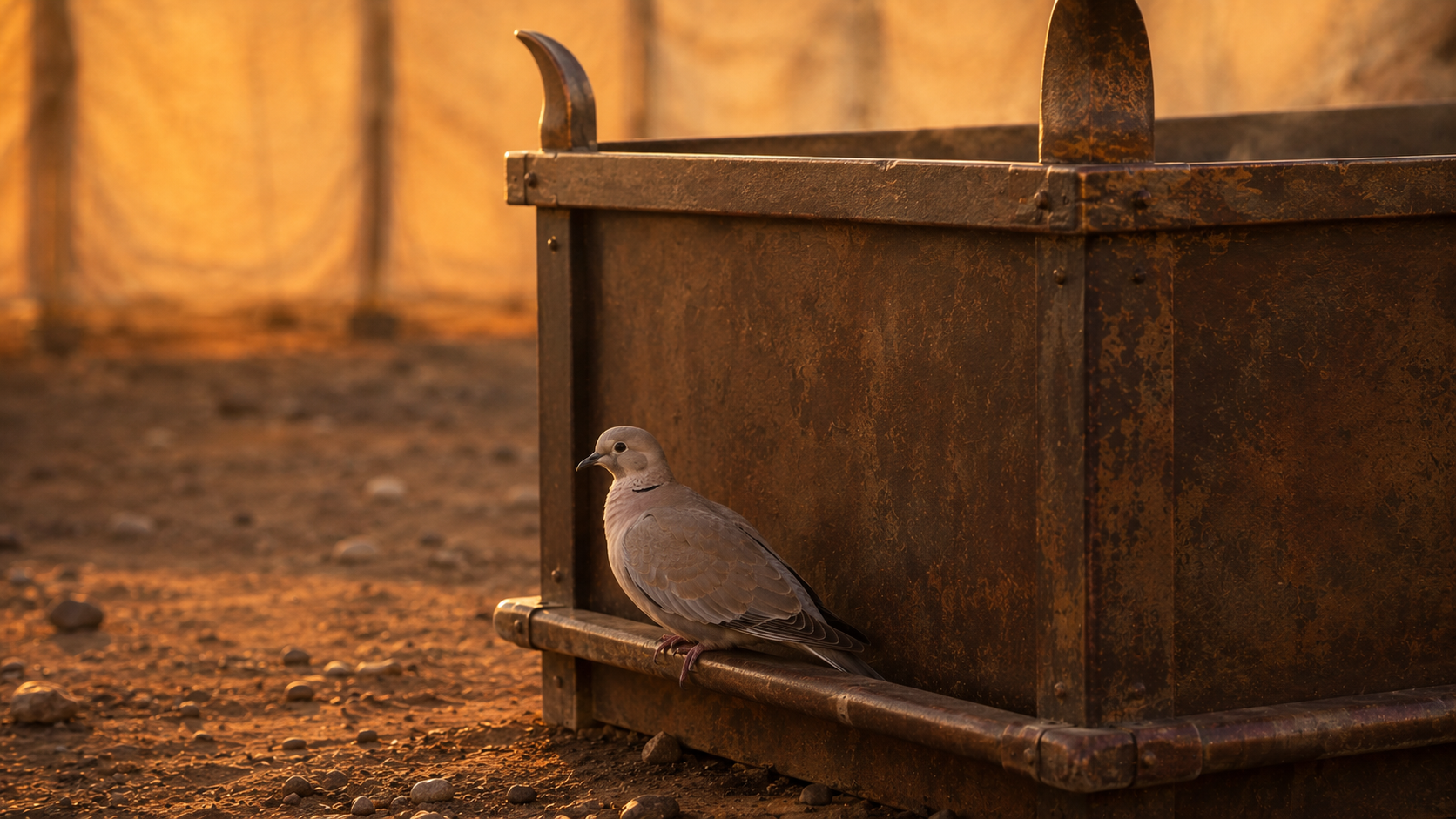
- Turtledoves or young pigeons (v. 14). The chapter ends with the offering for the poor. The same theological transaction (atonement, ascending gift, pleasing aroma) is accessible at the price of a turtledove. The book is teaching, in the chapter’s structure, that access to YHWH does not depend on wealth. Each economic tier (the bull, the sheep/goat, the bird) receives the same theological description: an offering made by fire, of a pleasant aroma to Yahweh (vv. 9, 13, 17). The phrase repeats unchanged across the tiers. The book is making, by deliberate textual repetition, an economic-egalitarian theological claim: the rich do not get a better atonement; the poor do not get a lesser one. The same nearness is offered at the price each person can afford.
- Wring off its head (v. 15). The priest, not the offerer, performs the killing in this case (the bird is too small for the offerer’s typical slaughter procedure). The priest accommodates the small animal to the same theological space the larger animals occupy.
- The crop with its filth (v. 16). The Hebrew is mura’ato be-notsato, “its crop with its feathers.” The bird’s digestive contents and feathers are removed and discarded on the east side of the altar. The chapter is honoring the bird’s small body with the same ritual care it gave the bull’s larger one. Nothing about the small animal is treated as less serious. The whole animal, with its specifics, comes into the system.
- He shall tear it by its wings, but shall not divide it apart (v. 17). The Hebrew specifies a partial tearing, not a full butchering. The bird’s body is small enough that further dividing would destroy it. The priest opens it just enough for the burning to be complete. The chapter’s mechanics scale down without losing the theology.
- The chapter’s gift of two birds for the poor will become theologically significant a thousand and four hundred years later. Mary and Joseph, taking the infant Jesus to be presented at the temple (Luke 2:22-24), offer a pair of turtledoves or two young pigeons. The Holy Family is, by this offering, identified as poor in the system Leviticus 1 has established. The Messiah is presented to YHWH on the Levitical bird-budget. The chapter’s egalitarian theology, in retrospect, has chosen its own moment.
Influence callout: Tim Mackie (BibleProject; the architecture of nearness)
Mackie’s reading of Leviticus 1 places the chapter inside the book’s broader architecture. The God who has just moved into the camp in Exodus 40 now teaches the camp how to come near to him. Mackie names the chapter’s deepest theological move: the sacrifices are not punishment-substitutes; they are means-of-access. The offerer brings the olah because he wants to come into the holy place’s orbit, and the system makes that approach possible. Mackie emphasizes the chapter’s invitational tone: when anyone of you brings. The book is opening not with mandatory ritual but with voluntary approach. The whole later biblical theology of Christ as the way (Jn 14:6; Heb 10:19-22) takes its first form here. Mackie’s pastoral note: the chapter is teaching that approach to God is built into the structure of the worshipping community. Israel does not have to wait for YHWH to come out; YHWH has come in, and Israel is being taught how to come further in. The whole sacrificial system is, in Mackie’s reading, the kindness of detailed instructions.
Reflection prompts
- The olah is the offering that ascends in full: nothing is reserved for the giver. What in your own life would you bring as an olah? What gift would have no piece held back?
- The hand is pressed down on the head of the animal. The gesture is identification, not just transfer. Where in your own spiritual practice do you maintain ritual distance from what the gift actually costs?
- The chapter establishes three economic tiers (bull, sheep/goat, bird) and gives them the same theological description. Access does not depend on wealth. Where in your own community has access to God been gated, formally or informally, by economic class? What would it look like to receive that aspect of Leviticus’s witness today?
Frameworks at play in this chapter: the five offerings, the kipper / atonement framework, the tabernacle as cosmic temple.