
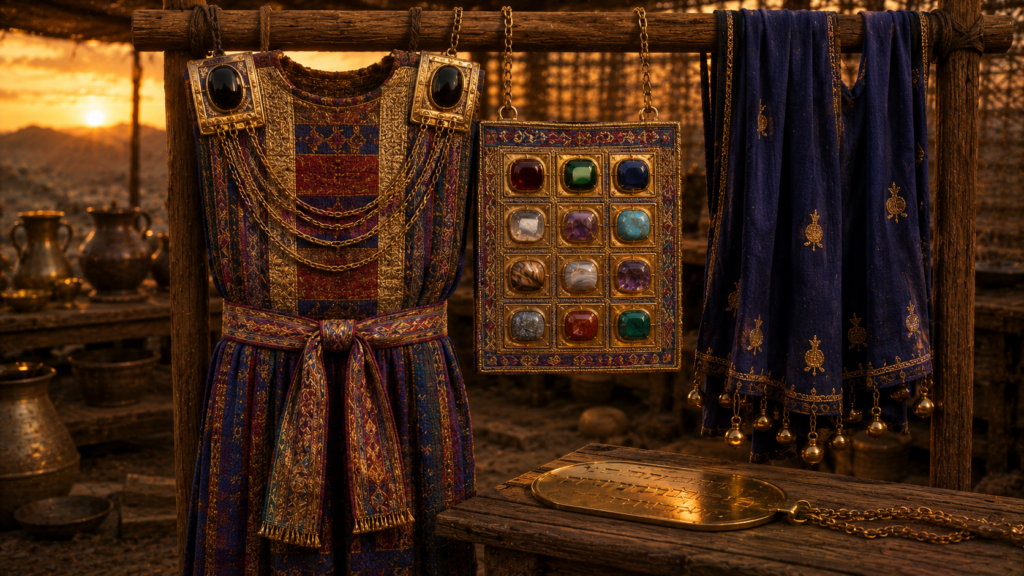
Exodus 39 is the construction-version of chapter 28: the priestly garments are made. The chapter has two movements. First, the garments themselves (39:1-31, paralleling 28:1-43). Second, the whole work of the tabernacle is brought to Moses; Moses inspects it; Moses blesses the artisans (39:32-43).
The chapter’s most distinctive feature is its refrain. The phrase as YHWH commanded Moses appears seven times in this chapter alone (vv. 1, 5, 7, 21, 26, 29, 31), and three more times in chapter 40 (40:16, 19, 21, 23, 25, 27, 29, 32, totaling sixteen instances in chapter 40, then a final triple-emphasis at 40:32 and surrounding verses). The refrain is the chapter’s structural argument. Every garment, every detail, every step of the construction was exactly as YHWH commanded Moses. The book is teaching that the obedience of Bezalel and the artisans is complete. There is no improvisation, no shortcut, no creative deviation.
The chapter ends with Moses inspecting the whole work, finding that they had done it as YHWH had commanded (v. 43), and blessing them. The book is teaching that the construction concludes with a priestly-mediator blessing of the workers. The same Moses who broke the tablets in chapter 32 now blesses the artisans whose work has rebuilt the conditions of YHWH’s dwelling.
A · Exodus 39:1-31 · The priestly garments made
¹ Of the blue, purple, and scarlet, they made finely worked garments, for ministering in the holy place, and made the holy garments for Aaron; as Yahweh commanded Moses. ² He made the ephod of gold, blue, purple, scarlet, and fine twined linen. ³ They beat the gold into thin plates, and cut it into wires, to work it in the blue, in the purple, in the scarlet, and in the fine linen, the work of the skillful workman. ⁴ They made shoulder straps for it, joined together. At the two ends it was joined together. ⁵ The skillfully woven band that was on it, with which to fasten it on, was of the same piece, like its work; of gold, of blue, purple, scarlet, and fine twined linen; as Yahweh commanded Moses. ⁶ They worked the onyx stones, enclosed in settings of gold, engraved with the engravings of a signet, according to the names of the children of Israel. ⁷ He put them on the shoulder straps of the ephod, to be stones of memorial for the children of Israel, as Yahweh commanded Moses. ⁸ He made the breastplate, the work of a skillful workman, like the work of the ephod; of gold, of blue, purple, scarlet, and fine twined linen. ⁹ It was square. They made the breastplate double. Its length was a span, and its width a span, being double. ¹⁰ They set in it four rows of stones. A row of ruby, topaz, and beryl was the first row; ¹¹ and the second row, a turquoise, a sapphire, and an emerald; ¹² and the third row, a jacinth, an agate, and an amethyst; ¹³ and the fourth row, a chrysolite, an onyx, and a jasper. They were enclosed in gold settings. ¹⁴ The stones were according to the names of the children of Israel, twelve, according to their names; like the engravings of a signet, everyone according to his name, for the twelve tribes. ¹⁵ They made on the breastplate chains like cords, of braided work of pure gold. ¹⁶ They made two settings of gold, and two gold rings, and put the two rings on the two ends of the breastplate. ¹⁷ They put the two braided chains of gold in the two rings at the ends of the breastplate. ¹⁸ The other two ends of the two braided chains they put on the two settings, and put them on the shoulder straps of the ephod, in its forepart. ¹⁹ They made two rings of gold, and put them on the two ends of the breastplate, on its edge, which was toward the side of the ephod inward. ²⁰ They made two more gold rings, and put them on the two shoulder straps of the ephod underneath, in its front part, close by its coupling, above the skillfully woven band of the ephod. ²¹ They bound the breastplate by its rings to the rings of the ephod with a lace of blue, that it might be on the skillfully woven band of the ephod, and that the breastplate might not come loose from the ephod, as Yahweh commanded Moses. ²² He made the robe of the ephod of woven work, all of blue. ²³ The opening of the robe in its midst was like the opening of a coat of mail, with a binding around its opening, that it should not be torn. ²⁴ They made on the skirts of the robe pomegranates of blue, purple, scarlet, and twined linen. ²⁵ They made bells of pure gold, and put the bells between the pomegranates around the skirts of the robe, between the pomegranates; ²⁶ a bell and a pomegranate, a bell and a pomegranate, around the skirts of the robe, to minister in, as Yahweh commanded Moses. ²⁷ They made the coats of fine linen of woven work for Aaron, and for his sons, ²⁸ and the turban of fine linen, and the linen headbands of fine linen, and the linen breeches of fine twined linen, ²⁹ and the sash of fine twined linen, and blue, and purple, and scarlet, the work of the embroiderer, as Yahweh commanded Moses. ³⁰ They made the plate of the holy crown of pure gold, and wrote on it a writing, like the engravings of a signet: “HOLY TO YAHWEH.” ³¹ They tied to it a lace of blue, to fasten it on the turban above, as Yahweh commanded Moses.
- As Yahweh commanded Moses (vv. 1, 5, 7, 21, 26, 29, 31). The chapter’s refrain. Seven times in thirty-one verses. The Hebrew Bible’s number for completeness (seven, the days of creation) frames the priestly garments’ construction. The book is teaching that the priesthood’s vestments are made in obedience as complete as creation itself. The same number that frames Genesis 1 frames Exodus 39.
- They beat the gold into thin plates, and cut it into wires (v. 3). The chapter records, in one detail not present in chapter 28, how the gold was integrated into the textile. The gold leaf was beaten thin, then cut into wires, then woven through the colored threads. The Hebrew technical vocabulary is patzu–qitse–sharekh (“they beat, cut, intertwined”). The book is teaching that the gold and the fabric are not merely placed near each other; they are physically interwoven. The ephod and breastpiece are cloth-and-metal woven into single garments.
- Holy to Yahweh (v. 30). The chapter records the gold plate’s inscription: qodesh la-YHWH. The same words 28:36 specified are now written on a writing, like the engravings of a signet, on pure gold. The book is teaching that the chief priestly inscription is engraved, not painted. Engraving requires removing material; the words are cut into the gold. The whole later Christian tradition of engraving on sacred objects (chalices, paten, baptismal fonts) takes its image from this verse.
Word study: ka-asher tsivvah YHWH et-moshe (כַּאֲשֶׁר צִוָּה יְהוָה אֶת־מֹשֶׁה)
The Hebrew refrain as YHWH commanded Moses appears with structural insistence across Exodus 39 and 40. The verbal form tsivvah (he commanded) is the piel perfect of tsavah, “to command, to charge, to instruct.” The same root gives the noun mitzvah, “commandment.” The chapter’s refrain is, at root, a mitzvah refrain: the artisans have fulfilled the mitzvah. The Hebrew Bible’s whole later vocabulary of commandment obedience (Deut 6:25, it will be righteousness for us if we are careful to do all this commandment before YHWH our God; Ps 119, I will keep your commandments) takes its construction-era image from this refrain. The chapter is teaching that the construction is a sustained act of mitzvah-keeping, on the part of every artisan, in every detail, at every stage. The whole tabernacle, materially considered, is the mitzvah made visible.
B · Exodus 39:32-43 · The whole work brought to Moses
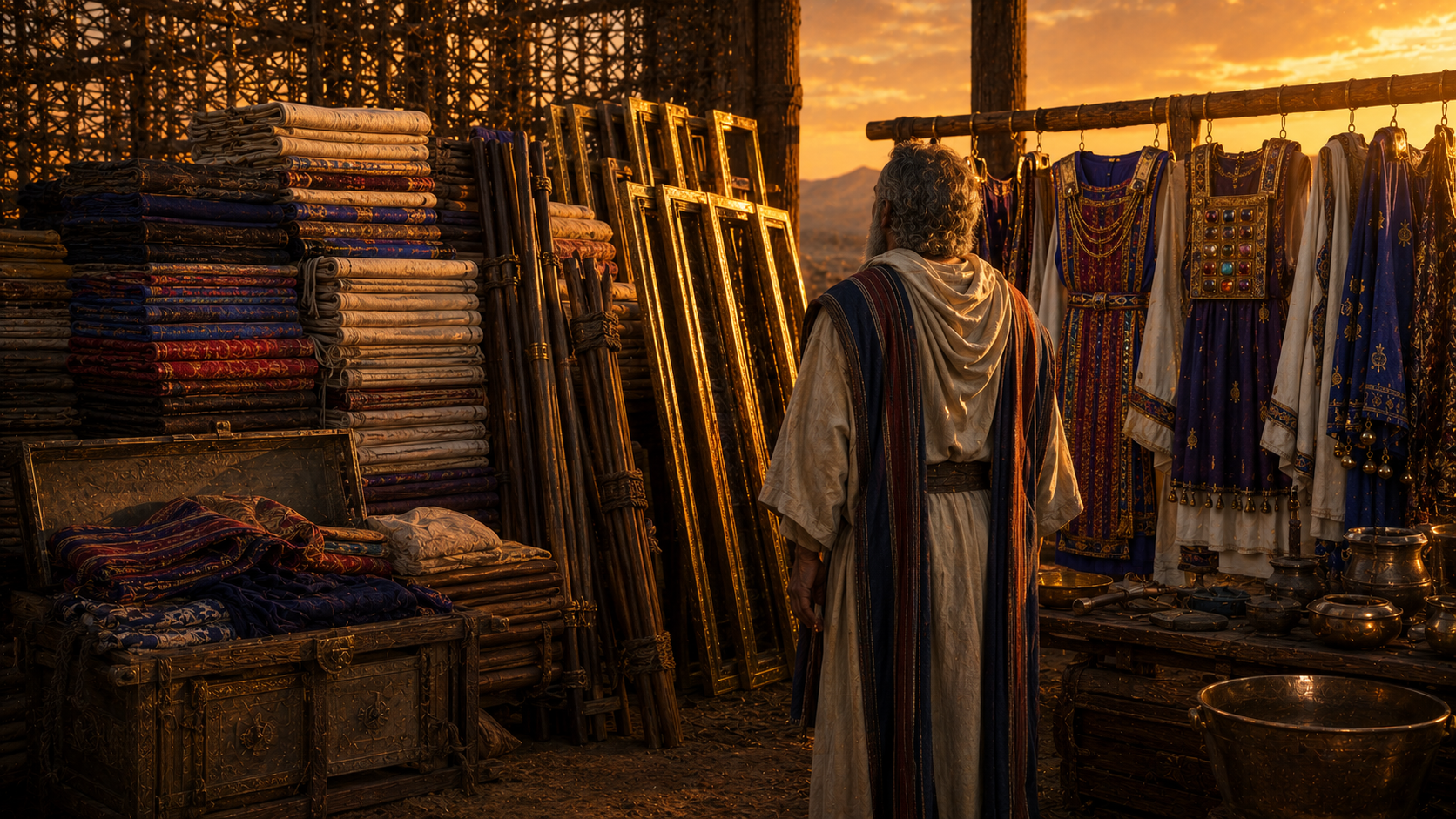
³² Thus all the work of the tabernacle of the Tent of Meeting was finished. The children of Israel did according to all that Yahweh commanded Moses; so they did. ³³ They brought the tabernacle to Moses, the tent, with all its furniture, its clasps, its boards, its bars, its pillars, its sockets, ³⁴ the covering of rams’ skins dyed red, the covering of sea cow hides, the veil of the screen, ³⁵ the ark of the testimony with its poles, the mercy seat, ³⁶ the table, all its vessels, the show bread, ³⁷ the pure lamp stand, its lamps, even the lamps to be set in order, all its vessels, the oil for the light, ³⁸ the golden altar, the anointing oil, the sweet incense, the screen for the door of the Tent, ³⁹ the bronze altar, its grating of brass, its poles, all of its vessels, the basin and its base, ⁴⁰ the hangings of the court, its pillars, its sockets, the screen for the gate of the court, its cords, its pins, all the instruments of the service of the tabernacle, for the Tent of Meeting, ⁴¹ the finely worked garments for ministering in the holy place, the holy garments for Aaron the priest, and the garments of his sons, to minister in the priest’s office. ⁴² According to all that Yahweh commanded Moses, so the children of Israel did all the work. ⁴³ Moses saw all the work, and behold, they had done it as Yahweh had commanded, even so had they done it: and Moses blessed them.
- Thus all the work of the tabernacle of the Tent of Meeting was finished (v. 32). The Hebrew is vatekhel kol-avodat mishkan ohel mo’ed. The verb vatekhel (it was finished) is the same verb the Hebrew Bible uses at Gen 2:1 for the heavens and the earth were finished (Hebrew vayekhulu). The book is teaching, by deliberate verbal echo, that the tabernacle’s completion mirrors the cosmos’s completion. The work of Bezalel and Oholiab is, in the chapter’s grammar, a micro-creation.
- The children of Israel did according to all that Yahweh commanded Moses; so they did (v. 32). The chapter pairs the refrain with the doubled subject: the children of Israel. The construction is not credited only to the artisans; it is credited to the whole people. The book is teaching that the willing-hearted offering of chapter 35 makes every Israelite a co-builder. Bezalel’s hands shaped the metal, but the metal came from the people. The whole nation is implicated in the construction.
- They brought the tabernacle to Moses (v. 33). The chapter records the delivery. The pieces are not assembled yet; they are brought to Moses for inspection. The chapter lists every piece (the tabernacle, the tent, the furniture, the clasps, the boards, the bars, the pillars, the sockets, the coverings, the veil, the ark, the table, the lampstand, the altar of incense, the altar of burnt offering, the basin, the courtyard, the screen, the garments). The list is the chapter’s inventory at handover. Everything is present.
- Moses saw all the work, and behold, they had done it as Yahweh had commanded (v. 43). The verb vayar (he saw) is the same verb the Hebrew Bible uses at Gen 1:31 for God saw everything that he had made, and behold, it was very good. The book is teaching the parallel: Moses’s seeing of the finished tabernacle echoes God’s seeing of the finished cosmos. The two acts of inspection are linguistically twinned.
- And Moses blessed them (v. 43). The chapter ends section B with Moses’s blessing. The Hebrew is vayebarekh otam moshe. The same verb (barakh) that God uses in Gen 1:22 (God blessed them) and Gen 2:3 (God blessed the seventh day) is now used of Moses blessing the artisans. The book is teaching that the construction completes with a creation-pattern blessing. The work has been seen; the work has been judged good; the workers have been blessed. The whole later Hebrew Bible’s vocabulary of priestly blessing (Num 6:24-26, YHWH bless you and keep you) has its construction-era seed in this verse.
Influence callout: Walter Brueggemann (the construction account as creation-redux)
Brueggemann’s reading of Exodus 39 names the chapter as the book’s clearest creation-typological move. Three verbs in the closing sentences of chapter 39 (and the opening sentences of chapter 40) deliberately echo Genesis 1: kalah (finished, 39:32 / Gen 2:1), ra’ah (saw, 39:43 / Gen 1:31), and barakh (blessed, 39:43 / Gen 1:22; 2:3). The construction account is structured to re-enact creation. The tabernacle, on Brueggemann’s reading, is being staged as the small cosmos within the larger cosmos: YHWH made the universe as his temple in Genesis 1; Bezalel makes the tabernacle as YHWH’s temple-within-the-temple in Exodus 35-40. The same God who finished, saw, and blessed his original creation will finish, see, and bless the small tabernacle-creation that the people have made for him to dwell in. Brueggemann’s pastoral note: the chapter is teaching that the work of building God’s dwelling is itself a creation act. To make space for God to dwell, in the Hebrew Bible’s deep grammar, is to re-enact what God did in the beginning. The whole later Christian tradition of the believer’s life as God’s dwelling place (1 Cor 3:16-17, do you not know that you are God’s temple?; Eph 2:21-22, being built together for a dwelling place of God in the Spirit) takes its creation-pattern from this chapter. Every person preparing room for God in their life is, in the chapter’s logic, another Bezalel finishing another tabernacle.
Reflection prompts
- As YHWH commanded Moses appears seven times. The chapter’s structural argument is complete obedience to the received instruction. Where in your own life has there been a clear instruction given that has been only partly followed, with the partial-following dressed up as complete obedience?
- Moses saw all the work, and behold, they had done it as YHWH had commanded, and Moses blessed them. The construction ends with seeing, judging good, and blessing. Whose finished work in your life have you not yet seen and blessed? What would it look like, this week, to deliberately do both?
- The chapter teaches that the construction is a creation-redux. To build God’s dwelling is to re-enact what God did in the beginning. What in your own life right now is a space being prepared for God to dwell? Where, even unrecognized, is Bezalel still working?
Frameworks at play in this chapter: the tabernacle as cosmic temple, bearing God’s name.