
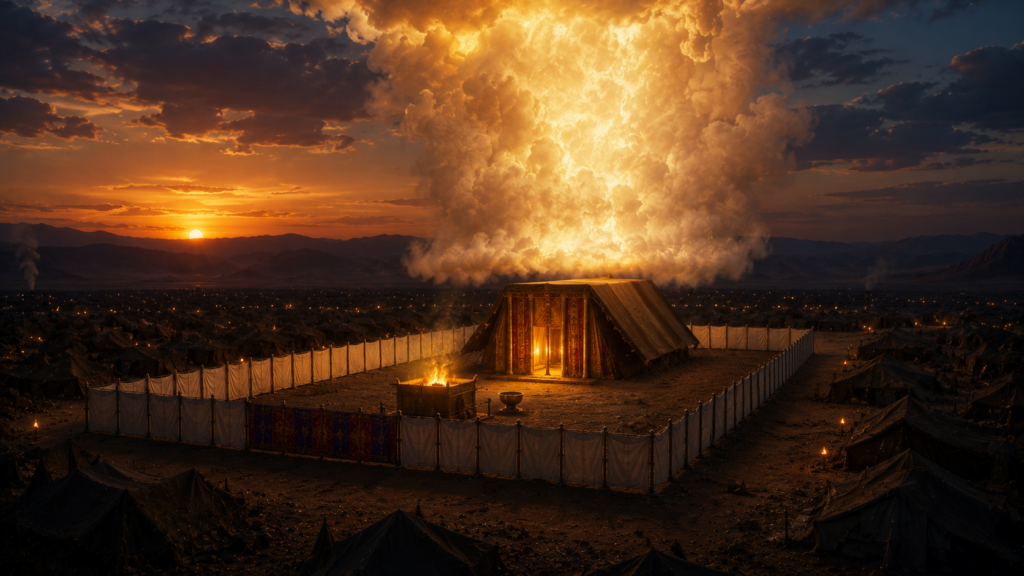
Exodus 40 is the book’s climax. Everything the book has been doing, the rescue from Egypt, the crossing of the Sea, the giving of the law, the building of the tabernacle, the renewal of the covenant after the calf, has been moving toward this single moment. On the first day of the first month, exactly one year after the Passover night (cf. 12:2), the tabernacle is raised in the wilderness of Sinai, and the cloud covered the Tent of Meeting, and the glory of YHWH filled the tabernacle (40:34).
The chapter has three movements. First, YHWH gives Moses the order of erection: where each piece goes and how to consecrate it (40:1-15). Second, Moses sets up the tabernacle, with the phrase as YHWH commanded Moses repeated eight times in the section (40:16-33). Third, the cloud and the glory arrive, Moses cannot enter, and the people begin their journey through the wilderness with the cloud as their guide (40:34-38).
The book ends with the promised indwelling actually arriving. The same God who said let them make me a sanctuary that I may dwell among them (25:8) and I will dwell among the children of Israel and will be their God (29:45) and if your presence does not go with us, do not bring us up from here (33:15) now fills the tabernacle with his glory. The book of Exodus, which began with Israel crying out from Egypt, ends with YHWH living in the camp.
The chapter is one of the Hebrew Bible’s most theologically loaded conclusions. The whole later tradition reads it: Solomon’s temple dedication (1 Kings 8:10-11) explicitly echoes this chapter; Ezekiel’s vision of the kavod leaving the temple (Ezek 10:18-19) and returning (Ezek 43:1-5) presumes this chapter; John’s gospel uses the same Greek verb eskenosen, “tabernacled,” to describe the Word becoming flesh (Jn 1:14); Revelation closes the canon with the dwelling of God is with humans, and he will dwell with them (Rev 21:3), which is, structurally, Exodus 40 made eschatological. The whole biblical theology of divine indwelling runs through this chapter.
A · Exodus 40:1-15 · The order of erection
¹ Yahweh spoke to Moses, saying, ² “On the first day of the first month you shall raise up the tabernacle of the Tent of Meeting. ³ You shall put the ark of the testimony in it, and you shall screen the ark with the veil. ⁴ You shall bring in the table, and set in order the things that are on it. You shall bring in the lamp stand, and light its lamps. ⁵ You shall set the golden altar for incense before the ark of the testimony, and put the screen of the door to the tabernacle. ⁶ You shall set the altar of burnt offering before the door of the tabernacle of the Tent of Meeting. ⁷ You shall set the basin between the Tent of Meeting and the altar, and shall put water therein. ⁸ You shall set up the court around it, and hang up the screen of the gate of the court. ⁹ You shall take the anointing oil, and anoint the tabernacle, and all that is in it, and shall make it holy, and all its furniture: and it will be holy. ¹⁰ You shall anoint the altar of burnt offering, with all its vessels, and sanctify the altar: and the altar will be most holy. ¹¹ You shall anoint the basin and its base, and sanctify it. ¹² “You shall bring Aaron and his sons to the door of the Tent of Meeting, and shall wash them with water. ¹³ You shall put on Aaron the holy garments; and you shall anoint him, and sanctify him, that he may minister to me in the priest’s office. ¹⁴ You shall bring his sons, and put coats on them. ¹⁵ You shall anoint them, as you anointed their father, that they may minister to me in the priest’s office. Their anointing shall be to them for an everlasting priesthood throughout their generations.”
- On the first day of the first month you shall raise up the tabernacle (v. 2). The Hebrew is be-yom ha-chodesh ha-rishon be-echad la-chodesh. The first day of the first month is Rosh Chodashim, the religious-calendar new year (cf. 12:2, where the month of Passover was named the first month). Exodus 12 instituted this as the new beginning of Israel’s time; Exodus 40 raises the tabernacle on its first anniversary. The chapter is teaching that YHWH’s dwelling among Israel coincides with the first anniversary of the deliverance. The whole later Jewish liturgical pattern of anniversary commemoration takes its construction-era anchor from this verse.
- The order of erection (vv. 3-8). The chapter specifies an inside-out sequence: ark first (v. 3), then veil; table (v. 4), then lampstand; altar of incense (v. 5), then door screen; altar of burnt offering (v. 6); basin (v. 7); courtyard (v. 8). The book is teaching that YHWH’s house is built from the holiest point outward. The ark goes in first; everything else is positioned around it. The architecture is centripetal: the inner sanctum is the gravitational center.
- Anoint the tabernacle, and all that is in it, and shall make it holy (v. 9). The chapter records the consecration of every piece by oil. The same holy anointing oil of 30:22-33, made by Bezalel in 37:29, is now poured on every element. The book is teaching that the construction is finalized by holiness-by-contact. Bronze, silver, gold, acacia, linen, leather: every material is anointed. The whole later sacramental tradition of blessing objects for sacred use (chalices, altars, churches at consecration) takes its construction-era pattern from this verse.
- An everlasting priesthood throughout their generations (v. 15). The chapter ends section A with the permanent installation of the Aaronic priesthood. The Hebrew li-khehunat olam le-dorotam names the permanence of the priestly office. The book is teaching that the priesthood is not provisional. It will last throughout their generations. The whole later Hebrew Bible’s struggle with priestly faithfulness (Eli’s sons, Hophni and Phinehas; the prophets’ indictments of corrupt priests; the Hasmonean priestly kings) presumes the permanence this chapter is establishing.
Word study: qum (קוּם) and vayaqem (וַיָּקֶם)
The Hebrew verb qum means to rise, to stand, to be erected. The chapter uses its causative form hiqim (in v. 2, taqim, “you shall raise up”; in v. 17, huqam, “it was raised up”; in v. 18, vayaqem, “and he set up”). The same verb-root names the resurrection of the dead in later Hebrew Bible texts (Isa 26:19, your dead shall live; their bodies shall rise) and the raising up of David’s kingdom (2 Sam 7:12, I will raise up your offspring after you). The chapter is using a vocabulary of rising for the tabernacle that the rest of the Hebrew Bible will use for the Messiah and the resurrection. The whole later Christian Easter vocabulary of anastasis (resurrection) is built on the same Hebrew root. The chapter is teaching that the dwelling of God is raised up, and the same God who raises sanctuaries will, in the Hebrew Bible’s deep grammar, raise the dead.
B · Exodus 40:16-33 · Moses sets up the tabernacle
¹⁶ Moses did so. According to all that Yahweh commanded him, so he did. ¹⁷ It happened in the first month in the second year, on the first day of the month, that the tabernacle was raised up. ¹⁸ Moses raised up the tabernacle, and laid its sockets, and set up its boards, and put in its bars, and raised up its pillars. ¹⁹ He spread the covering over the tent, and put the roof of the tabernacle above on it, as Yahweh commanded Moses. ²⁰ He took and put the testimony into the ark, and set the poles on the ark, and put the mercy seat above on the ark. ²¹ He brought the ark into the tabernacle, and set up the veil of the screen, and screened the ark of the testimony, as Yahweh commanded Moses. ²² He put the table in the Tent of Meeting, on the side of the tabernacle northward, outside of the veil. ²³ He set the bread in order on it before Yahweh, as Yahweh commanded Moses. ²⁴ He put the lamp stand in the Tent of Meeting, opposite the table, on the side of the tabernacle southward. ²⁵ He lit the lamps before Yahweh, as Yahweh commanded Moses. ²⁶ He put the golden altar in the Tent of Meeting before the veil; ²⁷ and he burnt incense of sweet spices on it, as Yahweh commanded Moses. ²⁸ He put up the screen of the door to the tabernacle. ²⁹ He set the altar of burnt offering at the door of the tabernacle of the Tent of Meeting, and offered on it the burnt offering and the meal offering, as Yahweh commanded Moses. ³⁰ He set the basin between the Tent of Meeting and the altar, and put water therein, with which to wash. ³¹ Moses, Aaron, and his sons washed their hands and their feet there. ³² When they went into the Tent of Meeting, and when they came near to the altar, they washed, as Yahweh commanded Moses. ³³ He raised up the court around the tabernacle and the altar, and set up the screen of the gate of the court. So Moses finished the work.
- It happened in the first month in the second year, on the first day of the month, that the tabernacle was raised up (v. 17). The chapter records the exact date of the tabernacle’s erection: first month, second year, first day. The Israelites left Egypt on the fourteenth day of the first month of year one (12:2-6); they arrived at Sinai in the third month (19:1); they have been at Sinai for about nine months. The chapter is preserving, in one verse, the precise chronological anchor of the tabernacle’s installation. The book is teaching that sacred space has a birthday.
- Moses did so. According to all that Yahweh commanded him, so he did (v. 16). The chapter’s first verse of section B is the summary statement. Then the chapter repeats the formula seven more times: as Yahweh commanded Moses (vv. 19, 21, 23, 25, 27, 29, 32). With the seven instances in chapter 39, the construction account totals fourteen explicit reaffirmations of obedience. The book is teaching, with insistent rhythm, that Moses’s installation of the tabernacle is the obedience that the calf interrupted, now completed.
- He took and put the testimony into the ark (v. 20). The chapter records the placing of the tablets (the edut, “testimony”) into the ark. The second set of tablets, chiseled by Moses in 34:1-4 and inscribed by YHWH in 34:28, is now installed in the ark of the testimony. The book is teaching that the Torah-tablets are physically at the center of the tabernacle. The whole later Hebrew Bible’s commitment to Torah at the center of the people (Deut 31:26; Ps 119:11) has its construction-era image in this verse.
- Moses, Aaron, and his sons washed their hands and their feet there (v. 31). The chapter records the first use of the bronze basin. Moses, Aaron, and his sons wash, as YHWH commanded Moses (v. 32). The book is teaching that the basin’s first action is the washing of the priests for service. The same basin that was made from the mirrors of the women at the tent door (38:8) now performs its first liturgical function. The whole worship-cycle the tabernacle was designed for is now operationally beginning.
- So Moses finished the work (v. 33). The Hebrew is vayechal moshe et-ha-melakhah. The verb vayechal (he finished) is identical to vayekhulu (they were finished, Gen 2:1) and to vatekhel (it was finished, 39:32). The book is teaching, with deliberate triple-echo, that Moses’s finishing of the tabernacle parallels God’s finishing of creation. The construction account is creation-shaped from start to finish.
C · Exodus 40:34-38 · The cloud and the glory
³⁴ Then the cloud covered the Tent of Meeting, and the glory of Yahweh filled the tabernacle. ³⁵ Moses wasn’t able to enter into the Tent of Meeting, because the cloud stayed on it, and Yahweh’s glory filled the tabernacle. ³⁶ When the cloud was taken up from over the tabernacle, the children of Israel went onward, throughout all their journeys; ³⁷ but if the cloud wasn’t taken up, then they didn’t travel until the day that it was taken up. ³⁸ For the cloud of Yahweh was on the tabernacle by day, and there was fire in it by night, in the sight of all the house of Israel, throughout all their journeys.
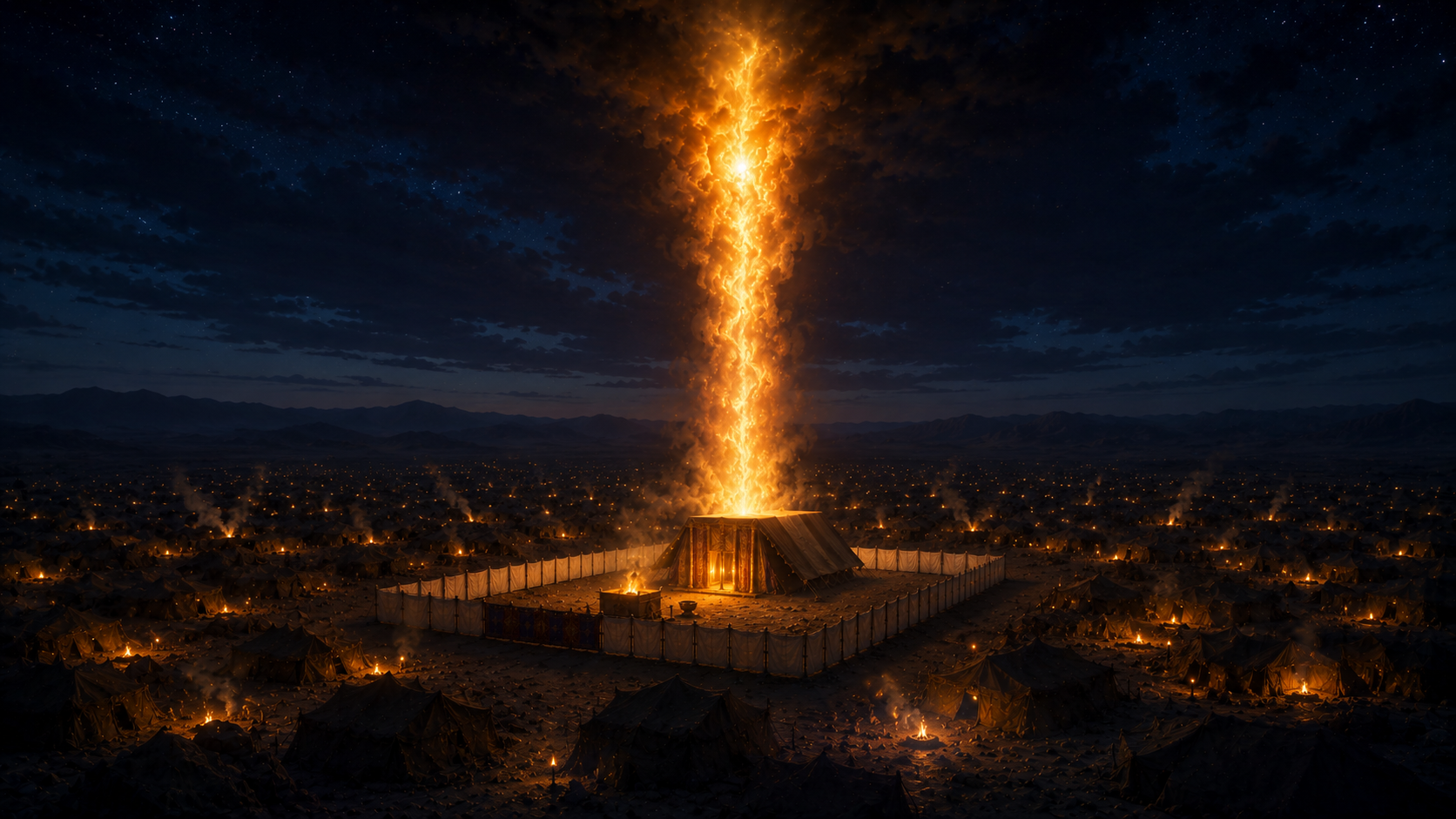
- Then the cloud covered the Tent of Meeting, and the glory of Yahweh filled the tabernacle (v. 34). The chapter’s climactic verse. The Hebrew is vayekhas he-anan et-ohel mo’ed u-khvod YHWH male et-ha-mishkan. The verb vayekhas (it covered) is the same verb that covered the Sea at the crossing (14:28) and that will later cover the temple at its dedication (1 Kings 8:10). The verb male (filled) is the same verb the prophets will later use for the glory filling the earth (Isa 6:3, the whole earth is full of his glory; Hab 2:14, the earth will be filled with the knowledge of the glory of YHWH). The book is teaching that the indwelling promised at 25:8 has now arrived in fact. The same kavod Moses asked to see at 33:18 now fills the tabernacle Moses built.
- Moses wasn’t able to enter into the Tent of Meeting (v. 35). The chapter’s most striking paradox. The same Moses who spoke face to face with YHWH (33:11), who was in the cloud forty days on the mountain (24:18, 34:28), who carried the tablets down with a shining face (34:29-35), cannot enter the tabernacle when the glory fills it. The book is teaching that intimacy with God is not the same as comprehensive access to God. Even the mediator who saw the back of YHWH cannot stand inside the unfiltered presence. The pattern reverses at 1 Kings 8:11, where the priests cannot stand to minister because the cloud has filled Solomon’s temple. The chapter is teaching that full divine presence is too much for any human, even the mediator. The whole later eschatological hope (Rev 21:3, the dwelling of God is with humans, and he will dwell with them) is for a world where humans can dwell in the unfiltered presence without being overwhelmed.
- When the cloud was taken up from over the tabernacle, the children of Israel went onward, throughout all their journeys (v. 36). The chapter teaches that the cloud’s lifting signals march. When the cloud stays, the people stay; when the cloud rises, the people break camp. The Hebrew verb masa (to break camp, to set out on a journey) gives the noun masa’ (journey). The book is preserving the construction-era pattern that will structure the wilderness wanderings: the cloud guides the journey. The whole later Hebrew Bible’s image of YHWH leading his people in the wilderness (Ps 78:14, he led them with a cloud by day, and all the night with a light of fire; Isa 4:5-6, YHWH will create over the whole site of Mount Zion a cloud by day, and smoke and the shining of a flaming fire by night) takes its starting point from this chapter.
- The cloud of Yahweh was on the tabernacle by day, and there was fire in it by night (v. 38). The chapter’s last full verse describes the visible doubled sign: cloud by day, fire by night. The same pillar of cloud and pillar of fire that led Israel out of Egypt (13:21-22) now settles on the tabernacle. The book is teaching that the guide-of-the-Exodus and the dwelling-of-YHWH-with-Israel are the same divine presence in two modes. The pillar that brought them out has come to live with them.
- In the sight of all the house of Israel, throughout all their journeys (v. 38). The chapter’s last clause. The Hebrew is le-einei kol-bet-yisra’el be-khol-mas’eihem. The presence is visible to the whole household of Israel, throughout all their journeys. The book ends with the promise that the visible cloud of YHWH’s glory will accompany Israel through every journey to come. The wilderness wanderings of Numbers, the entry into the land of Joshua, the kingdom-era and the exile and the return: every chapter ahead will be a chapter under this cloud. The whole later Hebrew Bible is structurally a continuation of the journey that this final verse begins.
Influence callout: Tim Mackie (the dwelling theology from Eden to Revelation)
Mackie’s reading of Exodus 40 names the chapter as one of the canonical pivot points in the Bible’s whole theology of divine indwelling. The story, on Mackie’s reading, runs in a long arc. Eden was the first dwelling: God walked with humans in the garden in the cool of the day (Gen 3:8). The expulsion meant the loss of immediate indwelling. The patriarchs encountered God in punctual theophanies (Abraham at Mamre; Jacob at Bethel; Moses at the bush) but no continuous indwelling. Exodus 40 is the first canonical event since Eden where YHWH actually moves in. The cloud descends, the glory fills the tabernacle, and the presence stays. Mackie traces the arc forward: Solomon’s temple (1 Kings 8:10-11) re-enacts Exodus 40 on a permanent stone foundation. Ezekiel’s vision (Ezek 10:18-19) records the departure of the glory at the exile, and Ezekiel 43:1-5 promises its return. The Jewish-Persian-era restoration never fully delivers the return; the second temple is built without the cloud descending. John’s gospel opens with the Word became flesh and tabernacled (eskenosen) among us, and we saw his glory (Jn 1:14), claiming that the Exodus 40 indwelling finally arrived again, this time in a person. Hebrews reads Christ’s death as opening the way through the veil (Heb 10:19-20). Revelation closes the canon with the city of God descending, the dwelling of God is with humans, and he will dwell with them (Rev 21:3), which is Exodus 40 made cosmic and final. Mackie’s pastoral note: the whole Bible can be read as the story of God’s project of moving in. Exodus 40 is one of the deepest single moments in that story. The chapter is teaching, in five verses, that the work of building the dwelling has been completed, and the dwelling has been filled. Everything else in the canon is the consequence.
Reflection prompts
- The chapter teaches that the indwelling promised at 25:8 finally arrives in 40:34. The whole book has been moving toward this moment. Where in your own life is there a long promise of presence that has not yet arrived? What would the patience of Exodus look like for you this season?
- Moses, the mediator, cannot enter when the glory fills the tabernacle. The chapter is teaching that intimacy with God is not the same as comprehensive access to God. Where in your spiritual life have you confused the two, expecting your closeness to God to translate into ease in every encounter with him?
- The cloud of Yahweh was on the tabernacle by day, and there was fire in it by night, in the sight of all the house of Israel, throughout all their journeys. The book ends with a presence that will accompany the people through every journey to come. As you finish this commentary on Exodus, where in your own life are you most aware of a cloud that has not lifted, and where are you most aware of a fire that has not gone out? What might it mean to trust that both are signs of the same continuing presence?
Frameworks at play in this chapter: the tabernacle as cosmic temple, the exodus pattern.