
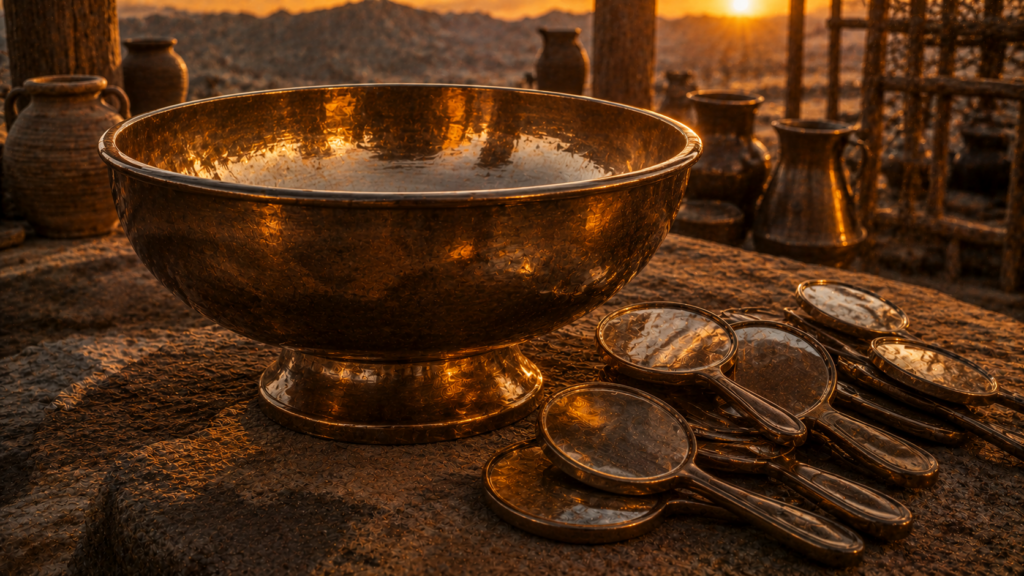
Exodus 38 is the construction-version of the outer courtyard. The chapter has three main movements (bronze altar 38:1-7, bronze basin 38:8, courtyard 38:9-20) plus an extended inventory of materials used (38:21-31). The structure parallels chapter 27 (altar and courtyard) and 30:17-21 (basin), but the chapter introduces two distinctive details not in the instructions.
First, the bronze basin is made from the mirrors of the women who served at the door of the tent of meeting. The Hebrew Bible has not previously named this group of women, and the source-material for the basin is a quietly stunning detail. Second, the chapter ends with a full accounting of the precious metals used: how much gold, how much silver, how much bronze. The silver count, in particular, ties back to the half-shekel census of chapter 30: every adult Israelite male over twenty contributed exactly half a shekel, and the resulting silver becomes the literal foundation of the tabernacle’s frames.
The chapter is doing something the rest of the construction account does not. It is naming the financial transparency and the unnoticed contributors. Where the previous chapters celebrated Bezalel’s craft and the willing-hearted offerings in the aggregate, this chapter records the specific source of one piece (mirrors of women) and the exact numerical accounting of the whole. The book is teaching that sacred construction is transparent and publicly auditable.
A · Exodus 38:1-8 · The bronze altar and the mirror basin
¹ He made the altar of burnt offering of acacia wood. It was square. Its length was five cubits, its width was five cubits, and its height was three cubits. ² He made its horns on its four corners. Its horns were of one piece with it, and he overlaid it with brass. ³ He made all the vessels of the altar, the pots, the shovels, the basins, the forks, and the fire pans. He made all its vessels of brass. ⁴ He made for the altar a grating of a network of brass, under the ledge around it beneath, reaching halfway up. ⁵ He cast four rings for the four ends of brass grating, to be places for the poles. ⁶ He made the poles of acacia wood, and overlaid them with brass. ⁷ He put the poles into the rings on the sides of the altar, with which to bear it. He made it hollow with planks. ⁸ He made the basin of brass, and its base of brass, out of the mirrors of the serving women who served at the door of the Tent of Meeting.
- The altar of burnt offering, square, five by five cubits (vv. 1-2). The bronze altar is the largest single piece in the tabernacle: roughly seven and a half feet square, four and a half feet tall. The chapter notes that its horns were of one piece with it (v. 2) and that it was hollow with planks (v. 7), exactly as 27:1-8 instructed. The book is teaching, with deliberate repetition, that the instruction-and-construction match.
- He made the basin of brass, and its base of brass, out of the mirrors of the serving women who served at the door of the Tent of Meeting (v. 8). The chapter’s most theologically dense single verse. Three things to notice. First, the basin is made of bronze (as 30:18 instructed), but the source material is now named. Second, the source is the mirrors of a previously unnamed group: women who served at the door of the tent of meeting. Third, this group is named in the iterative imperfect (tsove’ot, “those serving”), which suggests an ongoing ministry, not a one-time event. The verse is preserving the canonical memory of a women’s worshipping ministry at the tabernacle that the rest of the Hebrew Bible barely mentions (the same Hebrew root reappears at 1 Sam 2:22).
- The mirrors are themselves theologically loaded. In the ANE, polished bronze mirrors were personal possessions of women: items of grooming, vanity, daily life. The chapter records that the women gave their mirrors to be melted down for the basin. The basin is the place where the priests will look at themselves in the act of washing. The same surface that once reflected each individual woman now reflects the priest as he prepares to enter the holy place. The book is teaching, in a single image, that the worship of the community is built from the small daily objects of its individual members. The Rabbinic tradition reads this verse as the canonical foundation for the legitimacy of women’s offerings in the sanctuary economy.
Word study: tsove’ot (צֹבְאוֹת) and the women at the door
The Hebrew verb tsava means to wage war, to muster, to serve in an army-like assembly. The same noun tsava names the host of heaven (the stars) and the host of YHWH (the armies of God in the prophetic literature). The feminine plural participle tsove’ot, “those serving,” is the same vocabulary used elsewhere of Levitical service at the sanctuary (Num 4:23, 8:24, of the Levites who served at the tent). The chapter is using the same word for the women’s service at the door that the Hebrew Bible uses for Levitical liturgical service. The implication is significant: the women who served at the door of the tent of meeting were performing a liturgical role, not a secular one. The Hebrew Bible has not preserved details of what their service involved (prayer? gathering? ministering to the poor? guarding the threshold?), but the verb-choice is precise. The chapter is preserving, in one word, the existence of a women’s liturgical ministry at the tabernacle that later generations have largely forgotten.
B · Exodus 38:9-20 · The courtyard
⁹ He made the court: for the south side southward the hangings of the court were of fine twined linen, one hundred cubits. ¹⁰ Their pillars were twenty, and their sockets twenty, of brass; the hooks of the pillars and their fillets were of silver. ¹¹ For the north side one hundred cubits, their pillars twenty, and their sockets twenty, of brass; the hooks of the pillars, and their fillets, of silver. ¹² For the west side were hangings of fifty cubits, their pillars ten, and their sockets ten; the hooks of the pillars, and their fillets, of silver. ¹³ For the east side eastward fifty cubits. ¹⁴ The hangings for the one side were fifteen cubits; their pillars three, and their sockets three; ¹⁵ and so for the other side: on this hand and that hand by the gate of the court were hangings of fifteen cubits; their pillars three, and their sockets three. ¹⁶ All the hangings around the court were of fine twined linen. ¹⁷ The sockets for the pillars were of brass. The hooks of the pillars and their fillets of silver; and the overlaying of their capitals, of silver; and all the pillars of the court were filleted with silver. ¹⁸ The screen for the gate of the court was the work of the embroiderer, of blue, purple, scarlet, and fine twined linen. Twenty cubits was the length, and the height in the width was five cubits, like the hangings of the court. ¹⁹ Their pillars were four, and their sockets four, of brass; their hooks of silver, and the overlaying of their capitals, and their fillets, of silver. ²⁰ All the pins of the tabernacle, and around the court, were of brass.
- The court, one hundred cubits by fifty (vv. 9-13). The chapter records the courtyard’s full dimensions: roughly 150 feet by 75 feet (about the size of a small football field). The chapter is observing the instruction of 27:9-19 exactly. The book is teaching the bounded sacred space without elaboration; the theological work was done in the instruction.
- Sixty pillars on bronze sockets with silver hooks and capitals (vv. 10-17). The chapter records the graded-metal pattern from chapter 27: bronze sockets (foundation), silver hooks and capitals (mid-level), fine linen (the walls themselves), gold molding (only on the inner sanctuary’s pieces). The book is teaching that the outer-courtyard hardware is bronze-and-silver, the inner-sanctuary hardware is gold. The architecture is layered, and the chapter is observing that the layering was executed.
- Twenty cubits, the screen for the gate of the court (v. 18). The east-facing gate is twenty cubits wide (about thirty feet), embroidered in the same four colors as the inner veil and the door of the tent. The book is teaching, by deliberate repetition of the color-palette across all three thresholds, that the gradation of holiness is visually continuous. Same colors, more concentrated as you move inward.
C · Exodus 38:21-31 · The inventory of materials used
²¹ These are the amounts of materials used for the tabernacle, even the Tabernacle of the Testimony, as they were counted, according to the commandment of Moses, for the service of the Levites, by the hand of Ithamar, the son of Aaron the priest. ²² Bezalel the son of Uri, the son of Hur, of the tribe of Judah, made all that Yahweh commanded Moses. ²³ With him was Oholiab, the son of Ahisamach, of the tribe of Dan, an engraver, and a skillful workman, and an embroiderer in blue, in purple, in scarlet, and in fine linen. ²⁴ All the gold that was used for the work in all the work of the sanctuary, even the gold of the offering, was twenty-nine talents and seven hundred thirty shekels, after the shekel of the sanctuary. ²⁵ The silver of those who were numbered of the congregation was one hundred talents and one thousand seven hundred seventy-five shekels, after the shekel of the sanctuary: ²⁶ a beka a head, that is, half a shekel, after the shekel of the sanctuary, for everyone who passed over to those who were numbered, from twenty years old and upward, for six hundred three thousand five hundred fifty men. ²⁷ The one hundred talents of silver were for casting the sockets of the sanctuary, and the sockets of the veil; one hundred sockets for the one hundred talents, a talent for a socket. ²⁸ From the one thousand seven hundred seventy-five shekels he made hooks for the pillars, overlaid their capitals, and made fillets for them. ²⁹ The brass of the offering was seventy talents, and two thousand four hundred shekels. ³⁰ With this he made the sockets to the door of the Tent of Meeting, the bronze altar, the bronze grating for it, all the vessels of the altar, ³¹ the sockets around the court, the sockets of the gate of the court, all the pins of the tabernacle, and all the pins around the court.
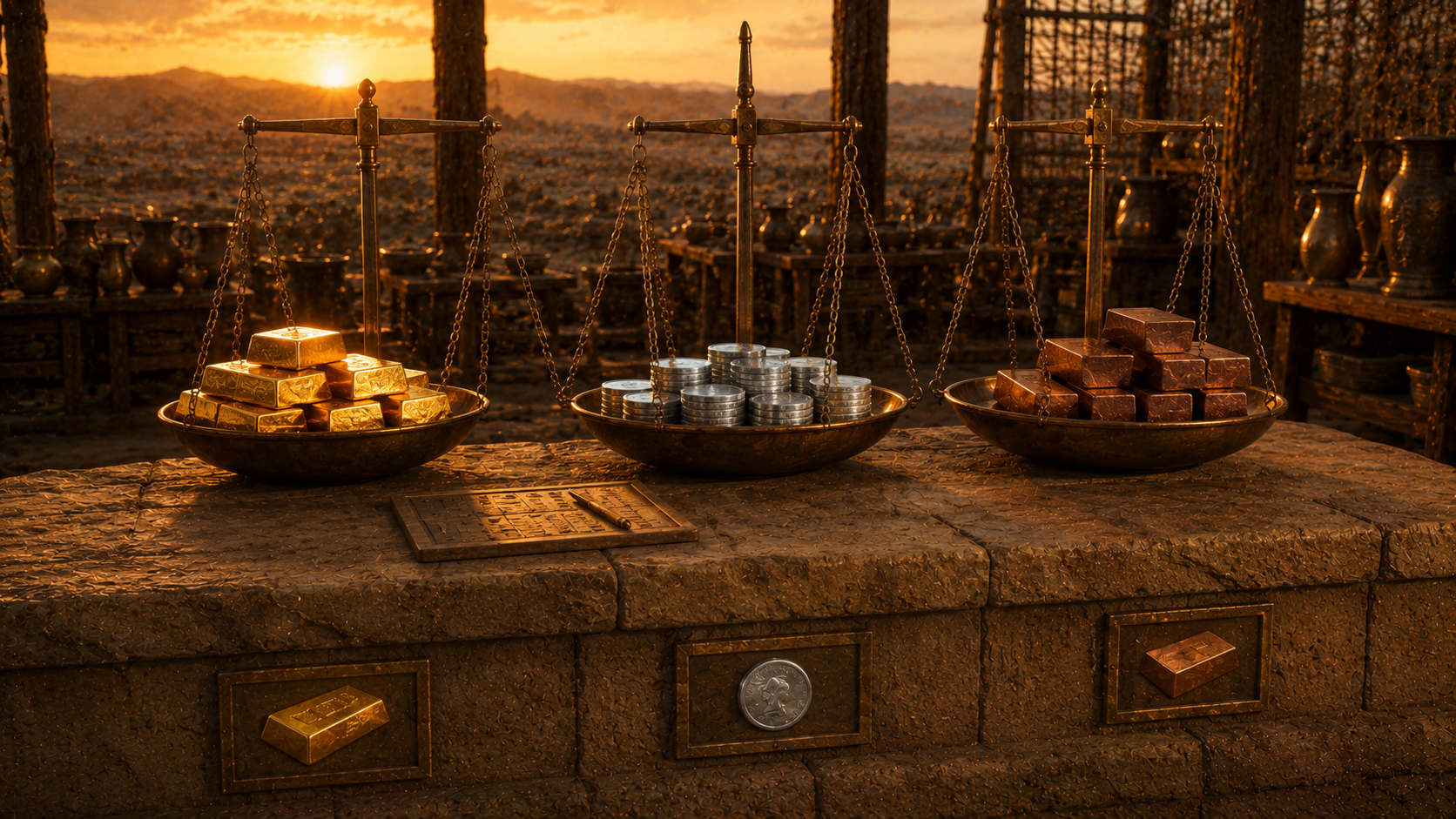
- These are the amounts of materials used (v. 21). The chapter pivots from construction-narrative to accounting. The Hebrew is eleh pequdei ha-mishkan, “these are the accounts of the tabernacle,” and pequdei (from the verb paqad, “to count, to muster, to inspect”) gives this parashah its Hebrew name. The chapter is staging the construction account’s audit. Every piece is going to be tallied.
- By the hand of Ithamar, the son of Aaron the priest (v. 21). The accounting is done by Ithamar, the fourth and youngest son of Aaron. Nadab and Abihu will die at Lev 10; Eleazar will become high priest after Aaron; Ithamar is the administrator. The book is teaching that priestly families divide labor: some serve at the altar, some keep the books. Ithamar’s vocation is the chapter’s quiet recognition that administrative integrity is itself priestly work.
- Twenty-nine talents and seven hundred thirty shekels of gold (v. 24). Roughly 2,200 pounds (1,000 kg) of gold. One hundred talents and one thousand seven hundred seventy-five shekels of silver (v. 25): roughly 7,500 pounds (3,400 kg) of silver. Seventy talents and two thousand four hundred shekels of bronze (v. 29): roughly 5,300 pounds (2,400 kg) of bronze. The chapter is recording, in precise weight, the enormous wealth of the tabernacle. By modern commodity prices, the metal alone would be worth roughly $70 million. The book is not embarrassed about the cost. The dwelling of YHWH was extravagantly resourced by the willing-hearted offering of the people.
- A beka a head, that is, half a shekel, for everyone who passed over to those who were numbered, from twenty years old and upward, for six hundred three thousand five hundred fifty men (v. 26). The chapter ties the silver count back to the half-shekel atonement money of 30:11-16. Every adult male over twenty paid exactly half a shekel. The total population recorded is 603,550 men (which would imply a total community of roughly 2-2.5 million when women, children, and the elderly are included). The chapter is preserving, in the same number that will appear at Num 1:46, the census figure of the wilderness generation.
- The one hundred talents of silver were for casting the sockets of the sanctuary (v. 27). The chapter records the specific use of the silver: one hundred sockets, a talent each. The whole tabernacle structurally rests on the silver atonement money of the people. Each frame stands on its silver socket; each silver socket comes from the half-shekel ransom of the men of Israel. The book is teaching the most concrete possible image: YHWH’s dwelling is structurally supported by the redemption-payment of his people. The sockets are the foundation, and the foundation is the kofer, the ransom. The whole later Hebrew Bible’s theology of the people’s redemption as the foundation of God’s dwelling among them takes its construction-era image from this verse.
Influence callout: Nijay Gupta (the women at the door)
Gupta’s reading of Exodus 38:8 in his work on women in the early biblical tradition names the verse as the canonical witness to women’s liturgical ministry at the tabernacle. The brief mention of the women who served at the door of the tent of meeting (Hebrew tsove’ot) is, on Gupta’s reading, far more significant than its small word-count suggests. The same verb-root names Levitical sanctuary service throughout the Hebrew Bible. Gupta argues that the verse preserves the canonical memory of a women’s ministry that the later patriarchal-priestly tradition partially submerged. The Hebrew Bible itself surfaces it again at 1 Sam 2:22, where the verse is cited in the context of the corruption of Eli’s sons. Gupta’s pastoral note: the chapter is making the bronze basin, the very place where priests prepare for sacred service, out of materials donated by women whose own liturgical service is barely named. The construction itself encodes the women’s contribution. The whole later New Testament’s record of women’s central liturgical participation (Phoebe at Rom 16:1; Junia at Rom 16:7; Lydia at Acts 16:14-15; Priscilla teaching Apollos at Acts 18:24-26) takes its Hebrew Bible foundation, on Gupta’s reading, partly from this single verse. The chapter is teaching that women have been at the door of the tent from the beginning, and the surface that priests look into to prepare for sacred service is the gift of women’s daily lives.
Reflection prompts
- The bronze basin is made from the mirrors of the women who served at the door. The most quotidian objects of personal daily life (a hand mirror) become the surface in which priests prepare to meet God. What in your own daily life, given away, could become a place where someone else meets God?
- The tabernacle rests on silver sockets that came from the half-shekel ransom of each Israelite male. YHWH’s dwelling is structurally supported by the redemption-payment of his people. Where in your own theology have you forgotten that the foundation of God’s dwelling among his people is his people’s redemption?
- Ithamar counts the metals. The chapter records the administrative integrity of the construction project. Where in your own life or community is the unflashy work of accounting still being done by someone whose name is rarely mentioned, and what would it look like to honor that work?
Frameworks at play in this chapter: the tabernacle as cosmic temple.