
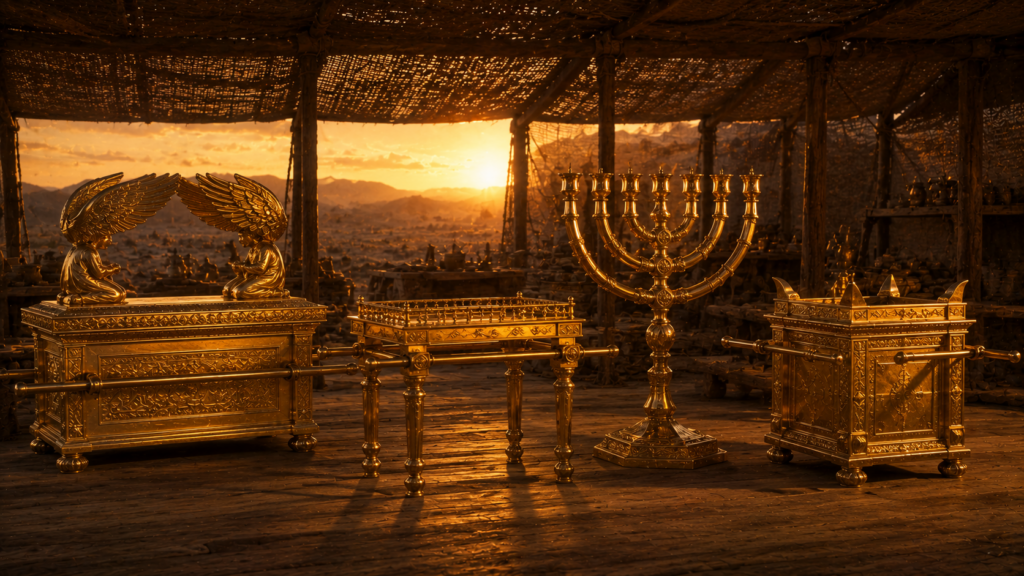
Exodus 37 is the construction-version of the inner sanctuary furniture: the ark of the covenant (37:1-9, paralleling 25:10-22), the table of the bread of the presence (37:10-16, paralleling 25:23-30), the lampstand (37:17-24, paralleling 25:31-40), and the altar of incense plus the anointing oil and incense (37:25-29, paralleling 30:1-10, 30:22-38). Each piece is built by Bezalel personally; the verb subject across the whole chapter is he made (singular).
The chapter’s distinctive theological note is the concentration of vocation. Where chapter 36’s curtains and frames were made by the wise-hearted men (plural), the most sacred furniture is made by Bezalel (singular). The most holy objects in the tabernacle pass through the hands of one named, Spirit-filled artisan. The book is teaching that the inner sanctuary belongs to the most concentrated craft. The same Bezalel whose name means in the shadow of God now makes the ark whose mercy seat is the meeting-place of YHWH. The whole chapter is a quiet statement about the named artisan and the most holy thing he makes.
For the theological substance of each object (ark and mercy seat, table and bread of the presence, lampstand as tree of life, altar of incense, anointing oil, sacred incense), the chapter assumes the work done in chapters 25 and 30. Read those chapters’ commentaries for the full theological background. The notes here highlight what is distinctive about the making, not what is distinctive about the meaning.
A · Exodus 37:1-9 · The ark and the mercy seat
¹ Bezalel made the ark of acacia wood. Its length was two and a half cubits, and its width a cubit and a half, and a cubit and a half its height. ² He overlaid it with pure gold inside and outside, and made a molding of gold for it around it. ³ He cast four rings of gold for it, in its four feet; even two rings on its one side, and two rings on its other side. ⁴ He made poles of acacia wood, and overlaid them with gold. ⁵ He put the poles into the rings on the sides of the ark, to bear the ark. ⁶ He made a mercy seat of pure gold. Its length was two and a half cubits, and a cubit and a half its width. ⁷ He made two cherubim of gold. He made them of beaten work, at the two ends of the mercy seat; ⁸ one cherub at the one end, and one cherub at the other end. He made the cherubim of one piece with the mercy seat at its two ends. ⁹ The cherubim spread out their wings above, covering the mercy seat with their wings, with their faces toward one another. The faces of the cherubim were toward the mercy seat.
- Bezalel made (v. 1). The chapter opens with the subject Bezalel in the singular. The most sacred furniture is the work of one artisan. The Hebrew Bible’s later tradition (Talmud, Bava Batra 14a-b) reads this as the canonical foundation for the singular master craftsman who makes the most holy things. Modern readers should hear it as a deliberate concentration: not a committee, not a guild, but a Spirit-filled person, named.
- Of one piece with the mercy seat at its two ends (v. 8). The chapter notes, as 25:19 had instructed, that the two cherubim are of one piece with the mercy seat (Hebrew miqshah, “hammered work”). The mercy seat and the cherubim are not assembled; they are hammered out of a single block of gold. The book is teaching that the meeting-place of YHWH is seamlessly continuous with its guardian angels. There is no joint between mercy and presence.
- Their faces toward the mercy seat (v. 9). The cherubim look at the mercy seat, not at each other and not at the worshipper. The Hebrew is u-fneihem ish el-achiv el-ha-kapporet hayu pnei ha-kerubim, “their faces toward one another, toward the mercy seat were the faces of the cherubim.” The chapter is teaching that the attention of the cherubim is directed at the atonement covering. The whole sanctuary’s gaze is at the place where mercy meets the throne.
B · Exodus 37:10-24 · The table and the lampstand
¹⁰ He made the table of acacia wood. Its length was two cubits, and its width was a cubit, and its height was a cubit and a half. ¹¹ He overlaid it with pure gold, and made a gold molding around it. ¹² He made a rim of a hand width around it, and made a golden molding on its rim around it. ¹³ He cast four rings of gold for it, and put the rings in the four corners that were on its four feet. ¹⁴ The rings were close by the rim, the places for the poles to carry the table. ¹⁵ He made the poles of acacia wood, and overlaid them with gold, to carry the table. ¹⁶ He made the vessels which were on the table, its dishes, its spoons, its bowls, and its pitchers with which to pour out, of pure gold. ¹⁷ He made the lamp stand of pure gold. He made the lamp stand of beaten work. Its base, its shaft, its cups, its buds, and its flowers were of one piece with it. ¹⁸ There were six branches going out of its sides: three branches of the lamp stand out of its one side, and three branches of the lamp stand out of its other side: ¹⁹ three cups made like almond blossoms in one branch, a bud and a flower, and three cups made like almond blossoms in the other branch, a bud and a flower: so for the six branches going out of the lamp stand. ²⁰ In the lamp stand were four cups made like almond blossoms, its buds and its flowers; ²¹ and a bud under two branches of one piece with it, and a bud under two branches of one piece with it, and a bud under two branches of one piece with it, for the six branches going out of it. ²² Their buds and their branches were of one piece with it. The whole thing was one beaten work of pure gold. ²³ He made its seven lamps, and its snuffers, and its snuff dishes, of pure gold. ²⁴ He made it of a talent of pure gold, with all its vessels.
- He made the table of acacia wood (v. 10). The table of the bread of the presence (lechem ha-panim, “bread of the face”) is built next. The same dimensions as 25:23: two cubits long, one cubit wide, a cubit and a half tall. The book is teaching that the table is modestly sized: roughly three feet by one and a half feet, half a meter tall. The same scale as a small low Mediterranean dinner table. The chapter is teaching, by sheer dimensions, that the bread of the presence is a meal-sized image, not a banquet-hall altar.
- One beaten work of pure gold (v. 22). The lampstand, like the mercy seat, is one piece. The Hebrew miqshah achat zahav tahor names the single hammered piece. The chapter is teaching that the seven-branched menorah is not assembled from parts; it is hammered into shape from a single talent of gold (about 75 pounds, v. 24). The book is emphasizing the lampstand’s organic continuity: branches, almond blossoms, cups, all of one piece with the central shaft. The tree-of-life imagery (cf. 25:31-40 commentary) is reinforced by the seamless construction.
- A talent of pure gold (v. 24). The chapter records the weight of the lampstand: one talent (Hebrew kikkar) of pure gold, roughly 75 lbs / 34 kg. The chapter is observing the cost of the inner sanctuary’s most distinctive piece. The book is not embarrassed about the expense. The lampstand is visibly precious. The whole later Hebrew Bible’s preservation of the menorah as a national symbol (Zech 4; modern Israeli state emblem) takes its weight from this verse.
Word study: miqshah (מִקְשָׁה), “hammered work, one piece”
The Hebrew word miqshah appears at three key points in the construction account: the cherubim on the mercy seat (37:7), the lampstand (37:17, 22), and the silver trumpets (Num 10:2). All three are of one piece, hammered into shape. The word denotes a craft technique called repousse: shaping metal by hammering it from the back to raise the front surface. The technique requires the entire object to be made from a single sheet of metal, with no joins, no welds, no rivets. The chapter is teaching that the most holy crafted objects are seamless. The whole later Hebrew Bible’s commitment to integrity (etymologically related to integer, “one whole thing”) takes its construction-era image from this technique. Miqshah is the chapter’s quiet metaphor for what holiness looks like in metalwork: continuous, unbroken, one piece.
C · Exodus 37:25-29 · The altar of incense, the anointing oil, and the holy incense
²⁵ He made the altar of incense of acacia wood. It was square: its length was a cubit, and its width a cubit. Its height was two cubits. Its horns were of one piece with it. ²⁶ He overlaid it with pure gold, its top, its sides around it, and its horns. He made a gold molding around it. ²⁷ He made two golden rings for it under its molding crown, on its two ribs, on its two sides, for places for poles with which to carry it. ²⁸ He made the poles of acacia wood, and overlaid them with gold. ²⁹ He made the holy anointing oil and the pure incense of sweet spices, after the art of the perfumer.
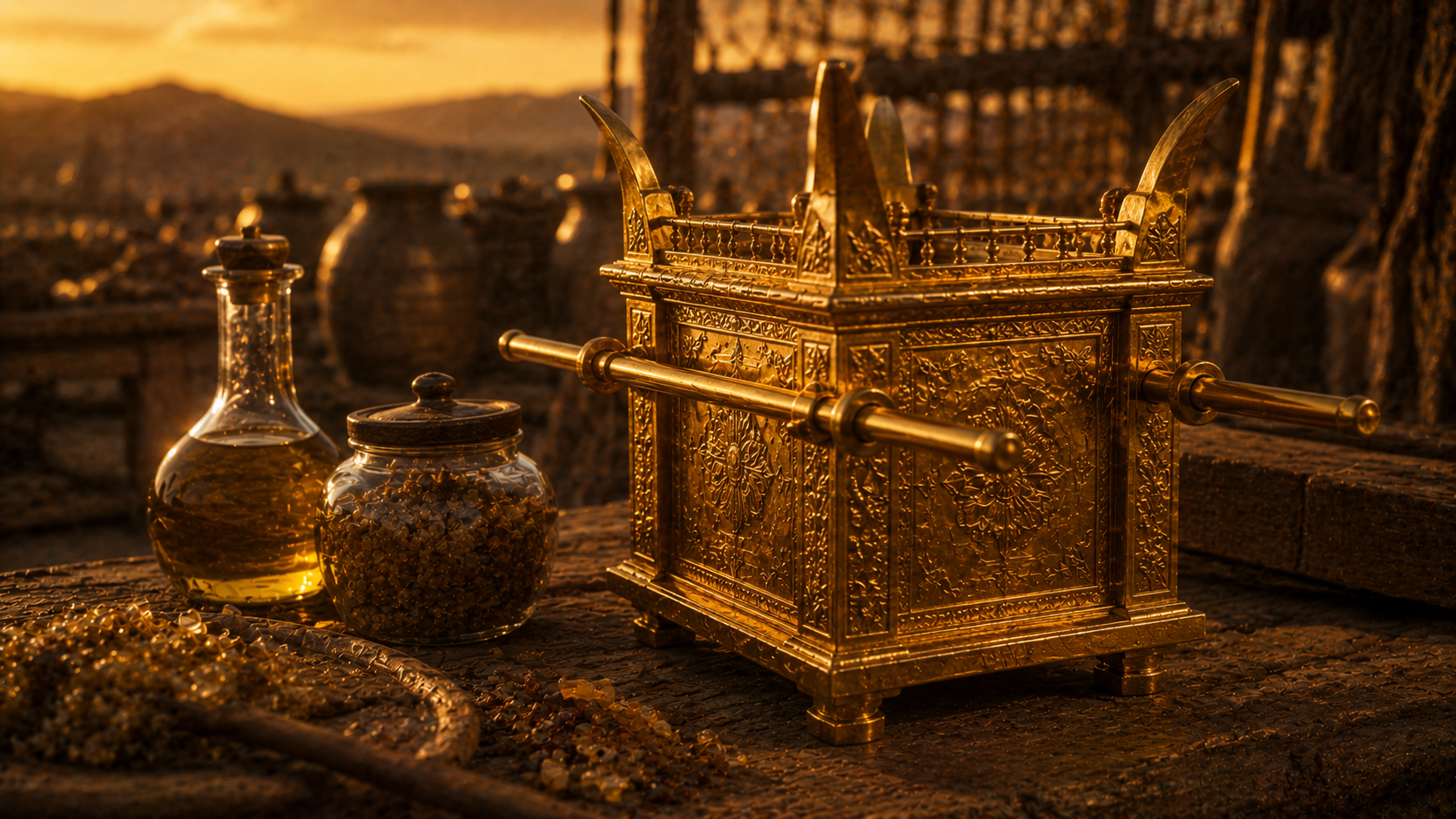
- He made the altar of incense (v. 25). The chapter places the altar of incense (from 30:1-10) here in the construction sequence, with the inner-sanctuary furniture, not with the courtyard furniture. The book is teaching that the gold altar is grouped, theologically and architecturally, with the ark, table, and lampstand. All four pieces share the same precious metal (gold), the same Spirit-filled artisan (Bezalel), and the same interior location (inside the tent of meeting). The bronze altar will be made next chapter, and it sits outside the tent.
- Its horns were of one piece with it (v. 25). The horns of the incense altar, like the horns of the bronze altar (27:2), are of one piece. The chapter is teaching that every altar in the tabernacle has horns, and the horns are always integral, not attached. The book is making horns of the altar a structural rather than ornamental feature.
- The holy anointing oil and the pure incense of sweet spices, after the art of the perfumer (v. 29). The chapter records, in a single sentence, the completion of the recipes from 30:22-38. The perfumer’s art (ma’aseh roqeach, “the work of the spice-mixer”) is named as the craft. The whole later Christian and Jewish tradition’s commitment to fragrance in worship (incense in liturgy, perfumed oils for anointing the sick, the sweet smell of consecration) has its construction-era warrant here.
Influence callout: Tim Mackie (the inner sanctuary as concentrated holiness)
Mackie’s reading of Exodus 37 names the chapter as the concentration point of the construction. Where chapter 36 made the walls and curtains (the bounded space), chapter 37 makes the inner furniture (the objects that fill the space). On Mackie’s reading, the chapter is teaching a deep principle of graded holiness: the closer to the ark, the more precious the metal, the more skilled the artisan, the more concentrated the symbolic load. The ark is the most holy single object; Bezalel personally makes it. The table and lampstand are next; Bezalel personally makes them. The altar of incense is next; Bezalel personally makes it. Mackie traces the inner-sanctuary cluster forward into the New Testament: Hebrews 9:1-5 names the golden altar of incense, the ark of the covenant, the gold-covered table, and the lampstand as the inventory of the second tabernacle, called the holy of holies. The New Testament reads chapter 37’s furniture as the type whose fulfillment is Christ’s intercession at the heavenly altar. Mackie’s pastoral note: the chapter is teaching that the closest things to YHWH’s presence are also the most concentrated in human craft. The deepest worship is not the largest; it is the most carefully made. The whole later Christian sacramental tradition, the chalice on the altar, the bread of the presence in the eucharist, the lampstand’s perpetual fire, takes its theology of concentrated material craft from chapter 37.
Reflection prompts
- The chapter teaches that the most holy objects pass through the hands of one named, Spirit-filled artisan. Where in your own life or community has concentrated, singular craft been undervalued in favor of committee work or distributed responsibility? What deserves the focused work of one named person?
- The cherubim’s faces are toward the mercy seat. Their gaze is directed at the place of atonement. Where is your own gaze most habitually directed, and what would it mean to reorient it toward the place where mercy meets the throne?
- Miqshah, of one piece. The most holy objects are seamless. Where in your own life are you experiencing yourself as assembled, joined, riveted when you might be invited to be hammered into one piece?
Frameworks at play in this chapter: the tabernacle as cosmic temple.