
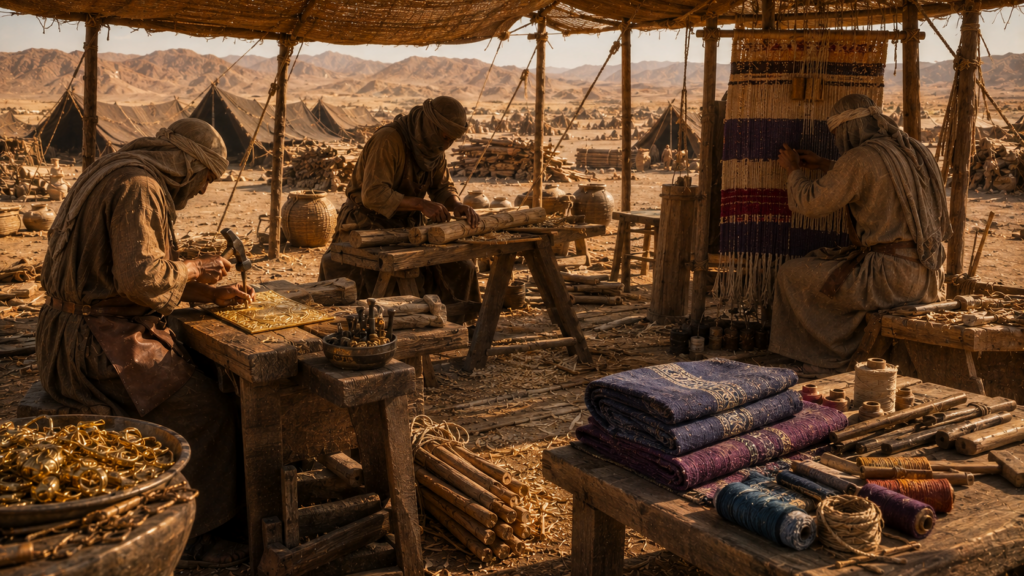
Exodus 36 is, structurally, the construction-version of chapter 26. Where 26 told Moses what to build (curtains, frames, veil), 36 records what was built. The chapter’s pattern, which will hold for the rest of the construction account, is that each section repeats the instruction from chapters 25-31 almost verbatim, now with the verbs in the past tense and the subject changed from you shall make to he made. The book is teaching, with deliberate redundancy, that every detail of the instruction was actually done. The Sinai pattern is not a theological dream; it is a finished building.
But the chapter opens with a moment that is not in the instruction. The artisans, only a few days into the work, report to Moses that the people keep bringing more than enough. Moses has to issue a public restraint: let neither man nor woman make any more offering for the sanctuary. The chapter is recording, in five short verses, the strangest fundraising problem in the Hebrew Bible: we have to ask the people to stop giving.
The chapter’s deepest theological note is in those five verses. The willing-hearted giving of chapter 35 has produced an over-fulfillment that no later Hebrew Bible building project will ever achieve. The temple of Solomon will be built with conscripted labor and royal funding (1 Kings 5:13-18; 9:15). The second temple will require imperial subsidies (Ezra 6:8-10). The tabernacle alone is more than fully funded by the gift of the willing. The book is making a one-time theological-economic claim: the dwelling of YHWH, built by free generosity, was met with too much.
A · Exodus 36:1-7 · The artisans receive more than enough
¹ “Bezalel and Oholiab shall work with every wise-hearted man, in whom Yahweh has put wisdom and understanding to know how to do all the work for the service of the sanctuary, according to all that Yahweh has commanded.” ² Moses called Bezalel and Oholiab, and every wise-hearted man, in whose heart Yahweh had put wisdom, even everyone whose heart stirred him up to come to the work to do it: ³ and they received from Moses all the offering which the children of Israel had brought for the work of the service of the sanctuary, with which to make it. They brought yet to him freewill offerings every morning. ⁴ All the wise men, who performed all the work of the sanctuary, each came from his work which he did. ⁵ They spoke to Moses, saying, “The people bring much more than enough for the service of the work which Yahweh commanded to make.” ⁶ Moses gave commandment, and they caused it to be proclaimed throughout the camp, saying, “Let neither man nor woman make any more offering for the sanctuary.” So the people were restrained from bringing. ⁷ For the stuff they had was sufficient to do all the work, and too much.
- They brought yet to him freewill offerings every morning (v. 3). The Hebrew is ve-hem hevi’u elav od nedavah ba-boqer ba-boqer. The phrase every morning (ba-boqer ba-boqer, with the noun repeated for intensification) is the Hebrew Bible’s idiom for continuous daily ongoing action. The chapter is recording that the people kept giving every single day, not just at the initial collection. The same verb-pattern (hevi’u, they brought) is used as an iterative imperfect. The whole camp is in a sustained mode of generosity that does not stop.
- Much more than enough (v. 5). The Hebrew is marbim ha-am le-havi mi-dei ha-avodah la-melakhah. The construction is unusual: the people increase (marbim) in their bringing beyond the need (mi-dei) of the work (la-melakhah). The book is teaching that the willing heart’s natural trajectory is over-fulfillment. Generosity, in the chapter’s reading, does not naturally calibrate itself to need; it overshoots. The chapter is staging a problem the rest of the Hebrew Bible will rarely have again.
- Let neither man nor woman make any more offering (v. 6). Moses’s response is the chapter’s most distinctive single moment. Religious leaders, in the Hebrew Bible and elsewhere, are usually pictured as needing to exhort the people to give. Moses has to exhort the people to stop. The chapter is preserving a permanent counter-image in the canonical memory: there once was a time, on the edge of the wilderness, when the dwelling of God was built by people who would not stop giving until they were told to stop. The book is teaching that this is possible.
- Sufficient to do all the work, and too much (v. 7). The Hebrew is ve-hayetah dayyam la-kol ha-melakhah ve-hoter. The word dayyenu (it would have been enough) from the Passover Haggadah is from the same root. The chapter is teaching the rare experience of enough-and-more. The whole later Hebrew Bible’s vocabulary of abundance (Ps 23:5, my cup overflows; Mal 3:10, pour out an overflowing blessing) takes its construction-era seed here. The book is naming, in one verse, what abundance looks like in practice.
Word study: nedavah (נְדָבָה) and nediv-lev (נְדִיב־לֵב)
The Hebrew word nedavah names a voluntary offering, a freewill gift. It is distinguished sharply from terumah (mandatory contribution) and minchah (required tribute). Nedavah is the chapter’s chief category. The compound nediv-lev, “willing of heart,” appeared throughout chapter 35 and reappears here as the disposition of the artisans as well as the givers. The same Hebrew root nadav gives the name of Aaron’s son Nadav (Nadab) and the Hebrew Bible’s noun nadiv (noble, generous). The chapter is teaching that nobility, in the Hebrew Bible’s vocabulary, is generosity. The two are the same word. The whole later prophetic tradition’s bond between noble-hearted and generous-hearted (Prov 17:7, fine speech is not appropriate for a fool, even less is lying speech to a noble; Isa 32:8, but the noble plans noble things, and by noble things he stands) takes its etymological depth from this chapter.
B · Exodus 36:8-19 · The curtains made
⁸ All the wise-hearted men among those who did the work made the tabernacle with ten curtains; of fine twined linen, blue, purple, and scarlet. They made them with cherubim, the work of a skillful workman. ⁹ The length of each curtain was twenty-eight cubits, and the width of each curtain four cubits. All the curtains had one measure. ¹⁰ He coupled five curtains to one another, and the other five curtains he coupled to one another. ¹¹ He made loops of blue on the edge of the one curtain from the edge in the coupling. Likewise he made in the edge of the curtain that was outermost in the second coupling. ¹² He made fifty loops in the one curtain, and he made fifty loops in the edge of the curtain that was in the second coupling. The loops were opposite to one another. ¹³ He made fifty clasps of gold, and coupled the curtains to one another with the clasps: so the tabernacle was a unit. ¹⁴ He made curtains of goats’ hair for a covering over the tabernacle. He made them eleven curtains. ¹⁵ The length of each curtain was thirty cubits, and four cubits the width of each curtain. The eleven curtains had one measure. ¹⁶ He coupled five curtains by themselves, and six curtains by themselves. ¹⁷ He made fifty loops on the edge of the curtain that was outermost in the coupling, and he made fifty loops on the edge of the curtain which was outermost in the second coupling. ¹⁸ He made fifty clasps of brass to couple the tent together, that it might be a unit. ¹⁹ He made a covering for the tent of rams’ skins dyed red, and a covering of sea cow hides above.
- All the wise-hearted men among those who did the work (v. 8). The chapter shifts subject: not Moses commanded, but the wise-hearted men. The construction account is, deliberately, the artisans’ story. The book is teaching that the work is delegated. Moses is not the chief artisan; he is the conveyor of the instructions. The hands that actually do the work belong to the chakhmei-lev. The chapter is preserving, in the verb structure, a quiet democratization of the construction.
- Cherubim, the work of a skillful workman (v. 8). The chapter notes the cherubim woven into the inner curtains. The same cherubim that flanked the mercy seat (37:7-9 will record their making) and that guarded the way to the tree of life (Gen 3:24) are woven into the textile walls of the tabernacle’s interior. The book is teaching that the tabernacle’s interior is Eden imagery. The whole space recapitulates the original garden-sanctuary the human was created in. The chapter is one of the canonical seeds of the tabernacle-as-Eden reading.
- The chapter’s verses 9-19 reproduce the instruction of 26:1-14 nearly word for word, with the verbs changed from you shall make to he made. The book is teaching, by deliberate redundancy, that the pattern given on the mountain was followed exactly on the ground. The same materials, the same measurements, the same coupling, the same loops, the same clasps. No deviation. The chapter is making exact-pattern obedience the visible mode of the construction.
C · Exodus 36:20-38 · The frames, the veil, and the screen
²⁰ He made the boards for the tabernacle of acacia wood, standing up. ²¹ Ten cubits was the length of a board, and a cubit and a half the width of each board. ²² Each board had two tenons, joined one to another. He made all the boards of the tabernacle this way. ²³ He made the boards for the tabernacle: twenty boards for the south side southward. ²⁴ He made forty sockets of silver under the twenty boards; two sockets under one board for its two tenons, and two sockets under another board for its two tenons. ²⁵ For the second side of the tabernacle, on the north side, he made twenty boards, ²⁶ and their forty sockets of silver: two sockets under one board, and two sockets under another board. ²⁷ For the far part of the tabernacle westward he made six boards. ²⁸ He made two boards for the corners of the tabernacle in the far part. ²⁹ They were double beneath, and in the same way they were all the way to its top to one ring. He did thus to both of them in the two corners. ³⁰ There were eight boards, and their sockets of silver, sixteen sockets; under every board two sockets. ³¹ He made bars of acacia wood; five for the boards of the one side of the tabernacle, ³² and five bars for the boards of the other side of the tabernacle, and five bars for the boards of the tabernacle for the hinder part westward. ³³ He made the middle bar to pass through in the middle of the boards from the one end to the other. ³⁴ He overlaid the boards with gold, and made their rings of gold for places for the bars, and overlaid the bars with gold. ³⁵ He made the veil of blue, purple, scarlet, and fine twined linen: with cherubim, the work of a skillful workman, he made it. ³⁶ He made four pillars of acacia for it, and overlaid them with gold. Their hooks were of gold. He cast four sockets of silver for them. ³⁷ He made a screen for the door of the tent, of blue, purple, scarlet, and fine twined linen, the work of an embroiderer; ³⁸ and the five pillars of it with their hooks. He overlaid their capitals and their fillets with gold, and their five sockets were of brass.
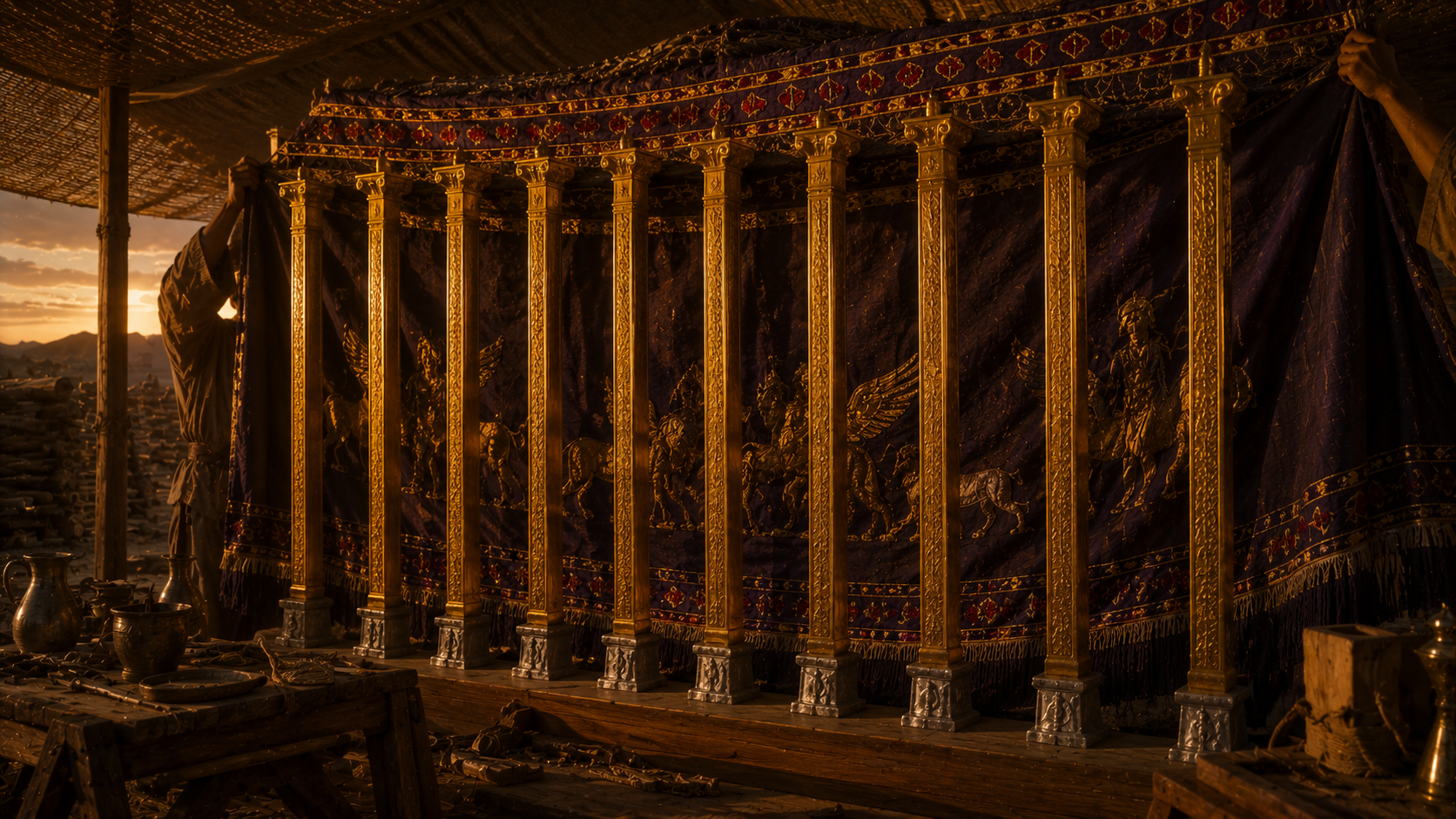
- Acacia wood, standing up (v. 20). The frames are made omdim, “standing up.” The Hebrew participle gives the frames an active quality: they are not merely placed; they stand. The book is using grammatical posture to teach theological posture. The same root that names standing (amad) will be used later in the Hebrew Bible for standing before YHWH in worship (Deut 18:5; Ezek 44:15). The frames are standing in their first installation, the priests will stand before the ark, and the people will stand in worship. The chapter’s vocabulary is consistent.
- Overlaid with gold (v. 34). The inner frames are gold-clad, matching the inner curtains’ golden clasps. The chapter is observing the graded-metal pattern from 26-27 in execution: gold inside, silver at the foundation, bronze for the outermost. The book is teaching that the artisans followed the metal-grading to the letter.
- Cherubim, the work of a skillful workman, he made it (v. 35). The veil between the holy place and the most holy place is made with the same cherubim-imagery as the inner curtains. The book is reinforcing the Eden-typology: the cherubim guarded the way back to the tree of life; now they guard the way into the most holy place. The chapter is teaching that the way to YHWH is the same way back to Eden, and that the cherubim are the constant guardians of the threshold.
Influence callout: John Walton (the cosmic-temple construction account)
Walton’s reading of Exodus 36 names the chapter as the canonical instance of cosmic-temple construction, mirroring the seven-day creation of Genesis 1. The construction account in Exodus 35-40, on Walton’s reading, is structured to recapitulate Genesis 1’s creation week. Just as Genesis 1’s seven days produce the cosmos as a habitable temple for YHWH’s rest, the artisans’ construction produces the tabernacle as a portable habitable model of the same temple. Walton points to the parallel repeated formula: Moses saw all the work (39:43, paralleling God saw all that he had made, Gen 1:31) and Moses finished the work (40:33, paralleling the heavens and the earth were finished, Gen 2:1). The chapter is, in Walton’s reading, the first explicit retelling of Genesis 1 by a human construction crew. The work of Bezalel and Oholiab is staged as a small re-enactment of YHWH’s first making of the cosmos. The whole later Hebrew Bible’s commitment to the temple as cosmic model (Ps 78:69; Isa 66:1) takes its construction-era foundation from this chapter. The pastoral note: every sanctuary that has ever been built by human hands, in the chapter’s reading, is Bezalel’s workshop continued. The work of cosmic re-creation has not stopped.
Reflection prompts
- The chapter records the rarest event in the Hebrew Bible: religious leaders telling the people to stop giving. The willing heart over-fulfilled. Where in your own life have you so feared scarcity that you cannot imagine the chapter’s problem? What would it take to give until you were told to stop?
- The artisans worked every morning in unbroken rhythm. The construction was a steady, daily project. Where in your own creative or sacred work have you been waiting for inspiration when the chapter’s logic says you should be working in the steady rhythm of every morning?
- The pattern given on the mountain was followed exactly on the ground. The chapter records, in its deliberately repetitive verb-structure, that what was commanded was done. Where in your own life is there a clear instruction from God that has been received but not yet executed? What would it look like to be the wise-hearted artisan who simply makes what was commanded?
Frameworks at play in this chapter: the tabernacle as cosmic temple.