
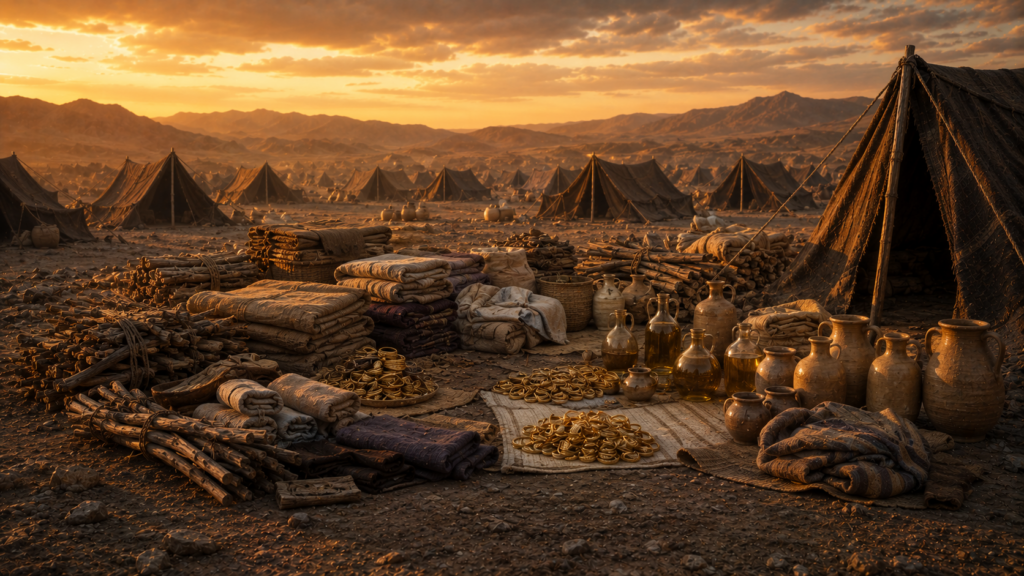
Exodus 35 is the moment Moses turns from the mountain back to the people and begins the construction phase of the book. Chapters 25-31 told Moses what to build; chapters 32-34 recorded the rupture and the renewal; chapter 35 begins, on the ground, with the assembly of Israel and the announcement of what will now actually be done. The chapter has three movements. First, Moses repeats the Sabbath command (35:1-3). Second, he calls for a freewill offering from the people, naming the materials needed and the willing hearts who will bring them (35:4-29). Third, he names again the Spirit-filled artisans, Bezalel and Oholiab, who will lead the work (35:30-35).
The chapter is doing two distinct theological things. First, it is teaching that sacred construction begins with Sabbath. The very people who will spend the next chapters building have to be reminded, at the start, that they will not be building seven days a week. The book is hardwiring rest into the project. Second, the chapter is teaching that the tabernacle will be built by gift, not by tax. No one is compelled. The people who bring materials are whose heart was willing, whose spirit moved them. The book is staging the construction as a participatory act of free generosity, not as a top-down imposition.
A · Exodus 35:1-3 · The Sabbath, before anything else
¹ Moses assembled all the congregation of the children of Israel, and said to them, “These are the words which Yahweh has commanded, that you should do them. ² ‘Six days shall work be done, but on the seventh day there shall be a holy day for you, a Sabbath of solemn rest to Yahweh: whoever does any work in it shall be put to death. ³ You shall kindle no fire throughout your habitations on the Sabbath day.’”
- Moses assembled all the congregation (v. 1). The Hebrew is vayaqhel moshe. The verb qahal (to assemble) gives the chapter (and the parashah) its Hebrew name: Vayaqhel. The book is recording, for the first time since the calf episode, a properly convened assembly of the whole people. The same people who had assembled around Aaron in 32:1 to demand the calf are now reassembled around Moses to hear the renewed instructions. The chapter is staging the reconstitution of the congregation after the rupture.
- These are the words which Yahweh has commanded (v. 1). The chapter opens, exactly as the Sinai covenant did in 19:6-8 and as the Book of the Covenant did in 24:3-4, with the same announcement: these are the words. The book is teaching that the renewed covenant has its own re-publishing moment. The words on the new tablets are re-issued to the people before construction begins. The order is theologically deliberate: hearing the words first, then building.
- Six days shall work be done, but on the seventh day there shall be a holy day (v. 2). The Sabbath command is repeated as the first instruction before any tabernacle work begins. The rabbinic tradition reads this as load-bearing: the Sabbath takes precedence over even the building of the sanctuary. The very project that would most tempt Israel to ignore the seventh day is prefaced by the Sabbath. The pattern from 31:12-17 (Sabbath given at the end of the instructions) is now restated as the opening of the construction. The book is teaching, twice, that the construction is Sabbath-shaped.
- You shall kindle no fire throughout your habitations on the Sabbath day (v. 3). The one new specification. The general Sabbath command (no work) is here applied to the specific case of kindling fire. The reason matters for the construction: fire is the central tool of the metalwork, the woodwork, the bronze-casting, the cooking, the weaving. To ban fire is to ban the work of construction on Sabbath. The chapter is teaching that the workshops will go dark every seventh day. The fires of Bezalel’s forge will be cold. The whole project will visibly stop. The book is making the Sabbath the most visible-from-outside feature of the Israelite work culture.
Word study: vayaqhel (וַיַּקְהֵל) and qahal (קָהָל)
The Hebrew verb qahal (in the hiphil stem, hiqhil) means to gather, to assemble, to call together. The noun qahal names the gathered assembly. The chapter’s opening word, vayaqhel, is the same root, used here as an iterative narrative form (“and he assembled”). The Septuagint translates qahal as ekklesia, which is the Greek word the New Testament will use for church. The chapter, in this etymological lineage, is the canonical seed of the assembly vocabulary that will become the New Testament’s word for the gathered people of God. The chapter is recording, in a single word, the moment when the calf-fragmented people are re-gathered around the words of YHWH for the work of building his dwelling.
B · Exodus 35:4-29 · The freewill offering and the willing heart
⁴ Moses spoke to all the congregation of the children of Israel, saying, “This is the thing which Yahweh commanded, saying, ⁵ ‘Take from among you an offering to Yahweh. Whoever is of a willing heart, let him bring it, as Yahweh’s offering: gold, silver, brass, ⁶ blue, purple, scarlet, fine linen, goats’ hair, ⁷ rams’ skins dyed red, sea cow hides, acacia wood, ⁸ oil for the light, spices for the anointing oil and for the sweet incense, ⁹ onyx stones, and stones to be set for the ephod and for the breastplate. ¹⁰ ‘Let every wise-hearted man among you come, and make all that Yahweh has commanded: ¹¹ the tabernacle, its outer covering, its roof, its clasps, its boards, its bars, its pillars, and its sockets; ¹² the ark, and its poles, the mercy seat, the veil of the screen; ¹³ the table with its poles and all its vessels, and the show bread; ¹⁴ the lamp stand also for the light, with its vessels, its lamps, and the oil for the light; ¹⁵ and the altar of incense with its poles, the anointing oil, the sweet incense, the screen for the door, at the door of the tabernacle; ¹⁶ the altar of burnt offering, with its grating of brass, it poles, and all its vessels, the basin and its base; ¹⁷ the hangings of the court, its pillars, their sockets, and the screen for the gate of the court; ¹⁸ the pins of the tabernacle, the pins of the court, and their cords; ¹⁹ the finely worked garments, for ministering in the holy place, the holy garments for Aaron the priest, and the garments of his sons, to minister in the priest’s office.’” ²⁰ All the congregation of the children of Israel departed from the presence of Moses. ²¹ They came, everyone whose heart stirred him up, and everyone whom his spirit made willing, and brought Yahweh’s offering, for the work of the Tent of Meeting, and for all of its service, and for the holy garments. ²² They came, both men and women, as many as were willing-hearted, and brought brooches, earrings, signet rings, and armlets, all jewels of gold; even every man who offered an offering of gold to Yahweh. ²³ Everyone, with whom was found blue, purple, scarlet, fine linen, goats’ hair, rams’ skins dyed red, and sea cow hides, brought them. ²⁴ Everyone who offered an offering of silver and brass brought Yahweh’s offering; and everyone, with whom was found acacia wood for any work of the service, brought it. ²⁵ All the women who were wise-hearted spun with their hands, and brought that which they had spun, the blue, the purple, the scarlet, and the fine linen. ²⁶ All the women whose heart stirred them up in wisdom spun the goats’ hair. ²⁷ The rulers brought the onyx stones, and the stones to be set, for the ephod and for the breastplate; ²⁸ with the spice, and the oil for the light, for the anointing oil, and for the sweet incense. ²⁹ The children of Israel brought a freewill offering to Yahweh; every man and woman, whose heart made them willing to bring for all the work, which Yahweh had commanded to be made by Moses.

- Whoever is of a willing heart, let him bring it (v. 5). The Hebrew is kol nediv libo, “all whose heart is willing.” The same phrase appears five more times in this passage (vv. 21, 22, 26, 29, plus a related phrase in v. 5). The chapter is naming the chief disposition required for participation: willingness. Not duty, not tax, not obligation. Willingness of heart. The whole Hebrew Bible’s later theology of freewill offering (nedavah) takes its anchor from this chapter. The same word will reappear in the New Testament’s each one as he has decided in his heart, not reluctantly or under compulsion, for God loves a cheerful giver (2 Cor 9:7). The chapter is the canonical seed.
- The list of materials (vv. 5-9). The chapter names exactly the same materials that 25:3-7 named (gold, silver, brass, blue, purple, scarlet, fine linen, goats’ hair, rams’ skins, sea cow hides, oil, spices, onyx, gemstones). The instruction has now become a shopping list given to the people. The book is teaching that the materials for sacred construction do not appear by miracle; they are brought by individual Israelites from their own resources. The whole tabernacle, in this telling, is the aggregated wealth of the willing.
- Both men and women, as many as were willing-hearted (v. 22). The chapter explicitly names both men and women as bringers. The Hebrew is ha-anashim al-ha-nashim, “the men with the women.” The book is being unusually careful here. Women bring jewelry (earrings, signet rings, armlets), spin yarn, contribute precious materials. The Hebrew Bible’s later prophetic tradition of women as central participants in the worshipping community (Miriam, Deborah, Huldah, Anna) has its construction-era seed here. The chapter is teaching that the tabernacle is built by the entire willing-hearted population, not by a single gendered class.
- All the women who were wise-hearted spun with their hands (v. 25). The chapter names a specific kind of chochmah (wisdom): the wise-hearted spinning women. The Hebrew chakhmot-lev names women whose hearts are wise in craft. The text records that they spun the blue, purple, scarlet, fine linen, and goats’ hair. The book is making the same theological move it made in 31:1-3: Spirit-filled craft is the chapter’s vocabulary, and it applies to the women’s spinning as fully as it applied to Bezalel’s metalwork. The whole later Christian and Jewish tradition’s commitment to the sanctity of women’s domestic labor takes its theological anchor here.
- The chapter’s repeated phrase whose heart stirred him up, whose spirit made willing (vv. 21, 22, 26, 29) names the Spirit’s work in the giver, not just in the maker. The book is teaching that the willingness to give is itself a charism, not just a human emotion. The same ruach that filled Bezalel’s hands for craft is filling the people’s hearts for offering. The whole tabernacle, materials and labor together, is Spirit-driven.
C · Exodus 35:30-35 · Bezalel and Oholiab named again
³⁰ Moses said to the children of Israel, “Behold, Yahweh has called by name Bezalel the son of Uri, the son of Hur, of the tribe of Judah. ³¹ He has filled him with the Spirit of God, in wisdom, in understanding, in knowledge, and in all kinds of workmanship; ³² and to make skillful works, to work in gold, in silver, in brass, ³³ in cutting of stones for setting, and in carving of wood, to work in all kinds of skillful workmanship. ³⁴ He has put in his heart that he may teach, both he, and Oholiab, the son of Ahisamach, of the tribe of Dan. ³⁵ He has filled them with wisdom of heart, to work all kinds of workmanship, of the engraver, of the skillful workman, and of the embroiderer, in blue, in purple, in scarlet, and in fine linen, and of the weaver, even of those who do any workmanship, and of those who make skillful works.
- Behold, Yahweh has called by name Bezalel (v. 30). The same naming-language from 31:2 is repeated here, now spoken by Moses to the people. The chapter is teaching that the artisans’ identity is publicly announced. Bezalel is not chosen quietly; he is named to the whole congregation. The book is making the chief artisan a public figure, with a publicly-known vocation.
- He has put in his heart that he may teach (v. 34). The chapter adds a new specification not in 31:1-6. Bezalel and Oholiab are not only Spirit-filled artisans; they are Spirit-filled teachers. Latorot, “to teach,” is from the same root as torah. The artisans will Torah-teach the other wise-hearted craftworkers. The chapter is teaching that Spirit-filled craft is transmissible. It is not a solitary virtuosity; it is a tradition that passes from master to apprentice. The whole later Hebrew Bible’s commitment to craft guilds and to transmission of skill takes its anchor here.
Influence callout: Marty Solomon (the willing heart as the heart of the camp)
Solomon’s reading of Exodus 35 names the willing heart as the chapter’s deepest theological move. The same word nediv libo (willing of heart) is, on Solomon’s reading, the chapter’s repeated proof that the tabernacle is not built by compulsion. Solomon notes the historical-cultural contrast: in the ANE, royal building projects (Egyptian pyramids, Mesopotamian ziggurats, Solomon’s own later temple) were built by forced labor, conscripted artisans, requisitioned materials. The tabernacle, in chapter 35’s deliberate insistence, is the opposite. Every bracelet, every length of cloth, every cut of acacia wood comes from a heart that chose to give. Solomon’s pastoral note: the deepest theological claim of the chapter is that the Israelite economy of God’s dwelling is voluntarist. YHWH does not coerce the materials of his sanctuary out of the people. The same God who refused to be served by the work-without-rest of Pharaoh’s Egypt now builds his own dwelling only from the gifts of the willing. The chapter is teaching, in Solomon’s reading, that the architecture of God’s presence is built from the architecture of free generosity. Modern readers, Solomon argues, are invited to ask: what in our own building of God’s house has migrated back toward the Pharaoh model? The chapter’s whole rebuke is that the willing heart is the only legitimate construction material for the things of God.
Reflection prompts
- The chapter opens with Sabbath, before any building begins. The book is teaching that sacred work is Sabbath-shaped from the start. Where in your own creative or vocational work has Sabbath been postponed until the project is done, when the chapter’s logic says it should frame the project from the beginning?
- Every man and woman whose heart made them willing. The tabernacle was built by gift, not by tax. Where in your own life have you confused compulsion with worship? What would it look like to bring something next week only because your heart was willing?
- The wise-hearted spinning women are named as Spirit-filled craft workers. The chapter is teaching that the Spirit’s work is just as present in domestic and manual labor as in priestly mediation. Whose Spirit-filled work in your own life have you overlooked because it does not happen in front of an altar?
Frameworks at play in this chapter: sabbath rest, the tabernacle as cosmic temple.