
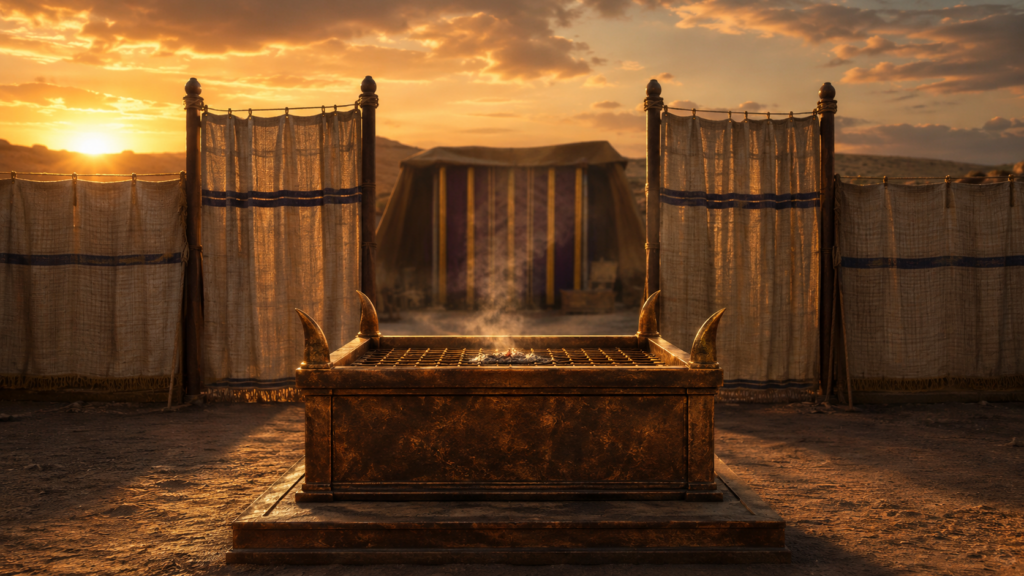
Exodus 27 keeps the tabernacle instructions moving outward. Chapter 25 set the ark in the most holy place; chapter 26 built the tent and hung the veil; now chapter 27 walks the worshipper backwards out from the inner sanctuary to the open-air space where most Israelites would actually have stood. The chapter has three concrete pieces: the bronze altar at the eastern entrance, the linen courtyard that frames the whole compound, and the olive oil that keeps the lampstand burning tamid, continually.
The chapter is doing two things at once. Architecturally, it is finishing the floor plan of YHWH’s first sanctuary. Theologically, it is teaching how a person comes near. You enter from the east, you encounter the altar before anything else, you are taught that approach to the holy passes through sacrifice, and you find that the inner light never goes out.
The Hebrew Bible’s later sacrificial system, the prophetic critique of misused sacrifice, the New Testament’s reading of Christ as the altar’s substance, and the Christian tradition’s habit of placing the cross at the entrance of the sanctuary all begin here.
A · Exodus 27:1-8 · The bronze altar
¹ “You shall make the altar of acacia wood, five cubits long, and five cubits wide. The altar shall be square. Its height shall be three cubits. ² You shall make its horns on its four corners. Its horns shall be of one piece with it. You shall overlay it with bronze. ³ You shall make its pots to take away its ashes, its shovels, its basins, its forks, and its fire pans; all its vessels you shall make of bronze. ⁴ You shall make a grating for it of network of bronze; and on the net you shall make four bronze rings in its four corners. ⁵ You shall put it under the ledge around the altar beneath, that the net may reach halfway up the altar. ⁶ You shall make poles for the altar, poles of acacia wood, and overlay them with bronze. ⁷ Its poles shall be put into the rings, and the poles shall be on the two sides of the altar in carrying it. ⁸ You shall make it hollow with planks. As it has been shown you on the mountain, so shall they make it.
- The altar is the first piece the worshipper encounters. Geographically, the tabernacle sits at the western end of the compound; the entrance gate is on the east; the altar stands between the gate and the tent. Anyone bringing a sacrifice has to come to the altar first. The chapter is making a spatial-theological argument: there is no approach to the holy that bypasses the place of substitution. The pattern is hardwired into the floor plan.
- Square, with horns at the four corners. The altar is geometrically rigorous (five by five, three high) and crowned by four protrusions, one at each corner, made of one piece with the altar itself. The horns are not decoration. They are the altar’s most theologically loaded feature. The blood of the sin offering will later be smeared on the horns (Lev 4:7, 4:18, 4:25). The horns will become refuge: Joab will grab them in 1 Kings 2:28, hoping that the altar’s holiness will protect him from execution. In Amos 3:14, YHWH announces that he will cut off the horns of the altar as the sign that Israel’s sanctuary will fall. The horns concentrate the altar’s whole theology: blood, refuge, judgment.
- Acacia overlaid with bronze. The same wood that built the ark (25:10) builds the altar, but where the ark is overlaid with gold (the metal of the throne room), the altar is overlaid with bronze (the metal of the courtyard, of judgment, of fire). The pattern continues throughout the tabernacle: gold inside, bronze outside. The further you move from the most holy place, the lower-value the metal. The architecture is teaching graded holiness, with the bronze altar marking the outer edge of the worshipping zone.
Word study: mizbeach (מִזְבֵּחַ)
The Hebrew word for altar is mizbeach, from the verb root zabach, “to slaughter (for sacrifice).” The noun is built on the place-prefix mi-: the mizbeach is the place of slaughter. The English word altar carries Latin echoes of “high place,” but the Hebrew is bluntly functional: this is where the animal dies. The book is using its plainest vocabulary. The altar’s beauty (bronze, geometrically perfect, with horns at the corners) is not decoration; it is the way Israel is taught to take seriously what is happening on it. The chapter does not let the worshipper sentimentalize the gate-of-approach. You come near to YHWH by way of a mizbeach.
- Hollow with planks (v. 8). The altar is not a solid block. It is a frame, a structure built around a hollow center, filled (presumably) with earth or rough stones for the fire-floor. The hollow construction is also pragmatic, the altar is portable; it has rings and poles like the ark and the table. The whole tabernacle is a movable sanctuary. Even the place of sacrifice travels with the people. The wilderness is teaching that YHWH’s presence and the approach to it are not tied to a single location. This will become important when the prophets later confront Israel’s temptation to absolutize the Jerusalem temple.
B · Exodus 27:9-19 · The courtyard
⁹ “You shall make the court of the tabernacle: for the south side southward there shall be hangings for the court of fine twined linen one hundred cubits long for one side. ¹⁰ Its pillars shall be twenty, and their sockets twenty, of bronze. The hooks of the pillars and their fillets shall be of silver. ¹¹ Likewise for the length of the north side there shall be hangings one hundred cubits long, and its pillars twenty, and their sockets twenty, of bronze; the hooks of the pillars, and their fillets, of silver. ¹² For the width of the court on the west side shall be hangings of fifty cubits; their pillars ten, and their sockets ten. ¹³ The width of the court on the east side eastward shall be fifty cubits. ¹⁴ The hangings for the one side of the gate shall be fifteen cubits; their pillars three, and their sockets three. ¹⁵ For the other side shall be hangings of fifteen cubits; their pillars three, and their sockets three. ¹⁶ For the gate of the court shall be a screen of twenty cubits, of blue, and purple, and scarlet, and fine twined linen, the work of the embroiderer; their pillars four, and their sockets four. ¹⁷ All the pillars of the court around shall be filleted with silver; their hooks of silver, and their sockets of bronze. ¹⁸ The length of the court shall be one hundred cubits, and the width fifty throughout, and the height five cubits, of fine twined linen, and their sockets of bronze. ¹⁹ All the instruments of the tabernacle in all its service, and all its pins, and all the pins of the court, shall be of bronze.
- The courtyard is a bounded outdoor room. One hundred cubits long by fifty wide (roughly 150 by 75 feet, the size of a small American football field), five cubits tall (about 7.5 feet, slightly higher than the average man could see over). The boundary is fine twined linen: woven cloth, not stone. The whole sanctuary is fabric: outer curtain, inner curtains, the veil, the screens. The chapter’s architecture is portable and breathable. YHWH’s first house is a tent inside a fabric fence.
- East-facing entrance (vv. 13-16). The gate is on the east side, opposite the most holy place at the west. The Hebrew geography is consistent throughout: when the worshipper enters, the sun is at the worshipper’s back. The most holy place is in the west. This is, deliberately, the opposite of the major ANE solar temples, which faced east so that the rising sun illuminated the inner sanctum. YHWH is not the sun; YHWH is not approached as the sun is approached. The orientation is its own polemic.
- The gate is twenty cubits wide (about 30 feet) and made of blue, purple, scarlet, and fine twined linen, the same four colors as the inner veil (26:31) and the door-screen of the tent (26:36). The chapter is teaching graded approach: same colors, different depths. The closer to the most holy you go, the more concentrated the holiness; but the same visual vocabulary marks the gate at the outer fence as marks the veil at the inner sanctuary. The aesthetic is one continuous thing.
Word study: chatser (חָצֵר) and qodesh (קֹדֶשׁ) and chol (חֹל)
Three Hebrew words name the courtyard’s theological function. Chatser, the court, is a bounded outdoor space, the same word used elsewhere for a king’s palace courtyard. The tabernacle has a chatser because YHWH is being staged as a king receiving petitioners in the open court before bringing chosen attendants into the inner rooms. Qodesh names the holy, the realm of God’s presence and the things consecrated for it. Chol names the common or profane (in its neutral, technical sense), the realm of everyday life. The courtyard is the threshold zone between chol outside and qodesh inside. The fence is not just a wall. It is the geographical statement that not all space is the same. Some places carry more weight. To cross from chol to qodesh is to enter into a different ontological register.
- Silver hooks, bronze sockets, silver fillets (vv. 10-11, 17). The chapter pays close attention to the courtyard’s hardware. Silver, in the Hebrew Bible, is the metal of redemption (the half-shekel ransom in 30:11-16 is silver; the firstborn is redeemed with silver in Num 18:16). The pillars holding up the courtyard’s fabric are attached to the ground by silver and bronze. The whole compound’s foundation language is redemption-and-judgment. The fence-line is materially preaching the gospel.
- The whole courtyard requires sixty pillars (twenty on each long side, ten on each short side), with sockets, hooks, fillets, and one hundred cubits of linen on the long sides. The sheer scale of the materials and the artistry is the chapter’s way of showing that the worshipping space matters. The outer courtyard is not less crafted than the inner tent. Every pin is to be made of bronze (v. 19), every hook silver, every length of linen finely twined. The graded-holiness language does not mean the courtyard is cheap; it means it is less holy than the inner sanctuary while still being holy.
C · Exodus 27:20-21 · The continual lamp
²⁰ “You shall command the children of Israel, that they bring to you pure olive oil beaten for the light, to cause a lamp to burn continually. ²¹ In the Tent of Meeting, outside the veil which is before the covenant, Aaron and his sons shall keep it in order from evening to morning before the LORD: it shall be a statute forever throughout their generations on the behalf of the children of Israel.
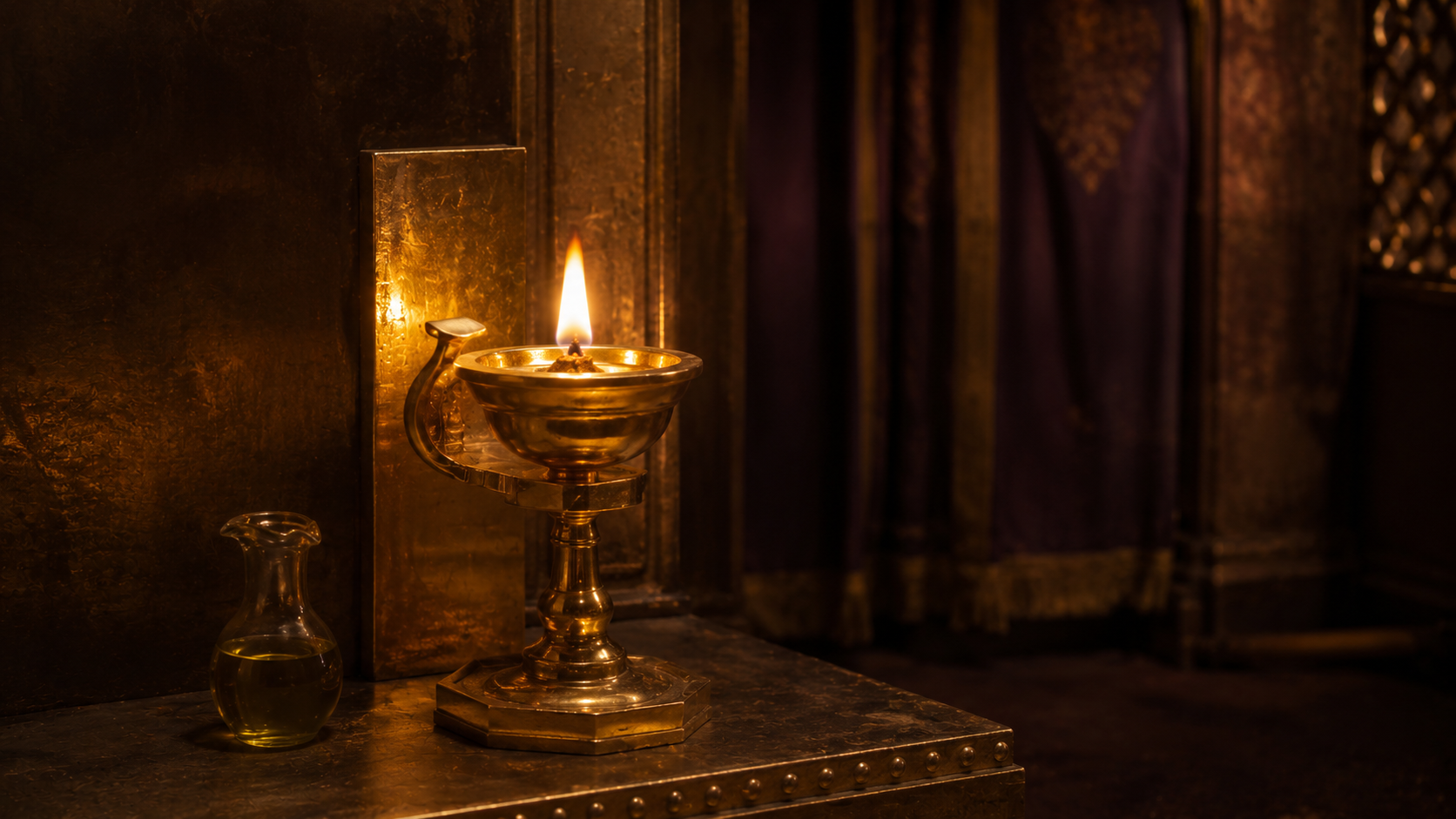
- Two short verses end the chapter and reshape it. After eighteen verses on bronze and acacia and linen, the chapter’s last word is light. The lampstand (the menorah) was specified back in 25:31-40; here we get its fuel and its keeper. The oil is to be pure olive oil beaten for the light. The Hebrew is shemen zayit zach katit la-ma’or: oil from olives, pure (the highest grade, oil from first-pressed olives without heating, before sediment can settle), beaten (pounded by hand rather than crushed in a press, the most labor-intensive method), and dedicated for the light. The chapter does not want any cheaper oil at the place of perpetual presence. The light depends on the oil; the oil depends on the people; the people are commanded to keep it coming.
- Continually, tamid (v. 20). The Hebrew word is one of the chapter’s structurally important terms. It does not mean never extinguished in some metaphysical sense; it means regularly, perpetually, with established rhythm. The lampstand was tended from evening to morning (v. 21), trimmed in the morning and lit in the evening, every day, forever. Tamid will become the technical word for daily, continual offerings (29:38-42 will use it for the tamid offering of two lambs each day; the same word names the bread of the presence always before YHWH at 25:30). The whole tabernacle runs on tamid-rhythm. The presence is not occasional; it is on a covenantal heartbeat.
- Outside the veil which is before the covenant (v. 21). The lampstand stands in the holy place (the front room of the tent), outside the most holy place (the inner room behind the veil). The priest tending the lamp would have stood, twice a day, with the veil in front of him, the ark hidden behind it, and the lampstand burning at his side. This is the posture the rest of the priestly system will assume: near the holy of holies, not yet in, lighting the path with the right oil. Hebrews 9:6-7 reads the priestly daily-tending-of-the-lamp / once-yearly-entry-of-the-high-priest pattern as a foreshadowing of Christ’s once and for all entry into the heavenly holy of holies.
- Aaron and his sons. The chapter’s last word about the perpetual lamp specifies who keeps it. The Aaronic priesthood is not yet formally instituted (that happens in chapter 28), but it is being assumed and named here. The book is staging the priesthood’s job description in the order of presence: first, keep the light on; everything else follows. The priest’s first vocation is not to perform spectacular rituals but to maintain the perpetual ordinariness of YHWH’s burning presence among the people.
Influence callout: John Walton (the lampstand as cosmic temple architecture)
Walton’s reading of the lampstand in the broader ANE temple context names it as part of the tabernacle’s cosmic-temple cosmology. ANE temples were understood as miniature replicas of the cosmos, with the sanctuary as the heavens, the courtyard as the earth, and the various furnishings as cosmic features (the sea-of-bronze later in Solomon’s temple is named after the watery deep; the bread of the presence is named after the cosmic table; the lampstand, with its seven branches, is named after the heavenly lights, sun-moon-stars-planets that Genesis 1 places in the raqia). The continually-burning lamp inside the tabernacle is the small visible echo of the great lights YHWH set in the heavens on day four of creation. The priest tending the lamp each evening and morning is doing in microcosm what the cosmos itself does each day. The chapter is using cosmic-temple architecture to teach that the tabernacle is not a tribal religious building. It is a portable model of YHWH’s whole created order, and the priest’s daily fire-tending work is participation in the rhythm of the cosmos itself.
- The chapter ends with a statute forever throughout their generations (v. 21). The lamp does not belong to a moment; it belongs to a tradition. The book is teaching its first readers, who will be tending lamps in the second temple centuries later, that they are connected to Aaron and his sons by an unbroken cord of evening-and-morning fidelity. Light is the chapter’s last image because light is the chapter’s hope: the journey from the bronze altar at the gate, through the courtyard, into the holy place, ends with a lamp that does not go out.
Reflection prompts
- The chapter teaches that the way in passes through the mizbeach, the place of slaughter. There is no approach to the holy that bypasses substitution. Where in your own spiritual practice are you tempted to skip the altar and try for the lamp directly?
- The courtyard is graded sacred space: not less holy than the inner sanctuary, just differently holy. Where in your life have you assumed that ordinary places, kitchen, commute, workplace, are not yet holy enough to count, when the chapter would say they are part of the same sanctuary?
- Tamid, perpetual. The chapter’s hope is not a one-time encounter but a daily rhythm. What is one tamid practice (morning prayer, evening reading, weekly worship) that you could keep burning in your own life this year?
Frameworks at play in this chapter: the tabernacle as cosmic temple.