
Genesis 16 is the chapter where the covenant family tries to fulfill the covenant by their own hands. The promise has been made (Genesis 12), repeated (Genesis 13), confirmed (Genesis 15), and ratified by God walking alone between the cut animals. Abram is told the heir will come from his own body. Years pass. Sarai is still barren. The biology says no.
So Sarai proposes a workaround. Hagar, an Egyptian slave woman in her household, will be given to Abram as a secondary wife. The child she bears will, by ANE custom, count as Sarai’s. The covenant promise will be fulfilled through this arrangement. Abram agrees. The child is conceived. And almost immediately, the household goes sideways.
Hagar despises Sarai. Sarai mistreats Hagar. Hagar flees into the wilderness, pregnant, alone, on the road back toward Egypt. She is the first character in the Bible to be visited by the angel of Yahweh in the wilderness, and she is the first character in the Bible to give God a name. She calls him El Roi, “the God who sees me.” A foreign slave woman, mid-flight from an abusive household, becomes the first person in Scripture to assign God a name based on her own encounter with him.
The chapter is doing several things at once. It is showing the cost of trying to help God along. It is showing how the household of the covenant carrier can become a place of exclusion. It is showing God’s posture toward those whom the covenant carriers have wronged. The seed of Abraham comes through Sarah eventually, but in chapter 16 it is the woman not in the covenant promise who receives the chapter’s most stunning theological revelation.
A note on Hagar. The Hagar narrative has been at the center of decades of careful scholarly work, especially in Womanist and Black theology (Delores Williams’ Sisters in the Wilderness is the major treatment). The lane this commentary occupies has not always read Hagar with the care she deserves. We will try here, but the chapter’s full weight is best read alongside that broader stream of scholarship.
A · Genesis 16:1–6 · Sarai’s plan and its consequences
¹ Now Sarai, Abram’s wife, bore him no children. She had a servant, an Egyptian, whose name was Hagar. ² Sarai said to Abram, “See now, Yahweh has restrained me from bearing. Please go in to my servant. It may be that I will obtain children by her.” Abram listened to the voice of Sarai. ³ Sarai, Abram’s wife, took Hagar the Egyptian, her servant, after Abram had lived ten years in the land of Canaan, and gave her to Abram her husband to be his wife. ⁴ He went in to Hagar, and she conceived. When she saw that she had conceived, her mistress was despised in her eyes. ⁵ Sarai said to Abram, “This wrong is your fault. I gave my servant into your bosom, and when she saw that she had conceived, I was despised in her eyes. May Yahweh judge between me and you.” ⁶ But Abram said to Sarai, “Behold, your servant is in your hand. Do to her what is good in your eyes.” Sarai dealt harshly with her, and she fled from her face. (Genesis 16:1–6, World English Bible)
- The chapter opens with Sarai naming the situation directly: “Yahweh has restrained me from bearing.” She does not blame her body or fate or chance. She places the situation in God’s economy. This is theologically alert speech. It is also, immediately, the platform for her workaround. Because Yahweh has not given her a child, she will give her servant. The plan is built on a true theological observation and a wrong theological conclusion.
- The cultural background to Sarai’s plan is important. ANE marriage contracts from this period (the Nuzi tablets, certain Mari texts, Hammurabi’s Code §146) document the practice: when a primary wife was barren, she could give a slave or secondary wife to her husband, and any child born to that union was legally considered the primary wife’s. Sarai is not inventing something scandalous. She is enacting a culturally available solution. The text is not condemning her for cultural participation; it is showing what happens when the covenant family follows cultural logic in the face of a divine promise.
Influence callout: John Walton
Walton’s ANE work places this practice squarely in its time and gives the reader a cultural lens. The Nuzi tablets, dating from the 15th-14th centuries BC, describe almost exactly the arrangement Sarai proposes: a barren wife provides a amtu (slave woman) so the household can produce an heir. The text’s interest is not in adjudicating the cultural ethics but in showing what happens when the covenant carriers reach for a culturally normal solution to a theologically unusual problem. The promise was that the offspring would come through Sarai’s own body; Sarai’s plan substitutes Hagar’s body. That substitution is the chapter’s narrative engine.
- “Abram listened to the voice of Sarai” (verse 2). The Hebrew construction vayishma le-qol echoes Genesis 3:17, where Adam “listened to the voice of his wife” (shamata le-qol ishtecha) and ate the fruit. The narrator is hyperlinking. Both moments are characterized by a husband following his wife’s lead into a path that will produce harm, and in both cases the speech is a deflection from a direct command God had given to the man. The parallel is not a misogynistic note about wives; it is a comment on Abram’s own complicity. He doesn’t push back. He doesn’t pray. He doesn’t ask God whether this is the path.
Influence callout: Tim Mackie
Mackie reads this hyperlink as part of the chapter’s structural argument: when the covenant family tries to advance the promise through human ingenuity, the result is always a return to the patterns of Genesis 1 to 11. The verbal echoes to Adam and Eve are deliberate. So is the parallel that follows in chapter 21, when Sarai will, in effect, have the household send Hagar away again. The Hagar narrative isn’t a moral case study about ancient infertility ethics; it’s the chapter where the covenant carriers learn what trying to help God produces.
- Verse 3 contains a small chronological note that matters. “Ten years” have passed since Abram entered Canaan. He is 85 (Genesis 16:16 will tell us he is 86 when Ishmael is born). The covenant promise was first given when he was 75. A decade has passed without the promised child. This is the pressure that makes Sarai’s plan feel reasonable. The chapter is not just about a moral failure; it is about the cumulative weight of waiting on God when biology and culture both keep tapping their watches.
- Hagar conceives, and the household’s power balance shifts. “When she saw that she had conceived, her mistress was despised in her eyes” (verse 4). The Hebrew word vateqal, “she was despised,” is the same root as qalal, the word translated “to curse” or “to make light of” elsewhere. Hagar, suddenly possessing what Sarai cannot produce, holds her mistress in lower regard. The narrator does not endorse this; the narrator just records it. The slave woman who has been used as a means becomes, in her pregnancy, the one with leverage. The household is now fractured along lines the original arrangement assumed could be ignored.
- Sarai’s response is to blame Abram. “This wrong is your fault” (verse 5). The Hebrew word for “wrong” is chamas, the same word used in Genesis 6:11 for the violence that filled the earth before the flood. It’s strong language. Sarai has made the proposal; Abram has agreed; the consequences have arrived; and Sarai now lays the responsibility back at Abram’s feet. This is, again, theologically alert speech and pastorally questionable conduct. The chapter is showing a household where everyone is partially right, partially wrong, and partially honest, and the burden of all of it falls on the woman who had no power to refuse the original arrangement.
- Abram’s reply (verse 6) is unsettling. “Your servant is in your hand. Do to her what is good in your eyes.” He returns Hagar to Sarai’s authority, washes his hands of the situation, and removes any protection his role as Hagar’s secondary husband might have provided. The Hebrew “what is good in your eyes” (ha-tov b’eynayich) is a phrase the book of Judges will later use to describe a culture where “every man did what was right in his own eyes” (Judges 17:6, 21:25). Abram is, in this moment, abdicating moral responsibility to a household member who is, by his own neglect, now the stronger party in a power conflict.
Pushback note
A common reading defends Abram by citing the cultural norms of the period. Yes, the patriarch had legal authority over his secondary wife only at the pleasure of the primary wife; once the primary wife reasserted her claim, the patriarch was customarily expected to step back. This is true. The text is not depicting Abram as legally wrong by the standards of his time. The text is depicting him as morally absent. What the text does not do is hold him up as a model. The narrator records his conduct without comment; that is part of how Hebrew narrative often delivers its harshest judgments. The reader is meant to feel the absence of pastoral leadership and to register that the covenant carrier has, again, left the people in his orbit unprotected.
- “Sarai dealt harshly with her” (verse 6). The Hebrew verb vate’aneha is the same root used later for what the Egyptians do to the Israelites in Exodus 1:11 (vaye’anuhu, “they afflicted them”). The narrator is, again, hyperlinking. The patriarchal household is now functioning as an Egypt for an Egyptian woman. Hagar, fleeing affliction in the household of God’s covenant family, runs in the direction of her own people. The geographic detail in the next section will confirm it.
B · Genesis 16:7–12 · The angel of Yahweh meets Hagar
⁷ Yahweh’s angel found her by a fountain of water in the wilderness, by the fountain on the way to Shur. ⁸ He said, “Hagar, Sarai’s servant, where did you come from? Where are you going?” She said, “I am fleeing from the face of my mistress Sarai.” ⁹ Yahweh’s angel said to her, “Return to your mistress, and submit yourself under her hands.” ¹⁰ Yahweh’s angel said to her, “I will greatly multiply your offspring, that they will not be counted for multitude.” ¹¹ Yahweh’s angel said to her, “Behold, you are with child, and will bear a son. You shall call his name Ishmael, because Yahweh has heard your affliction. ¹² He will be like a wild donkey among men. His hand will be against every man, and every man’s hand against him. He will live opposite all of his brothers.” (Genesis 16:7–12, World English Bible)

- Verse 7 contains the first appearance in Scripture of malakh Yahweh, “the angel of Yahweh.” The figure will recur throughout the Old Testament, sometimes speaking as Yahweh, sometimes speaking on Yahweh’s behalf, sometimes interchangeable with Yahweh in a single passage (Genesis 22, Exodus 3, Judges 6, Judges 13). The Christian tradition has often read these encounters as pre-incarnational appearances of the Son. The Jewish reading tradition is more cautious, treating the figure as a divine messenger so closely associated with Yahweh’s presence that the distinction blurs. The chapter is comfortable with both observations: Yahweh sends his angel; the angel speaks as Yahweh; Hagar names her encounter as an encounter with God himself.
Word study: malakh Yahweh (מַלְאַךְ יְהוָה), “the angel of Yahweh”
The phrase malakh means “messenger” and is the same word used for human messengers throughout the Hebrew Bible. When paired with Yahweh’s name, it designates a divine emissary whose speech is treated, by both the narrator and the recipients, as Yahweh’s own speech. The figure is sometimes called the malakh ha-Elohim (“messenger of God”) and sometimes simply Yahweh in the same passage. The traditional Jewish reading is that the malakh is a divine representative; the Christian reading often identifies the figure as a Christophany (a pre-incarnational appearance of the Son). The text’s interest is less in resolving the metaphysics and more in showing where God’s presence shows up in the narrative.
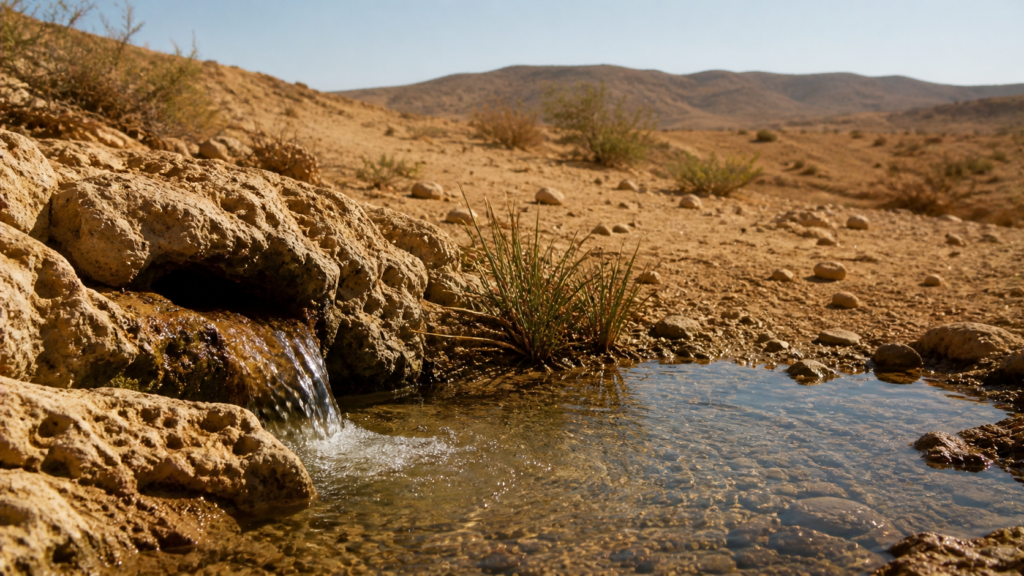
- The geography matters. “By the fountain on the way to Shur.” Shur is the desert region on the east side of the Egyptian frontier. Hagar, an Egyptian, is fleeing in the direction of home. She is not aimless; she is taking the most direct route back to where she came from. The covenant household, the household of the seven-fold blessing, has become a place she needs to flee.
Influence callout: Ray Vander Laan
Vander Laan teaches the Negev and the road to Shur as a real and harsh terrain. The wilderness south of Beersheba is dry, sparse, and dotted with seasonal springs that traders and shepherds knew. Hagar finds water at one of those springs. She is alone, pregnant, fleeing, and a foreigner in this terrain. The angel of Yahweh meets her precisely there: at a desert spring, in mid-flight, when she has reached the edge of her own resources. Vander Laan often points out that the patriarchal narratives are not staged in symbolic landscapes; they happen at real wells and real ridges that real people had to cross. The water Hagar drinks before the encounter is the water she needed to survive the journey.
- The angel’s first words are a question, and the question is striking: “Hagar, Sarai’s servant, where did you come from? Where are you going?” (verse 8). The questions are not informational. The angel knows. They are pastoral. They invite her to name her own situation. The angel speaks her name and her social status (“Hagar, Sarai’s servant”) and then asks her to articulate her own story. Hagar answers truthfully: “I am fleeing from the face of my mistress Sarai.” The encounter begins with her speaking her own truth.
- Verses 9 to 12 deliver three separate divine speeches, each introduced with the formula “the angel of Yahweh said to her.” This triple introduction is a Hebrew narrative device for emphasis. The angel’s words are being delivered as a structured, weighty pronouncement, not a casual conversation.
- The first speech (verse 9) is the difficult one. “Return to your mistress, and submit yourself under her hands.” Modern readers feel the difficulty immediately. Hagar is being told to return to a household where she has been mistreated. The difficulty is real and the chapter does not soften it. Several things matter for reading this without flattening it: – In the ANE, a slave who fled and was unprotected by a divine word would face starvation, slavery to a worse master, or death. The angel’s instruction is, in part, a survival instruction in a world where running away alone was usually fatal. – The instruction is delivered with a promise that follows immediately. The return is not a return to the same situation. The next words promise her descendants on a scale that mirrors the Abrahamic promise. Hagar is being asked to return to a household she will outlive in a sense; she is being given a covenant of her own. – The text is not endorsing the household’s treatment of her. It is locating God’s faithfulness to her inside the harsh situation, in a way that does not require her to be rescued out of it before God can speak to her.
Pushback note
Some pastoral readings of this passage have, historically, used verse 9 to instruct people in abusive situations to return to those situations. That is a misuse of the text. The angel speaks to Hagar in a specific cultural moment with a specific divine promise. He does not establish a general principle that mistreated people must return to mistreatment. The chapter’s broader trajectory is that Hagar will, in fact, leave the household for good in chapter 21. The angel’s instruction here is for this moment, on this road, with this promise; it is not a universal directive. We need to read both the text and the trajectory.
- The second speech (verse 10) is a covenantal promise: “I will greatly multiply your offspring, that they will not be counted for multitude.” This language is the same language used to Abram in Genesis 13:16 and Genesis 15:5 (“as the dust of the earth,” “as the stars of the heavens”). Hagar is being given a promise that mirrors the Abrahamic promise in its scale and structure. She is not being absorbed into the Abrahamic promise; she is being given her own version of it. Her descendants will form their own great nation. The Ishmaelite line, traditionally associated with the Arab peoples, has its theological origin in this verse.
Influence callout: N.T. Wright
Wright reads the parallel-but-distinct promise to Hagar as a key piece of the larger biblical pattern: God’s covenant work with Abraham is for the sake of the world, but it does not exhaust God’s care for the world. There are other lines, other promises, other peoples in whom God is at work. Hagar’s covenant is its own thread. The chapter is showing that the covenant carrier’s story is part of God’s larger story, not the whole of it. The Abrahamic line is the strategic spine; it is not the only place divine attention shows up.
- The third speech (verse 11) names the child: “Behold, you are with child, and will bear a son. You shall call his name Ishmael, because Yahweh has heard your affliction.” The Hebrew name Yishma’el combines the verb shama (“to hear”) and El (“God”). The name means “God hears.” The angel does not say I have heard; the angel says Yahweh has heard your affliction, using the same word (oni) that Hagar’s mistreatment was named with in verse 6. God has heard her affliction. The naming ties the child’s identity, for life, to the fact that his mother was heard.
Word study: Yishma’el (יִשְׁמָעֵאל), “God hears”
The name Ishmael is constructed from two Hebrew roots: shama (“to hear, to listen, to attend to”) and El (“God”). The construction yields “God will hear” or “God hears.” The name is given before the child is born and before Hagar speaks her own naming of God in the next verse. It is a pre-emptive theological declaration: the boy who is coming carries, in his name, the testimony that his mother was not invisible. Every time Hagar will call her son to dinner, his name will say God heard you, Hagar.
- The fourth speech (verse 12) is the harder pronouncement about Ishmael’s life: “He will be like a wild donkey among men.” The Hebrew pere adam, “wild donkey of a man,” is not a pure insult. The wild donkey was a respected animal in ANE imagination, free, untamable, surviving the wilderness. The phrase carries connotations of independence, untameability, and wilderness self-sufficiency. The pronouncement is also realistic: Ishmael’s line will live in tension with the line of Isaac. “His hand against every man, and every man’s hand against him” describes the pattern that will shape Ishmael’s descendants. The chapter is honest. The blessing of Ishmael does not make him an Israelite; it makes him a legitimate, cared-for, free-spirited people of his own.
C · Genesis 16:13–16 · Hagar names God; the birth of Ishmael
¹³ She called the name of Yahweh who spoke to her, “You are a God who sees,” for she said, “Have I even stayed alive after seeing him?” ¹⁴ Therefore the well was called Beer Lahai Roi. Behold, it is between Kadesh and Bered. ¹⁵ Hagar bore a son for Abram. Abram called the name of his son, whom Hagar bore, Ishmael. ¹⁶ Abram was eighty-six years old when Hagar bore Ishmael to Abram. (Genesis 16:13–16, World English Bible)
- Verse 13 is one of the most surprising verses in the Bible. She called the name of Yahweh who spoke to her. Hagar, the Egyptian slave woman, is the first character in the Hebrew Bible to give Yahweh a name based on her own encounter with him. Adam named the animals; God named most of his own appearances; the patriarchs received Yahweh’s self-disclosures. Hagar names him. The name is El Roi, “the God who sees” or “the God of seeing.”
Word study: El Roi (אֵל רֳאִי), “the God who sees”
The construction pairs El (“God”) with roi, a participial form of the verb ra’ah (“to see, to perceive, to behold”). The phrase can be rendered “God who sees” (active sense) or “God of seeing” (more abstract). The naming responds to Hagar’s own situation: she had been used by Sarai, returned by Abram, mistreated, fled, exhausted, and arrived at a desert spring expecting nothing. There she found a God who saw her. The name does not just describe an attribute; it names a relationship. El Roi is the God who saw me. Hagar, the foreigner, the slave, the woman without standing in the patriarchal narrative, gives Yahweh a name no one in the Bible has thought to give him before.
Influence callout: Walter Brueggemann
Brueggemann reads Hagar’s naming of God as a foundational act of biblical lament-becoming-doxology. She has every reason to be silent or bitter; she has been treated as a means by the household and as expendable on the road. Instead, she gives God a name based on the experience of being seen in her unseen-ness. Brueggemann argues that this naming inaugurates a tradition of marginalized speech in Scripture: the speech of those whose lives the powerful have not noticed, addressed to the God who has. Hannah, Mary, the woman with the issue of blood, and many others stand in the line Hagar opened. The chapter is not just a personal vignette; it is a textual founding moment for a particular kind of biblical voice.
- The name continues. “She said, ‘Have I even stayed alive after seeing him?’” The Hebrew of this clause is difficult and has been translated several ways. The line carries the recognition that direct divine encounter is dangerous (a theme that will recur throughout the Pentateuch: Exodus 33:20, “no man can see me and live”). Hagar has seen God and survived. She is, in this moment, in a category of biblical figures who have had a direct encounter and lived to tell the story.
- Verse 14 names the place. “The well was called Beer Lahai Roi.” The Hebrew Be’er Lachai Ro’i is built on three elements: be’er (well), chai (living), ro’i (seeing-of-me, or seeing me). The well’s name is “the well of the Living One who sees me.” Geography becomes theology. A real water source on the road to Shur, between Kadesh and Bered, will from this point forward carry the name Hagar gave it. Generations of travelers passing this well will hear the name and remember a woman who was not seen by her household but was seen by God. The naming is one of the chapter’s quiet permanence.
Influence callout: Ray Vander Laan
Vander Laan often presses the importance of these named places in biblical geography. Wells in the Negev are not just utilities; they are landmarks, gathering points, sites of negotiation and remembrance. Beer Lahai Roi will reappear in the Isaac narrative (Genesis 24:62, 25:11). Isaac will eventually live near this well. The covenant family’s geography ends up running through a place named by an Egyptian slave woman in flight. The narrator’s care for naming Beer Lahai Roi is the narrator’s care for honoring Hagar’s witness for as long as the patriarch’s family endures.
- Verse 15 returns the narrative to the household. “Hagar bore a son for Abram. Abram called the name of his son, whom Hagar bore, Ishmael.” The phrasing is careful. Hagar bore the son; Abram named him. The name Abram gives is the name the angel told Hagar in the wilderness. There is no record that Hagar told Abram what name to use. The implication is that Hagar returned with the name she had been given, and Abram accepted it. The covenant carrier, who had been morally absent for most of the chapter, at least gets this part right: he names the child in obedience to the encounter Hagar had.
- Verse 16 closes the chapter with a chronological note that does the same kind of theological work as Genesis 12:4. “Abram was eighty-six years old when Hagar bore Ishmael to Abram.” Eighty-six. Eleven years after the call. Thirteen years before chapter 17 will return with the renaming of Abram and the deeper covenant ratification. The chapter sits at a hinge in the patriarchal chronology. The next major divine speech to Abram does not come for thirteen years. The chapter is, in part, a long silence: God has spoken to Hagar; he will not speak again to Abram for over a decade. Whatever the household has earned, it has earned the silence.
Reflection prompts
- The chapter opens with a true theological observation (“Yahweh has restrained me from bearing”) that becomes the platform for a workaround. Where in your life are you using a true observation about God as the platform for a plan God hasn’t authorized? What would it look like to sit with the observation without immediately producing the plan?
- Hagar gives Yahweh a name based on her own encounter, and the name is the God who sees me. What encounter, in your own life, would you name God by? If you had to give God a name based on what you have actually known of him, not what you have read about him, what would the name be?
- The chapter records a long household failure and a single faithful act: Abram names the child what the angel told Hagar to name him. Sometimes the only obedience available, after many earlier failures, is the obedience of naming what God has already named. Where in your life is that the obedience God is asking of you?