

Exodus 19 is the chapter where Israel arrives at the mountain. The whole book has been moving toward this moment. The plagues unmade Egypt; the Sea was crossed; the wilderness has tested and provided. Now the people are at Sinai, three months to the day from the night they left Egypt. The chapter contains some of the Hebrew Bible’s most theologically dense single verses: the eagles’ wings speech (vv. 4-6), the segullah (treasured possession) clause, the naming of Israel as a kingdom of priests and holy nation, the people’s we will do response, three days of preparation, the cloud and the trumpet on the mountain. By the chapter’s end, Israel stands at the foot of Sinai trembling, and YHWH speaks the Ten Words from the cloud. The Sinai covenant has begun.
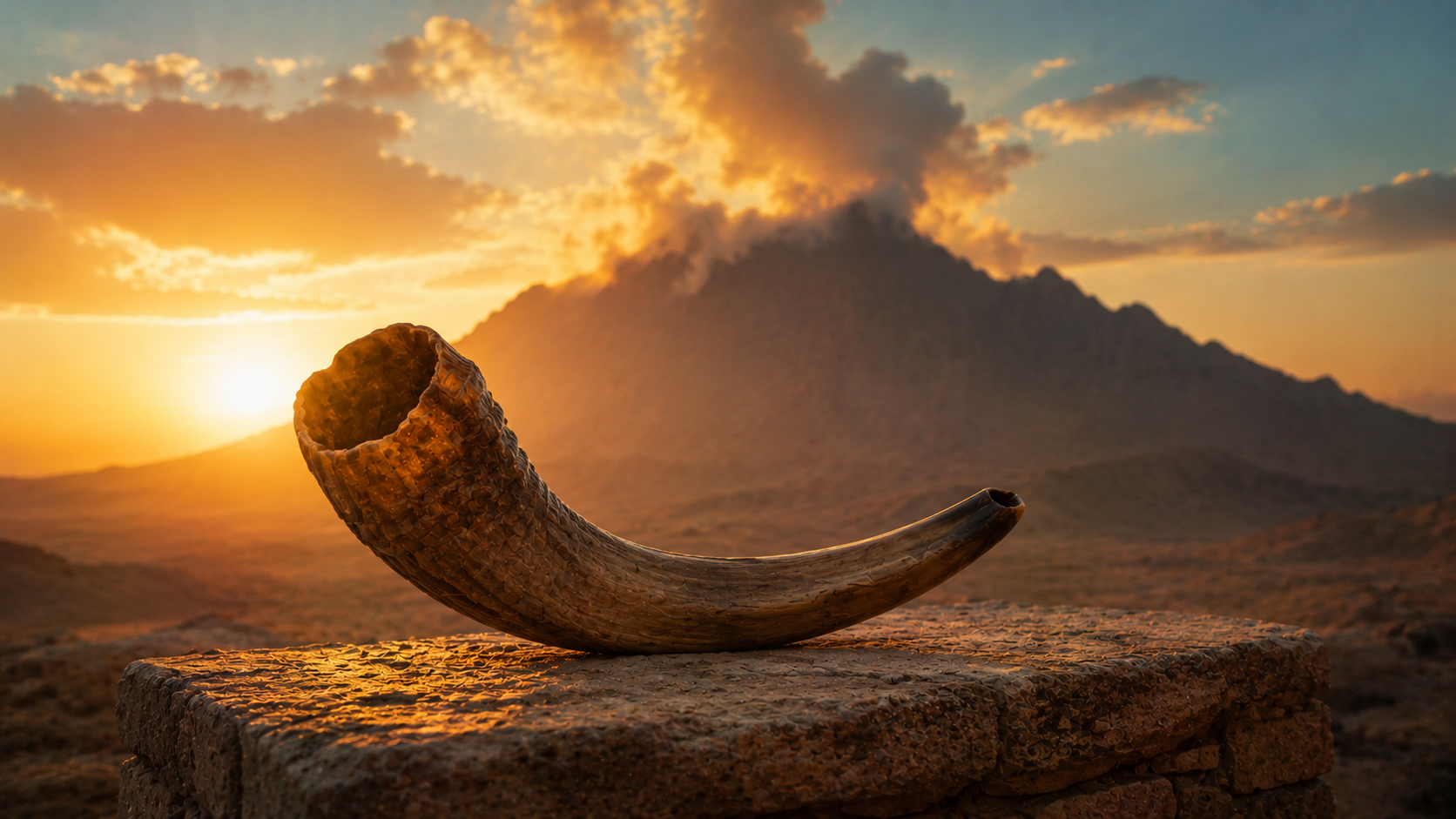
The Sinai-as-wedding framework (see The Sinai covenant) lights up here. Solomon’s reading (drawing on the rabbinic tradition) hears wedding-language in nearly every detail: the consecration of the people (the bride’s mikvah), the three days of preparation, the trumpet blast (the wedding shofar), the cloud over the mountain (the chuppah canopy), the people coming out to meet God (the bride going out to meet her bridegroom in the Mekhilta tradition), and the entire structure of the segullah clause as the betrothal-covenant. The chapter is, on this reading, the morning of Israel’s wedding to YHWH. Imes’s reading (see Bearing God’s Name) overlays the same scene with the suzerain-vassal treaty form: Israel is being branded with God’s Name, conscripted into a vocation as priestly mediator to the watching nations. Both readings hold; they are two faces of the same ANE genre.
A · Exodus 19:1-6 · Eagles’ wings, and the segullah clause
¹ In the third month after the children of Israel had gone out of the land of Egypt, on that same day they came into the wilderness of Sinai. ² When they had departed from Rephidim, and had come to the wilderness of Sinai, they encamped in the wilderness; and there Israel encamped before the mountain. ³ Moses went up to God, and Yahweh called to him out of the mountain, saying, “This is what you shall tell the house of Jacob, and tell the children of Israel: ⁴ ‘You have seen what I did to the Egyptians, and how I bore you on eagles’ wings, and brought you to myself. ⁵ Now therefore, if you will indeed obey my voice, and keep my covenant, then you shall be my own possession from among all peoples; for all the earth is mine; ⁶ and you shall be to me a kingdom of priests, and a holy nation.’ These are the words which you shall speak to the children of Israel.”
- In the third month… on that same day. The Hebrew is ba-chodesh ha-shelishi… ba-yom ha-zeh. Three months to the day from the Pesach. The Hebrew tradition will mark the giving of the Torah at Sinai on this anniversary as Shavuot (Pentecost), the Festival of Weeks, fifty days after Pesach. The chapter’s calendar will become Israel’s liturgical calendar. The Acts 2 Pentecost will land on this same day, fifty days after Christ’s Pesach death. The Hebrew Bible’s calendar is the New Testament’s calendar.
- Moses went up to God. The Hebrew is u-Mosheh alah el-ha-elohim. The verb alah (to go up, ascend) will become Sinai’s signature verb. Moses goes up the mountain repeatedly. The chapter is establishing the foundational pattern: God comes down (3:8); Moses goes up. The two motions meet on the mountain.
- You have seen what I did to the Egyptians, and how I bore you on eagles’ wings, and brought you to myself. The Hebrew is va-essa etkhem al-kanfey nesharim. The verb nasa (to lift, carry, bear) is the same root as the bearing-the-Name verb in the third commandment (see Bearing God’s Name). YHWH has carried Israel out of Egypt as an eagle carries her young. The image is striking: the deliverance was not Israel’s running; it was YHWH’s carrying. Solomon’s note: the Hebrew word nesher (eagle) often refers in the Bible to the vulture (the great soaring bird of the desert). Vultures are the consummate parents in ANE imagination: they carry their fledglings on the back, gliding on thermals, until the fledglings can fly themselves. The image is of the mother-bird-carrying-the-young across the wilderness.
- And brought you to myself. The Hebrew is va-avi etkhem elay. The deliverance is not first about out of Egypt; it is about to me. The chapter is teaching: the goal of the Exodus was not freedom-from but freedom-toward. Israel was carried to YHWH. The mountain is the destination the deliverance has been moving toward.
- If you will indeed obey my voice, and keep my covenant, then you shall be my own possession. The Hebrew is im-shamoa tishme’u be-qoli u-shmartem et-briti, vihyitem li segullah mi-kol-ha-amim. The conditional structure is precise: if you obey, then you will be segullah. Mackie’s note: the if/then is not a threat. It is a vocational invitation. The covenant is being offered; Israel’s yes will activate the role.
- Segullah is the chapter’s load-bearing word. The Hebrew segullah means treasured possession, personal property of the king, crown jewels. Imes’s reading (see Bearing God’s Name): segullah in the ANE world named the king’s personal treasure, distinct from the rest of the kingdom’s resources. To be segullah was not just to be valuable; it was to be set apart for the king’s specific purposes. Imes argues segullah is job description, not sentiment. Israel is not God’s favorite in some affectionate-pet sense. Israel is God’s crown property with a specific representational job: to bear God’s Name to the watching nations.
- You shall be to me a kingdom of priests, and a holy nation. The Hebrew is mamlekhet kohanim ve-goy qadosh. The two phrases are theologically equivalent: Israel is to be priestly in its national identity, holy (set apart) in its corporate life. Goldingay reads kingdom of priests as priestly nation: a nation whose entire collective vocation is to mediate between YHWH and the rest of humanity. The role-description matches the framework: Israel is to be the bridge between the One God and the watching world. The New Testament will pick up this very phrase at 1 Pet 2:9 and apply it to the church: you are a chosen race, a royal priesthood, a holy nation, a people for God’s own possession. The phrase travels.
Word study: segullah (סְגֻלָּה)
The Hebrew word segullah names the king’s personal treasure: jewels, gold, possessions specifically owned by the sovereign for the sovereign’s particular purposes. The word is rare: it appears only six times in the Hebrew Bible (here at Ex 19:5; Deut 7:6; 14:2; 26:18; Ps 135:4; Mal 3:17; Eccl 2:8 in a non-theological context). In every theological occurrence, segullah names Israel as YHWH’s set-apart-for-purpose people. Imes’s reading is that segullah is vocational rather than affective: not God’s favorite, but God’s specially-deputized agent. Solomon’s note: segullah is also a Hebrew word still used in modern Israeli wedding contracts. The bride and groom make each other segullah. The wedding-as-treaty reading hears Israel’s segullah-status as Israel’s wedding-vow: I am yours; you are mine; we belong to each other for the purpose of being a witness to the watching world. Both readings hold. The chapter is patient with both.
B · Exodus 19:7-15 · The people’s we will do, and the days of preparation
⁷ Moses came and called for the elders of the people, and set before them all these words which Yahweh commanded him. ⁸ All the people answered together, and said, “All that Yahweh has spoken we will do.” Moses reported the words of the people to Yahweh. ⁹ Yahweh said to Moses, “Behold, I come to you in a thick cloud, that the people may hear when I speak with you, and may also believe you forever.” Moses told the words of the people to Yahweh. ¹⁰ Yahweh said to Moses, “Go to the people, and sanctify them today and tomorrow, and let them wash their clothes, ¹¹ and be ready against the third day; for on the third day Yahweh will come down in the sight of all the people on Mount Sinai. ¹² You shall set bounds to the people all around, saying, ‘Be careful that you don’t go up onto the mountain, or touch its border. Whoever touches the mountain shall be surely put to death. ¹³ No hand shall touch him, but he shall surely be stoned or shot through; whether it is animal or man, he shall not live.’ When the trumpet sounds long, they shall come up to the mountain.” ¹⁴ Moses went down from the mountain to the people, and sanctified the people; and they washed their clothes. ¹⁵ He said to the people, “Be ready by the third day. Don’t have sexual relations with a woman.”
- All that YHWH has spoken we will do. The Hebrew is kol asher-diber YHWH na’aseh. The people’s collective yes to the covenant. Solomon (drawing on the Talmud, b. Shabbat 88a): na’aseh ve-nishma, we will do and we will hear, is the bride’s wedding-vow. Israel commits before hearing the specifics. The chapter’s na’aseh alone here, without nishma, will be paired with nishma in Ex 24:7. The two together form the rabbinic tradition’s foundational vow of covenant-trust. We will do, and we will hear is, in the rabbinic reading, the highest form of faith: agreeing to the covenant before fully knowing what it requires.
- Behold, I come to you in a thick cloud. The Hebrew is be-av he-anan. The thick cloud is the visible form of YHWH’s presence on the mountain. Solomon’s reading: the cloud is the chuppah, the wedding canopy traditionally held over the couple at a Jewish wedding. The Mekhilta de-Rabbi Ishmael (3rd c. CE rabbinic commentary on Exodus) reads Sinai’s cloud explicitly as the chuppah. The covenant is being given under the cloud-canopy. The wedding image is unmistakable in the rabbinic tradition.
- Sanctify them today and tomorrow, and let them wash their clothes. The Hebrew is qiddashtam ha-yom u-machar, ve-khibsu simlotam. The instructions are wedding-preparation language. Sanctify (set apart for the holy moment) and wash clothes (the bride’s mikvah, the ritual purification). The three-day waiting period is the customary wedding preparation period in ANE practice. The chapter’s third day will become the appointed-time of the wedding-meeting.
- Set bounds to the people all around. The Hebrew is ve-higbalta et-ha-am saviv. The mountain is not yet open territory. Boundaries are to be marked, and crossing them brings death. The chapter is teaching the holiness of the meeting-place. YHWH is near (the mountain is right there), and YHWH is holy (the boundaries are deadly). Both at once. This is the structural pattern of the entire later sanctuary system: God is near, and the approach is regulated.
- On the third day YHWH will come down. The Hebrew is yered YHWH le-eyney khol-ha-am. The verb yarad (to come down) is the same verb of Ex 3:8 (I have come down to deliver) and the Genesis 11 Babel narrative (God comes down to the tower). YHWH comes down to the mountain. The Hebrew Bible’s vocabulary of divine descent finds its public-meeting moment here.
- No hand shall touch him, but he shall surely be stoned or shot through. The instruction is sharp. Anyone (or any animal) who crosses the boundary will die. The execution is by stones or arrows because no human hand can touch the boundary-violator (the violator is now ritually contagious). The chapter is teaching, in stark terms, that the mountain is genuinely qadosh (holy / set apart). Casual proximity to YHWH’s presence is fatal. The pattern will recur at the tabernacle (Lev 10, Nadab and Abihu) and at the ark (1 Sam 6, the Beth-shemesh men; 2 Sam 6, Uzzah).
- Be ready by the third day. Don’t have sexual relations with a woman. The Hebrew is al-tigshu el-ishah. The prohibition is part of the ritual preparation. Sexual abstinence before a sacred moment was a known ANE practice. Solomon’s note: this also fits the wedding-preparation reading. The bride and groom abstain before the wedding night. Israel is preparing for the consummation of the covenant.
C · Exodus 19:16-25 · The cloud, the trumpet, and the trembling
¹⁶ On the third day, when it was morning, there were thunders and lightnings, and a thick cloud on the mountain, and the sound of an exceedingly loud trumpet; and all the people who were in the camp trembled. ¹⁷ Moses led the people out of the camp to meet God; and they stood at the lower part of the mountain. ¹⁸ All of Mount Sinai smoked, because Yahweh descended on it in fire; and its smoke ascended like the smoke of a furnace, and the whole mountain quaked greatly. ¹⁹ When the sound of the trumpet grew louder and louder, Moses spoke, and God answered him by a voice. ²⁰ Yahweh came down on Mount Sinai, to the top of the mountain. Yahweh called Moses to the top of the mountain, and Moses went up. ²¹ Yahweh said to Moses, “Go down, warn the people, lest they break through to Yahweh to gaze, and many of them perish. ²² Let the priests also, who come near to Yahweh, sanctify themselves, lest Yahweh break out on them.” ²³ Moses said to Yahweh, “The people can’t come up to Mount Sinai, for you warned us, saying, ‘Set bounds around the mountain, and sanctify it.’” ²⁴ Yahweh said to him, “Go down and you shall bring Aaron up with you, but don’t let the priests and the people break through to come up to Yahweh, lest he break out on them.” ²⁵ So Moses went down to the people, and told them.
- Thunders and lightnings, and a thick cloud on the mountain, and the sound of an exceedingly loud trumpet. The Hebrew is qolot u-vraqim ve-anan kaved… ve-qol shofar chazaq me’od. The theophany is full sensory: thunders, lightnings, cloud, trumpet, smoke, fire, earthquake. Mackie’s note: every element of the description is creation-undoing language. The mountain quakes; the cloud is thick; the trumpet grows louder and louder. The chapter is staging the most dramatic theophany in the Hebrew Bible. Pentecost in Acts 2 will intentionally echo this scene (wind, fire, languages); Sinai is being recapitulated in the church’s foundational moment.
- Moses led the people out of the camp to meet God. The Hebrew is vayotse Mosheh et-ha-am liqrat ha-elohim. The phrase liqrat ha-elohim (to meet God) is striking. Solomon (drawing on the Mekhilta): Israel went out to meet God like a bride goes out to meet her bridegroom. The Hebrew Bible’s bride-and-bridegroom imagery is in the chapter’s grammar. The processing-out-to-meet is the bride’s procession in ANE wedding practice.
- Mount Sinai smoked, because YHWH descended on it in fire; and its smoke ascended like the smoke of a furnace. The Hebrew is kashan ha-kivshan. The simile is precise. Kivshan (furnace, kiln) is the Hebrew Bible’s word for an intense industrial fire. The smoke of YHWH’s descent looks like a working brick-kiln. Solomon catches the irony: the brick-kilns of Egypt that Hebrew slaves had been forced to feed are now the visual echo of the fire of YHWH’s descent at Sinai. The chapter is wordplay even in its imagery: the empire’s furnace and YHWH’s mountain look the same from a distance, and the difference is everything.
- When the sound of the trumpet grew louder and louder, Moses spoke, and God answered him by a voice. The Hebrew is Mosheh yedaber ve-ha-elohim ya’anennu ve-qol. The pattern is dialogical. Moses speaks; God answers. The chapter is establishing the foundational pattern of Sinai mediation: Moses on the mountain, God in the cloud, the people at the foot. The Hebrew Bible’s whole prophetic vocation will be patterned on this.
- YHWH came down on Mount Sinai, to the top of the mountain. The Hebrew is vayered YHWH al-har Sinai. Yered again. The descent is now visible. The chapter is teaching: the God who said I have come down in Ex 3:8 is coming down visibly here. The God who travels with the people is now meeting the people at the appointed mountain.
- Go down, warn the people, lest they break through to YHWH to gaze. The Hebrew is yeher’su el-YHWH lir’ot. The verb haras (to break through) is intense. The warning is real. The chapter is teaching, in repeated form, that the closeness of YHWH to the camp does not eliminate the holiness of the boundary. Israel can hear the cloud, see the smoke, feel the trembling, and must not cross the line. The dual-truth (God is near and God is holy) will become the architecture of the tabernacle. The whole later sanctuary system is built on this verse’s principle.
- The chapter ends with Moses going down to the people. The cloud is on the mountain. The boundaries are set. The trumpet is sounding. The people are trembling at the foot of the mountain. The next chapter will narrate what happens when YHWH speaks the Ten Words out of the cloud, in the hearing of all Israel. The covenant words are about to be spoken.
Influence callout: Carmen Joy Imes (Bearing God’s Name) on the segullah clause
Imes reads the segullah clause (Ex 19:5-6) as the covenant’s job description. Segullah names Israel as God’s crown property with a specific role: to bear God’s Name among the watching nations. The kingdom of priests phrase makes the role explicit. Israel is to be the priestly nation, mediating between the One God and the surrounding peoples. Imes’s argument is that this is the foundational logic of the entire Hebrew Bible’s mission-theology. Israel is not chosen for privilege but for vocation. The election is for the sake of the watching world. Every later Hebrew Bible passage about Israel’s mission to the nations (Isa 49:6, I will give you as a light to the nations; Mic 4:2, the law shall go out from Zion) is rooted in this chapter. And the New Testament’s extension of the segullah status to the church (1 Pet 2:9-10, the same exact phrase quoted) is direct continuation: the church is now grafted into the segullah-vocation of representing God’s character to the watching world. The chapter is the seedbed of the whole biblical mission. See Bearing God’s Name.
Reflection prompts
- I bore you on eagles’ wings, and brought you to myself. The deliverance was not first about out of Egypt; it was about to me. Where, in your own life, are you celebrating having been brought out of something while still resisting the to whom the deliverance is moving you? What does it look like to let the redemption land at the mountain?
- Segullah names Israel as God’s crown property with a job. Election is vocation, not exemption. Where, in your own faith life, have you slipped into reading God’s choosing of you as exemption from the world’s hardness rather than commissioning into the world’s healing? What does the chapter’s priestly nation call ask you to step into?
- Israel went out to meet God like a bride goes out to meet her bridegroom. The chapter’s posture is going out to meet. Most modern faith-life is structured to receive God in the comfort of one’s own routine. What would it look like to go out to meet God, the way a bride goes out from the house to meet the wedding procession?
Frameworks at play in this chapter: the Sinai covenant, bearing God’s name.