
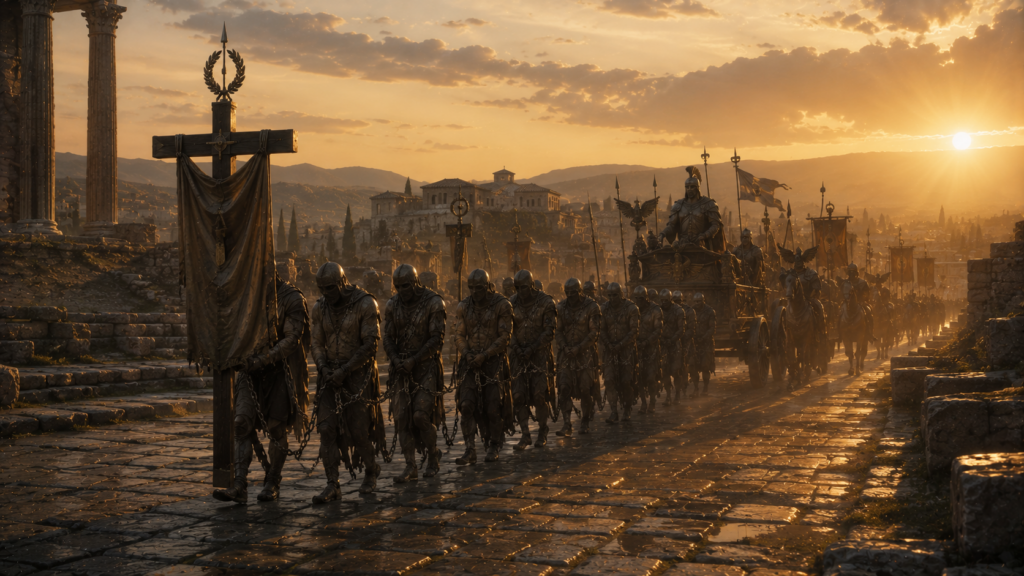
Colossians 2 is the letter’s polemical center. After the great Christ-hymn of chapter 1 has named the cosmic supremacy of Christ as the structural ground of everything, chapter 2 turns to the specific teaching that was pressing on the Colossian church and refutes it directly. The polemic’s mode is not item-by-item rebuttal but structural reframing: the chapter does not so much argue against the philosophy as show that the cosmic Christ already contains everything the philosophy was promising and disarms everything the philosophy was fearing. In him all the fullness of the Deity dwells bodily (verse 9), and in him you are made full (verse 10), with no remainder for any supplementation. In him you were circumcised with a circumcision not made with hands (verse 11), buried with him in baptism and raised with him through faith (verse 12), and in him the powers the philosophy ranked have been stripped and paraded as defeated (verses 14-15).
The chapter has three movements. The first (verses 1 to 7) frames Paul’s pastoral concern for a church he has never visited and instructs them to walk in him as they received him. The second (verses 8 to 15) is the chapter’s theological climax: the warning against the philosophy, the declaration of Christ’s bodily fullness, the cross’s victory over the cosmic powers, and the believer’s incorporation into that victory through baptismal union. The third (verses 16 to 23) is the practical application: the Colossians are not to let anyone judge them by the philosophy’s ascetic standards (food, drink, festivals, new moons, sabbaths, self-imposed worship, angel veneration, body-severity), because these things are shadow compared to the body that is Christ.
The chapter’s most-cited verse, the cross-disarms-the-powers declaration of 2:14-15, is the New Testament’s clearest single statement of the cross as cosmic victory. Whatever the Colossian philosophy was fearing about the unseen stoicheia tou kosmou (the elemental spirits of the world) and the angelic hierarchies, Paul says the cross has already dealt with them. The Roman crucifixion that the philosophy might have read as a humiliation of the Messiah is, on Paul’s reading, the moment of cosmic triumph.
A · Colossians 2:1-7 · Pastoral concern and the call to walk in him
¹ For I desire to have you know how greatly I struggle for you and for those at Laodicea, and for as many as have not seen my face in the flesh; ² that their hearts may be comforted, they being knit together in love, and gaining all riches of the full assurance of understanding, that they may know the mystery of God, both of the Father and of Christ, ³ in whom all the treasures of wisdom and knowledge are hidden. ⁴ Now I say this that no one may delude you with persuasiveness of speech. ⁵ For though I am absent in the flesh, yet I am with you in the spirit, rejoicing and seeing your order, and the steadfastness of your faith in Christ. ⁶ As therefore you received Christ Jesus the Lord, walk in him, ⁷ rooted and built up in him and established in the faith, even as you were taught, abounding in it in thanksgiving. (Colossians 2:1-7, World English Bible)
- For I desire to have you know how greatly I struggle for you and for those at Laodicea, and for as many as have not seen my face in the flesh (verse 1). The chapter opens with Paul naming his actual pastoral situation. He has not personally visited Colossae (the founding work was Epaphras’s, 1:7); he has not visited Laodicea; he has not visited the broader Lycus Valley church network. And yet he struggles (Greek agōn, the language of athletic contest and intense effort) on their behalf. The verse names a deep pastoral instinct: the apostle’s care extends not just to the churches he has planted but to every church he has heard of. The letter to a church-he-has-never-seen is itself an act of apostolic struggle on their behalf.
- that their hearts may be comforted, they being knit together in love, and gaining all riches of the full assurance of understanding, that they may know the mystery of God, both of the Father and of Christ, in whom all the treasures of wisdom and knowledge are hidden (verses 2-3). The pastoral purpose of the struggle. Three goals: hearts comforted (the believer’s interior settling); knit together in love (the body’s relational cohesion); full assurance of understanding (cognitive confidence in the gospel). The phrase full assurance of understanding (plērophoria tēs syneseōs) is a noun-cluster of confidence, naming an epistemic security in the gospel that the Colossian philosophy was trying to unsettle. And then the climactic clause: the mystery of God, both of the Father and of Christ, in whom all the treasures of wisdom and knowledge are hidden. The Colossian philosophy was offering hidden wisdom; Paul says the hidden treasures are already in Christ. The verse will return in 2:8 as the chapter’s structural answer to the philosophy: whatever wisdom and knowledge it claims to mediate, the actual treasury is in him.
- Now I say this that no one may delude you with persuasiveness of speech. For though I am absent in the flesh, yet I am with you in the spirit, rejoicing and seeing your order, and the steadfastness of your faith in Christ (verses 4-5). The danger named: someone will try to delude (paralogizomai, “to mislead by false reasoning”) the church with persuasiveness of speech (pithanologia, the Greco-Roman rhetorical art of argument-by-charm). The Colossian philosophers were almost certainly skilled rhetoricians; Paul names the danger as much in their delivery as in their content. Pastoral presence is named: I am with you in spirit. The military vocabulary that follows (order, taxis, the disciplined arrangement of troops; steadfastness, stereōma, a firm position) is the language of a community holding its line under attack.
- As therefore you received Christ Jesus the Lord, walk in him, rooted and built up in him and established in the faith, even as you were taught, abounding in it in thanksgiving (verses 6-7). The chapter’s pastoral thesis. As you received Christ Jesus the Lord (the Greek parelabete, the technical verb for receiving an apostolic tradition or teaching; cf. 1 Cor 15:3, I delivered to you what I also received) sets the standard: walk in the same Christ you originally received, not the one the philosophy is offering. The two metaphors in verse 7 are mixed but vivid: rooted (errizōmenoi, agricultural; cf. Eph 3:17, rooted and grounded in love) and built up (epoikodomoumenoi, architectural; cf. Eph 2:20-22). The Christian life is both organic growth and architectural construction, and both are in him. The closing word thanksgiving (eucharistia) frames the whole walk: gratitude as the constitutional posture.
Word study: peripateō in Colossians (2:6 and the chapter’s organizing verb)
The Greek verb peripateō (“to walk”) is, as in Ephesians 4-6, the structural verb of Colossians’ ethical instruction. In Colossians it appears at 1:10 (walk worthily of the Lord), 2:6 (as you received Christ Jesus the Lord, walk in him), 3:7 (you also once walked in those, of the pre-Christian life left behind), and 4:5 (walk in wisdom toward those who are outside). The Pauline figure is, as always, Hebraic: halak in the Hebrew Bible is the verb for living out covenant faithfulness (Gen 5:24; Mic 6:8; Deut 8:6), and the rabbinic tradition’s term for the legal-ethical application of Torah, halakhah, comes from this verb. Paul’s choice of peripateō as the organizing imperative of his ethical instruction draws on this Hebraic-covenantal grammar: the Christian life is a way of walking, daily, in the One who has been received. The phrase walk in him in Colossians 2:6 is the chapter’s pastoral motto. The believer’s daily life is not the acquisition of more Christ, but the walking out of the Christ already received. The philosophy was promising more; Paul says the way forward is walking in what was already given.
B · Colossians 2:8-15 · The cosmic Christ and the cross’s victory
⁸ Be careful that you don’t let anyone rob you through his philosophy and vain deceit, after the tradition of men, after the elemental spirits of the world, and not after Christ. ⁹ For in him all the fullness of the Deity dwells bodily, ¹⁰ and in him you are made full, who is the head of all principality and power. ¹¹ In him you were also circumcised with a circumcision not made with hands, in the putting off of the body of the sins of the flesh, in the circumcision of Christ, ¹² having been buried with him in baptism, in which you were also raised with him through faith in the working of God, who raised him from the dead. ¹³ You were dead through your trespasses and the uncircumcision of your flesh. He made you alive together with him, having forgiven us all our trespasses, ¹⁴ wiping out the handwriting in ordinances which was against us. He has taken it out of the way, nailing it to the cross. ¹⁵ Having stripped the principalities and the powers, he made a show of them openly, triumphing over them in it. (Colossians 2:8-15, World English Bible)

- Be careful that you don’t let anyone rob you through his philosophy and vain deceit, after the tradition of men, after the elemental spirits of the world, and not after Christ (verse 8). The chapter’s named target. The Greek philosophia kai kenē apatē (“philosophy and empty deceit”) is the only New Testament occurrence of philosophia, and Paul is not condemning the discipline of thinking itself, he is naming a specific teaching that has come to Colossae. The three diagnostic markers are precise: after the tradition of men (the teaching is grounded in human succession, not in Christ); after the elemental spirits of the world (kata ta stoicheia tou kosmou, the same vocabulary as Gal 4:3, 9, naming the cosmic powers as the underlying frame); not after Christ (the conclusive judgment). The exact identification of the Colossian philosophy is debated (the chapter’s later mentions of food and drink, festivals, new moons, sabbaths, 2:16, and worship of angels, 2:18, and do not handle, do not taste, do not touch, 2:21, suggest a Jewish mystical-ascetic teaching, possibly with Phrygian-religious accents); the precise label matters less than the structural diagnosis. The teaching was placing additional disciplines, mediators, and cosmic powers between the Colossians and the Christ they had received.
Word study: stoicheia tou kosmou (στοιχεῖα τοῦ κόσμου), “the elemental spirits of the world”
The Greek phrase stoicheia tou kosmou is one of the most-debated noun-clusters in Pauline studies. It appears here (Col 2:8, 20) and in Galatians 4:3 and 4:9, and the underlying noun stoicheion has a range of meanings. In its most basic sense it means element (the alphabetic letters that are elements of words; the four classical elements of earth, water, air, fire). In Hellenistic usage it could mean fundamental teachings (the elementary principles of a discipline). In late Hellenistic and early imperial-era astrology and magic, it came to mean the cosmic powers (the elemental spirits that ruled the heavenly spheres and the calendar). The lane’s reading (Wright, Gombis, Walsh and Keesmaat, Arnold’s adjacent work on Ephesus and Colossae) takes the Pauline usage as the third sense: the cosmic powers that the philosophy thought ranked the universe above human life. On this reading, the Colossian philosophy was, like much of the Greco-Roman religious world Paul moved through, organized around the assumption that unseen cosmic powers (the stoicheia) regulated the human world and had to be appeased through ascetic discipline, calendar observance, and angelic mediation. Paul’s answer in 2:14-15 is that the cross has disarmed exactly these powers; the believer is no longer under them, but in Christ is above them with the One who reigns over them. The same vocabulary in Galatians 4 makes the same point: returning to the stoicheia (whether through gentile paganism or through Judaizing Torah-observance) is going backward from the freedom Christ has won. See powers and principalities.
- For in him all the fullness of the Deity dwells bodily, and in him you are made full, who is the head of all principality and power (verses 9-10). The chapter’s theological climax, in two compressed verses. Pan to plērōma tēs theotētos (“all the fullness of the Deity”) names the totality of divine presence as dwelling in him; the qualifier bodily (sōmatikōs) names this as not abstract or metaphorical but embodied in the incarnate Christ. The same plērōma word that runs through Ephesians (1:23; 3:19; 4:13) and Colossians 1:19 returns here in its sharpest formulation. And the corresponding claim about the believer: in him you are made full (peplērōmenoi este en autō). The believer’s fullness is in him, the same vocabulary the philosophy was likely using of its own promised initiation. Paul says: you do not need to seek fullness through the philosophy’s mediators; you are already full in him. And then the structural answer to the philosophy: he is the head of all principality and power (archē kai exousia, the cosmic-power vocabulary). The chapter has already named the philosophy’s cosmic powers (verse 8); Christ is over them. Whatever the stoicheia offer or threaten, the head over them is the one in whom the Colossians already dwell.
- In him you were also circumcised with a circumcision not made with hands, in the putting off of the body of the sins of the flesh, in the circumcision of Christ, having been buried with him in baptism, in which you were also raised with him through faith in the working of God, who raised him from the dead (verses 11-12). The chapter’s most concentrated participatory passage. The Greek prefixes syn- run through the verses: buried with him (syntaphentes), raised with him (synēgerthēte). The same compound verbs that organized Ephesians 2:5-6 return here. The Colossian believer’s narrative is now the Messiah’s narrative: incorporation has happened, by baptism, through faith in the working of God. The phrase circumcision not made with hands (peritomē acheiropoiētos) draws on the Hebrew Bible’s anticipation of an interior circumcision (Deut 10:16; 30:6; Jer 4:4) and explicitly distances the Colossians from the philosophy’s apparent insistence on bodily circumcision as a ritual marker. The new-covenant interiority of Deuteronomy 30:6 has, in Christ, become the believer’s actual location. See the new covenant and in Christ: participation and union.
Influence callout: Timothy Gombis on the cross-as-cosmic-victory (Col 2:14-15)
Timothy Gombis’s The Drama of Ephesians (IVP, 2010) and broader work on apocalyptic Paul name Colossians 2:14-15 as the canonical text for the cross-as-cosmic-victory motif that the lane’s powers and principalities framework names. The structural move is theatrical. The Greek thriambeuō in verse 15 is the technical verb for the Roman triumph procession: a victorious Roman general was granted by the Senate the right to a public procession through the streets of Rome, leading his defeated enemies in chains, stripped of their weapons, with the spoils of war paraded behind. Paul takes this very Roman image and applies it to the cross: at the cross, God in Christ led the cosmic powers as captives, stripped them of their weapons (the verb apekdyomai is the language of stripping off armor or clothing), and made a public spectacle of them. The image is fierce inversion: the cross that the Romans used to humiliate their enemies has, in this verse, become the chariot in which Christ humiliates the cosmic powers. Gombis’s argument: the believer who has read this verse should never again imagine the cross as defeat or shame; the cross is, in Paul’s apocalyptic reading, the precise moment of the cosmic powers’ public defeat. The Colossian philosophy was teaching the church to fear and accommodate the cosmic powers; Paul is teaching them to read the cross as the cosmic powers’ funeral. See powers and principalities.
- You were dead through your trespasses and the uncircumcision of your flesh. He made you alive together with him, having forgiven us all our trespasses, wiping out the handwriting in ordinances which was against us. He has taken it out of the way, nailing it to the cross (verses 13-14). The cross’s forensic dimension. The phrase the handwriting in ordinances (to kath’ hēmōn cheirographon tois dogmasin) has been variously read across the church’s history. Cheirographon is the technical Greek term for a signed promissory note, an IOU acknowledging debt. The lane reads the phrase as naming the record of the believer’s trespasses (a record that was against us), now wiped out, taken out of the way, nailed to the cross. The image is concrete: the IOU has not been forgiven in the loose sense of overlooked; it has been cancelled by being nailed up publicly with the One who paid it. The cross is, on this verse, both the place of cosmic victory (verse 15) and the place of debt cancellation (verse 14), in a single redemptive act.
- Having stripped the principalities and the powers, he made a show of them openly, triumphing over them in it (verse 15). The triumph image’s climax. The Greek deigmatizō (“to make a public show, to exhibit publicly”) is the standard Greco-Roman vocabulary for the parading of defeated enemies. The cosmic powers, archai kai exousiai, the same vocabulary as Ephesians 1:21 and Colossians 1:16, are paraded as stripped, publicly exposed, triumphed over in it (the antecedent of in it is either the cross or Christ himself; both readings work). The cosmic powers the Colossian philosophy was teaching the church to fear and appease are, by this verse, already disarmed. The pastoral consequence is the framework’s standing claim: the believer’s life is conducted in the gap between Christ’s victory and its visible completion, not in the anxiety of an undecided cosmic war.
C · Colossians 2:16-23 · Do not let anyone judge you: against the philosophy’s regulations
¹⁶ Let no one therefore judge you in eating or drinking, or with respect to a feast day or a new moon or a Sabbath day, ¹⁷ which are a shadow of the things to come; but the body is Christ’s. ¹⁸ Let no one rob you of your prize by self-abasement and worshiping of the angels, dwelling in the things which he has not seen, vainly puffed up by his fleshly mind, ¹⁹ and not holding firmly to the Head, from whom all the body, being supplied and knit together through the joints and ligaments, grows with God’s growth. ²⁰ If you died with Christ from the elemental spirits of the world, why, as though living in the world, do you subject yourselves to ordinances, ²¹ “Don’t handle, nor taste, nor touch” ²² (all of which perish with use), according to the precepts and doctrines of men? ²³ These things indeed appear like wisdom in self-imposed worship, humility, and severity to the body, but aren’t of any value against the indulgence of the flesh. (Colossians 2:16-23, World English Bible)
- Let no one therefore judge you in eating or drinking, or with respect to a feast day or a new moon or a Sabbath day, which are a shadow of the things to come; but the body is Christ’s (verses 16-17). The chapter’s first practical application. The five categories the Colossians are not to be judged on (eating, drinking, feast day, new moon, Sabbath) are recognizably Jewish observances: the food laws of Leviticus 11 and Deuteronomy 14, the festival calendar of Leviticus 23 and Numbers 28-29 (annual feasts, monthly new moons, weekly sabbaths). The philosophy was apparently pressing on the Colossian gentile Christians a regime of Jewish-ascetic observance, though probably with mystical-Phrygian accents (the worship of angels of verse 18 is not native Jewish-Pharisaic practice). Paul’s answer is striking. He does not say the festivals were wrong; he says they were shadow (skia, the cast image of a reality not yet present), and the body (sōma, the substance that casts the shadow) is Christ. The Hebrew Bible’s calendar pointed forward; Christ is the reality it pointed to; the Colossians do not need to retreat into the shadow when they have the substance. The phrase echoes Hebrews 10:1 (the law has a shadow of the good things to come, but not the very image of them). See Paul within Judaism.
- Let no one rob you of your prize by self-abasement and worshiping of the angels, dwelling in the things which he has not seen, vainly puffed up by his fleshly mind, and not holding firmly to the Head, from whom all the body, being supplied and knit together through the joints and ligaments, grows with God’s growth (verses 18-19). The chapter’s most specific naming of the philosophy’s practices. Self-abasement (tapeinophrosynē, here used pejoratively, in contrast to its positive use at 3:12 and Phil 2:3) names a kind of ascetic discipline that mortifies the body to mediate access to spiritual reality. Worship of the angels, debated whether this means worship offered to angels or the worship the angels offer (the genitive tōn angelōn admits both readings, and recent scholarship leans toward the second: the philosophy was promising visionary participation in the heavenly liturgy the angels perform, accessible through ascetic preparation), is, on either reading, not Christ-centered worship. The phrase dwelling in the things which he has not seen could be read as making much of visions he claims to have seen (the irony then is that the philosopher’s seeings are unseen by anyone else); some translations render the verb embateuō as the technical term for entering into a mystery-cult initiation. The diagnosis closes with not holding firmly to the Head, from whom all the body… grows with God’s growth. The philosophy’s vertical-angelic-mystical orientation has detached the Colossians from the Head (Christ), and a body detached from its head cannot grow.
Pushback note: the philosophy’s ascetic appeal and the modern equivalents
The Colossian philosophy worked, in part, because it was spiritually impressive. Ascetic discipline, visionary experience, calendar observance, angelic mediation, and severe treatment of the body have a gravity that ordinary cruciform Christianity often lacks. The Colossians were not being seduced by something obviously wrong; they were being seduced by something that looked deeper and more spiritually serious than walking in the Christ they had received. Paul’s pastoral diagnosis is precise: the appearance of wisdom (logos sophias, verse 23) is real, but the value against fleshly indulgence is nil. The modern equivalents are not hard to find. Whenever Christianity is offered as a deeper level available only through additional disciplines, additional mediators, additional spiritual practices, additional rule-keeping, additional visionary experiences, the Colossian dynamic is reappearing. Modern American evangelical Christianity has produced any number of such additional-discipline movements (rigorous fasting regimes that promise breakthrough; prophetic-vision movements that mediate the Spirit through human prophets; calendar-observance movements that retrieve Jewish festivals as spiritually superior; ascetic counter-cultural communities that read severity as fidelity), and each has its honest pastoral logic, discipline is genuinely formative, the visionary tradition is real in Scripture, the Hebrew calendar is theologically rich, and counter-cultural seriousness is sometimes necessary. The Pauline pushback is not against any of these as practices; it is against making any of them the location of fullness. The Colossian believer is already full in him (verse 10); whatever discipline, vision, festival, or community-form is added, it is added inside the fullness already received, not as the path to a fullness still to be acquired. Where modern Christian practices function as prerequisites for spiritual depth, the Colossian dynamic is in operation, and Paul’s word here applies. The cruciform Christ does not need supplementation, and any teaching that quietly suggests he does is the philosophy in new dress.
- If you died with Christ from the elemental spirits of the world, why, as though living in the world, do you subject yourselves to ordinances, “Don’t handle, nor taste, nor touch” (all of which perish with use), according to the precepts and doctrines of men? (verses 20-22). The chapter’s logical question. The believer has died with Christ (verse 12 has already named this; verse 20 names it again) and is therefore no longer under the stoicheia. To subject yourselves (Greek dogmatizesthe, “to allow yourselves to be regulated by ordinances”) to the philosophy’s prohibitions is to go backward into the regime Christ’s death has freed you from. The three prohibitions in verse 21 (do not handle, do not taste, do not touch) are the chapter’s snapshot of the philosophy’s pattern: ritual avoidances of contact with ordinary material goods (food, drink, perhaps objects considered unclean). Paul’s parenthetical all of which perish with use names the absurdity: the things the philosophy was treating as spiritually significant are perishable material objects, the kind whose actual function in the world is to be used and consumed. The philosophy was treating perishable matter as if it had eternal spiritual significance; Paul’s answer is the deflationary, almost amused note that food gets eaten, drink gets drunk, things get used.
- These things indeed appear like wisdom in self-imposed worship, humility, and severity to the body, but aren’t of any value against the indulgence of the flesh (verse 23). The chapter’s closing diagnosis. The philosophy has the appearance of wisdom (logos sophias); its self-imposed worship (ethelothrēskia, a noun Paul appears to coin for this verse), its humility (here pejoratively, as in verse 18), and its severity to the body (apheidia sōmatos, “unsparing treatment of the body”) look spiritually serious. But the verse’s closing clause is devastating: these practices are of no value against the indulgence of the flesh (ouk en timē tini pros plēsmonēn tēs sarkos). The body-severity that looked like spiritual depth turns out to have no power against the actual problem (the indulgence of the flesh; the cognate of sarx throughout the Pauline corpus). The philosophy promised an asceticism that would master the flesh; Paul’s verdict is that it produces nothing of the sort. Only being raised with Christ into the new humanity (the move chapter 3 will now make) actually addresses the flesh. The verse closes the polemic with a quiet, almost weary, factual claim: these things don’t work.
Reflection prompts
- The Colossian philosophy was attractive because it looked deeper than ordinary Christianity. Where in your own spiritual life have you been drawn to additional disciplines, additional practices, additional levels that promise a depth the gospel did not seem to offer? What changes if Christ is already the full depth, and the additional things are not the way to him but a distraction from the fullness you already have in him?
- Colossians 2:14-15 says the cosmic powers were stripped, paraded, triumphed over at the cross. Where in your life are you still living as if the cosmic powers had not been disarmed, afraid of what might overcome you, what spiritual force might catch you, what cosmic agency might still rule you? What changes when you read the cross as the powers’ funeral rather than as just your forgiveness?
- In him you are made full (verse 10). The verb is in the perfect tense: you have been filled and you remain in that filled state. Where in your spiritual life are you trying to get more full, through one more conference, one more book, one more discipline, one more breakthrough, when the chapter says you are already full? What would it look like to simply walk in him (verse 6) without seeking the additional fullness the philosophy is always selling?
Frameworks at play in this chapter: powers and principalities, in Christ: participation and union, cosmic Christology, apocalyptic Paul, the cruciform hermeneutic, Paul within Judaism, the new covenant, flesh and spirit.