
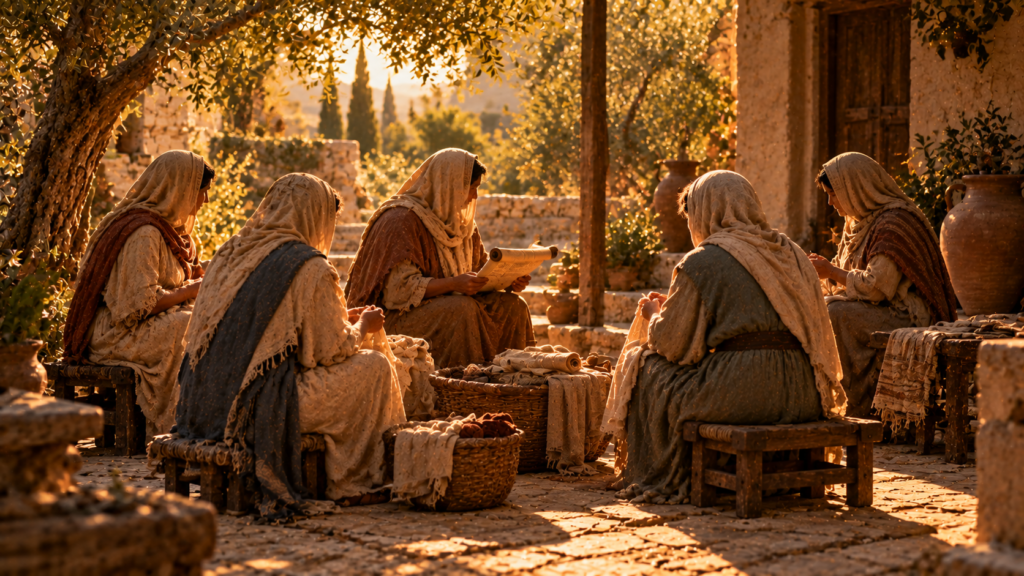
1 Timothy 5 is the letter’s household-care chapter, the most institutionally practical of the six. It works through three concentric layers of the church’s internal life: how Timothy relates to the various age-and-gender groups in the assembly (verses 1-2), how the community cares for its widows and enforces family-provision responsibilities (verses 3-16), and how the eldership is honored, disciplined, and preserved (verses 17-25). Between these movements the chapter also gives one of the New Testament’s most disputed personal instructions, the little wine recommendation to Timothy for his stomach’s sake (5:23), which sits inside the larger charge to keep yourself pure against premature ordination.
The chapter has three movements. The first (verses 1-2) is a short but pointed instruction on age-and-gender-appropriate pastoral care: elders as fathers, younger men as brothers, elder women as mothers, younger women as sisters in all purity. The second (verses 3-16) is the widows’ section, the New Testament’s most detailed passage on this topic, distinguishing widows indeed from other categories, defining family-provision responsibilities, and giving the enrollment criteria for the widows’ order that will develop in the second-century church. The third (verses 17-25) is the elders’ section, covering double honor for those who labor in the word, the biblical warrant for paying elders (the ox-muzzle citation plus a Jesus-logion), the two-witness rule for accusations, the discipline procedure, the ordination caution, the personal wine instruction, and the closing observation about visible and hidden sins.
The chapter’s connecting logic is the household of God, cared for like an actual household. If the church is the household of God, the pillar and ground of the truth (3:15), then it operates by the same care ethics that would run a well-managed Greco-Roman household: the elders are honored the way a father would be honored, the younger members are treated with age-and-gender-appropriate respect, the widows are cared for according to ecclesial and familial responsibilities, and the leadership is disciplined transparently rather than protected. The chapter is not merely rules; it is what it looks like when a church takes its own household-metaphor seriously.
A · 1 Timothy 5:1-2 · Age-and-gender-appropriate pastoral care
¹ Don’t rebuke an older man, but exhort him as a father; the younger men as brothers; ² the elder women as mothers; the younger as sisters, in all purity. (1 Timothy 5:1-2, World English Bible)
- Don’t rebuke an older man, but exhort him as a father; the younger men as brothers; the elder women as mothers; the younger as sisters, in all purity (verses 1-2). The chapter opens with a compressed pastoral-relations framework, organized by age and gender. Four groups are named. Older men (presbyterō, the same term used later for the office of elder in verses 17-19; here used in the demographic sense) are to be exhorted as fathers, not rebuked (mē epiplēxēs, “do not strike down verbally”). Younger men (neōterous) as brothers. Elder women (presbyteras, plural feminine of the same root) as mothers. Younger women (neōteras) as sisters, with the crucial qualifier in all purity (en pasē hagneiā).
The verses do three specific things. First, they relocate the delegate’s authority into a family-metaphor rather than a hierarchical-power register: the delegate is not a boss over the congregation but a son, brother, or brother to its various members. Second, they name age-and-gender-appropriate conduct: an older man is treated with the deference due a father (even when he is being corrected), and a younger woman is treated with the chastity-marked care due a sister. Third, the closing in all purity qualifier is doing pastoral work: the young male delegate’s relationships with the younger women of the congregation are the specific risk point the verse names. Timothy is being warned that pastoral care of young women requires specific vigilance about the appearance and reality of purity, because both his ministry and their reputations are at stake. The verse’s application to contemporary male pastoral ministry is direct.
Word study: the family-metaphor pastoral vocabulary (1 Tim 5:1-2)
The Pauline corpus consistently deploys fictive-kinship vocabulary for the church’s internal relationships. Adelphoi (“brothers”) is the standard address to the whole congregation across every Pauline letter. Timothy is teknon (“child”) to Paul (1 Tim 1:2, 2 Tim 1:2, 2 Tim 2:1); Titus is likewise (Titus 1:4). Onesimus is Paul’s child (Phlm 10). The Pauline mission calls itself the household of faith (Gal 6:10), the household of God (1 Tim 3:15), and the family from whom every family is named (Eph 3:15). This vocabulary is strong in its social-ethical implications. In Greco-Roman society, family relationships carried the strongest obligations: economic support, political loyalty, honor-defense, care in illness, provision at death. The Pauline appropriation of family language for the church’s internal relationships transferred those actual obligations onto the assembly. The chapter’s opening verses are therefore not sentimental family-language; they are naming the actual ethical weight that Timothy is to carry in his pastoral relationships with the congregation. The older man is a father, and Timothy owes him the honor due a father. The younger woman is a sister, and Timothy is obligated to her the same chaste protective care due a sister in a first-century household. The verse is high-stakes ethics under the family-metaphor umbrella.
B · 1 Timothy 5:3-16 · The widows’ order and family provision
³ Honor widows who are widows indeed. ⁴ But if any widow has children or grandchildren, let them learn first to show piety toward their own family and to repay their parents, for this is acceptable in the sight of God. ⁵ Now she who is a widow indeed and desolate, has her hope set on God and continues in petitions and prayers night and day. ⁶ But she who gives herself to pleasure is dead while she lives. ⁷ Also command these things, that they may be without reproach. ⁸ But if anyone doesn’t provide for his own, and especially his own household, he has denied the faith and is worse than an unbeliever.
⁹ Let no one be enrolled as a widow under sixty years old, having been the wife of one man, ¹⁰ being approved by good works, if she has brought up children, if she has been hospitable to strangers, if she has washed the saints’ feet, if she has relieved the afflicted, and if she has diligently followed every good work. ¹¹ But refuse younger widows, for when they have grown wanton against Christ, they desire to marry, ¹² having condemnation, because they have rejected their first pledge. ¹³ Besides, they also learn to be idle, going about from house to house. Not only idle, but also gossips and busybodies, saying things which they ought not. ¹⁴ I desire therefore that the younger widows marry, bear children, rule the household, and give no occasion to the adversary for insulting. ¹⁵ For already some have turned away after Satan. ¹⁶ If any man or woman who believes has widows, let them relieve them, and don’t let the assembly be burdened, that it might relieve those who are widows indeed. (1 Timothy 5:3-16, World English Bible)
- Honor widows who are widows indeed (verse 3). The section opens with the imperative tima (“honor”), the same verb used in the Decalogue’s honor your father and mother (Exod 20:12, Deut 5:16). In Greek usage, timaō carries a dual sense: honor in the relational-respect sense, and support materially (as in Matt 15:5-6’s Corban saying, where the honor owed to parents includes financial provision). Both senses are in play here. Widows indeed (tas ontōs chēras, “the widows who are really widows”) introduces the chapter’s categorization of widows into different subsets requiring different responses. The Greek ontōs (“really, truly”) means the widow whose situation actually is what the word signifies: without husband, without adult male family support, in need of the community’s provision. The verse’s implicit contrast is with other women called widow who may not be ontōs widows (women with adult children, women with resources, women whose remarriage is possible or expected).
- But if any widow has children or grandchildren, let them learn first to show piety toward their own family and to repay their parents, for this is acceptable in the sight of God (verse 4). The chapter’s first practical principle: family-provision responsibility. The verse’s grammar makes the children or grandchildren the subject of the learn first to show piety clause, not the widow herself. Show piety toward their own family (eusebein ton idion oikon, using the eusebeia root the letter loves): family-provision is a form of godliness. Repay their parents (amoibas apodidonai tois progonois, “give back reciprocal payment to their progenitors”): the reciprocity motif is culturally familiar; children whose parents raised them owe a reciprocal material provision when the parents grow old. The verse names this as acceptable in the sight of God. The Greek-cultural expectation and the biblical-ethical claim converge.
- Now she who is a widow indeed and desolate, has her hope set on God and continues in petitions and prayers night and day. But she who gives herself to pleasure is dead while she lives (verses 5-6). The verses further specify the ontōs widow. Desolate (memonōmenē, “left alone, isolated”): the widow without family. Has her hope set on God (ēlpiken epi ton theon): the widow whose religious posture is hopeful trust. Continues in petitions and prayers night and day (prosmenei tais deēsesin kai tais proseuchais nyktos kai hēmeras): the widow whose life is characterized by intercessory prayer. The verse’s picture is of Anna the prophetess (Luke 2:36-38, never left the temple, worshiping with fasting and prayers night and day), and the widows’ order of the second-century church would take Anna as its patron and model. The counter-portrait in verse 6: she who gives herself to pleasure (hē spatalōsa, “the woman living luxuriously”), is dead while she lives. The verse’s severity is real: a widow who has chosen a life of self-indulgence has, on the chapter’s terms, died to the ministry of the widows, even while biologically alive. The verse targets not the widow who accepts remarriage or ordinary comforts, but the widow whose life has been reoriented around self-indulgence rather than around the widows’ ministry of prayer and service.
- Also command these things, that they may be without reproach. But if anyone doesn’t provide for his own, and especially his own household, he has denied the faith and is worse than an unbeliever (verses 7-8). Verse 8 is one of the chapter’s most-quoted single verses, and it carries broad application. If anyone doesn’t provide for his own (ei de tis tōn idiōn kai malista oikeiōn ou pronoei, “if anyone does not provide for his own, especially those of his own household”). The Greek pronoeō (“to think ahead for, to make provision for”) names anticipatory provision, not just responsive care. He has denied the faith and is worse than an unbeliever. The verse’s severity is real: refusal of family provision is treated as practical apostasy. The verse cannot be pressed into every direction (the specific historical situation is the widow’s family provision), but its underlying principle is clear: Christian discipleship is inseparable from family responsibility. A man whose theology is orthodox but whose parents are financially neglected has, on this verse’s terms, contradicted his own confession.
- Let no one be enrolled as a widow under sixty years old, having been the wife of one man, being approved by good works, if she has brought up children, if she has been hospitable to strangers, if she has washed the saints’ feet, if she has relieved the afflicted, and if she has diligently followed every good work (verses 9-10). The verses give the enrollment criteria for what appears to be a recognized widows’ order in the Ephesian church. Let no one be enrolled (chēra katalegesthō, “let a widow be listed/enrolled”): the Greek katalegō is a technical term for entering on a list, and it presupposes a formal register of widows the church supports and recognizes. Five criteria are named. At least sixty years old: the age threshold that placed the widow beyond the normal expectation of remarriage in the Greco-Roman world. Having been the wife of one man (henos andros gynē, the female parallel to the husband of one wife of 3:2 and 3:12): the same character-language about marital faithfulness. Approved by good works: her fruit has been visible. Brought up children: her domestic vocation has been fulfilled. Hospitable to strangers: she has practiced the essential missional-Christian virtue. Washed the saints’ feet: the specific hospitality-and-service act (John 13:14; Luke 7:44) that marked care for traveling believers. Relieved the afflicted: she has cared for those in distress. Diligently followed every good work: her whole life is characterized by good works. The five criteria are more stringent than the deacon or overseer requirements in some ways, and they define the widows’ order as a ministering ecclesial category, not merely a dependent category.
Influence callout: Nijay K. Gupta on the widows’ order as recognized ministry (1 Tim 5:9-10)
Gupta’s Tell Her Story documents the widows’ order as one of the earliest and most robust women’s ministerial offices in the New Testament and early church. The enrollment criteria of verses 9-10 read as ministerial qualifications, not merely as care-eligibility criteria. The widow enrolled was expected to serve the church through her ministry of prayer (verses 5-6), her hospitality, her care for the afflicted, and her good works. The second-century Christian literature (Ignatius of Antioch, Apostolic Tradition of Hippolytus, the Didascalia Apostolorum) documents the widows’ order as a functioning ecclesial category with recognized ministry roles: intercessory prayer for the church, catechesis of women baptismal candidates, care for the sick and dying, hospitality to travelers, teaching of the younger women. Gupta reads 1 Tim 5:9-10 as documenting the earliest formal establishment of this order, and the chapter’s careful criteria (the sixty-year threshold, the marital-faithfulness requirement, the good-works test) as the church’s early attempt to distinguish the ministering widow from the widow-in-need-of-support. The two categories overlap in some ways and diverge in others; the enrolled widow is a worker in the church’s ministry, not merely a recipient of the church’s care. See women in ministry and leadership.
- But refuse younger widows, for when they have grown wanton against Christ, they desire to marry, having condemnation, because they have rejected their first pledge. Besides, they also learn to be idle, going about from house to house. Not only idle, but also gossips and busybodies, saying things which they ought not. I desire therefore that the younger widows marry, bear children, rule the household, and give no occasion to the adversary for insulting. For already some have turned away after Satan (verses 11-15). The chapter turns to the younger widows, and the tone is severe. The Greek neōteras de chēras paraitou (“but refuse younger widows”): the verb paraitou names decline to enroll, not refuse to help. The rejection is of enrollment in the widows’ order, not of pastoral care. The reasons: younger widows grow wanton (katastrēniasōsin, “become sexually restless”) against Christ (having, at their enrollment, committed to a widowhood-vocation that their youth cannot sustain); they desire to marry (which, having pledged themselves to the widows’ vocation, they can only fulfill by rejecting their pledge); they learn to be idle; and they become gossips and busybodies (phlyaroi kai periergoi, “chatterers and meddlers”), saying things which they ought not (perhaps disseminating the false teaching the letter has been fighting). Paul’s pastoral prescription: the younger widows should marry, bear children, rule the household (oikodespotein, “be the mistress of the house”), and give no occasion to the adversary. The chapter is not denying the younger widow’s dignity or personhood; it is naming the specific vulnerability of young widowhood in the ancient world and providing a stable social path through remarriage and household leadership.
- If any man or woman who believes has widows, let them relieve them, and don’t let the assembly be burdened, that it might relieve those who are widows indeed (verse 16). The section closes by restating the family-provision principle of verse 4 more broadly. Any believer, male or female, who has widows in their extended family is to relieve them (eparkeitō, “provide sufficient aid”) privately, so that the assembly’s limited resources can go to the widows indeed who have no family support. The chapter’s logic is concentric responsibility: family-first, then church. The church is not the primary welfare provider; it is the secondary provider when family provision is not available.
C · 1 Timothy 5:17-25 · The elders’ honor, discipline, and preservation
¹⁷ Let the elders who rule well be counted worthy of double honor, especially those who labor in the word and in teaching. ¹⁸ For the Scripture says, “You shall not muzzle the ox when it treads out the grain.” And, “The laborer is worthy of his wages.”
¹⁹ Don’t receive an accusation against an elder except at the word of two or three witnesses. ²⁰ Those who sin, reprove in the sight of all, that the rest also may be in fear. ²¹ I command you in the sight of God, and the Lord Jesus Christ, and the chosen angels, that you observe these things without prejudice, doing nothing by partiality. ²² Lay hands hastily on no one. Don’t be a participant in other people’s sins. Keep yourself pure.
²³ Be no longer a drinker of water only, but use a little wine for your stomach’s sake and your frequent infirmities.
²⁴ Some men’s sins are evident, preceding them to judgment, and some also follow later. ²⁵ In the same way also there are good works that are obvious, and those that are otherwise can’t be hidden. (1 Timothy 5:17-25, World English Bible)

- Let the elders who rule well be counted worthy of double honor, especially those who labor in the word and in teaching (verse 17). The chapter turns to the elders (the same presbyteroi office of chapter 3’s overseer qualifications, here in its plural collective sense). Rule well (kalōs proestōtes, “leading nobly”): the same lead-nobly verb used of the overseer’s household management in 3:4. Double honor (diplēs timēs, “twofold honor”). The double honor has been read variously: (a) both respect and material provision (drawing on the timaō dual sense), (b) both the general honor due elders and additional honor for those who preach and teach, (c) literal doubled financial compensation. The following verse’s citations (the ox-muzzle Torah citation, plus what appears to be a Jesus-logion about the laborer’s wages) strongly suggest that material provision (specifically, financial support) is at least part of what double honor names. The verse’s especially those who labor in the word and in teaching (malista hoi kopiōntes en logō kai didaskaliā) suggests a distinction within the eldership: some elders bear primarily general oversight, while some bear the specific labor of word-and-teaching, and the latter receive specific additional honor (probably meaning financial compensation, given verse 18’s citations).
- For the Scripture says, “You shall not muzzle the ox when it treads out the grain.” And, “The laborer is worthy of his wages” (verse 18). The chapter’s citation-warrant for elder-compensation. The first citation is Deuteronomy 25:4, don’t muzzle the ox when he treads out the grain, the Torah command that Paul had already applied to apostolic-worker compensation in 1 Cor 9:9 (is it for the oxen that God cares? Or does he say it altogether for our sake?). The second citation, the laborer is worthy of his wages, is the Jesus-logion preserved in Luke 10:7 (and paralleled in Matthew 10:10 in a slightly different form). Notably, Paul introduces both citations with the same formula (legei gar hē graphē, “for the Scripture says”), which is significant: the second citation is being treated as Scripture alongside a Torah citation. This is one of the earliest documented instances of a Jesus-saying being cited as Scripture within the New Testament itself, and the verse has been read across critical scholarship as significant evidence for the authority-status of Jesus-tradition in the earliest Christian communities. The verse’s practical point: the elder who labors in word and teaching is to be materially compensated by the community he serves.
- Don’t receive an accusation against an elder except at the word of two or three witnesses. Those who sin, reprove in the sight of all, that the rest also may be in fear (verses 19-20). The chapter’s elder-discipline procedure. The two-or-three-witnesses requirement is from Deuteronomy 19:15 (also cited by Jesus at Matt 18:16 and by Paul at 2 Cor 13:1). Elders are protected from single-witness accusations, which in the ancient world could easily be malicious. But the corresponding severity is real: elders who actually sin (tous hamartanontas, present participle, ongoing sin that has been established) are to be reproved in the sight of all (enōpion pantōn elenche, “convict in the presence of everyone”). The public character of the discipline is deliberate; the elder’s public standing requires public correction when he falls, so that the rest also may be in fear (hina kai hoi loipoi phobon echōsi): the public discipline serves the deterrent function for the remaining eldership. The verse’s balance of protection from accusation and severity of public discipline is careful; the contemporary church has often failed both sides simultaneously (protecting elders from any accountability while failing to publicly discipline elders who are accused with credible evidence).
- I command you in the sight of God, and the Lord Jesus Christ, and the chosen angels, that you observe these things without prejudice, doing nothing by partiality (verse 21). The verse names the cosmic-witness character of the discipline. In the sight of God, and the Lord Jesus Christ, and the chosen angels (enōpion tou theou kai Christou Iēsou kai tōn eklektōn angelōn): the three-fold witness list is striking. The chosen angels (probably the elect angels of the divine council; cf. Deut 32:8) are named alongside the Father and Son as observers of Timothy’s disciplinary decisions. Without prejudice (chōris prokrimatos, “without prejudgment”) and doing nothing by partiality (mēden poiōn kata prosklisin, “doing nothing by favoritism”). The verse warns against the two directions of misdiscipline: prejudging the accused elder (finding them guilty before hearing) and favoritism toward the accused elder (protecting them from accountability because of relationship, prestige, or shared history). Both are named as cosmic-witness failures.
- Lay hands hastily on no one. Don’t be a participant in other people’s sins. Keep yourself pure (verse 22). The verse names the ordination discipline. Lay hands hastily on no one (cheiras tacheōs mēdeni epitithei): the delegate is warned against quick ordination of candidates who have not been thoroughly tested (echoing the first be tested requirement of 3:10). Don’t be a participant in other people’s sins (mēde koinōnei hamartiais allotriais, “do not share in others’ sins”): the hasty ordainer becomes complicit in the sins the insufficiently-tested ordinand later commits. The verse’s keep yourself pure (seauton hagnon tērei) closes the section with the personal purity charge that will return at 6:11-14. The verse’s contemporary application is direct: rushed ordination, unaccountable elevation, and the ordination of unqualified candidates is treated by the chapter as a shared sin between the ordainer and the ordained.
- Be no longer a drinker of water only, but use a little wine for your stomach’s sake and your frequent infirmities (verse 23). The chapter’s most personally addressed verse, and one of the New Testament’s most situationally specific pastoral instructions. Timothy has apparently been a water-only drinker, perhaps in overreaction to the ascetic vs anti-ascetic debates the letter has been fighting, or perhaps as a general ascetic-personal-discipline choice. Paul instructs him to stop being a water-only drinker and to use a little wine (oligō oinō chrō, “use a small amount of wine”) for your stomach’s sake and your frequent infirmities (stomachon kai tas pyknas sou astheneias, “stomach and your frequent illnesses”). The verse is strictly medical: wine, in the first-century medical tradition (Hippocratic corpus, Galen), was standard treatment for digestive complaints and water impurity (the local Ephesian water supply was likely often contaminated). The verse is neither a general endorsement of wine consumption nor a general prohibition of it; it is a specific medical instruction to a specific person for a specific condition. The verse’s misuse in both directions (as license for excess drinking, or as biblical-teetotal warrant) misses the situated pastoral care the verse actually models.
- Some men’s sins are evident, preceding them to judgment, and some also follow later. In the same way also there are good works that are obvious, and those that are otherwise can’t be hidden (verses 24-25). The chapter closes with a compressed observation about the visibility of sins and good works. Some sins are obvious (prodēloi, “visible ahead of time”) and go before the sinner to judgment; other sins are hidden and follow later. The same holds for good works: some are obvious, others hidden, but the hidden good works cannot ultimately be hidden (krybēnai ou dynatai). The verse likely returns to the elder discipline concern of verses 17-22: some candidates for ordination will have obvious qualifications or obvious disqualifications; others’ character will only be revealed over time. The pastoral instruction is patience in assessment, and the theological ground is that nothing hidden will remain hidden (echoing Jesus at Matt 10:26, Mark 4:22, Luke 8:17, 12:2).
Pushback note: the misuse of the “little wine” verse (1 Tim 5:23)
The verse has been badly used in two opposing directions across Christian history. First, the teetotal-prohibitionist reading has taken the verse’s little wine qualifier as evidence that all wine consumption is otherwise prohibited and that Paul’s instruction is reluctant medical exception to a general rule. This reading has no basis in the verse itself, which contains no such prohibition, and it contradicts the broader biblical picture of wine (Ps 104:15’s wine to gladden the heart, Jesus’ first miracle at Cana, the Passover cup used at the Last Supper, Paul’s own multiple positive mentions of wine including 1 Tim 3:8’s not addicted to much wine for deacons, which presupposes moderate consumption). Second, the license-to-drink-freely reading has taken the verse as a general endorsement of wine consumption that overrides other cautions. This too misses the mark; the verse’s little qualifier and its medical situational context specify moderate use for a specific health condition, not general beverage-preference. The verse is doing what pastoral care does: it addresses a specific person in a specific situation with a specific instruction that would not necessarily apply the same way to another person in another situation. The verse is not a universal principle; it is a situational pastoral care moment. The verse’s actual application to the contemporary church is the pattern it models, care that is specific, personal, medical when needed, and unafraid to instruct the person contrary to their prior ascetic default when their body’s need warrants it.
Pre-modern callout: John Chrysostom on the widows’ order (Homily 14 on 1 Timothy)
Chrysostom’s fourteenth homily on 1 Timothy treats the widows’ section extensively and is worth naming for two contributions. First, Chrysostom takes the enrollment criteria of verses 9-10 as evidence for the high dignity of the widows’ order in the ancient church. His congregation in Antioch had an enrolled widows’ order in his day (late fourth century), and he presses his hearers to support the widows generously both through direct family provision (verse 4’s principle) and through the church’s collection (verses 3, 16). Second, Chrysostom notes the sober realism of Paul’s treatment of the younger widows (verses 11-15). The chapter’s severity toward the younger widows who reject their first pledge is not, on Chrysostom’s reading, misogyny or generational contempt; it is the honest recognition that making pledges the pledger cannot keep damages both the pledger and the community. The chapter’s pastoral prescription (marry, bear children, rule the household) is on Chrysostom’s reading a positive vocation-offering to the younger widow, not a demotion from ministerial dignity. The lane reads with Chrysostom’s balanced treatment: the widows’ order is high dignity, and the pastoral care for younger widows is honest realism rather than restrictive gender-role imposition.
Reflection prompts
- Verse 8’s if anyone doesn’t provide for his own, he has denied the faith and is worse than an unbeliever names family provision as practical apostasy when neglected. Where in your own life or community is biblical-doctrine confession coexisting with unaddressed family responsibility? What would it look like to align them?
- The chapter’s widows’ order (verses 9-10) is a recognized ministerial category, not merely a welfare recipient category. Where in your own church are older women (widowed, single, or otherwise) whose ministry gifts are being underrecognized? What would it look like to give them the ecclesial standing the chapter models?
- Verses 17-22’s elder discipline protocol requires two-or-three witnesses for accusation, public reproof for confirmed sin, and no favoritism. Which side of the balance is your current church more likely to fail: protecting elders from any accountability or rushing to accusation without due process? What would recovering the balanced discipline look like?
- Verse 23’s little wine for your stomach’s sake is situationally specific pastoral care. Where in your own life have you defaulted to a rigid rule (either ascetic prohibition or self-permissive license) instead of specific, situated, wise care for a particular body and a particular circumstance?