Exodus 26 is the chapter that gives the architectural specifications for the tabernacle structure itself. Where chapter 25 described the furniture (ark, table, lampstand), chapter 26 describes the building: the curtains, the coverings, the wooden frames, the silver bases, and the veil that separates the holy place from the most holy place. The chapter is dense with measurement, materials, and joinery. Read at speed, the chapter feels like a construction manual. Read with attention, the chapter is a theological geometry: every dimension and every material is doing typological work.
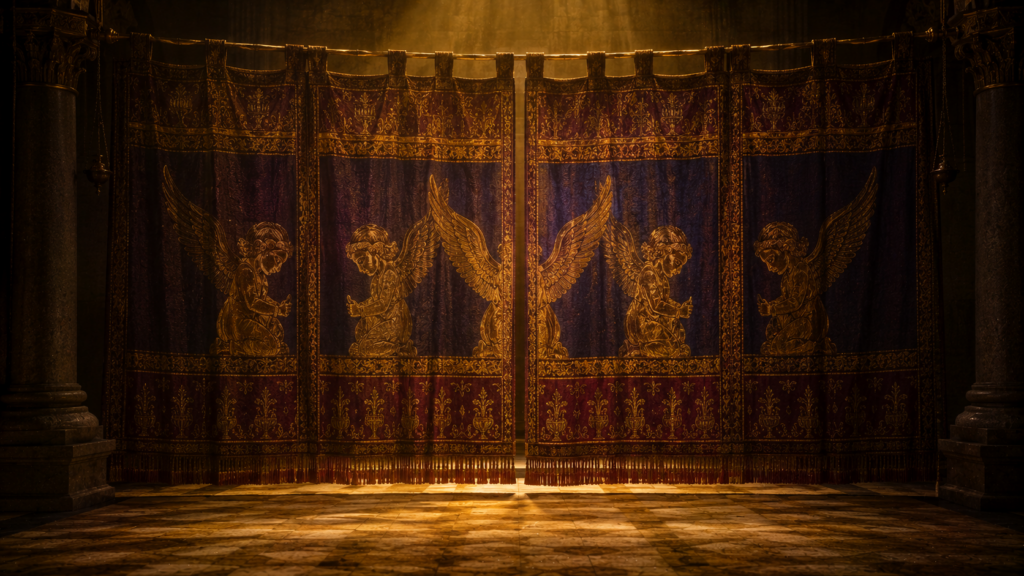
Three details give the chapter its weight. First, the cherubim woven into the inner curtains. The tabernacle’s inner space is, on its very walls, a garden of cherubim. Israel walks into a sanctuary whose decoration is the same creatures who guard the way to Eden’s tree. The chapter is staging the tabernacle as Eden re-entered (see The tabernacle as cosmic temple). Second, the four layers of covering. Inner linen with cherubim, then goats’ hair, then ram skins dyed red, then the outer tachashim hides. The architecture is layered: the closer to the holy of holies, the more precious and intricate; the closer to the outside world, the more durable and weatherproof. Third, the veil. Verse 31 introduces the parochet: the dividing curtain between the holy place and the most holy place. The veil is woven of the same blue, purple, scarlet, and fine linen as the inner curtains, with cherubim woven into it. The veil is the visible boundary of the most holy. The same veil will be torn from top to bottom at Mt 27:51 the moment Christ dies on the cross. The chapter is establishing the geography of holiness that the New Testament will fulfill.
A · Exodus 26:1-14 · The four coverings of the tabernacle
¹ “Moreover you shall make the tabernacle with ten curtains; of fine twined linen, blue, purple, and scarlet, with cherubim. The work of the skillful workman you shall make them. ² The length of each curtain shall be twenty-eight cubits, and the width of each curtain four cubits: all the curtains shall have one measure. ³ Five curtains shall be coupled together to one another; and the other five curtains shall be coupled to one another. ⁴ You shall make loops of blue on the edge of the one curtain from the edge in the coupling; and likewise you shall make in the edge of the curtain that is outermost in the second coupling. ⁵ You shall make fifty loops in the one curtain, and you shall make fifty loops in the edge of the curtain that is in the second coupling. The loops shall be opposite to one another. ⁶ You shall make fifty clasps of gold, and couple the curtains to one another with the clasps; and the tabernacle shall be a unit. ⁷ “You shall make curtains of goats’ hair for a covering over the tabernacle. You shall make eleven curtains. ⁸ The length of each curtain shall be thirty cubits, and the width of each curtain four cubits: the eleven curtains shall have one measure. ⁹ You shall couple five curtains by themselves, and six curtains by themselves, and shall double over the sixth curtain in the front of the tent. ¹⁰ You shall make fifty loops on the edge of the one curtain that is outermost in the coupling, and fifty loops on the edge of the curtain which is outermost in the second coupling. ¹¹ “You shall make fifty clasps of brass, put the clasps into the loops, and couple the tent together, that it may be one. ¹² The overhanging part that remains of the curtains of the tent, the half curtain that remains, shall hang over the back of the tabernacle. ¹³ The cubit on the one side, and the cubit on the other side, of that which remains in the length of the curtains of the tent, shall hang over the sides of the tabernacle on this side and on that side, to cover it. ¹⁴ You shall make a covering for the tent of rams’ skins dyed red, and a covering of sea cow hides above.
- Moreover you shall make the tabernacle with ten curtains; of fine twined linen, blue, purple, and scarlet, with cherubim. The Hebrew is eseh ha-mishkan eser yeri’ot. The innermost layer of the tabernacle is ten curtains, woven of fine twined linen dyed in the three royal-priestly colors: blue, purple, and scarlet. The cherubim are woven into the curtains. The whole inner space of the tabernacle is, on its very walls, a garden of cherubim. Solomon’s reading: the cherubim woven into the curtains echo the cherubim guarding Eden’s tree (Gen 3:24). The tabernacle’s inner space is the re-entry into Eden that Genesis 3 closed off. See The tabernacle as cosmic temple.
- The work of the skillful workman. The Hebrew is ma’aseh choshev. Choshev names the artistically-trained craftsman: skilled in design and execution. The chapter is establishing that the tabernacle is the work of the most skilled artisans Israel has. Bezalel and Oholiab will be named in chapter 31 as the principal craftsmen, filled with the Spirit of God. The whole later Hebrew Bible’s vocabulary of artistic excellence in service of YHWH starts here.
- Five curtains shall be coupled together to one another; and the other five curtains shall be coupled to one another. The ten curtains are joined into two sets of five. The geometry is precise: each curtain is 28 cubits long by 4 cubits wide; the two sets are joined with fifty gold clasps making the tabernacle’s interior covering 40 cubits by 28 cubits. The mathematical specifications are detailed throughout the chapter. Goldingay’s pastoral note: the chapter’s painstaking measurements are themselves part of the theology. YHWH’s dwelling-place is precisely specified. Nothing is left to improvisation.
- You shall make curtains of goats’ hair for a covering over the tabernacle. You shall make eleven curtains. The second layer of the tabernacle is goats’ hair: a black, durable, weatherproof material commonly used for ANE Bedouin tents. The eleven curtains (one more than the inner ten) overlap and cover the joining-line of the inner curtains. The geometry is precise.
- You shall make a covering for the tent of rams’ skins dyed red, and a covering of sea cow hides above. The third and fourth layers are rams’ skins dyed red and sea cow hides. Four layers total: linen-with-cherubim (innermost), goats’ hair, red ram skins, and tachashim hides (outermost). The architecture is, from inside to outside, increasingly weatherproof and decreasingly precious. The geography is theology: the most precious materials face inward, toward the most holy place; the most durable face outward, toward the wilderness.
- The chapter is patient with detail. To the modern reader, the specifications are tedious. To the ANE reader, the specifications are praise. The detail is the chapter’s act of careful obedience: make it exactly as YHWH has shown. Every dimension is part of the tavnit (pattern) Moses was shown on the mountain.
Word study: yeri’ah (יְרִיעָה)
The Hebrew word yeri’ah names a curtain or tent-cloth: a large rectangular piece of woven fabric used as a wall or covering. The word appears repeatedly in the tabernacle chapters and gives the texture of how Israel’s first sanctuary is built. The tabernacle is, structurally, not a building of stone; it is a tent of curtains. The verb-root yara means to tremble, shake, fear (the same root, in different forms, gives Hebrew its words for fear and for curtain). Goldingay’s note on the underlying connection: a yeri’ah is something that moves with the wind. YHWH’s first sanctuary is built on the rhythm of curtains rippling in the desert breeze. The whole later Hebrew Bible’s image of God’s presence as something that moves (Pillar of cloud, John’s Spirit-as-wind) is in continuity with the architecture of the mishkan.
B · Exodus 26:15-30 · The acacia frames and the silver bases
¹⁵ “You shall make the boards for the tabernacle of acacia wood, standing up. ¹⁶ Ten cubits shall be the length of a board, and one and a half cubits the width of each board. ¹⁷ There shall be two tenons in each board, joined to one another: thus you shall make for all the boards of the tabernacle. ¹⁸ You shall make twenty boards for the tabernacle, for the south side southward. ¹⁹ You shall make forty sockets of silver under the twenty boards; two sockets under one board for its two tenons, and two sockets under another board for its two tenons. ²⁰ For the second side of the tabernacle, on the north side, twenty boards, ²¹ and their forty sockets of silver; two sockets under one board, and two sockets under another board. ²² For the far part of the tabernacle westward you shall make six boards. ²³ You shall make two boards for the corners of the tabernacle in the far part. ²⁴ They shall be double beneath, and in the same way they shall be whole to its top to one ring: thus shall it be for them both; they shall be for the two corners. ²⁵ There shall be eight boards, and their sockets of silver, sixteen sockets; two sockets under one board, and two sockets under another board. ²⁶ “You shall make bars of acacia wood: five for the boards of the one side of the tabernacle, ²⁷ and five bars for the boards of the other side of the tabernacle, and five bars for the boards of the side of the tabernacle, for the far part westward. ²⁸ The middle bar in the middle of the boards shall pass through from end to end. ²⁹ You shall overlay the boards with gold, and make their rings of gold for places for the bars. You shall overlay the bars with gold. ³⁰ You shall set up the tabernacle according to the way that it was shown to you on the mountain.
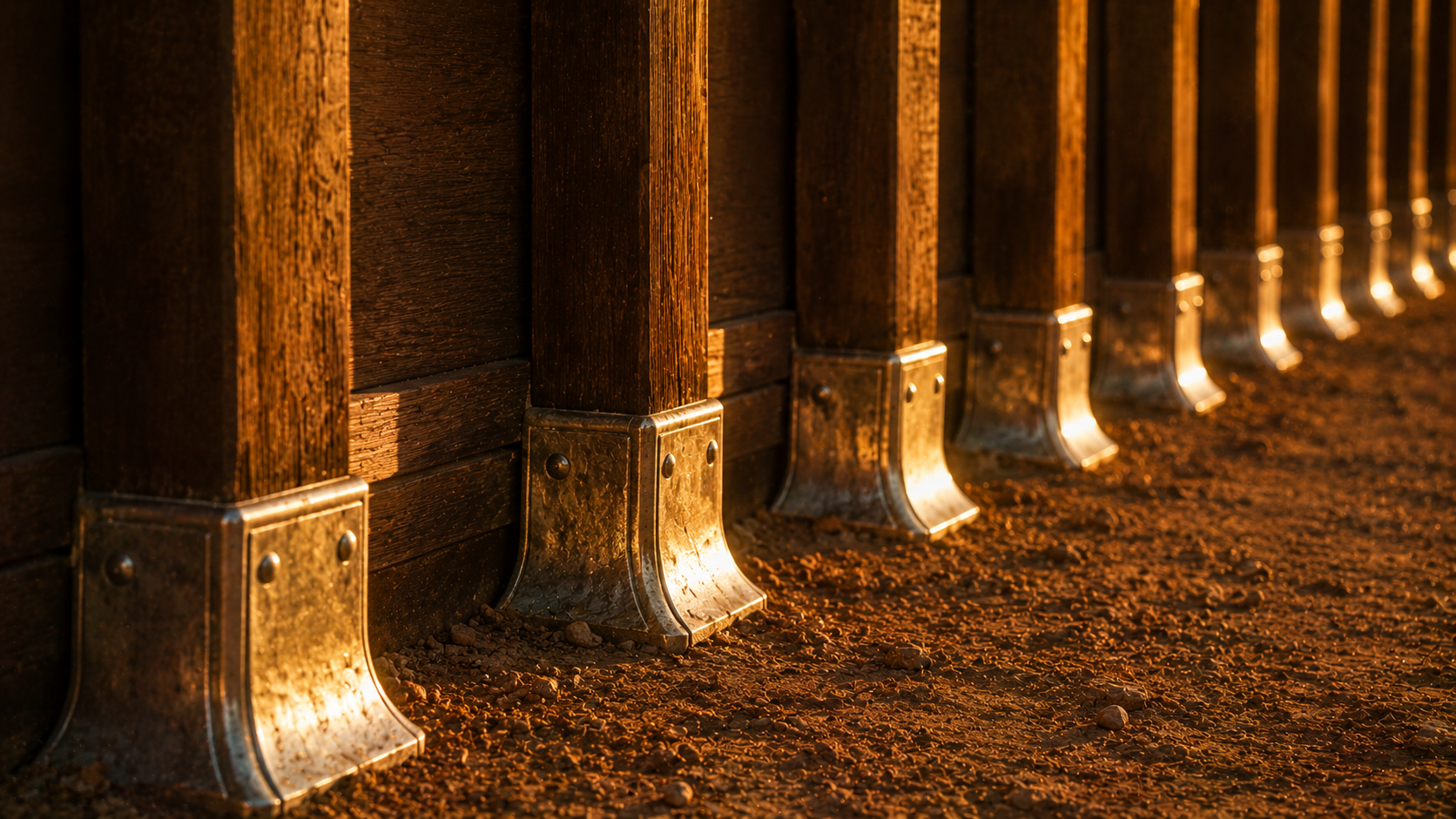
- You shall make the boards for the tabernacle of acacia wood, standing up. The Hebrew is qerashim atsey shittim omdim. The structural frame of the tabernacle is acacia boards standing upright. The same desert hardwood that made the ark is making the walls. The frame is local material; the gold overlay is precious. The geography of common-and-precious-together runs through the whole architecture.
- Ten cubits shall be the length of a board, and one and a half cubits the width of each board. The boards are 10 cubits tall (about 4.5 meters / 15 feet) and 1.5 cubits wide (about 0.7 meters / 2.25 feet). The tabernacle’s interior is therefore approximately 30 cubits long (north and south sides of 20 boards each at 1.5 cubits wide) by 10 cubits wide and 10 cubits tall. The Holy of Holies, separated by the veil at the back, is a 10x10x10 cube; the holy place in front is a 20x10x10 rectangle. The geometry is theological: the most holy place is a perfect cube. Solomon’s note: this same cubic geometry will recur in Solomon’s temple’s most holy place (1 Kgs 6:20) and in the new Jerusalem‘s descending cube of Rev 21:16. The shape is consistent across the canon.
- Forty sockets of silver under the twenty boards; two sockets under one board for its two tenons. The Hebrew is adney khesef. Silver bases are placed under each board. The silver came from the half-shekel atonement money the people will pay (Ex 30:11-16). Solomon’s reading: the tabernacle stands on atonement-silver. The whole structure literally rests on the redemption-payment of the people. The framework is theological: YHWH’s dwelling-place rests on the redemption of the people. The chapter’s structural geometry is also its theological geometry.
- You shall set up the tabernacle according to the way that it was shown to you on the mountain. The chapter restates the tavnit principle from chapter 25:9 and 25:40. The pattern is exact. Every detail of the construction is grounded in what Moses saw on the mountain. The tabernacle is the earthly copy of the heavenly pattern. Heb 8:5 will quote this exact verse.
C · Exodus 26:31-37 · The veil and the entrance
³¹ “You shall make a veil of blue, and purple, and scarlet, and fine twined linen, with cherubim. The work of the skillful workman shall it be made. ³² You shall hang it on four pillars of acacia overlaid with gold; their hooks shall be of gold, on four sockets of silver. ³³ You shall hang up the veil under the clasps, and shall bring the ark of the covenant in there within the veil. The veil shall separate the holy place from the most holy for you. ³⁴ You shall put the mercy seat on the ark of the covenant in the most holy place. ³⁵ You shall set the table outside the veil, and the lamp stand opposite the table on the side of the tabernacle toward the south. You shall put the table on the north side. ³⁶ “You shall make a screen for the door of the Tent, of blue, and purple, and scarlet, and fine twined linen, the work of the embroiderer. ³⁷ You shall make for the screen five pillars of acacia, and overlay them with gold. Their hooks shall be of gold. You shall cast five sockets of brass for them.
- You shall make a veil of blue, and purple, and scarlet, and fine twined linen, with cherubim. The Hebrew is parochet. The veil is the chapter’s most theologically loaded single object. It is woven of the same materials as the inner tabernacle curtains: blue, purple, scarlet, fine linen, with cherubim woven into the fabric. The veil is the visible boundary between the holy place and the most holy place. The cherubim woven into the veil are the same creatures who guarded Eden’s tree, and they are now standing at the threshold of the most holy.
- The veil shall separate the holy place from the most holy for you. The Hebrew is ve-hivdilah ha-parochet lakhem beyn ha-qodesh u-veyn qodesh ha-qodashim. The verb hivdil (to divide, separate, distinguish) is the same verb of Genesis 1: God divided the light from the darkness… God divided the waters which were under the firmament from the waters which were above. The chapter is using creation language to describe the veil’s function. The veil is a Genesis 1 separation in fabric form. The most holy place is set apart from the holy place the way light is set apart from darkness, the heavens from the earth.
- You shall bring the ark of the covenant in there within the veil. You shall put the mercy seat on the ark of the covenant in the most holy place. The geography is now complete. The most holy place contains the ark of the covenant (with the two tablets, eventually a jar of manna, and Aaron’s budded rod). On top of the ark is the kapporet (mercy seat), with the two cherubim spreading their wings over it. This is where YHWH meets Moses (Ex 25:22). Only the high priest will enter, once a year on the Day of Atonement (Yom Kippur, Lev 16). The Hebrew Bible’s most concentrated holy space is being defined.
- You shall set the table outside the veil, and the lamp stand opposite the table on the side of the tabernacle toward the south. You shall put the table on the north side. The holy place (outside the veil) contains the table (north side, with the bread of the presence) and the lampstand (south side, with the seven lamps). The chapter completes the spatial layout of the holy place’s interior.
- You shall make a screen for the door of the Tent. The Hebrew is masakh le-petach ha-ohel. A second curtain hangs at the entrance to the tabernacle (the eastern entrance, since the tabernacle faces east). This is the outer curtain that separates the holy place from the courtyard. Three layers of separation total: the courtyard from the world (outer fence), the holy place from the courtyard (the eastern entrance screen), and the most holy place from the holy place (the parochet).
- You shall make for the screen five pillars of acacia, and overlay them with gold… You shall cast five sockets of brass for them. The chapter ends with a small detail: the eastern-entrance screen’s pillars sit on bronze sockets (not silver). The structural geography is precise: as you move outward (away from the most holy place), the metals shift from gold to silver to bronze. The whole architecture is graded. The chapter’s geometry is the theological journey from the world inward to YHWH’s presence.
Influence callout: The torn veil at Mt 27:51 (Christological reading)
The chapter’s parochet will, fifteen hundred years later, become one of the New Testament’s most theologically loaded single objects. Mt 27:51, and behold, the veil of the temple was torn in two from the top to the bottom, names the moment Christ died. The veil that this chapter so carefully establishes (the boundary between the holy place and the most holy, woven with cherubim, sitting under the clasps that hold the inner curtains together) is torn open at the cross. The patristic and Reformation traditions both heard the chapter’s veil as the boundary that the cross unmakes. Heb 9-10 reads the veil-tearing explicitly as Christ’s body opening the way into the holy of holies. Heb 10:19-20: we have boldness to enter into the holy place by the blood of Jesus, by the way which he dedicated for us, a new and living way, through the veil, that is to say, his flesh. The whole chapter’s geography of holiness is, on the New Testament’s reading, the geography that Christ’s death undoes. The chapter is one of the canonical seeds of the New Testament’s direct access theology. The cherubim woven into the veil are the same cherubim woven into the way the cross redefines.
- The chapter ends. The tabernacle’s structure has been specified: ten curtains, eleven goats’ hair coverings, rams’ skins, tachashim hides, acacia frames, silver bases, gold overlays, the veil, the entrance screen. The next chapter will narrate the altar (the bronze altar of burnt offering, in the courtyard) and the court (the perimeter fence of the tabernacle complex). The whole sanctuary system is being constructed in painstaking detail. Each element will, in the New Testament’s reading, find its fulfillment in Christ.
Reflection prompts
- The cherubim woven into the curtains are the same creatures who guarded Eden’s tree. The chapter is staging the tabernacle as Eden re-entered. Where, in your own faith life, are you living as if the cherubim still blocked the way, when the chapter’s word is that the cherubim now frame the meeting place? What does it mean to enter rather than to stand outside?
- The tabernacle stands on silver bases. The whole structure rests on the half-shekel atonement money of the people. The framework is theological: YHWH’s dwelling-place rests on the redemption of the people. Where, in your own life, are you trying to build something that should rest on grace but you keep trying to build it on your own performance?
- The veil that separates the holy place from the most holy was torn from top to bottom at Mt 27:51. The chapter’s careful boundary is undone in the gospel’s center. Where, in your own faith life, are you still living as if the veil were intact when the New Testament’s word is that Christ has torn it open? What does direct access through Christ’s torn body actually look like in your prayer life?
Frameworks at play in this chapter: the tabernacle as cosmic temple.