Exodus 25 is the chapter where the tabernacle instructions begin. The book pivots. Everything before chapter 25 has been narrative; everything from chapter 25 to chapter 31 is construction-instruction. YHWH speaks to Moses on the mountain for forty days and gives, in seven divine speeches, the complete instructions for the tabernacle, its furnishings, the priestly garments, and the consecration ritual. The chapter is the first of the seven speeches.
The chapter has three parts. First, the freewill offering (vv. 1-9): every Israelite contributes the materials for the sanctuary from the heart, not by compulsion. Second, the ark of the covenant (vv. 10-22): the most holy object in the whole Hebrew Bible, the chest that will hold the two tablets, with two cherubim of beaten gold facing each other across its cover. Third, the table and the lampstand (vv. 23-40): the second and third pieces of furniture in the holy place, with detailed specifications.
Two themes run through. First, the chapter is teaching, in its opening verse (v. 8), the foundational claim of the whole tabernacle account: let them make me a sanctuary, that I may dwell among them. The Hebrew is ve-shakhanti be-tokham. Shakhan (dwell, settle) is the root of shekinah. YHWH is moving in. The kavod that settled on the mountain in the previous chapter is now going to settle in the mishkan (tabernacle, dwelling-place) of the camp. The whole later sanctuary tradition rests on this purpose-statement.
Second, the chapter is staging the tabernacle as cosmic temple (see The tabernacle as cosmic temple). The instructions deliberately echo Genesis 1-2: the tabernacle is being built as Eden re-entered, with cherubim guarding the way to the inside, the lampstand as a tree, the gold as the precious metal of Eden’s garden, and the seven divine speeches mirroring the seven days of creation. The chapter is the first of those seven speeches.
A · Exodus 25:1-9 · The freewill offering
¹ Yahweh spoke to Moses, saying, ² “Speak to the children of Israel, that they take an offering for me. From everyone whose heart makes him willing you shall take my offering. ³ This is the offering which you shall take from them: gold, silver, brass, ⁴ blue, purple, scarlet, fine linen, goats’ hair, ⁵ rams’ skins dyed red, sea cow hides, acacia wood, ⁶ oil for the light, spices for the anointing oil and for the sweet incense, ⁷ onyx stones, and stones to be set for the ephod and for the breastplate. ⁸ Let them make me a sanctuary, that I may dwell among them. ⁹ According to all that I show you, the pattern of the tabernacle, and the pattern of all of its furniture, even so you shall make it.
- YHWH spoke to Moses, saying. The Hebrew is vayedaber YHWH el-Mosheh lemor. This is the first of the seven divine speeches that structure the tabernacle account. The phrase YHWH spoke to Moses, saying will reappear at Ex 30:11; 30:17; 30:22; 30:34; 31:1; 31:12. Solomon’s structural reading: the seven divine speeches deliberately mirror the seven and God said statements of Genesis 1. The tabernacle is being constructed as creation in miniature. The chapter is the first divine speech of this new creation. See The tabernacle as cosmic temple.
- That they take an offering for me. From everyone whose heart makes him willing you shall take my offering. The Hebrew is me’et kol-ish asher yidvenu libo. The verb yidvenu libo (his heart will make willing) names voluntary, heart-driven offering. The Israelite tabernacle is to be built from what the people freely give, not from what is taxed or compelled. Goldingay’s note: the framework is foundational. YHWH’s dwelling-place among Israel will be built from Israelite generosity. The whole later Hebrew Bible’s grammar of terumah (heave-offering, freewill offering) starts here.
- Gold, silver, brass. The materials list is precise. Gold (the metal of Eden’s garden, Gen 2:11-12). Silver. Bronze (the alloy used for ANE construction). The metals will be used for different layers of the sanctuary: gold for the most holy interior, silver for transitional elements, bronze for the courtyard and outer altar. The geometry of increasing precious-ness as you move toward the holy of holies is built into the materials.
- Blue, purple, scarlet, fine linen, goats’ hair. The fabrics. Blue (tekhelet) is the dye derived from a Mediterranean sea-snail; purple (argaman) is the royal Tyrian dye; scarlet (shani) is from the kermes insect. All three were the most expensive ANE textile dyes, traditionally reserved for royal and priestly garments. Fine linen (the byssus of Egypt). Goats’ hair (for the outer covering). The chapter is, again, layering theology in materials. The interior fabrics of YHWH’s dwelling-place use the same dyes that would mark royal and priestly status across the ANE world. YHWH’s tabernacle is king-and-priest space.
- Rams’ skins dyed red, sea cow hides. The Hebrew orot tachashim is uncertain in translation; sea cow / dolphin / dugong / badger are all proposed. The hides are the outermost weatherproof layer of the tabernacle. The structure has multiple coverings: the inner curtains of fine linen with cherubim, then goats’ hair, then ram skins dyed red, then the tachashim skins. The layered architecture is part of the tabernacle’s symbolic geometry: the closer you get to the Holy of Holies, the more precious and intricate the material; the farther out you are, the more durable and weatherproof.
- Let them make me a sanctuary, that I may dwell among them. The Hebrew is ve-asu li miqdash, ve-shakhanti be-tokham. The chapter’s purpose-statement. Sanctuary is miqdash: holy place, sacred space. Dwell is shakhan. The whole later tradition of shekinah (divine dwelling-presence) flows from this verse. YHWH is moving into the camp. The whole point of the tabernacle is be-tokham: in their midst. God with the people, not God above the people from a distance.
- According to all that I show you, the pattern of the tabernacle. The Hebrew is be-khol asher ani mar’eh otkha et-tavnit ha-mishkan. Tavnit (pattern, plan, model) is the chapter’s third theologically loaded word. YHWH is showing Moses a pattern. Heb 8:5 will pick this up directly: they serve a copy and shadow of the heavenly things, even as Moses was warned by God when he was about to make the tabernacle: “See,” he said, “that you make everything according to the pattern that was shown you on the mountain.” The chapter’s tavnit is the seedbed of the New Testament’s heavenly tabernacle theology.
Word study: mishkan (מִשְׁכָּן)
The Hebrew word for the tabernacle is mishkan: literally, dwelling-place. It derives from shakhan (to dwell, settle, encamp). Note carefully: a mishkan is not a palace (a different Hebrew word, heykhal). It is a tent, a temporary structure, a moveable dwelling. The chapter is establishing that YHWH’s first sanctuary among Israel is a moveable tent. God will travel with the people. The same word shakhan gives us shekinah (the rabbinic-Jewish word for divine indwelling presence), and it is the verb John picks up at John 1:14: the Word became flesh and tabernacled (eskenosen) among us. The Hebrew Bible’s whole vocabulary of God dwelling among the people runs through the verb shakhan. The chapter is the verb’s first major occurrence in this technical sense.
B · Exodus 25:10-22 · The ark of the covenant
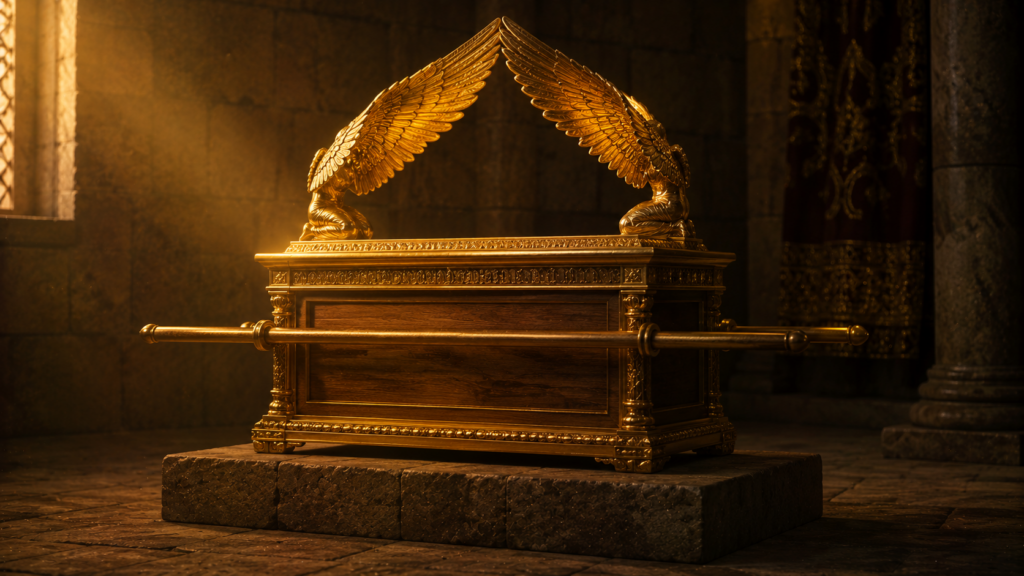
¹⁰ “They shall make an ark of acacia wood. Its length shall be two and a half cubits, its width a cubit and a half, and a cubit and a half its height. ¹¹ You shall overlay it with pure gold. You shall overlay it inside and outside, and you shall make a gold molding around it. ¹² You shall cast four rings of gold for it, and put them in its four feet. Two rings shall be on the one side of it, and two rings on the other side of it. ¹³ You shall make poles of acacia wood, and overlay them with gold. ¹⁴ You shall put the poles into the rings on the sides of the ark to carry the ark. ¹⁵ The poles shall be in the rings of the ark. They shall not be taken from it. ¹⁶ You shall put the covenant which I shall give you into the ark. ¹⁷ “You shall make a mercy seat of pure gold. Its length shall be two and a half cubits, and a cubit and a half its width. ¹⁸ You shall make two cherubim of hammered gold. You shall make them at the two ends of the mercy seat. ¹⁹ Make one cherub at the one end, and one cherub at the other end. You shall make the cherubim on its two ends of one piece with the mercy seat. ²⁰ The cherubim shall spread out their wings upward, covering the mercy seat with their wings, with their faces toward one another. The faces of the cherubim shall be toward the mercy seat. ²¹ You shall put the mercy seat on top of the ark, and in the ark you shall put the covenant that I will give you. ²² There I will meet with you, and I will tell you from above the mercy seat, from between the two cherubim which are on the ark of the covenant, all that I shall command you for the children of Israel.
- They shall make an ark of acacia wood… overlay it with pure gold. The Hebrew is aron atsey shittim. The ark is to be acacia wood overlaid with gold inside and outside. Acacia is the desert hardwood available in the Sinai peninsula; gold is the precious metal of Eden. The construction layers the local-and-available with the precious-and-set-apart. The Hebrew Bible’s later vocabulary for gold over wood will become a symbol of humanity overlaid with divinity: a typological reading the patristic tradition found in this construction.
- You shall put the covenant which I shall give you into the ark. The Hebrew is ve-natata el-ha-aron et ha-edut. Edut (testimony, witness, covenant document) names the two stone tablets. The ark is the covenant filing cabinet: the box that holds the formal covenant document. Imes’s reading: this is consistent with ANE suzerain-vassal treaty practice. The two duplicate copies of the treaty were stored together in the holiest place of the vassal’s land. The ark is precisely this storage. The chapter is establishing the aron ha-edut (chest of the testimony) as the central object of the whole sanctuary system.
- You shall make a mercy seat of pure gold. The Hebrew is kapporet zahav tahor. Kapporet derives from kipper (to cover, to atone). The English mercy seat is one tradition; atonement cover is more literal. The cover is the throne of YHWH’s presence in the holy of holies. From here YHWH will speak to Moses (v. 22). The kapporet will become the focal point of the Yom Kippur ritual (Lev 16, where the high priest sprinkles blood on the kapporet). Rom 3:25 will pick up the same word: Christ is hilastērion (the Greek translation of kapporet), the place of atonement.
- You shall make two cherubim of hammered gold. The Hebrew is shenayim keruvim zahav miqshah. The two cherubim, hammered from a single piece of gold with the kapporet, face each other with wings spread upward. The image is striking: the cherubim guard the way to the Tree of Life in Gen 3:24, and now they cover the mercy seat over the ark. The same creatures whose flaming sword blocked Eden are now spreading their wings over the kapporet. The reversal is theological. The cherubim now frame rather than block the way to the divine presence. Solomon’s reading (and Walton’s): the tabernacle is Eden re-entered. The cherubim’s posture has changed. See The tabernacle as cosmic temple.
- There I will meet with you. The Hebrew is ve-no’adti lekha sham. The verb yaad (to appoint, meet at an appointed place) is the same root as mo’ed (appointed time, festival, meeting). The ark’s kapporet is the appointed meeting-place. The whole later vocabulary of the ohel mo’ed (tent of meeting) is built from this root. YHWH does not promise to be everywhere in the camp; YHWH promises to meet Moses at this specific place, on top of this specific cover, between these specific cherubim. The chapter’s geography is precise.
Word study: kapporet (כַּפֹּרֶת)
The Hebrew word for the cover of the ark. Kapporet derives from kipper, the verb that means to cover, to atone, to make-amends-for. The word is rendered mercy seat in older English translations and atonement cover in newer ones. Both are partial. The kapporet is the place where atonement happens. The high priest will sprinkle the blood of the Yom Kippur sacrifice on this exact spot once a year (Lev 16). The whole later sacrificial system’s geometry rests on this verse: blood goes here, on the kapporet. Rom 3:25 picks up the Greek translation of kapporet, hilasterion, to name Christ: *whom God set forth to be a hilasterion through faith in his blood*. Christ is the kapporet; his blood is on the kapporet; the meeting between God and humanity happens over the cherubim-flanked place where blood is sprinkled. The chapter establishes the geography of atonement.
C · Exodus 25:23-40 · The table and the lampstand
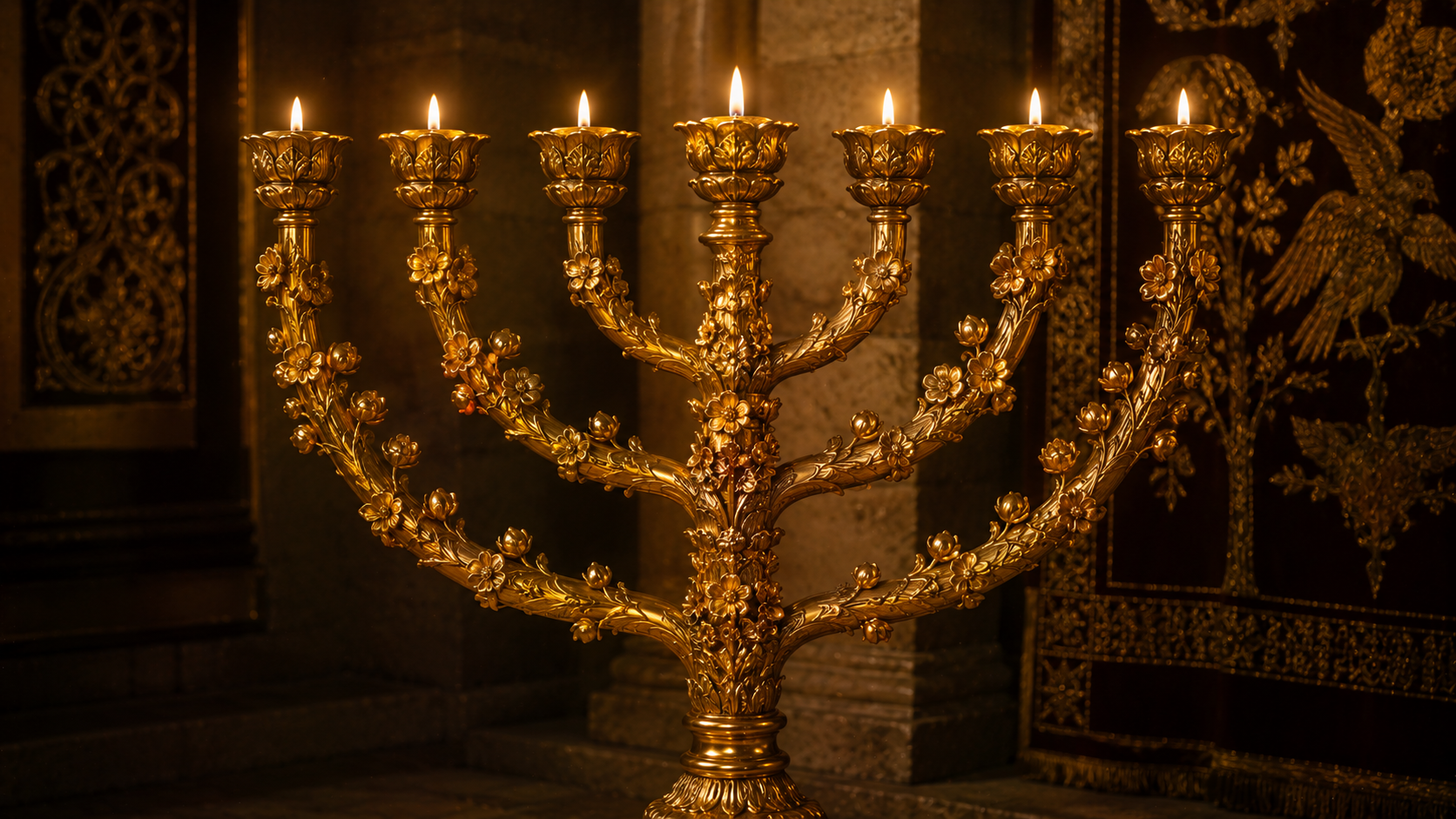
²³ “You shall make a table of acacia wood. Its length shall be two cubits, and its width a cubit, and its height one and a half cubits. ²⁴ You shall overlay it with pure gold, and make a gold molding around it. ²⁵ You shall make a rim of a hand width around it. You shall make a golden molding on its rim around it. ²⁶ You shall make four rings of gold for it, and put the rings in the four corners that are on its four feet. ²⁷ The rings shall be close to the rim, for places for the poles to carry the table. ²⁸ You shall make the poles of acacia wood, and overlay them with gold, that the table may be carried with them. ²⁹ You shall make its dishes, its spoons, its ladles, and its bowls to pour out offerings with. You shall make them of pure gold. ³⁰ You shall set bread of the presence on the table before me always. ³¹ “You shall make a lamp stand of pure gold. Of hammered work shall the lamp stand be made, even its base, its shaft, its cups, its buds, and its flowers, shall be of one piece with it. ³² There shall be six branches going out of its sides: three branches of the lamp stand out of its one side, and three branches of the lamp stand out of its other side; ³³ three cups made like almond blossoms in one branch, a bud and a flower; and three cups made like almond blossoms in the other branch, a bud and a flower, so for the six branches going out of the lamp stand; ³⁴ and in the lamp stand four cups made like almond blossoms, its buds and its flowers; ³⁵ and a bud under two branches of one piece with it, and a bud under two branches of one piece with it, and a bud under two branches of one piece with it, for the six branches going out of the lamp stand. ³⁶ Their buds and their branches shall be of one piece with it, all of it one beaten work of pure gold. ³⁷ You shall make its lamps seven, and they shall light its lamps to give light to the space in front of it. ³⁸ Its snuffers and its snuff dishes shall be of pure gold. ³⁹ It shall be made of a talent of pure gold, with all these accessories. ⁴⁰ See that you make them after their pattern, which has been shown to you on the mountain.
- A table of acacia wood… overlay it with pure gold. The chapter’s second piece of furniture is the shulchan (table). It will sit in the holy place, opposite the lampstand. The table holds the bread of the presence (lechem ha-panim, literally bread of the face).
- You shall set bread of the presence on the table before me always. The Hebrew is ve-natata al-ha-shulchan lechem panim le-fanay tamid. The bread of the presence is twelve loaves (one for each tribe; cf. Lev 24:5-9), set out fresh every Sabbath. The bread sits before YHWH’s face continuously. The image is one of constant communion-meal. YHWH’s people are continuously represented at the table in YHWH’s presence. The framework will reach the eucharist directly: the church’s communion bread is constantly before God’s face in continuous remembrance.
- You shall make a lamp stand of pure gold… three branches of the lamp stand out of its one side, and three branches of the lamp stand out of its other side… three cups made like almond blossoms. The Hebrew is menorat zahav tahor. The menorah: the chapter’s most iconic single piece of furniture. Seven lamps, six branches plus the central shaft, with almond-blossom cups, buds, and flowers. The whole structure is a tree. Walton’s reading: the menorah is a stylized tree of life. The lampstand-as-tree is a deliberate echo of Eden’s central tree (Gen 2:9). The holy place contains the table (the bread, representing the harvest of the land), the menorah (the tree-of-life, representing the cosmos’s source-of-life), and (in chapter 30) the altar of incense. The whole interior of the holy place is a miniature Eden.
- Its lamps seven. The Hebrew is shiv’ah nerot. Seven. The number of completion, the number of creation, the number of the divine speeches that structure this whole tabernacle account. The menorah’s seven lamps will burn continuously before the face of YHWH. The Hebrew Bible’s later imagery (Zech 4:2; Rev 1:12; Rev 4:5) will pick up the seven-lamp pattern as the seven Spirits before the throne.
- See that you make them after their pattern, which has been shown to you on the mountain. The Hebrew is u-r’eh va-aseh be-tavnitam asher-attah mar’eh ba-har. The chapter’s closing verse repeats the tavnit (pattern) language from v. 9. The construction is to be exact to what Moses has been shown. The chapter ends with the principle: the earthly tabernacle is the copy of a heavenly pattern. Heb 8:5 will quote this exact verse. The principle will reach the New Testament’s Christology: Christ is, in some sense, the true tabernacle of which the earthly is a shadow.
Influence callout: John H. Walton (The Lost World of Genesis One) on the tabernacle as cosmic temple
Walton reads the tabernacle as the miniaturized cosmic temple of Genesis 1. The whole framework is structural: Genesis 1 staged the cosmos as YHWH’s temple in seven days; Exodus 25-31 constructs YHWH’s moveable temple in seven divine speeches. The materials, the geography, and the imagery all echo Eden. The cherubim guard the way (Gen 3:24, Ex 25:18). The lampstand is a tree (Gen 2:9, Ex 25:31-40). The tabernacle is moveable Eden. Walton’s pastoral framing: the chapter is teaching that YHWH’s whole purpose has been to dwell among his image-bearers from the beginning. Eden was the first temple. Its loss in Genesis 3 was the founding theological problem of the Hebrew Bible. The tabernacle is the first restored sanctuary. The pattern continues in the temple, in Christ (John 1:14, the Word tabernacled among us), in the church (1 Cor 3:16), and reaches its consummation in the new creation (Rev 21:3, the dwelling-place of God is with man). The chapter is the foundational restoration of the be-tokham (in their midst) reality that has been lost since Eden. See The tabernacle as cosmic temple.
- The chapter ends. The first divine speech has been given. The freewill offering has been instructed. The ark, the kapporet, the cherubim, the table, and the menorah have been described. The next chapter will narrate the construction of the tabernacle structure itself: the curtains, the frames, the veil, and the entrance.
Reflection prompts
- From everyone whose heart makes him willing. The tabernacle is built from freewill offering, not from compulsion. Where, in your own giving, are you measuring against duty rather than letting your heart make you willing? What does it look like to give from a yidvenu libo (his heart will make willing) posture?
- Let them make me a sanctuary, that I may dwell among them. The chapter’s purpose-statement. God wants to dwell with the people, not above them. Where, in your own faith life, are you imagining God as a remote deity who visits rather than the God who moves in? What changes when the framework is be-tokham (in your midst)?
- The cherubim that guarded the way to Eden’s tree are now covering the mercy seat. The reversal is theological. Where, in your own life, are you still living as if the cherubim with the flaming sword were blocking the way? What does it mean to receive the chapter’s word: the cherubim now frame the meeting place rather than block it?
Frameworks at play in this chapter: the tabernacle as cosmic temple.