Exodus 24 is the chapter where the covenant is ratified. The Book of the Covenant has been spoken (chapters 21-23); the people have heard it; now the agreement is made formal. Moses writes the words. The people respond a second time with their we will do. Twelve pillars are erected for the twelve tribes. Burnt offerings are sacrificed; the blood is divided and applied to the altar and the people. Behold the blood of the covenant, Moses says. Then Moses, Aaron, Nadab, Abihu, and seventy of Israel’s elders ascend the mountain, eat a covenant-meal in YHWH’s presence, and see the God of Israel. The chapter ends with Moses on the summit of the mountain for forty days and forty nights, while the cloud and the kavod (glory) cover the mountain like a devouring fire.
The chapter is one of the most theologically loaded single chapters in the Hebrew Bible. Three details give it its weight. First, the blood of the covenant. Half of the sacrificial blood is sprinkled on the altar (representing YHWH); half is sprinkled on the people. The covenant is being cut through blood, with both parties marked. The phrase the blood of the covenant will reach Jesus’s words at the Last Supper directly: this is my blood of the covenant (Mt 26:28). The Hebrew Bible’s covenant-ratification grammar becomes the New Testament’s eucharistic vocabulary. Second, the meal on the mountain. The seventy elders climb the mountain and eat in God’s presence. They see the God of Israel. Under his feet, the chapter says, was something like a pavement of sapphire stone, like the very heaven for clearness. The image will reach Ezekiel 1, Daniel 7, Isaiah 6, and Revelation 4. The chapter is establishing the canonical vocabulary for seeing God in vision. Third, forty days and forty nights. Moses’s mountain-stay matches Israel’s later forty years of wilderness, Elijah’s forty-day journey to Horeb, and Jesus’s forty-day temptation. The number is theological.
A · Exodus 24:1-8 · The covenant cut in blood
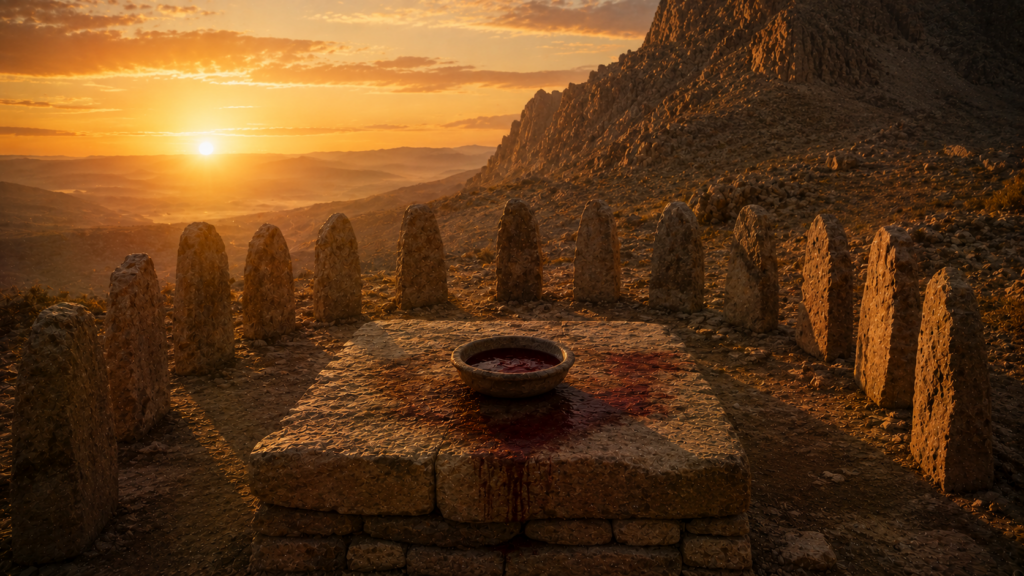
¹ He said to Moses, “Come up to Yahweh, you, and Aaron, Nadab, and Abihu, and seventy of the elders of Israel; and worship from a distance. ² Moses alone shall come near to Yahweh, but they shall not come near. The people shall not go up with him.” ³ Moses came and told the people all Yahweh’s words, and all the ordinances; and all the people answered with one voice, and said, “All the words which Yahweh has spoken will we do.” ⁴ Moses wrote all Yahweh’s words, and rose up early in the morning, and built an altar under the mountain, and twelve pillars for the twelve tribes of Israel. ⁵ He sent young men of the children of Israel, who offered burnt offerings and sacrificed peace offerings of cattle to Yahweh. ⁶ Moses took half of the blood and put it in basins, and half of the blood he sprinkled on the altar. ⁷ He took the book of the covenant and read it in the hearing of the people, and they said, “All that Yahweh has spoken will we do, and be obedient.” ⁸ Moses took the blood, and sprinkled it on the people, and said, “Look, this is the blood of the covenant, which Yahweh has made with you concerning all these words.”
- Come up to YHWH, you, and Aaron, Nadab, and Abihu, and seventy of the elders of Israel; and worship from a distance. The Hebrew is aleh el-YHWH. The seventy-and-three (Moses, Aaron, Nadab, Abihu, plus seventy elders, totaling seventy-three) are summoned up the mountain. The number seventy is theologically loaded: it echoes the seventy souls who came down to Egypt (Gen 46:27), the seventy nations of Genesis 10, and the seventy palms at Elim (Ex 15:27). Solomon’s note: in the rabbinic tradition, the seventy elders represent Israel as a whole, in the presence of the seventy nations. The covenant is being made for Israel, but in a representational form that already gestures toward the watching world.
- Moses came and told the people all YHWH’s words, and all the ordinances; and all the people answered with one voice, and said, “All the words which YHWH has spoken will we do.” The Hebrew is kol ha-devarim asher-diber YHWH na’aseh. The people’s response is the second na’aseh. The first was at Ex 19:8, before the words were spoken; this is the second, after the words are spoken and the case-law has been heard. The rabbinic tradition pairs this with the na’aseh ve-nishma of v. 7 (we will do and we will hear). The order do-then-hear will become the rabbinic tradition’s foundational vow: agreeing to the covenant before fully understanding it is the highest form of trust. See The Sinai covenant.
- Moses wrote all YHWH’s words, and rose up early in the morning, and built an altar under the mountain, and twelve pillars for the twelve tribes of Israel. The chapter is preserving an important detail. Moses wrote. The Hebrew Bible’s whole later canonical tradition rests, in part, on this verse. Moses writes the words of the covenant. The chapter is documenting the practice of written covenant memory that began at Ex 17:14 (write this for a memorial in a book) and continues here.
- Twelve pillars for the twelve tribes of Israel. The Hebrew is shtem-esrei matsevah. The twelve standing-stones are the visible representation of the twelve tribes at the covenant ceremony. The whole nation, in symbolic form, is present at the altar. The chapter is staging Israel’s ratification as a complete people, not just as the elders or the leadership.
- He sent young men of the children of Israel, who offered burnt offerings and sacrificed peace offerings of cattle to YHWH. The Hebrew names young men (na’arey), not yet the formal Aaronic priesthood (which has not yet been established at this point in the narrative). The Israelite priesthood is in seed-form here. The young men perform sacrificial actions that will, in subsequent chapters, be formally restricted to the Levites and the sons of Aaron.
- Moses took half of the blood and put it in basins, and half of the blood he sprinkled on the altar. The blood is divided. Half on the altar (representing YHWH); half held in basins. The chapter is preparing the ratification’s most theologically loaded act.
- He took the book of the covenant and read it in the hearing of the people, and they said, “All that YHWH has spoken will we do, and be obedient.” The Hebrew is kol asher-diber YHWH na’aseh ve-nishma. The full na’aseh ve-nishma (we will do and we will hear) is spoken here. Solomon’s reading: this is the highest covenant vow. Doing comes before hearing. The people commit to living the covenant before they fully understand it. The framework is foundational. The rabbinic tradition reads this as the essential pattern of Israelite faith.
- Moses took the blood, and sprinkled it on the people, and said, “Look, this is the blood of the covenant.” The Hebrew is hineh dam ha-berit asher karat YHWH immakhem. The phrase dam ha-berit (the blood of the covenant) is the chapter’s most quoted single phrase. The blood is sprinkled on the people. They are now marked with the same blood that marks the altar. The covenant is being cut (karat; the Hebrew idiom for making a covenant is cutting a covenant) in blood. The phrase will be quoted, verbatim and deliberately, by Jesus at the Last Supper: this is my blood of the covenant, which is poured out for many for the forgiveness of sins (Mt 26:28). The seedbed of the New Testament eucharist is here.
Word study: na’aseh ve-nishma (נַעֲשֶׂה וְנִשְׁמָע)
“We will do, and we will hear.” The Hebrew of Ex 24:7. The phrase has become one of the rabbinic tradition’s foundational vows. The Talmud (b. Shabbat 88a) treats this as the highest form of Israelite faith: agreeing to the covenant before fully knowing what it requires. The order is striking. Doing comes before hearing. The Christian convert’s standard pattern (hear the gospel, believe, then act) is here reversed: Israel commits to do, and the understanding will follow as the doing unfolds. Solomon’s pastoral framing: this is the marriage-vow grammar. The bride does not first interrogate every clause of the ketubah; she says yes and the discovery happens inside the relationship. The verse is the foundational covenant-vow that the rabbinic tradition reads as the moment of Israel’s yes. The Hebrew Bible’s whole later faith-tradition assumes this pattern. See The Sinai covenant.
B · Exodus 24:9-11 · The seventy elders eat with God
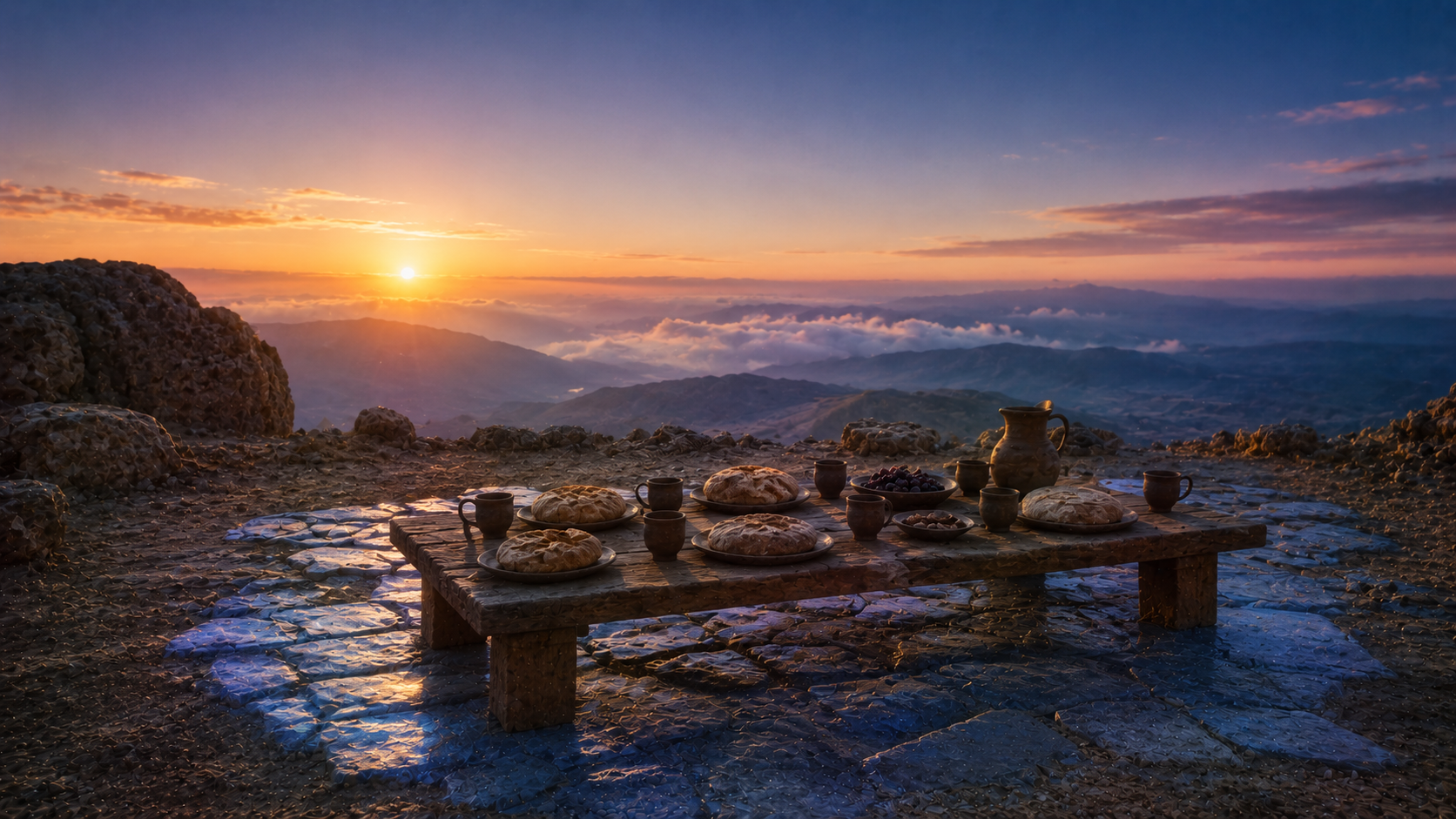
⁹ Then Moses, Aaron, Nadab, Abihu, and seventy of the elders of Israel went up. ¹⁰ They saw the God of Israel. Under his feet was like a paved work of sapphire stone, like the skies for clearness. ¹¹ He didn’t lay his hand on the nobles of the children of Israel. They saw God, and ate and drank.
- Then Moses, Aaron, Nadab, Abihu, and seventy of the elders of Israel went up. The seventy-and-three ascend together. The verse is a small, quiet ascent of a delegation. The chapter is staging the ratification’s most numinous moment with surprising restraint.
- They saw the God of Israel. The Hebrew is vayir’u et elohey Yisra’el. The verb raah (see) is direct. The chapter is unblinking. The seventy elders saw God. This is one of the Hebrew Bible’s most theologically loaded single verses. Most other passages teach that no one can see God and live (Ex 33:20). The chapter here is making a different claim: at the covenant ratification, the elders saw and lived. Goldingay’s pastoral note: the seeing is visionary, not metaphysical. What they saw is described in v. 10 by what was under his feet (a sapphire pavement). The text is patient with the indirection. The elders saw but the chapter does not describe what they saw of God himself; it describes only the pavement under his feet. The reverent silence around the divine appearance is itself part of the chapter’s theology.
- Under his feet was like a paved work of sapphire stone, like the skies for clearness. The Hebrew is u-ke-etsem ha-shamayim la-tohar. The image is striking. The pavement under God’s feet is like the heavens themselves for clearness: a pavement of pure transparent blue, the colour of the sky, as if the heavens themselves were the floor of God’s throne room. The image will be picked up across the canon. Ezek 1:26 will see something like a sapphire stone under the firmament throne. Rev 4:6 will see a sea of glass like crystal before the throne. The chapter is establishing the canonical vocabulary of what is under YHWH’s feet in vision: the heavens themselves, transparent like glass.
- He didn’t lay his hand on the nobles of the children of Israel. They saw God, and ate and drank. The verse is patient with the chapter’s miraculous restraint. The seventy elders should have died for seeing God; they did not. Instead, they ate and drank in YHWH’s presence. The covenant-meal is the chapter’s most under-noted single image. The seventy elders sit in the presence of God and eat the covenant-meal together. The framework will reach Mt 8:11 (many will come from east and west and recline at table with Abraham, Isaac, and Jacob in the kingdom of heaven) and Rev 19:9 (blessed are those who are invited to the marriage supper of the Lamb). The eschatological banquet of Scripture begins with this meal on the mountain. The seventy ate with God; they survived; they came down. The covenant has been ratified at table.
Influence callout: Marty Solomon (Bema Discipleship) on the chapter as wedding consummation
Solomon reads the chapter as the consummation of the wedding-covenant at Sinai. The pattern, in his framework, is precise: chapter 19’s trumpet, cloud, and consecration was the wedding-procession; chapter 20’s aseret ha-debarim was the ketubah-reading; chapters 21-23 were the ketubah’s stipulations spelled out; chapter 24 is the blood-marriage and the wedding-meal. The blood sprinkled on the altar and the people is the blood-marriage in ANE terms (compare the Zipporah chatan damim episode in Ex 4:24-26). The seventy elders eating in YHWH’s presence is the wedding-banquet. The forty-day mountain-stay that follows is the consummation. Solomon’s pastoral framing: Sinai is not a courtroom. Sinai is a wedding. The chapter is the wedding’s most intimate moment: the bride and groom (Israel and YHWH) marked with the same blood, eating together in the presence of God, sealed in the relationship that the rest of Israel’s life will live out. See The Sinai covenant.
C · Exodus 24:12-18 · Moses on the mountain forty days
¹² Yahweh said to Moses, “Come up to me on the mountain, and stay here, and I will give you the tablets of stone with the law and the commands that I have written, that you may teach them.” ¹³ Moses rose up with Joshua, his servant, and Moses went up onto God’s Mountain. ¹⁴ He said to the elders, “Wait here for us, until we come again to you. Behold, Aaron and Hur are with you. Whoever is involved in a dispute can go to them.” ¹⁵ Moses went up on the mountain, and the cloud covered the mountain. ¹⁶ Yahweh’s glory settled on Mount Sinai, and the cloud covered it six days. The seventh day he called to Moses out of the middle of the cloud. ¹⁷ The appearance of Yahweh’s glory was like devouring fire on the top of the mountain in the eyes of the children of Israel. ¹⁸ Moses entered into the middle of the cloud, and went up on the mountain; and Moses was on the mountain forty days and forty nights.
- Come up to me on the mountain, and stay here, and I will give you the tablets of stone with the law and the commands. The Hebrew is ve-ettenah lekha et-luchot ha-even ve-ha-torah ve-ha-mitsvah asher katavti le-horotam. The two stone tablets are introduced for the first time. They will be the physical artifacts of the covenant: the duplicate copies (one for YHWH, one for Israel) of the covenant document, kept inside the ark of the covenant in the most holy place. Imes’s reading (see The Sinai covenant): the two tablets are not five-commandments-each; they are two duplicate copies of the covenant, the same way ANE suzerain-vassal treaties were written and kept.
- Aaron and Hur are with you. Aaron and Hur, who held up Moses’s arms in chapter 17, now hold the camp’s authority while Moses is on the mountain. The chapter is teaching that the same brothers who supported the leader in battle now support him in absence. The continuity of co-leadership is structural.
- YHWH’s glory settled on Mount Sinai, and the cloud covered it six days. The seventh day he called to Moses. The Hebrew is vayishkon kevod-YHWH al-har Sinai. The verb shakhan (to dwell, settle, encamp) is the same root that gives later Jewish theology the word shekinah: the dwelling-presence of God. The chapter’s kavod (glory) is settling on the mountain in the cloud. The vocabulary will saturate the rest of Exodus and the tabernacle narrative: God’s kavod will settle in the tabernacle (40:34), in the temple (1 Kgs 8:11), and ultimately in Christ (John 1:14, the Word became flesh and tabernacled among us, and we beheld his glory).
- The seventh day he called to Moses out of the middle of the cloud. The seven-day pattern recurs. Mackie’s note: the chapter’s six-days-of-cloud-then-the-seventh-day-call mirrors Genesis 1’s six-days-of-creation-then-the-seventh-day-rest. The covenant is being given inside a creation-week pattern. The Sinai theophany is, structurally, new creation.
- The appearance of YHWH’s glory was like devouring fire on the top of the mountain in the eyes of the children of Israel. The Hebrew is u-mar’eh kevod YHWH ke-esh okhelet be-rosh ha-har. The image is fearsome. From the people’s vantage, the kavod on the mountaintop looks like a devouring fire. The chapter is patient with the dual-truth: God is near (just up the mountain), and God is consuming holy (the fire is devouring). Both at once.
- Moses entered into the middle of the cloud, and went up on the mountain; and Moses was on the mountain forty days and forty nights. The Hebrew is vayavo Mosheh be-tokh he-anan. Moses enters the cloud. The deliverer goes into the divine presence. The forty-day mountain-stay begins. The Hebrew Bible’s forty days and forty nights pattern (Noah’s flood, Elijah’s journey, Jesus’s wilderness) is being established. The chapter ends with Moses inside the cloud, on the summit, for forty days. The next chapters will narrate what YHWH speaks to him there: the instructions for the tabernacle.
Influence callout: Tim Mackie (BibleProject, Sacred Spaces) on the chapter’s seven-day pattern
Mackie reads the chapter’s seven-day pattern as one of the Hebrew Bible’s most under-noted typological seeds. The cloud covers the mountain six days, and the seventh day YHWH calls Moses. The pattern is Genesis 1 in miniature: six days of preparation, the seventh day as the day of YHWH’s word reaching the human. The chapter is staging Sinai as a cosmic temple inauguration. From this verse forward, every later seven-day temple-dedication pattern in the Hebrew Bible (Solomon’s temple, 1 Kgs 8:65-66; the second temple, Ezra; even the seven divine speeches of the tabernacle account, Ex 25-31) will pick up this sequence. Mackie’s pastoral note: Sinai is the first temple. The kavod settles on the mountain the way it will later settle on the tabernacle and the temple. The mountain is YHWH’s first dwelling place among Israel after the Exodus. The whole later sanctuary system is downstream of this chapter. See The tabernacle as cosmic temple.
Reflection prompts
- Na’aseh ve-nishma, we will do, and we will hear. The order is striking. Doing comes before hearing. Where, in your own faith life, are you waiting to fully understand before you commit to doing? What does the chapter’s word ask of your willingness to step into a covenant-life before all the questions are resolved?
- Behold the blood of the covenant. The same phrase Jesus quotes at the Last Supper. The chapter’s covenant-ratification grammar becomes the New Testament’s eucharistic vocabulary. Where, in your own life with the eucharist, are you hearing the chapter’s blood-of-the-covenant under the wine of the cup?
- They saw God, and ate and drank. The seventy elders ate the covenant-meal in YHWH’s presence and lived. The image will reach the eschatological banquet (Mt 8:11; Rev 19:9). Where, in your own life, are you receiving the table as the small foretaste of the seventy elders’ meal? What changes when the meal is read inside the chapter’s image?
Frameworks at play in this chapter: the Sinai covenant, the new covenant, the tabernacle as cosmic temple.