
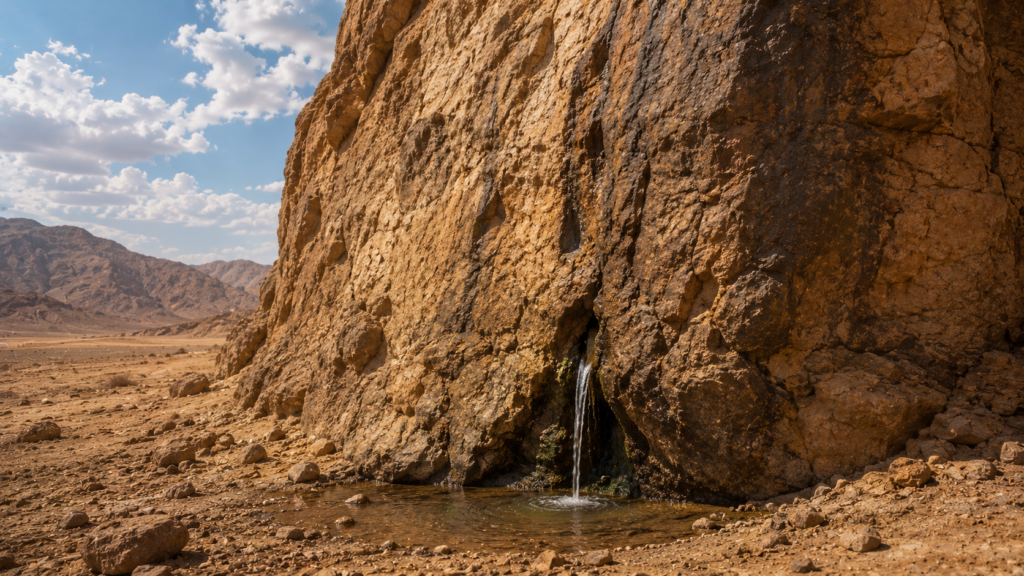
Exodus 17 is the chapter where the wilderness’s testing-pattern reaches its sharpest forms. Two crises are narrated back-to-back: a water crisis at Massah and Meribah, where the people’s grumbling reaches the pitch of almost stoning Moses; and a battle at Rephidim, where the Amalekites ambush the back of Israel’s line and have to be fought off. The chapter sits immediately before Jethro’s arrival in chapter 18 and Israel’s arrival at Sinai in chapter 19. It is the last narrative beat before the covenant.
Solomon’s reading (drawing on Bema’s larger structural pattern) names the wilderness’s tests as a teaching-sequence that maps to the Shema’s clauses (love YHWH with all your heart, all your soul, and all your strength; Deut 6:5). Marah was the test of the vav (heart). The manna and quail of chapter 16 continued that test. Massah/Meribah is the test of the nephesh (soul). Amalek at Rephidim is the test of the meod (strength / very). The chapter is the third and fourth wilderness tests, in sequence.
Two details give the chapter its particular force. First, the rock at Horeb. The water is not produced from any rock; it is produced from the rock at Horeb, the same mountain where God will give the covenant in two more chapters. The water of life flows from the place of the law before the law is given. Second, Aaron and Hur holding up Moses’s arms. The chapter’s most unforgettable image is the structural one: when Moses’s strength fails, he sits, and his brothers hold up his arms. The deliverance is communal even when one person is named the leader.
A · Exodus 17:1-7 · The water at Massah and Meribah
¹ All the congregation of the children of Israel traveled from the wilderness of Sin, by their stages, according to Yahweh’s commandment, and encamped in Rephidim; but there was no water for the people to drink. ² Therefore the people quarreled with Moses, and said, “Give us water to drink.” Moses said to them, “Why do you quarrel with me? Why do you test Yahweh?” ³ The people were thirsty for water there; and the people murmured against Moses, and said, “Why have you brought us up out of Egypt, to kill us, our children, and our livestock with thirst?” ⁴ Moses cried to Yahweh, saying, “What shall I do with these people? They are almost ready to stone me.” ⁵ Yahweh said to Moses, “Walk on before the people, and take the elders of Israel with you, and take the rod in your hand with which you struck the Nile, and go. ⁶ Behold, I will stand before you there on the rock in Horeb. You shall strike the rock, and water will come out of it, that the people may drink.” Moses did so in the sight of the elders of Israel. ⁷ He called the name of the place Massah, and Meribah, because the children of Israel quarreled, and because they tested Yahweh, saying, “Is Yahweh among us, or not?”
- They are almost ready to stone me. The Hebrew is od m’at u-sqaluni. The grumbling has escalated from complaint (Marah, manna) to imminent violence. Moses fears for his life. The chapter is honest about the wilderness’s emotional pressure: hunger and thirst, on a body, will do what no calm theological argument can do. The deliverance has not yet remade the people. The same crowd that sang on the seashore in chapter 15 is now on the verge of stoning the man who led them.
- Moses cried to Yahweh. The Hebrew is vayitsa’aq el-YHWH. The verb tsa’aq (cry from oppression) is the same word Israel cried in 2:23 from Egypt, the same word they cried at the Sea in 14:10. Now Moses is the one crying. The Hebrew Bible is honest: the leader’s cry is the same word as the oppressed’s cry. The deliverer is, in this moment, the one being threatened.
- Solomon’s reading (drawing on the rabbinic tradition) makes much of the staging in v. 6: Behold, I will stand before you there on the rock in Horeb. You shall strike the rock. The Hebrew is hineni omed lefaneykha sham al-ha-tsur. Hineni (behold, I am) places YHWH on the rock. The verb omed (standing) puts YHWH there as the visible target. The next instruction is strike the rock. Read the geometry: God is standing on the rock. Moses is told to strike the rock with the same staff that struck the Nile (an instrument of judgment). In the elders’ field of view, Moses appears to be striking God. The water comes out, but the choreography is striking. Solomon: this whole thing screams Jesus. The Hebrew Bible’s pattern of the leader striking the rock and water flowing out is, on figural reading, the seed of Christ struck on the cross with water flowing from his side (John 19:34). 1 Cor 10:4 will pick up this very rock typology directly: they all drank the same spiritual drink, for they drank from a spiritual rock that followed them, and that rock was Christ.
- Massah, and Meribah. The Hebrew names mean testing and quarreling, respectively. The chapter is naming the place by what it exposed about Israel’s heart. The names will recur across the Hebrew Bible as warning-words. Ps 95:8 will quote this exact verse: Don’t harden your heart, as at Meribah, as in the day of Massah in the wilderness. Hebrews 3:7-19 will pick up the Psalm and apply it to the church: the wilderness rebellions are warnings for the disciple-community. The chapter’s place-names become canonical shorthand for the heart that does not trust.
- Is YHWH among us, or not? The Hebrew is ha-yesh YHWH be-qirbenu im-ayin. The chapter’s most piercing question. Is YHWH in our midst, or not? After the Sea, the song, the manna, the quail, the pillar, Israel still has to ask this question. Goldingay’s pastoral note: this is honest. The deliverance does not, by itself, make the heart believe. Each new crisis is another test of whether the people trust. The wilderness’s whole work is to slowly answer the question: yes, YHWH is among us, in the daily ration, in the rock, in the cloud.
Word study: massah u-meribah (מַסָּה וּמְרִיבָה)
Massah derives from the verb nissah (to test, to try). Meribah derives from the verb riv (to quarrel, contend, dispute). The pair names the chapter’s double-naming of the place: it was both a test (nissah) and a quarrel (riv). The Hebrew Bible will weave these two roots throughout the wilderness narrative. Nissah will appear repeatedly in Deuteronomy as the verb for what God did to Israel (to test you, to know what was in your heart, Deut 8:2). Riv will become the prophetic vocabulary for God’s lawsuit-against-Israel in Mic 6:1-2 and Hos 4:1. Both roots have a long canonical life. The chapter is the seed-bed.
B · Exodus 17:8-13 · Amalek at Rephidim
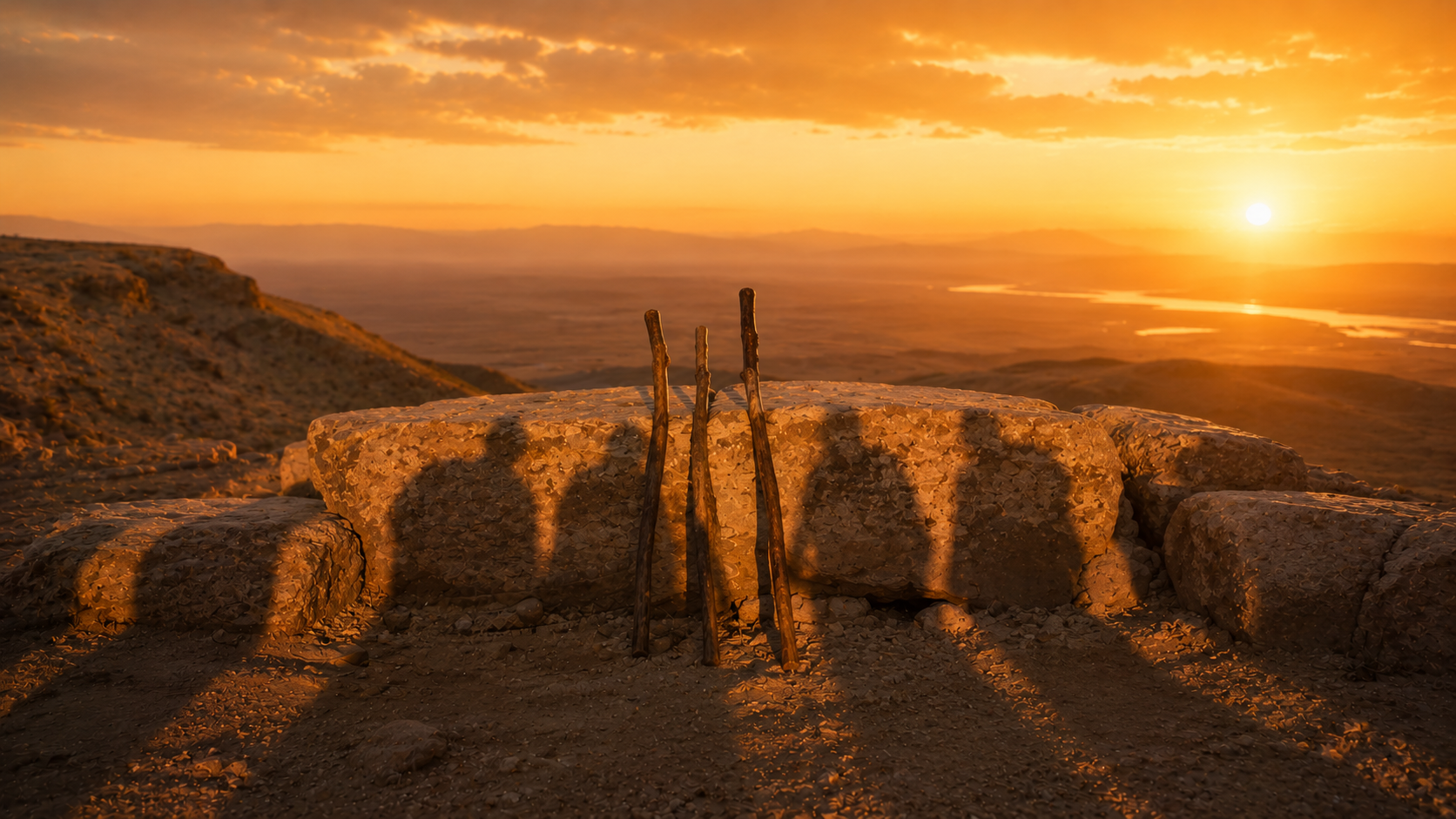
⁸ Then Amalek came and fought with Israel in Rephidim. ⁹ Moses said to Joshua, “Choose men for us, and go out, fight with Amalek. Tomorrow I will stand on the top of the hill with God’s rod in my hand.” ¹⁰ So Joshua did as Moses had told him, and fought with Amalek; and Moses, Aaron, and Hur went up to the top of the hill. ¹¹ When Moses held up his hand, Israel prevailed; and when he let down his hand, Amalek prevailed. ¹² But Moses’ hands were heavy; and they took a stone, and put it under him, and he sat on it. Aaron and Hur held up his hands, the one on the one side, and the other on the other side. His hands were steady until sunset.
- Amalek came and fought with Israel in Rephidim. Amalek is a tribe descended from Esau (Gen 36:12). They are the first people-group to attack Israel after the Exodus. Deuteronomy 25:17-19 will later record the precise nature of the attack: Amalek met you on the way, and attacked the rear of you, all who were feeble behind you, when you were faint and weary, and he didn’t fear God. The chapter does not state the back-of-the-line detail explicitly, but Deuteronomy fills it in. Amalek attacks the weakest travelers first: the elderly, the sick, the children, the slow. The empire’s old grammar (the strong eat the weak) reasserts itself at the back of Israel’s line. Solomon’s reading (see Wilderness and liminality): this is the test of meod (strength / very). Will Israel use its strength to fight for the vulnerable at the back, or only for itself?
- Joshua is named for the first time in the Bible at v. 9. He has been waiting in the silent margins. From this verse forward, Joshua will be one of the canonical figures: the eventual successor to Moses, the leader of the conquest, the namesake of Yeshua (Jesus). The chapter is launching one of the Hebrew Bible’s longest single careers. Joshua is, in Hebrew, Yehoshua: YHWH saves.
- Moses… with God’s rod in my hand. The Hebrew is u-matteh ha-elohim be-yadi. The same shepherd’s staff that has been doing redemption-work since chapter 4. Moses takes the staff to the hilltop. Solomon notes: the staff is raised on the hill, not used directly in battle. The visual is theological: the banner of YHWH lifted high while Joshua and the men fight in the valley.
- When Moses held up his hand, Israel prevailed; and when he let down his hand, Amalek prevailed. The Hebrew is vehayah ka’asher yarim Mosheh yado, ve-gavar Yisra’el; ve-ka’asher yaniach yado, ve-gavar Amaleq. The geometry is precise. Moses’s raised hand (with the staff) is the visible sign of YHWH’s authority over the battle. When the hand drops, the battle turns. Goldingay’s note: this is not magic. The hand is a banner. As long as the banner is up, Israel knows where to look. When the banner falls, Israel loses sight of the One they are fighting under.
- Moses’ hands were heavy. The Hebrew is videy Mosheh kevedim. Kevedim is the same root as kavod (heavy / glory). Pharaoh’s heart was kavod-heavy in refusal; Moses’s hands are now kavod-heavy in fatigue. The Hebrew Bible’s wordplay is patient. Moses is not a divine superman. He gets tired. His arms ache. The deliverance is being carried by a tired old man.
- They took a stone, and put it under him, and he sat on it. Aaron and Hur held up his hands. The chapter’s most unforgettable image. Moses sits on a stone. His brother Aaron is on one side; Hur (Caleb’s grandfather, per 1 Chr 2:18-20; tradition holds he is Miriam’s husband) is on the other. They hold up the arms. The Hebrew Bible is teaching, in a single visual, that the deliverance is communal even when one person is named the leader. Solomon’s pastoral note: every leader’s arms get heavy. The question is whether there is a community willing to sit beside the leader and hold up the arms for the rest of the battle. The image is the Hebrew Bible’s most concrete picture of co-leadership.
- His hands were steady until sunset. The Hebrew is vayhi yadav emunah ad-bo’ ha-shamesh. Emunah is faithfulness (the noun-form of the verb aman, to trust). The same root as amen. Moses’s hands, held up by his brothers, are emunah-hands. The Hebrew Bible’s most intimate single use of emunah names the steady hands of the tired leader held up by the men beside him. Trust is, in this verse, the embodied posture of arms held by other arms.
C · Exodus 17:14-16 · The book, the altar, the banner
¹³ Joshua defeated Amalek and his people with the edge of the sword. ¹⁴ Yahweh said to Moses, “Write this for a memorial in a book, and rehearse it in the ears of Joshua: that I will utterly blot out the memory of Amalek from under the sky.” ¹⁵ Moses built an altar, and called its name “Yahweh our Banner.” ¹⁶ He said, “Yah has sworn: ‘Yahweh will have war with Amalek from generation to generation.’”
- Write this for a memorial in a book. The Hebrew is ketov zot zikkaron ba-sefer. This is the first time in the Hebrew Bible the verb ketov (write) is paired with sefer (book / scroll) as a memorial. The chapter is establishing the practice of written memory as part of the wilderness formation. From this verse forward, Israel writes things down. The Hebrew Bible’s whole future as a written canon begins with this verse. Write this in a book.
- I will utterly blot out the memory of Amalek. The Hebrew is macho emcheh et-zekher Amaleq. The doubled root machah (blot out, wipe away) is emphatic. Amalek’s zekher (memorial / memory) will be blotted out by YHWH. The Hebrew Bible’s later memory of Amalek will be complex (1 Sam 15 and Esther’s Haman-as-Amalekite are the most famous), but the chapter’s word here is unequivocal: the empire-pattern that Amalek embodied (the strong eating the weak at the back of the line) is what YHWH commits to erase. The cruciform reading of the canon (see The cruciform hermeneutic) will eventually reframe how blotting out happens, but the principle stands: God is at war with the practice of strong-eating-weak.
- Moses built an altar, and called its name “YHWH our Banner.” The Hebrew is YHWH-Nissi. Nes (banner, standard, ensign) is the word for the flag-pole that ancient Near Eastern armies marched under. The Egyptian armies marched under banners pointing to their patron deities. Israel’s banner is YHWH himself. The chapter is naming a permanent attribute of God: the banner-under-which-his-people-march. Adonai-Nissi will recur in the prophets and in the church’s later hymnody.
- Solomon’s reading (drawing on Vander Laan): in the ancient world, a city’s gate displayed a banner pointing toward the city’s patron deity. Travelers approaching the city read the banner to know whose protection they were entering. Israel’s banner is YHWH. The chapter is teaching that Israel’s identity is read, by the watching world, by the banner the people march under. In the New Testament, Paul will say we are ambassadors for Christ (2 Cor 5:20); the church’s whole vocation is to march under the YHWH-Nissi banner that this chapter establishes.
Influence callout: Marty Solomon (Bema Discipleship, Episodes 19-21)
Solomon reads the wilderness’s testing-sequence as a deliberate pedagogical mapping to the Shema (Deut 6:5, love YHWH with all your heart, all your soul, and all your strength). Marah is the test of the vav (heart / will). The manna is the continuing test of the heart. Massah/Meribah is the test of the nephesh (soul). Amalek at Rephidim is the test of the meod (strength / very). The chapter is the third and fourth tests in this sequence. Solomon’s pastoral framing: the wilderness is teaching Israel to love YHWH at each layer of the self. The tests are not punishments. They are formation-by-crisis. The same God who delivered Israel at the Sea is, in the wilderness, slowly re-shaping the affections of the people he delivered. The Amalek test in particular is the test of what you do with your strength when the weakest are at the back of the line. Solomon notes the rabbinic tradition: the tribe of Dan, in the later wilderness travel order (Numbers 10:25), is appointed the rear-guard, the protectors of the back of the line. The test of Amalek becomes the permanent vocation of the strongest tribe.
- The chapter ends. Israel has been tested and has prevailed (with Aaron and Hur’s help). The banner is up. The book is being written. The next chapter will introduce Jethro, who will see what is happening and come to bless YHWH and to give Moses the most important administrative advice in the book. After Jethro, Israel will arrive at Sinai. The wilderness’s most concentrated formation-work is reaching its destination.
Reflection prompts
- Is YHWH among us, or not? Israel asks this question after the Sea, after the song, after the manna, after the pillar. The deliverance does not, by itself, settle the question. Where, in your own faith life right now, are you still asking the Massah question? What would it mean to let the daily evidence of YHWH’s presence (your manna, your rock, your pillar) actually settle the question?
- Moses sat on a stone, and Aaron and Hur held up his hands. The chapter’s most unforgettable image is co-leadership. Whose hands are you holding up right now? Whose hands need to hold yours up? What does it look like to refuse the lie of the lone heroic leader and accept the slower, communal way the chapter actually shows?
- Amalek attacked the back of the line, where the weak and slow were. The test of meod (strength) is whether you will use your strength to fight for those at the back. Where, in your own life and work, are you tempted to use your strength only for the front of the line? What would it look like to walk the rear-guard instead?
Frameworks at play in this chapter: wilderness and liminality, the cruciform hermeneutic.