

Exodus 13 is the chapter where the deliverance is kept. Israel has just been redeemed; chapter 12 narrated the night. Chapter 13 narrates the first morning after and the long arc of remembrance that begins now. The chapter is structured in three parts: the law of the firstborn (every firstborn is mine), the road out (the deliberate longer route through the wilderness), and the pillar of cloud and fire that begins to lead Israel by day and night.
Three themes weave through the chapter. First, firstbornness moves from event to ongoing practice: the Passover lamb redeemed Israel’s firstborn last night, and from now on, every firstborn (human and animal) is consecrated to YHWH in a perpetual ritual that re-enacts the redemption. This is the seed of pidyon haben, the redemption-of-the-firstborn rite that observant Jews still perform on the thirty-first day after a firstborn boy’s birth. Second, intergenerational telling is named explicitly: when your son asks you, what is this? The chapter scripts the conversation parents will have with their children at Pesach for thousands of years. Third, guidance: God does not lead Israel by the short route to the land. He leads them on the long route, through the wilderness, with a pillar of cloud by day and fire by night. The deliverance is not just out of Egypt; it is into formation.
The chapter ends with one detail worth pausing on: Moses took the bones of Joseph with him. The promise Joseph made on his deathbed at the close of Genesis (God will surely visit you, and bring up my bones from this place, Gen 50:25) is being kept. Joseph’s coffin in Egypt has been waiting four hundred years for this morning. The Hebrew Bible’s narrative arc closes a long loop here.
A · Exodus 13:1-16 · The consecration of the firstborn, and the tefillin law
¹ Yahweh spoke to Moses, saying, ² “Sanctify to me all the firstborn, whatever opens the womb among the children of Israel, both of man and of animal. It is mine.” ³ Moses said to the people, “Remember this day, in which you came out from Egypt, out of the house of bondage; for by strength of hand Yahweh brought you out from this place. No leavened bread shall be eaten. ⁴ Today you are going out in the month Abib. ⁵ It shall be, when Yahweh shall bring you into the land of the Canaanite, and the Hittite, and the Amorite, and the Hivite, and the Jebusite, which he swore to your fathers to give you, a land flowing with milk and honey, that you shall keep this service in this month. ⁶ Seven days you shall eat unleavened bread, and in the seventh day shall be a feast to Yahweh. ⁷ Unleavened bread shall be eaten throughout the seven days; and no leavened bread shall be seen with you. No yeast shall be seen with you, within all your borders. ⁸ You shall tell your son in that day, saying, ‘It is because of that which Yahweh did for me when I came out of Egypt.’ ⁹ It shall be for a sign to you on your hand, and for a memorial between your eyes, that Yahweh’s law may be in your mouth; for with a strong hand Yahweh has brought you out of Egypt. ¹⁰ You shall therefore keep this ordinance in its season from year to year. ¹¹ It shall be, when Yahweh shall bring you into the land of the Canaanite, as he swore to you and to your fathers, and shall give it to you, ¹² that you shall set apart to Yahweh all that opens the womb, and every firstborn that comes from an animal which you have. The males shall be Yahweh’s. ¹³ Every firstborn of a donkey you shall redeem with a lamb; and if you will not redeem it, then you shall break its neck; and you shall redeem all the firstborn of man among your sons. ¹⁴ It shall be, when your son asks you in time to come, saying, ‘What is this?’ that you shall tell him, ‘By strength of hand Yahweh brought us out from Egypt, from the house of bondage. ¹⁵ When Pharaoh stubbornly refused to let us go, Yahweh killed all the firstborn in the land of Egypt, both the firstborn of man, and the firstborn of animal. Therefore I sacrifice to Yahweh all that opens the womb, being males; but all the firstborn of my sons I redeem.’ ¹⁶ It shall be for a sign on your hand, and for symbols between your eyes; for by strength of hand Yahweh brought us out of Egypt.”
- Sanctify to me all the firstborn. The Hebrew is qaddesh-li khol-bekhor. The verb qaddesh (to consecrate, set apart as holy) is the same verb the bush-ground was qodesh in Ex 3:5 and that will name the holy place of the tabernacle. Every firstborn human and animal in Israel from now on is qaddesh: set apart to YHWH. The night of Passover did not just happen once. It is being institutionalized into the ongoing life of every Hebrew household.
- Whatever opens the womb. The Hebrew is kol-peter rechem. The phrase is precise: not just firstborn, but specifically the one who first opens the womb. The image is of a child whose birth itself is the moment of YHWH’s claim. Every Hebrew mother, from now on, will know that her firstborn is, in some real sense, on loan to her. He must be redeemed, bought back at the temple in a ritual transaction (vv. 13, 15). The Levites will eventually be substituted for the firstborn (Num 3:11-13), but every firstborn boy will be redeemed through the priestly ritual that becomes pidyon haben. See The firstborn / bechor.
- Today you are going out in the month Abib. Abib is the month-name (later renamed Nisan in the Babylonian calendar, c. mid-March to mid-April). Abib literally means the month of the new ears of grain. The Hebrew Bible names the month of redemption by what the barley is doing. The agricultural calendar is now also the redemption calendar. Pesach lands every year at the moment the new grain is appearing. Solomon’s note: this is itself a theological claim. The Israelite calendar wraps redemption and creation into a single rhythm. New grain. New people. New beginning.
- Seven days you shall eat unleavened bread. The chapter establishes the Festival of Unleavened Bread (Hag HaMatzot), the seven-day festival that bookends Pesach. Why no leaven? Several layers. First, the haste of the deliverance (chapter 12 said they had no time for the dough to rise). Second, the symbolism of purification (leaven was associated with corruption, fermentation, decay). Third, the breaking of Egyptian baking practice (Egypt was famous for its leavened breads; Israel’s bread is now distinctively unleavened). Paul will pick up the symbol at 1 Cor 5:6-8 (purge out the old yeast, that you may be a new lump).
- You shall tell your son in that day. The Hebrew is ve-higgadta le-vinkha. From this verb higgadta comes the noun Haggadah, the name of the Passover seder text that scripts the parent-child conversation every year. Every observant Jewish home has owned a Haggadah and read it at Pesach for nearly two thousand years. The verse is the liturgical instruction itself: tell your son. The seder’s whole structure is built around answering the questions a child asks at the table. The chapter is, again, scripting the liturgy in real time.
- It shall be for a sign to you on your hand, and for a memorial between your eyes. The Hebrew is le-ot al yadkha u-le-zikkaron beyn eyneykha. This verse, repeated again at v. 16, is one of the four passages that observant Jews place inside tefillin (phylacteries) and bind to the arm and forehead during morning prayer. The other three are Ex 13:11-16 (the rest of this chapter’s law of the firstborn, including the strange broken-neck-of-the-donkey verse), Deut 6:4-9 (the Shema), and Deut 11:13-21. Why is this chapter’s law one of the four? Because, as Solomon (drawing on Fohrman) notes, every observant Jew straps the law of the firstborn to forehead and arm every morning. The whole point of being Israel is to be God’s bechor (firstborn). The text’s own selection of itself for tefillin makes the framework’s centrality unmistakable.
- Every firstborn of a donkey you shall redeem with a lamb; and if you will not redeem it, then you shall break its neck. This is one of the strangest verses in the chapter, and one Fohrman makes much of. Why donkeys? Why the violent alternative? Donkeys are the workhorses of Israelite agriculture. The Israelite household’s capital is its donkeys. The verse is teaching: even your capital, your means of production, your economy, is on loan from YHWH. The firstborn donkey must be redeemed with a lamb (a real cost) or its neck must be broken (the household forfeits the asset entirely). The sharpness is on purpose. Bechor-thinking touches every layer of household life, including the economy.
Word study: peter rechem (פֶּטֶר רֶחֶם)
“Whatever opens the womb.” The phrase appears in Ex 13:2, 12, 15 and again in Num 3:12 and elsewhere. The verb patar means to open, release, set loose. The image is of birth as an opening, the womb releasing the firstborn into the world. Every firstborn (human and animal) is, by virtue of being the womb-opener, claimed by YHWH. The framework is theological and biological. The chapter’s law of redemption-of-the-firstborn (pidyon haben) institutionalizes this claim: every firstborn boy in Israel from this morning forward will be presented at the temple on the thirty-first day after birth, redeemed with five sanctuary-shekels, and given back to his parents. Mary and Joseph perform exactly this ritual on Jesus at Lk 2:22-24. The framework reaches the gospel directly: the Firstborn redeems the firstborn.
- When your son asks you in time to come, saying, “What is this?” The chapter explicitly anticipates the Four Questions (Mah Nishtana) of the Pesach seder. The structure is: child asks; parent answers with the redemption story. This is the Hebrew Bible’s foundational catechism by table. Solomon’s pastoral note: the deliverance is structured to be taught at the dinner table, by parents to children, in the most ordinary and formative pedagogical setting in any household. The chapter is teaching, in passing, that the church’s most important formation happens at family tables, not pulpits.
B · Exodus 13:17-19 · The long route, and Joseph’s bones
¹⁷ When Pharaoh had let the people go, God didn’t lead them by the way of the land of the Philistines, although that was near; for God said, “Lest perhaps the people change their minds when they see war, and they return to Egypt;” ¹⁸ but God led the people around by the way of the wilderness by the Red Sea; and the children of Israel went up armed out of the land of Egypt. ¹⁹ Moses took the bones of Joseph with him, for he had made the children of Israel swear, saying, “God will surely visit you, and you shall carry up my bones away from here with you.”
- God didn’t lead them by the way of the land of the Philistines, although that was near. The chapter pauses to explain a geographic decision with theological weight. The shortest route from Egypt to Canaan ran along the Mediterranean coast through Philistine territory (“the way of the land of the Philistines”). It was the imperial highway, well-traveled, fast. But God deliberately did not take Israel by that route. Why? Because they would have seen war and turned back to Egypt. Goldingay’s pastoral observation: this is one of the Hebrew Bible’s most under-noted theological notes. God does not give his people the route they could not yet handle. The longer way through the wilderness exists for the formation (see Wilderness and liminality). Israel needs the wilderness even when the wilderness looks like a detour.
- God led the people around by the way of the wilderness by the Red Sea. The Hebrew is ba-derekh ha-midbar yam suf. Yam suf (Sea of Reeds) is named here for the first time as the body of water Israel will cross. The chapter is setting the stage for chapter 14. The deliverance has not yet narrowed to its iconic moment. The Sea is ahead.
- The children of Israel went up armed out of the land of Egypt. The Hebrew is va-chamushim alu bney-yisra’el me-erets mitsrayim. The word chamushim is uncertain (possibly armed, possibly in battle order, possibly in fives / organized in formations). Whatever the precise meaning, the picture is of Israel leaving Egypt in order, not as a fleeing rabble. The chapter is signaling: this is YHWH’s army (cf. Ex 12:41, all of YHWH’s armies went out). Israel is not running away; they are going out. The verb yatsa (go out) is the chapter’s keyword: it appears repeatedly. Going out is the deliverance’s grammar.
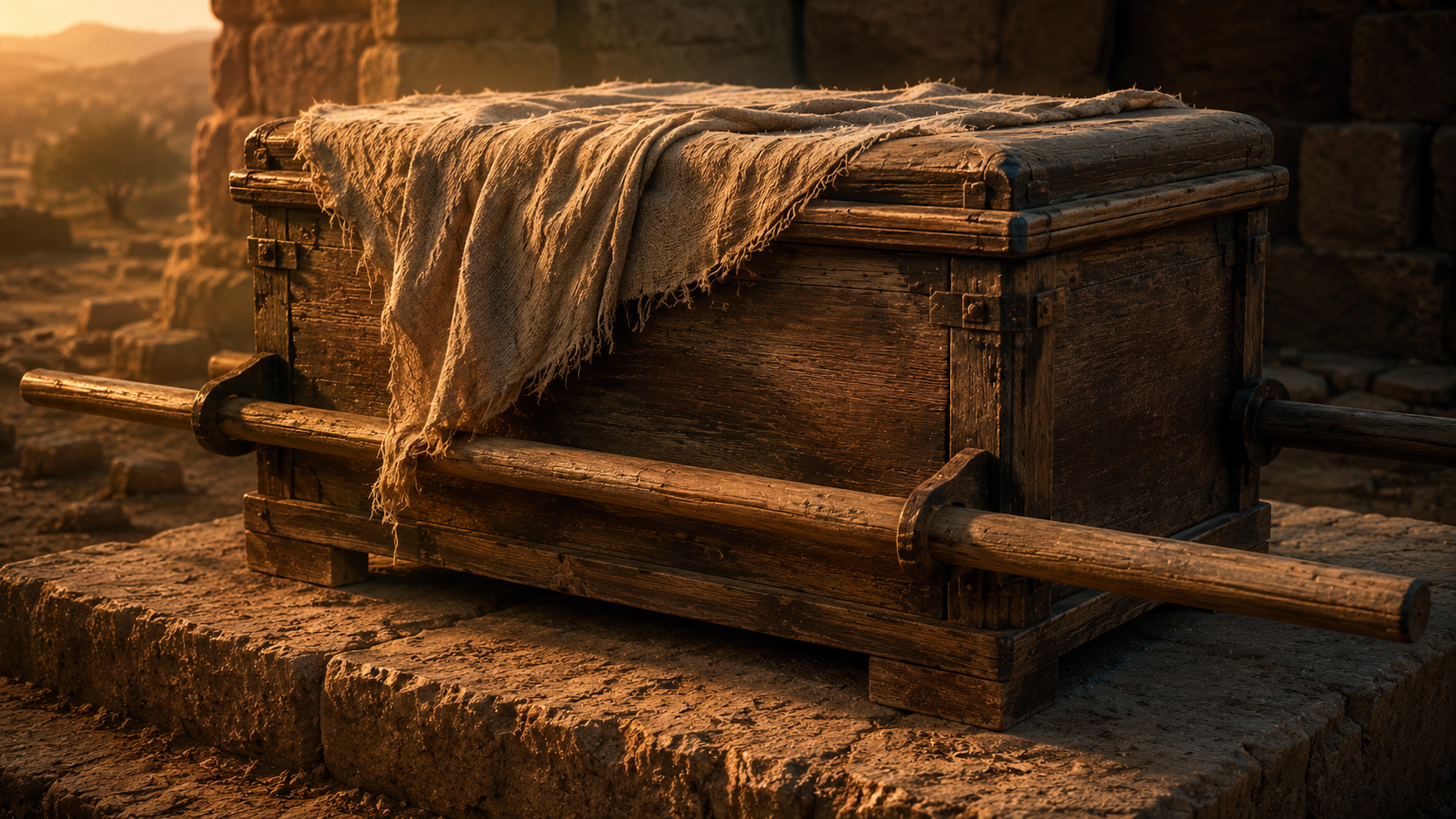
- Moses took the bones of Joseph with him. The Hebrew is vayikkach Mosheh et-atsmot Yosef immo. The detail is small, but theologically enormous. Joseph’s deathbed promise at the very end of Genesis (God will surely visit you, and bring up my bones from this place, Gen 50:25) is being kept. Joseph’s coffin has been waiting in Egypt for four hundred years. Today, at last, his bones go up.
- He had made the children of Israel swear, saying, “God will surely visit you, and you shall carry up my bones away from here with you.” The Hebrew is paqod yifqod elohim etkhem, visiting, God will surely visit you. Genesis 50:24-25 used paqod (visit, attend to). Exodus 3:16 picked it up (paqod paqadti, visiting, I have surely visited) at the bush. The same verb-pair brackets Genesis-into-Exodus. The promise made by Joseph on his deathbed is fulfilled by Moses on the morning of the Exodus. The Hebrew Bible is keeping a long literary memory.
- The implication is staggering: Israel goes out of Egypt carrying Joseph’s bones. The exodus generation does not bury Joseph’s body in Egypt; they carry it with them. The bones travel through the wilderness for forty years and are finally buried at Shechem in Joshua 24:32. Joseph’s coffin becomes, in effect, the second sacred object Israel carries (the first being the ark, which they will receive at Sinai). The promise of Genesis is buried in the land at the end of Joshua. The canon’s literary architecture is precise.
Influence callout: Tim Mackie (BibleProject, The Exodus Way)
Mackie reads the chapter’s geographic note (not by the way of the Philistines) as one of the Hebrew Bible’s quietest theological lines. The longer way through the wilderness is the formative way. Israel needs the wilderness to become Israel. The same pattern shows up across the Bible: David in the wilderness becomes king-ready (1 Sam); Elijah at Horeb is re-formed (1 Kgs 19); Jesus’s forty days in the wilderness recapitulate Israel’s forty years (Mt 4); the early church goes through Acts as a sustained wilderness-shaped formation. Mackie’s pastoral note: the long way is not the wrong way. Most disciples, in their hardest seasons, are tempted to read the long route as evidence that something has gone wrong. The Hebrew Bible reads it the opposite way. The longer route exists because God knows the formation we need is not yet complete. The chapter is the canonical seed of the church’s whole spirituality of wilderness.
C · Exodus 13:20-22 · The pillar of cloud and fire
²⁰ They took their journey from Succoth, and encamped in Etham, in the edge of the wilderness. ²¹ Yahweh went before them by day in a pillar of cloud, to lead them on their way, and by night in a pillar of fire, to give them light, that they might go by day and by night: ²² the pillar of cloud by day, and the pillar of fire by night, didn’t depart from before the people.
- YHWH went before them by day in a pillar of cloud, to lead them on their way, and by night in a pillar of fire, to give them light. The Hebrew is amud anan / amud esh. The pillars are introduced briefly here and will reappear throughout the wilderness narrative (Ex 14:19-20 at the Sea, Ex 33:9-10 at the meeting tent, Num 9:15-23 over the tabernacle). Everything that Hebrew Bible later associates with God’s visible presence (shekinah, glory-cloud, fire over the temple, dove at Jesus’s baptism) starts here.
- Pillar is the Hebrew word amud. It is the word for a standing column. The image is of a vertical, fixed presence. The cloud and fire are not diffuse atmospheric phenomena; they are standing pillars that travel with Israel. The pillar is YHWH on the move. The God who has come down into Egypt (Ex 3:8) is now traveling with the people God came down to deliver.
- By day in a pillar of cloud… by night in a pillar of fire. The two forms cover the full twenty-four-hour cycle. By day, the cloud shades and guides. By night, the fire warms and lights. The provision is total. Goldingay’s pastoral note: the chapter is teaching that God’s guidance is never partial. The whole of life, day and night, is held inside the pillar. Whether Israel is awake and walking or asleep and resting, the pillar does not depart.
- Didn’t depart from before the people. The chapter’s closing line. The Hebrew is lo’ yamish amud he-anan yomam ve-amud ha-esh laylah liphney ha-am. Lo’ yamish: it never moved away. The pillar is permanent. Israel’s deliverance does not end at the Egyptian border. It continues, day and night, all the way through.
- The chapter ends with the pillar in place, the bones of Joseph carried up, the firstborn law established, and Israel encamped at Etham at the edge of the wilderness. The next chapter will narrate the most iconic single event in the Hebrew Bible: the crossing of the sea. But this chapter is the structural bridge. Pesach is finished. Sinai is ahead. Between them stretches the wilderness, and the pillar is now in place.
Reflection prompts
- God did not lead them by the way of the Philistines, though that was near. The shorter way was the wrong way. Where, in your own life right now, are you trying to negotiate with God for the shorter route, when God’s longer-way-through-the-wilderness is the actual formation you need?
- You shall tell your son in that day. The Pesach seder is, structurally, a parent-child catechism. The Hebrew Bible’s foundational pedagogical setting is the family table at Pesach. Where, in your own household, is the table-conversation actually doing the formative work? What would it look like to hold one meal a year (or more) the way Israel holds Pesach: with the children’s questions setting the structure?
- The pillar of cloud and fire did not depart. The day and the night were both held inside YHWH’s presence. Where, in your own life, are you assuming the pillar is only with you in your day (when you can perform) but absent in your night (when you can’t)? What changes when you remember the chapter’s claim is that both are held inside the same pillar?
Frameworks at play in this chapter: the firstborn / bechor, wilderness and liminality, the exodus pattern.