
Matthew 18 is the fourth of Matthew’s five teaching discourses, the community discourse. Where the Sermon on the Mount delivered the kingdom’s constitution and the missionary discourse sent the twelve out into the towns, this discourse turns to life inside the disciple-community: how disciples relate to each other, how the community handles the sin and rupture that will inevitably surface, how forgiveness actually works under the kingdom’s economy. The chapter is the gospel’s most sustained single teaching on community life, and it is one of only two places in the gospels where Jesus uses the word ekklesia (church / assembly). Both occurrences are in Matthew (here at 18:17, and at 16:18 with Peter’s confession).
The chapter has three movements. The first (verses 1 to 14) opens with the disciples’ question about who is greatest in the kingdom and Jesus’s answer (the child); the warnings about causing little ones to stumble; and the parable of the lost sheep. The second (verses 15 to 20) is the community-discipline procedure: how to address sin between members, the witnesses-and-community escalation, and the where two or three are gathered promise. The third (verses 21 to 35) is the forgiveness teaching: Peter’s question (how often?), the seventy-seven answer, and the parable of the unforgiving servant.
Beneath the chapter’s surface flow is the gospel’s most concentrated single argument about what kind of people the kingdom-community is being formed into. The disciples have just argued (along the road) about who is greatest among them. The chapter’s whole answer is that the question is wrong. The kingdom’s greatness is the child’s lowness; the kingdom’s economy is forgiveness-from-the-forgiveness-already-received; the kingdom’s procedure for managing rupture is to keep the door open at every escalation. The community Jesus is forming is structurally different from the communities the world’s-system forms.
A · Matthew 18:1–14 · The kingdom’s child-shape and the lost sheep
¹ In that hour the disciples came to Jesus, saying, “Who then is greatest in the Kingdom of Heaven?” ² Jesus called a little child to himself, and set him in the midst of them, ³ and said, “Most certainly I tell you, unless you turn, and become as little children, you will in no way enter into the Kingdom of Heaven. ⁴ Whoever therefore humbles himself as this little child, the same is the greatest in the Kingdom of Heaven. ⁵ Whoever receives one such little child in my name receives me, ⁶ but whoever causes one of these little ones who believe in me to stumble, it would be better for him that a huge millstone should be hung around his neck, and that he should be sunk in the depths of the sea. ⁷ “Woe to the world because of occasions of stumbling! For it must be that the occasions come, but woe to that person through whom the occasion comes! ⁸ If your hand or your foot causes you to stumble, cut it off, and cast it from you. It is better for you to enter into life maimed or crippled, rather than having two hands or two feet to be cast into the eternal fire. ⁹ If your eye causes you to stumble, pluck it out, and cast it from you. It is better for you to enter into life with one eye, rather than having two eyes to be cast into the Gehenna of fire. ¹⁰ See that you don’t despise one of these little ones, for I tell you that in heaven their angels always see the face of my Father who is in heaven. ¹² “What do you think? If a man has one hundred sheep, and one of them goes astray, doesn’t he leave the ninety-nine, go to the mountains, and seek that which has gone astray? ¹³ If he finds it, most certainly I tell you, he rejoices over it more than over the ninety-nine which have not gone astray. ¹⁴ Even so it is not the will of your Father who is in heaven that one of these little ones should perish.” (Matthew 18:1–14, World English Bible)

- Who then is greatest in the Kingdom of Heaven? (verse 1). The Greek tis ara meizon estin en te basileia ton ouranon, “who therefore is greater in the kingdom of heaven,” is the question that opens the chapter. Mark 9:33-34 and Luke 9:46 record the same conversation as having begun with the disciples arguing among themselves about which of them was greatest on the road. The chapter is recording, with characteristic narrative honesty, the disciples’ status-jockeying, and the question that opens the entire community discourse is therefore the wrong question.
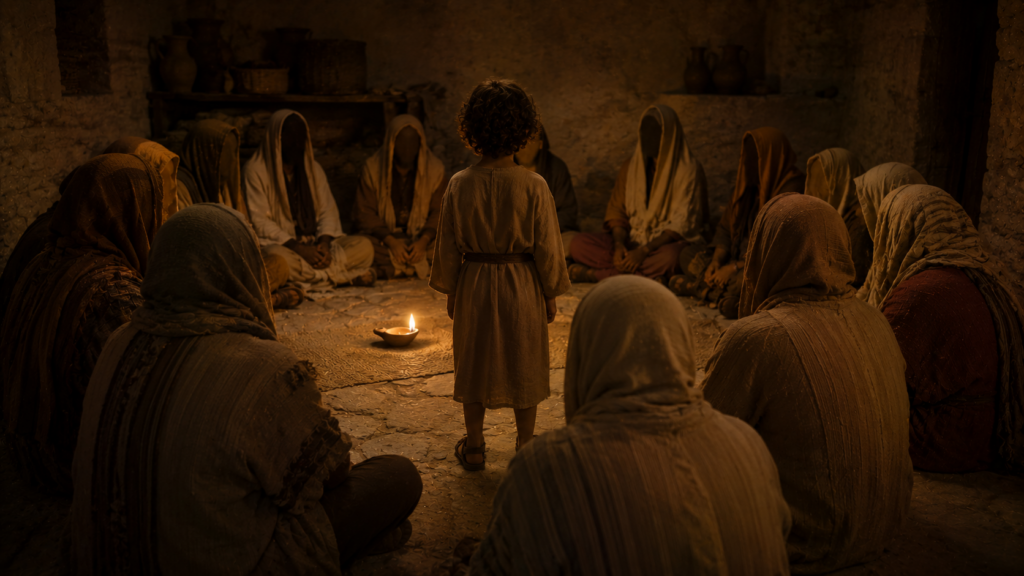
- Jesus called a little child to himself, and set him in the midst of them (verse 2). The Greek paidion, “little child,” is the diminutive: a small child, not an adolescent. The chapter is recording, with characteristic narrative-pedagogical care, that Jesus answers the question by gesture before he answers it in words. He sets a child in the middle. The child becomes the visual answer to the question.
Influence callout: Marty Solomon (the kingdom’s child-shape)
Solomon’s reading of the child-in-the-middle scene names it as the gospel’s most counter-cultural single answer to a status question. First-century Mediterranean culture was structured around honor-shame hierarchies in which children occupied the lowest social position. They had no legal standing, no economic power, no political voice; they were, by every cultural measure, small. Solomon argues that Jesus is doing in the chapter’s opening gesture what the genealogy did in chapter 1, what the Beatitudes did in chapter 5, what the centurion-and-Canaanite-woman did in chapters 8 and 15: the kingdom is structured by an inversion of the world’s status-hierarchy. The disciple who humbles himself as this little child (verse 4) is not adopting a religious posture; the disciple is positioning himself at the actual social bottom: the place the world’s-system has reserved for those without standing. Solomon connects this to the mumzer agenda the gospel has been developing throughout: the kingdom is for the people the world’s-system has placed at the bottom, and the disciple who wants to be greatest is being asked to take the same position. The chapter is recording, in one gesture and four verses, the kingdom’s discipleship-shape: the way to greatness is the way down. The kenosis-pattern of Philippians 2 is operating here in the disciples’ formation: let this mind be in you which was also in Christ Jesus, who emptied himself. The community discourse opens by naming the disposition the rest of the discourse will be teaching the community to inhabit.
- Whoever receives one such little child in my name receives me (verse 5). The Greek dexetai, “receives,” uses the standard hospitality vocabulary. The chapter is recording, with characteristic narrative care, that the kingdom’s hospitality-economics works through the actual reception of the lowest-status people in the room. Receiving a child is receiving Jesus is receiving the Father (verse 5 explicitly, and the chain extends through 10:40-42 and elsewhere).
- Woe to that person through whom the occasion comes! (verse 7). The Greek ouai, “woe,” uses the prophetic-lament vocabulary the Hebrew Bible’s prophets used (Isaiah 5; Habakkuk 2). The chapter is recording, with characteristic narrative honesty, the seriousness of the kingdom’s protection of the little ones. To cause one of them to stumble is to incur prophetic woe.
- If your hand or your foot causes you to stumble, cut it off, and cast it from you (verse 8). The chapter’s most uncomfortable instruction continues 5:29-30 from the Sermon on the Mount. The Greek hyperbole names the principle (the stumbling-cause is to be removed even at high cost) without prescribing the practice (early Christian tradition has consistently read the verse as hyperbolic, not as a literal call to self-mutilation). The chapter is recording, with characteristic rhetorical-intensification, how seriously the kingdom takes the stumbling of the little ones.
- In heaven their angels always see the face of my Father who is in heaven (verse 10). The Greek hoi angeloi auton, “their angels,” is the gospel’s most explicit reference to the early Jewish-Christian guardian-angel tradition (the idea that each person, especially each child, has a corresponding angelic representative before God). The chapter is recording, with characteristic Jewish-cultural literacy, the early church’s belief about the heavenly representation of the little ones. Whether Jesus is endorsing the tradition or accommodating it, the verse names the seriousness with which heaven attends to the small ones.
- If a man has one hundred sheep, and one of them goes astray, doesn’t he leave the ninety-nine, go to the mountains, and seek that which has gone astray? (verse 12). The Greek records the parable of the lost sheep in its Matthean form (Luke 15:3-7 records a parallel version in a different setting). The chapter is recording, with characteristic narrative-pedagogical care, the kingdom’s seek-the-one-lost economy. The arithmetic is jarring: leave 99% of the inventory exposed to find the 1% that is missing. The chapter is teaching, in one image, the kingdom’s anti-utilitarian shape.
- It is not the will of your Father who is in heaven that one of these little ones should perish (verse 14). The Greek en thelema emprosthen tou patros, “it is not the will before your Father,” names the chapter’s deepest single statement of pastoral-theological priority. The Father’s will is not the loss of even one little one. The chapter is recording, with characteristic theological care, that the community-discipline procedures that follow are organized around this priority: the goal of every escalation is the recovery of the brother, not his expulsion.
B · Matthew 18:15–20 · The community-discipline procedure
¹⁵ “If your brother sins against you, go, show him his fault between you and him alone. If he listens to you, you have gained back your brother. ¹⁶ But if he doesn’t listen, take one or two more with you, that at the mouth of two or three witnesses every word may be established. ¹⁷ If he refuses to listen to them, tell it to the assembly. If he refuses to hear the assembly also, let him be to you as a Gentile or a tax collector. ¹⁸ Most certainly I tell you, whatever things you bind on earth will have been bound in heaven, and whatever things you release on earth will have been released in heaven. ¹⁹ Again, assuredly I tell you, that if two of you will agree on earth concerning anything that they will ask, it will be done for them by my Father who is in heaven. ²⁰ For where two or three are gathered together in my name, there I am in the midst of them.” (Matthew 18:15–20, World English Bible)
- If your brother sins against you, go, show him his fault between you and him alone (verse 15). The Greek hypage elenxon auton metaxy sou kai autou monou, “go, expose him between you and him alone,” names the chapter’s most concrete community-discipline instruction. The first move is private and direct: the offended brother goes alone to the offending brother. The chapter is recording, with characteristic narrative care, that the kingdom’s procedure begins with the smallest possible footprint. No third parties; no public processing; just the two parties in the actual relationship.
- Take one or two more with you, that at the mouth of two or three witnesses every word may be established (verse 16). The Greek echoes Deuteronomy 19:15, the Mosaic-legal principle that any disputed matter must be established by two or three witnesses. The chapter is recording, with characteristic Hebrew Bible-legal echo, the kingdom’s escalation: if the private conversation does not work, the next step is not public exposure but a small private widening: one or two witnesses to ensure the matter is being treated fairly.
- If he refuses to listen to them, tell it to the assembly (verse 17). The Greek eipe te ekklesia, “tell it to the assembly,” uses ekklesia, only the second occurrence in any of the gospels (16:18 was the first). The chapter is recording, with characteristic narrative-ecclesial precision, that the third step in the procedure is the gathered community itself. The kingdom-community has a role in addressing the rupture; the community is not a bystander to the disciplinary process.
Word study: ekklesia (ἐκκλησία), “assembly, gathering, the gathered community”
The Greek word that the New Testament uses for what English translates as church. Ekklesia in pre-Christian Greek meant a political assembly of citizens called out of the wider population to deliberate the city’s affairs. The Septuagint uses ekklesia to translate the Hebrew qahal, the assembly of Israel (Deuteronomy 4:10; 9:10; 31:30). The word’s combined Greek-political and Hebrew-covenantal background carries weight: when Jesus uses ekklesia here and at 16:18, he is not founding a new private religious organization; he is naming a political assembly of citizens whose primary loyalty is to the kingdom of heaven. The community-discipline procedure of 18:15-20 operates inside this ekklesia: a gathered body with the authority to receive testimony, to bind and to loose, to issue or withhold welcome. The chapter is recording, in one Greek word, the gospel’s vision of the community Jesus is forming: a political-assembly-of-citizens-of-the-kingdom, structurally not a private spiritual association.
- Let him be to you as a Gentile or a tax collector (verse 17b). The Greek hosper ho ethnikos kai ho telones, “as the Gentile and the tax collector,” names the final step. Some readers have heard this as expulsion-language; others have heard it as continued-relationship-language given how the gospel itself treats Gentiles and tax collectors (the centurion of chapter 8, the Canaanite woman of chapter 15, Matthew the tax collector of chapter 9). The chapter is recording, with characteristic narrative ambiguity, that the outsider status conferred at the end of the procedure is the same status the gospel’s whole mumzer agenda has been moving toward inclusion. The exclusion-as-final-judgment reading and the exclusion-as-renewed-mission reading both have textual support; the kingdom’s actual practice has tended to honor both.
- Whatever things you bind on earth will have been bound in heaven, and whatever things you release on earth will have been released in heaven (verse 18). The Greek repeats 16:19 (Peter’s keys) but applies the binding-and-loosing language to the gathered community as a whole, not just to Peter. The chapter is recording, with characteristic narrative-theological care, that the ekklesia‘s communal discernment carries the same heavenly weight as Peter’s individual keys. The community’s binding-and-loosing is the kingdom’s authority distributed.
- Where two or three are gathered together in my name, there I am in the midst of them (verse 20). The Greek ekei eimi en meso auton, “there I am in their midst,” uses the divine self-identification I am (ego eimi echo, though here the verb is eimi alone). The verse has been quoted in countless devotional contexts as a small-group encouragement; the chapter’s actual context is the community-discipline procedure. The promise where two or three are gathered is, in context, specifically a promise to the community gathering for the binding-and-loosing work of verses 15-19. The chapter is recording, with characteristic narrative-theological care, the king’s presence in the community’s discipline-and-discernment work.
C · Matthew 18:21–35 · Seventy-seven forgiveness and the unforgiving servant
²¹ Then Peter came and said to him, “Lord, how often shall my brother sin against me, and I forgive him? Until seven times?” ²² Jesus said to him, “I don’t tell you until seven times, but, until seventy times seven. ²³ Therefore the Kingdom of Heaven is like a certain king, who wanted to settle accounts with his servants. ²⁴ When he had begun to settle, one was brought to him who owed him ten thousand talents. ²⁵ But because he couldn’t pay, his lord commanded him to be sold, with his wife, his children, and all that he had, and payment to be made. ²⁶ The servant therefore fell down and kneeled before him, saying, ‘Lord, have patience with me, and I will repay you all!’ ²⁷ The lord of that servant, being moved with compassion, released him, and forgave him the debt. ²⁸ “But that servant went out, and found one of his fellow servants, who owed him one hundred denarii, and he grabbed him, and took him by the throat, saying, ‘Pay me what you owe!’ ²⁹ “So his fellow servant fell down at his feet and begged him, saying, ‘Have patience with me, and I will repay you!’ ³⁰ He would not, but went and cast him into prison, until he should pay back that which was due. ³¹ So when his fellow servants saw what was done, they were exceedingly sorry, and came and told their lord all that was done. ³² Then his lord called him in, and said to him, ‘You wicked servant! I forgave you all that debt, because you begged me. ³³ Shouldn’t you also have had mercy on your fellow servant, even as I had mercy on you?’ ³⁴ His lord was angry, and delivered him to the tormentors, until he should pay all that was due to him. ³⁵ So my heavenly Father will also do to you, if you don’t each forgive your brother from your hearts for his misdeeds.” (Matthew 18:21–35, World English Bible)
- Lord, how often shall my brother sin against me, and I forgive him? Until seven times? (verse 21). The Greek heos heptakis, “until seven times,” names what would have been considered, in Pharisaic teaching, an extraordinarily generous forgiveness-quota. The rabbinic tradition typically set the limit at three offenses (Babylonian Talmud, Yoma 86b-87a, citing Amos 1-2’s for three transgressions and for four). Peter’s seven is more than double the rabbinic standard. The chapter is recording, with characteristic narrative honesty, that Peter is asking what he thinks is a generous question.
- I don’t tell you until seven times, but, until seventy times seven (verse 22). The Greek heos hebdomekontakis hepta, “seventy times seven” (or possibly “seventy-seven”), is the chapter’s most theologically loaded number. The phrase is a deliberate echo of Genesis 4:24 (Lamech’s if Cain shall be avenged sevenfold, truly Lamech seventy-sevenfold). Lamech’s escalation of vengeance is being inverted: where Lamech promised seventy-sevenfold retaliation, Jesus commands seventy-sevenfold forgiveness. The chapter is recording, with characteristic Hebrew Bible-narrative inversion, the kingdom’s reversal of the Genesis 4 vengeance-pattern.
Influence callout: Scot McKnight (the unforgiving servant and forgiveness-from-the-forgiveness-received)
McKnight’s reading of the parable of the unforgiving servant names it as the kingdom’s most extended single staging of the forgiveness-economy. The first servant owes ten thousand talents (Greek myrioi talanta), a deliberately impossible figure. A talent was the largest unit of currency, equal to roughly twenty years’ wages for a day-laborer; ten thousand was the largest Greek number-word commonly used. The two combined name a debt of roughly two hundred thousand years of wages: the parable’s deliberate hyperbole. The first servant’s fellow servant owes him one hundred denarii, about three months’ wages, a substantial but recoverable sum. McKnight argues that the parable is teaching, in deliberate numerical contrast, the forgiveness-disproportion that the kingdom is built around. The disciple has been forgiven an impossible debt by the king. To withhold forgiveness from a fellow servant for a comparatively trivial debt is to misunderstand the entire economy in which one’s own forgiveness was given. The chapter’s closing line, so my heavenly Father will also do to you, if you don’t each forgive your brother from your hearts (verse 35), is therefore not arbitrary divine retribution; it is the inevitable consequence of the disciple’s failure to live inside the economy he has been welcomed into. McKnight reads this as the gospel’s most concrete single application of the Lord’s Prayer line forgive us our debts as we also forgive our debtors (6:12). The forgiveness-from-the-forgiveness-already-received is the kingdom’s pastoral shape, and the chapter is recording, in one parable, what the failure to live inside that economy actually looks like.
- Therefore the Kingdom of Heaven is like a certain king, who wanted to settle accounts with his servants (verse 23). The Greek synarai logon meta ton doulon autou, “to take account with his servants,” uses commercial-ledger vocabulary. The chapter is recording, with characteristic narrative-economic care, that the parable is operating in the same accounting-imagery register as Philippians 4:15-19 (the doseos kai lempseos, the giving-and-receiving account). The kingdom keeps books, but the books are organized around forgiveness-from-the-forgiveness-given.
- His lord, being moved with compassion, released him, and forgave him the debt (verse 27). The Greek splanchnistheis, “having been moved with compassion,” uses the same gut-level verb the gospel has used at 9:36, 14:14, 15:32. The chapter is recording, with characteristic verbal continuity, that the king’s forgiveness is the same disposition that produced the feeding miracles. The kingdom’s compassion is the same compassion in every scene.
- Shouldn’t you also have had mercy on your fellow servant, even as I had mercy on you? (verse 33). The Greek eleesai, “to have mercy,” picks up the mercy not sacrifice vocabulary the gospel has been developing since 9:13. The chapter is recording, with characteristic verbal-thematic continuity, that the gospel’s whole mercy-tradition is now being applied to inter-disciple relationships. The disciple who has received the kingdom’s mercy is being asked to pass it on at scale.
- So my heavenly Father will also do to you, if you don’t each forgive your brother from your hearts (verse 35). The Greek apo ton kardion hymon, “from your hearts,” names the integration the chapter requires. The forgiveness is not a verbal performance; it is a heart-level reorientation. The chapter is closing the discourse on the kingdom’s most demanding single principle: the disciple’s forgiveness of others is the visible evidence of the disciple’s reception of the king’s forgiveness.
Reflection prompts
- The disciples ask, who is greatest in the kingdom of heaven? The question is wrong. Jesus answers by setting a child in the middle. The kingdom’s greatness is the child’s lowness; the kingdom’s status-economy inverts the world’s. Where in your life are you currently asking the disciples’ wrong question (angling for position, comparing rank, jockeying for influence), and what would it mean to take the chapter’s gesture as the actual answer: become like the child, take the lowest social position, and find the kingdom’s greatness there?
- The lost sheep is found because the shepherd leaves the ninety-nine to seek the one. The arithmetic is jarring. The kingdom’s economy is structurally anti-utilitarian: the one matters as much as the many. Where in your life or in your community are you currently letting one person remain gone because the math of attending to them does not work, and what would it mean to take the chapter’s instruction: leave the ninety-nine, go after the one?
- The unforgiving servant has been forgiven a debt of two hundred thousand years’ wages and refuses to forgive his fellow servant a debt of three months’ wages. The disproportion is the parable’s whole point. Where in your life are you currently withholding forgiveness from a fellow servant for a comparatively trivial debt, and what would it mean to actually inhabit the economy the king has welcomed you into?