
Genesis 13 is what happens after Egypt. Abram has stumbled, been corrected by a pagan king, and is now back in the land. The chapter is mostly about a quiet domestic problem: the family has grown too large, the herds compete for water, the herdsmen quarrel. So Abram and his nephew Lot decide to part ways.
That sounds like ordinary family business. The narrator treats it as a turning point.
Two characters in the same family, in the same chapter, both making a major choice. Lot chooses by sight. Abram chooses by faith. Lot picks the lush plain that looks “like the garden of Yahweh, like the land of Egypt” (verse 10) and pitches his tent toward Sodom. Abram lets Lot pick first, accepts the leftovers, and then walks the land Yahweh promised him. The chapter is, on its surface, about real estate. Underneath, it’s a study in two ways of seeing.
Watch the small phrases. The narrator drops “like the land of Egypt” into Lot’s deliberation just three verses after the family has come back out of Egypt with all the wealth and shame that detour produced. Watch the directions. Lot moves east, repeating the eastward motion of Adam expelled from Eden (Genesis 3:24), Cain settling east of Eden (Genesis 4:16), and humanity migrating east before Babel (Genesis 11:2). Eastward, in Genesis, is the direction of drift away from God’s presence. Watch what Yahweh says to Abram at the end of the chapter: “look in every direction, walk the land.” The land is given to the one who walks it in trust, not the one who eyes it for advantage.
By the end, Abram is back at the high country, building yet another altar, this time at the oaks of Mamre near Hebron, where most of the rest of his life will be lived.
A · Genesis 13:1–7 · Out of Egypt, into a problem
¹ Abram went up out of Egypt into the South, he, his wife, all that he had, and Lot with him. ² Abram was very rich in livestock, in silver, and in gold. ³ He went on his journeys from the South even to Bethel, to the place where his tent had been at the beginning, between Bethel and Ai, ⁴ to the place of the altar, which he had made there at the first. There Abram called on Yahweh’s name. ⁵ Lot also, who went with Abram, had flocks, herds, and tents. ⁶ The land was not able to bear them, that they might live together; for their possessions were so great that they couldn’t live together. ⁷ There was strife between the herdsmen of Abram’s livestock and the herdsmen of Lot’s livestock. The Canaanite and the Perizzite lived in the land at that time. (Genesis 13:1–7, World English Bible)
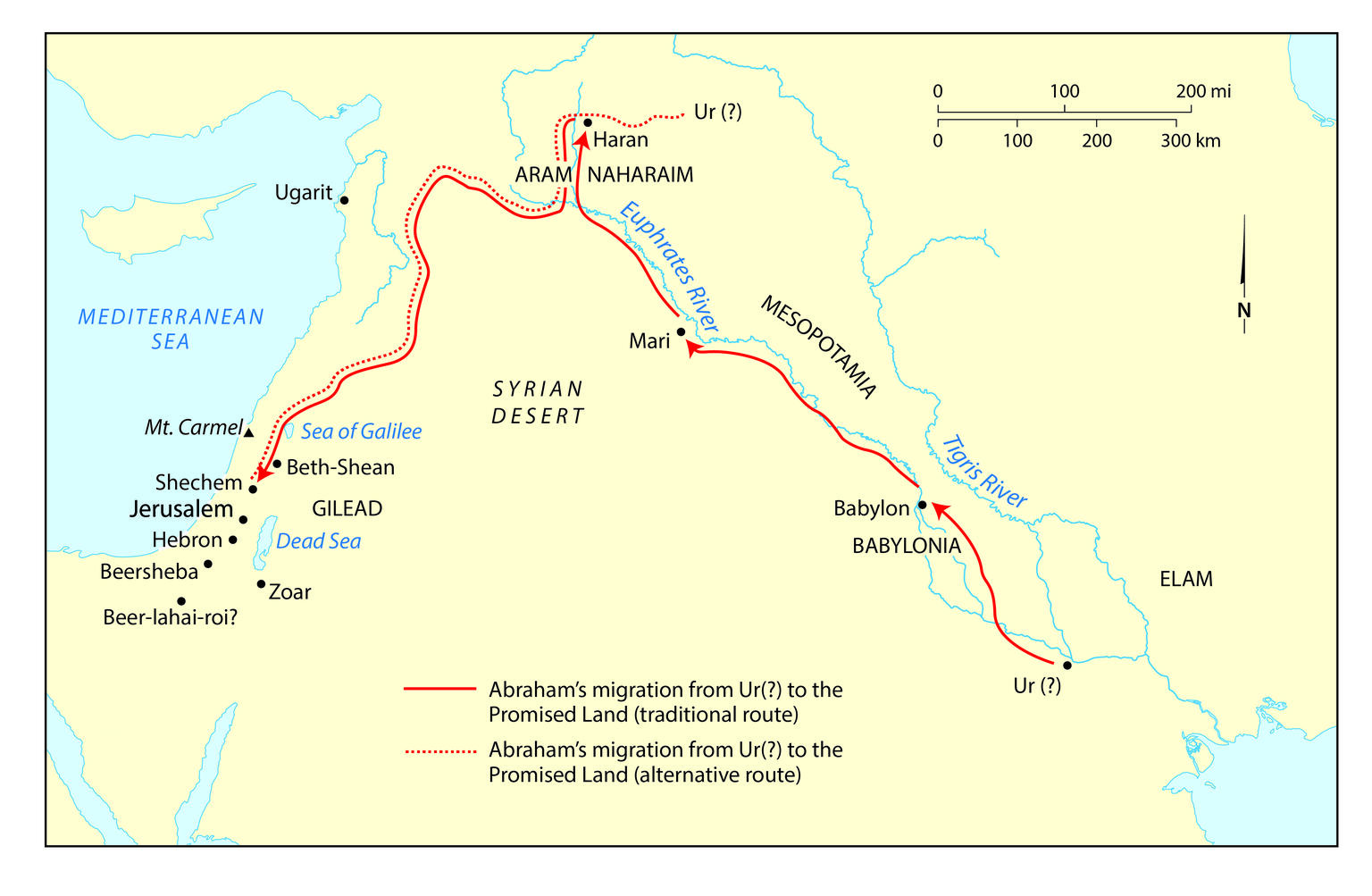
- The chapter begins with a slow walk back. Abram comes up out of Egypt, through the Negev, all the way to Bethel, where he had pitched his first altar. The narrator gives us the geography in detail because the geography is the theology. The man who failed in Egypt does not start over in a new place. He goes back to the altar. The covenant life works by return, not reinvention.
- Verse 2 reports the wealth bluntly: “Abram was very rich in livestock, in silver, and in gold.” We know where most of this came from. Genesis 12:16 told us Pharaoh “dealt well with Abram for [Sarai’s] sake,” and listed the same kinds of holdings. The Hebrew word kavod in this verse (often translated “rich” or “weighty”) is the same word used elsewhere for “glory.” Abram has come out of Egypt heavy with goods. The text doesn’t moralize, but it doesn’t celebrate either. It just notes what he carries.
- Verse 4 contains the small line that does the work of the section: “There Abram called on Yahweh’s name.” After the failure in Egypt, before any of the conflict that follows, the first thing Abram does is worship at the altar he built before the failure. That’s the theological gesture the chapter wants you to see. Worship is what reorients him.
Influence callout: Ray Vander Laan
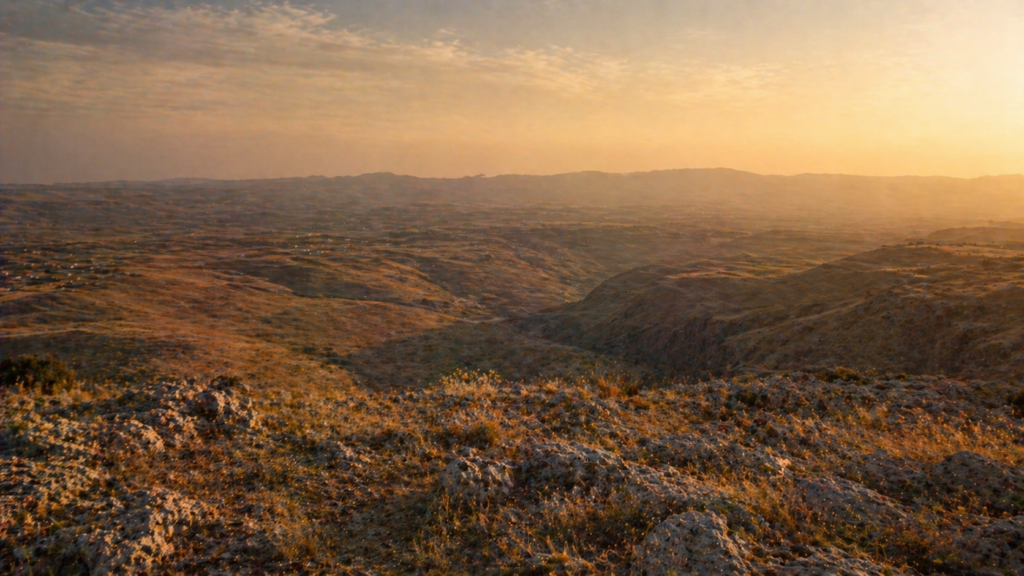
Vander Laan teaches the Bethel-Ai ridge as a real place you can stand on. From the high country between the two ridges, you can see the central highlands stretching north, the wilderness to the east, and the Jordan Rift Valley dropping away below you. Abram, in Vander Laan’s reading, is not just at “an altar.” He is at a vantage point on the spine of the land, calling on Yahweh’s name in the place where the geography preaches the promise. The altars of Abram are the high places of trust, scattered like markers along the route of his obedience.
- Verses 5 and 6 introduce the practical problem: there’s not enough water. Lot has herds too. The land cannot carry them both. The Hebrew is direct: “the land was not able to bear them” (nasa with a negative). The land is being asked to do what no land in this region can do for two large pastoral households at once. The conflict is not personal at first; it’s hydraulic.
- Verse 7 closes the section with the small comment: “The Canaanite and the Perizzite lived in the land at that time.” The narrator has told us this before (12:6) and will tell us again. The reminder is doing two things. First, it complicates the romantic picture of Abram and Lot as the only people on the landscape. They are guests in a populated country. Second, it heightens the awkwardness: a herdsman quarrel between two related Hebrew families, in front of the locals, is not a witness to anything. The chapter is going to resolve the conflict in a way that lets the family rejoin its calling.
B · Genesis 13:8–13 · The separation
⁸ Abram said to Lot, “Please, let there be no strife between you and me, and between your herdsmen and my herdsmen; for we are relatives. ⁹ Isn’t the whole land before you? Please separate yourself from me. If you go to the left hand, then I will go to the right. Or if you go to the right hand, then I will go to the left.” ¹⁰ Lot lifted up his eyes, and saw all the plain of the Jordan, that it was well-watered everywhere, before Yahweh destroyed Sodom and Gomorrah, like the garden of Yahweh, like the land of Egypt, as you go to Zoar. ¹¹ So Lot chose the Plain of the Jordan for himself. Lot traveled east, and they separated themselves the one from the other. ¹² Abram lived in the land of Canaan, and Lot lived in the cities of the plain, and moved his tent as far as Sodom. ¹³ Now the men of Sodom were exceedingly wicked and sinners against Yahweh. (Genesis 13:8–13, World English Bible)
- Abram speaks first, and he speaks generously. He’s the elder. By every cultural convention of the time, the right of first choice belongs to him. He waives it. “Please separate yourself from me. If you go to the left hand, then I will go to the right.” The Hebrew uses the courtesy particle (na, “please”) twice. Abram is not commanding; he is requesting. The man who lied to Pharaoh in chapter 12 is now, in chapter 13, the one yielding the better land to a junior relative. Something is forming in him.
Pushback note
A common reading turns Abram’s offer into a clever maneuver: “He knew Yahweh would protect his portion regardless, so he could afford to be generous.” Maybe. The text doesn’t say that. The text just shows the offer. The simpler and more demanding reading is that Abram makes a generous, faith-shaped choice without knowing in advance how it will turn out. That’s what makes it faith. Stripping the risk out of the gesture by making Abram secretly confident misses the point of the gesture.
- Verse 10 is the chapter’s hinge. Lot lifted up his eyes, and saw. The verb here (“lifted up his eyes,” vayisa et einav) is the same Hebrew construction Abram will use at the end of the chapter (verse 14) when Yahweh tells him to do the same thing. Two characters, same physical action: looking out over the land. Same chapter. Different theology. Lot lifts his eyes and sees what looks profitable. Abram, when he lifts his eyes, sees what Yahweh is giving. The narrator is pairing the two scenes deliberately.
Influence callout: Tim Mackie
Mackie reads the description of the Jordan plain as a deliberate “double-marker” of trouble: it looked “like the garden of Yahweh” and “like the land of Egypt.” The first phrase is Eden imagery. The second is Egypt imagery. The narrator is hyperlinking both ways. Eden is the place humanity was placed and then expelled from. Egypt is the place Abram just came out of. To choose a place that looks like both is to choose a place poised on the edge of both expulsions. Mackie’s eye for narrative hyperlinks is on full display here. The reader who has been paying attention is supposed to feel the warning before Lot does.
- Notice the direction. “Lot traveled east.” In Genesis, east is the direction of distancing. Adam and Eve are sent east of Eden (3:24). Cain settles east of Eden (4:16). The whole human migration before Babel goes east (11:2). Lot travels east. This is not a travel detail. It’s a theological compass. The narrator is signaling that Lot’s good business decision is also a spiritual drift.
Influence callout: Ray Vander Laan
Vander Laan and a few other students of biblical geography note that the Jordan plain in this period (before the destruction of the cities) was likely an irrigated agricultural zone, possibly fed by canals tied to the Jordan and the Dead Sea inflow. The “well-watered everywhere” phrase isn’t just lyrical; it’s economic. Lot is moving to a region with a surplus economy, urban centers, and the cosmopolitan opportunities the cities of the plain offered. His drift toward Sodom is, in part, a drift toward a way of life Abram was not called to share.
- Verse 12 narrates the move in two short clauses: “Abram lived in the land of Canaan, and Lot lived in the cities of the plain, and moved his tent as far as Sodom.” The Hebrew verb for “moved his tent” implies a gradual shift. Lot doesn’t enter Sodom immediately. He drifts toward it, tent-stake by tent-stake. By chapter 19 he will be living inside the city, sitting at the gate, fully embedded. The chapter is recording the first frame of that long story.
- Verse 13 is one of the bluntest narratorial comments in Genesis: “Now the men of Sodom were exceedingly wicked and sinners against Yahweh.” The text doesn’t tell us yet what their wickedness consists of. Ezekiel 16:49 will later name it (“she and her daughters had pride, fullness of food, and prosperous ease, and didn’t strengthen the hand of the poor and needy”). For now, the narrator just plants the warning. Lot is moving into a city the narrator already knows is doomed.
C · Genesis 13:14–18 · The renewed promise
¹⁴ Yahweh said to Abram, after Lot was separated from him, “Now, lift up your eyes, and look from the place where you are, northward and southward and eastward and westward, ¹⁵ for I will give all the land which you see to you and to your offspring forever. ¹⁶ I will make your offspring as the dust of the earth, so that if a man can count the dust of the earth, then your offspring may also be counted. ¹⁷ Arise, walk through the land in its length and in its width; for I will give it to you.” ¹⁸ Abram moved his tent, and came and lived by the oaks of Mamre, which are in Hebron, and built an altar there to Yahweh. (Genesis 13:14–18, World English Bible)
- The renewed promise comes “after Lot was separated from him” (verse 14). The timing is theological. As long as Lot was attached to the narrative as a possible heir-by-default (Abram has no son; Lot is his nephew), the promise was ambiguous: maybe Lot is the seed. With Lot’s departure, the question of the heir is left open in a new way. Yahweh reaffirms the promise to Abram alone. The seed will not come through Lot. It will come through Abram and (eventually) through Sarai.
- “Lift up your eyes” (verse 14). The same construction Lot used in verse 10. Yahweh is restoring to Abram the very gesture Lot used to make a faithless choice. The lifted eye is now a sanctified eye. It is going to see the same kind of land in a different way.
- The promise has three components, all amplified from chapter 12. Land: in every direction, “to you and your offspring forever.” Offspring: as the dust of the earth, an image of innumerability. Vocation: “arise, walk through the land in its length and in its width.” All three are familiar; all three are now sharper. The promise is not new. It is being deepened by repetition.
Influence callout: N.T. Wright
Wright reads the dust-of-the-earth promise here, paired with the stars-of-the-heavens promise in Genesis 15, as two halves of the same covenant intent. Dust speaks of earth-bound multiplication; stars speak of cosmic destiny. The covenant family will be both numerous and significant; they will fill the earth and they will reach toward heaven. Read forward into the New Testament, the promise of the family of Abraham becomes the family of Christ, drawn from every nation, comprising both ordinary humans (dust) and a cosmic-scale calling (stars). The chapter is, in Wright’s frame, already gesturing toward the universal scope of what God is doing.
- “Walk through the land in its length and in its width.” This command is sometimes overlooked. The Hebrew is hithallech, the same verb used for Adam and Eve walking with God in the garden (Genesis 3:8) and for Enoch and Noah walking with God (Genesis 5:22, 24; 6:9). It is the verb of covenant fellowship. To walk the land is not to survey it as property. It is to live it as gift. The patriarchs will keep doing this for the rest of Genesis. Their descendants will inherit the walking memory.
Framework note
The walking-the-land theme will recur in the conquest narratives (Joshua 1:3, “every place that the sole of your foot will tread upon, I have given to you”), in the prophetic literature (Isaiah’s walking imagery), and in the Gospels (Jesus walks the same land, often along the same routes). The covenant family is a walking family. Their relationship to the land is shaped by the soles of their feet, not the boundaries of a deed.
- Verse 18 closes the chapter at Hebron. Abram moves his tent to “the oaks of Mamre” and builds another altar. Hebron will become his lifelong base. Sarah will be buried there (Genesis 23). Abraham himself will be buried there (Genesis 25). David will be anointed king there (2 Samuel 2:4). The chapter ends with the patriarch settling into the place that will become the geographic spine of the rest of his story. He has no son. He has no city. He has no deed to the land. He has an altar, a tent, and a promise that grows by being walked.
Reflection prompts
- The chapter opens with Abram going back to his first altar before doing anything else. After a stumble or a season away, what does it look like for you to “go back to the altar” before resolving the next thing? Where is your Bethel?
- Lot lifts his eyes and chooses by sight. Abram lifts his eyes only after God tells him to. Both characters are doing something that looks like discernment. What’s the difference, in your own life, between a choice you make by lifting your eyes to the available options and a choice you make by lifting your eyes to receive what God is giving?
- The chapter ends with no son, no deed, and no city. Just an altar at the oaks of Mamre. What does it mean to settle, faithfully, into a place that is not yet what it will be? Where in your life is God asking you to plant a tent and wait?