

Exodus 7 is the chapter where the contest between YHWH and Pharaoh becomes visible. The negotiation phase is over. Moses and Aaron walk back into Pharaoh’s court with God’s authorization to perform signs, and the plague cycle begins. The chapter contains two events: the staff-and-serpent contest in the throne room, and the first plague, water turned to blood. By the end of the chapter, the Nile is undrinkable, the fish are dying, the magicians have replicated the sign in miniature, and Pharaoh’s heart has been hardened for the first time.
But the chapter is doing more than narrating the start of the plagues. It is announcing the meaning of the plagues. Verses 5 and 17 say the same thing in two different mouths: and Egypt will know that I am YHWH. The plagues are not just punishment. They are revelation, a sustained tutorial, plague by plague, in who YHWH is and who Egypt’s gods are not. The chapter also introduces the Hebrew vocabulary of Pharaoh’s heart, kavod, chazaq, qashah, three different verbs the rest of Exodus will use to track the deepening of Pharaoh’s refusal. The contest is theological from the first sign.
A · Exodus 7:1-7 · “I have made you as God to Pharaoh”
¹ Yahweh said to Moses, “Behold, I have made you as God to Pharaoh; and Aaron your brother shall be your prophet. ² You shall speak all that I command you; and Aaron your brother shall speak to Pharaoh, that he let the children of Israel go out of his land. ³ I will harden Pharaoh’s heart, and multiply my signs and my wonders in the land of Egypt. ⁴ But Pharaoh will not listen to you, so I will lay my hand on Egypt, and bring out my armies, my people the children of Israel, out of the land of Egypt by great judgments. ⁵ The Egyptians shall know that I am Yahweh, when I stretch out my hand on Egypt, and bring the children of Israel out from among them.” ⁶ Moses and Aaron did so. As Yahweh commanded them, so they did. ⁷ Moses was eighty years old, and Aaron eighty-three years old, when they spoke to Pharaoh.
- I have made you as God to Pharaoh. The Hebrew is netatikha elohim le-far’oh, I have given you as God to Pharaoh. The construction is striking. Moses is being placed in the position of God relative to Pharaoh. Aaron is being placed in the position of prophet relative to Moses. The chain is precise: God speaks to Moses; Moses speaks to Aaron; Aaron speaks to Pharaoh. Where Pharaoh in Egyptian theology is a god (the Son of Ra), the Hebrew Bible is now installing Moses in that conceptual position vis-à-vis the very Pharaoh who claims it. The text is doing theological warfare on Pharaoh’s claim to divinity by placing Moses in that role.
- The chapter is also explaining how prophets work. Speak all that I command you; Aaron will speak to Pharaoh; I will harden Pharaoh’s heart. The prophet does not generate the message; the prophet carries the message. Solomon’s note: this is the Hebrew Bible’s foundational definition of prophecy. The prophet is not a fortune-teller; the prophet is a conduit.
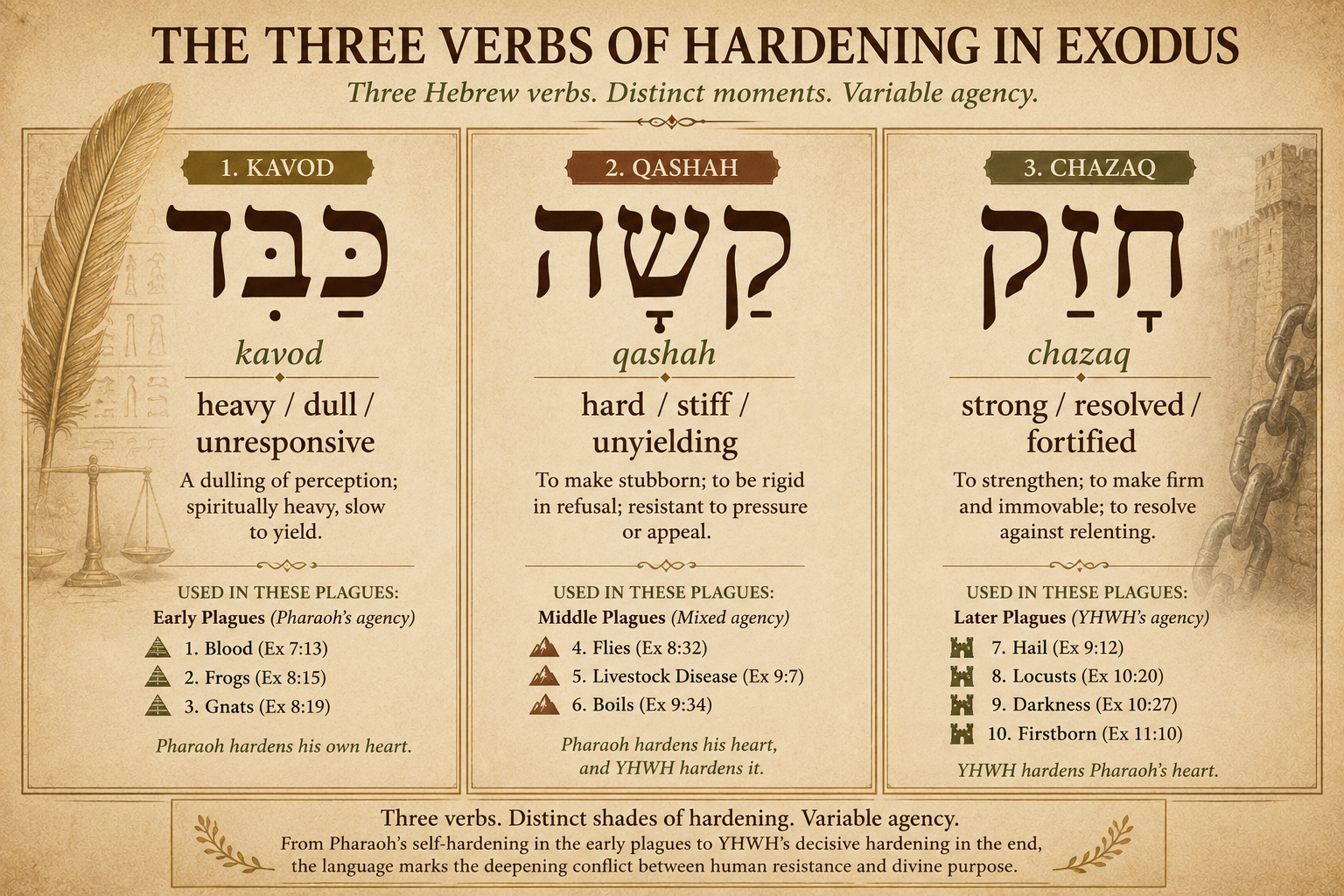
- I will harden Pharaoh’s heart. The Hebrew is ani aqsheh et-lev par’oh. The verb here is qashah, to make hard. The Bible uses three different Hebrew verbs across the plague cycle for what happens to Pharaoh’s heart, and they are not interchangeable:
- kavod, “to make heavy / dull / unresponsive”: the heart that no longer feels the weight of evidence (Ex 7:14; 8:15, 32; 9:7, 34; 10:1).
- qashah, “to make hard / stiff / unyielding”: the resolved refusal (Ex 7:3; 13:15).
- chazaq, “to make strong / strengthened / resolute”: the deepened resolve (Ex 4:21; 7:13, 22; 8:19; 9:12, 35; 10:20, 27; 11:10; 14:4, 8, 17).
Read the chapter (and the next several chapters) tracking which verb appears each time. Solomon’s reading (drawing on Fohrman): early in the plague cycle, Pharaoh kavods (dulls / hardens) his own heart. Then God begins to chazaq (strengthen) Pharaoh in the direction Pharaoh has already chosen. Imes’s read: this is intensification, not override. God is not bypassing Pharaoh’s will; God is amplifying Pharaoh’s chosen resolve so that the consequences play out fully. Solomon adds the warmer reading: God is also patiently pursuing Pharaoh up to the very last moment, giving him chance after chance to relent. The two readings are compatible.
- Pharaoh will not listen to you, so I will lay my hand on Egypt. God names the outcome before the contest begins. The plagues will happen because Pharaoh will refuse. The “stretching out the hand” language echoes 6:6 (I will redeem you with an outstretched arm), God’s hand against Pharaoh’s hand. The contest is strong hand against strong heart.
- The Egyptians shall know that I am YHWH. This is the chapter’s second-most-important verse, and it will reappear in v. 17 with Pharaoh as the explicit subject of the knowing. The plagues are epistemological events. Egypt is going to learn who YHWH is. The contest is not first about freeing Israel; it is about teaching Egypt. Pharaoh’s “I do not know YHWH” (5:2) will be answered by the plagues: and Egypt will know. The book is teaching that God’s deliverance is not just rescue; it is revelation. Pharaoh’s empire is being given a sustained tutorial in who is actually God.
- Moses was eighty years old, and Aaron eighty-three. The chapter pauses to record their ages. Moses spent forty years in Pharaoh’s court, forty in Midian, and now begins the deliverance work at eighty. The Hebrew Bible loves these temporal markers. Moses is older than the Pharaoh he stands before, older than every Israelite he leads, older than the deliverance is going to take to complete. The text is teaching that God’s deliverers are sometimes called late and used long.
B · Exodus 7:8-13 · The staff that ate the staffs
⁸ Yahweh spoke to Moses and to Aaron, saying, ⁹ “When Pharaoh speaks to you, saying, ‘Perform a miracle!’ then you shall tell Aaron, ‘Take your rod, and cast it down before Pharaoh, that it become a serpent.’” ¹⁰ Moses and Aaron went in to Pharaoh, and they did so, as Yahweh had commanded. Aaron cast down his rod before Pharaoh and before his servants, and it became a serpent. ¹¹ Then Pharaoh also called for the wise men and the sorcerers. They also, the magicians of Egypt, did the same thing with their enchantments. ¹² For they each cast down their rods, and they became serpents; but Aaron’s rod swallowed up their rods. ¹³ Pharaoh’s heart was hardened, and he didn’t listen to them, as Yahweh had spoken.
- Perform a miracle! The Hebrew is tnu lakhem mofet, give yourselves a sign. Pharaoh demands credentialing. He is treating the moment as a contest of magicians, not a confrontation with deity. The text shows him misreading the situation from the first request.
- Aaron cast down his rod before Pharaoh, and it became a serpent. The Hebrew word for serpent here is tannin: not the nachash of Ex 4:3. Tannin is a larger creature: the sea monster, the dragon, sometimes the crocodile. In Egyptian iconography, the tannin is associated with the sea-chaos serpent Apophis, the enemy of the sun-god Ra; Pharaoh is Ra’s son; defeating Apophis is part of Pharaoh’s mythological identity. The Hebrew word choice is loaded. Aaron’s staff becomes the very figure Pharaoh’s mythology says Pharaoh defeats.
- The Hebrew word tannin will reappear in Ezekiel 29:3, where YHWH calls Pharaoh himself the great tannin lying in the midst of his streams. The Bible is staging a quiet wordplay across centuries: Pharaoh is the tannin. Aaron’s tannin swallows Pharaoh’s tannin. The staff-contest in Ex 7 is foreshadowing the Sea-event in Ex 14: Pharaoh-as-tannin will be swallowed by the waters that YHWH commands.
- Pharaoh also called for the wise men and the sorcerers. Egypt’s magicians (later named in 2 Tim 3:8 as Jannes and Jambres) replicate the sign. Their rods, too, become serpents. The Hebrew Bible is honest about this: real magic, of some kind, happens in Pharaoh’s court. The text does not say the magicians faked it or the magicians were tricked. They genuinely produced a duplicate sign. The contest is not over whether Egyptian magic is real; the contest is over whether it is equal.
- Aaron’s rod swallowed up their rods. The Hebrew is vayivla matteh-Aharon et-matotam, and Aaron’s staff swallowed their staffs. The verb bala (swallow) is the same verb that will describe the earth swallowing Korah’s company in Num 16:32 and the Sea swallowing Pharaoh’s chariots in Ex 15:12. Bala is a judgment verb. The chapter is establishing, in the throne room before the first plague, that YHWH’s sign consumes Pharaoh’s signs. This is the contest’s grammar. Whatever Pharaoh produces, YHWH’s response is more, and ultimately consumes the produced thing entirely.
- They each cast down their rods… but Aaron’s rod swallowed their rods. Notice the verbal economy. Brent’s note (in Solomon’s Bema reading) is worth pausing on: Pharaoh never throws his own rod down. He delegates. He calls for his wise men. He has his magicians cast their rods. Pharaoh himself never enters the contest with his own staff. He hides behind proxies. The Hebrew Bible is making a quiet point about empire: empires fight by proxy; they do not put themselves on the line. Moses, by contrast, throws his own rod down. Aaron throws his own rod down. The deliverers are exposed in a way Pharaoh never is.
- Pharaoh’s heart was hardened. The Hebrew is vaye-chezaq lev par’oh. Pharaoh’s heart was strengthened / made resolute. The verb is chazaq. The same word God uses in v. 3 of his own role in the hardening. The chapter is teaching, from the first instance, that Pharaoh’s heart and God’s hand are entangled in a way the text refuses to fully sort out. Imes’s reading: God’s chazaq of Pharaoh is intensification of what Pharaoh has already chosen. Pharaoh has already, in v. 11, called for his magicians to contest God’s sign. The hardening is the strengthening of that refusal.
Word study: kavod, qashah, chazaq: the three Hebrew verbs of Pharaoh’s heart
Across the plague cycle, the text uses three different Hebrew verbs to describe what happens to Pharaoh’s heart, and they are not interchangeable.
Kavod (כָּבֵד), to be heavy, dull, unresponsive. The same root as kavod (glory / weight). To have a kavod heart is to have a heart so weighed down that it cannot perceive what is happening. Pharaoh kavods his heart through plagues 1-5 (Ex 7:14; 8:15, 32; 9:7).
Qashah (קָשָׁה), to be hard, stiff, unyielding. To qashah the heart is to make it stiff against persuasion. The verb appears in 7:3 (God’s announcement of what he will do) and 13:15 (Pharaoh’s eventual final state). It is the resolved-refusal word.
Chazaq (חָזַק), to be strong, resolved, fortified. The same root as chazaq (strong). To chazaq the heart is to strengthen it in its chosen direction. This is the verb most often used by God of his own role in the hardening, God strengthens Pharaoh in the direction Pharaoh has already chosen. The verb cluster is dense in the later plagues (Ex 9:12; 10:20, 27; 11:10; 14:4, 8, 17).
The three verbs together name what Imes calls intensification and Solomon (drawing on Fohrman) calls divine pursuit and human refusal in tension. Pharaoh hardens his own heart; God strengthens Pharaoh in Pharaoh’s chosen direction; the result is that resolved refusal becomes irreversible. The text refuses to simplify this into either pure determinism or pure libertarian free will. Both Pharaoh and God are agents in the hardening, in a way the Hebrew Bible holds together without resolving.
The Egyptian backdrop: weighing the heart against the feather of Ma’at. The choice of kavod (heavy) is almost certainly doing wordplay against an Egyptian theological framework. In Egyptian afterlife religion (codified in the Book of the Dead, especially Spell 125), every soul faced the Hall of Ma’at: the heart (ib) was weighed on a balance against the feather of Ma’at. The goddess whose name means truth, order, justice, cosmic right. Anubis tended the scales; Thoth, the scribe-god, recorded; Osiris presided. If the heart was lighter than or equal to the feather, the deceased was ma’a-kheru, true of voice, and entered the afterlife. If the heart was heavier, it was devoured by Ammit, the crocodile-lion-hippopotamus Devourer of Hearts, and the soul was annihilated. A heavy heart is, in Egyptian religion, the technical term for moral failure exposed in judgment.
Pharaoh, in Egyptian theology, is son of Ra and the human guarantor of Ma’at on earth. The king whose role is to keep cosmic order in balance. The Hebrew narrator’s choice to describe his heart as kavod, heavy, is therefore a piercing polemic in Pharaoh’s own theological vocabulary. By the standard of the Egyptian afterlife, Pharaoh’s heart is already failing the test. The plagues are not merely Hebrew indictment; they are the public exposure of what every Egyptian’s funerary ritual would condemn. The Egyptians watching their king refuse YHWH are watching, in their own theological language, a man whose heart will not pass the weighing. The Hebrew Bible is making the polemic devastating: Pharaoh is wicked by Egyptian standards too. He cannot win on his own home court. This sharpens the recurring refrain and Egypt will know that I am YHWH. The Egyptians are being given, plague by plague, evidence that their own theology condemns their king.
- And he didn’t listen to them, as YHWH had spoken. The Hebrew is ve-lo’ shama aleyhem ka’asher diber YHWH, and he did not listen to them, as YHWH had said. The verb shama (listen) is the same verb Pharaoh refused in 5:2. The pattern is being set: Pharaoh refuses to listen, and the refusal is described as exactly what YHWH said would happen. The plagues will not be the surprise. They will be the working out of what has already been announced.
C · Exodus 7:14-25 · The first plague: water to blood
¹⁴ Yahweh said to Moses, “Pharaoh’s heart is stubborn. He refuses to let the people go. ¹⁵ Go to Pharaoh in the morning. Behold, he goes out to the water. You shall stand by the river’s bank to meet him. You shall take the rod which was turned to a serpent in your hand. ¹⁶ You shall tell him, ‘Yahweh, the God of the Hebrews, has sent me to you, saying, “Let my people go, that they may serve me in the wilderness. Behold, until now you haven’t listened.” ¹⁷ Yahweh says, “In this you shall know that I am Yahweh. Behold, I will strike with the rod that is in my hand on the waters which are in the river, and they shall be turned to blood. ¹⁸ The fish that are in the river shall die, and the river shall become foul. The Egyptians shall loathe to drink water from the river.”‘” ¹⁹ Yahweh said to Moses, “Tell Aaron, ‘Take your rod, and stretch out your hand over the waters of Egypt, over their rivers, over their streams, and over their pools, and over all their ponds of water, that they may become blood. There shall be blood throughout all the land of Egypt, both in vessels of wood and in vessels of stone.’” ²⁰ Moses and Aaron did so, as Yahweh commanded; and he lifted up the rod, and struck the waters that were in the river, in the sight of Pharaoh, and in the sight of his servants, and all the waters that were in the river were turned to blood. ²¹ The fish that were in the river died. The river became foul. The Egyptians couldn’t drink water from the river. The blood was throughout all the land of Egypt. ²² The magicians of Egypt did the same thing with their enchantments. So Pharaoh’s heart was hardened, and he didn’t listen to them, as Yahweh had spoken. ²³ Pharaoh turned and went into his house, and he didn’t even take this to heart. ²⁴ All the Egyptians dug around the river for water to drink; for they couldn’t drink the river water. ²⁵ Seven days were fulfilled, after Yahweh had struck the river.
- Pharaoh’s heart is stubborn. The Hebrew is kaved lev par’oh, Pharaoh’s heart is heavy. The first occurrence of kavod in the heart-hardening sequence. Pharaoh himself has a heavy heart. God has not yet acted to harden it (the chazaq of v. 13 was the immediate response to the staff-sign; this kavod in v. 14 is the underlying state). The text is precise.
- Pharaoh’s heart is heavy, and the same Hebrew root kavod is the word that means glory. The Hebrew Bible’s wordplay is theological: Pharaoh’s heavy (kavod) heart will be confronted by the kavod of YHWH (Ex 16:7, 10; 24:16-17; 33:18-22; 40:34-35). Two kavods in conflict: Pharaoh’s heavy refusal and YHWH’s heavy presence. By Ex 40, YHWH’s kavod fills the tabernacle and Moses cannot enter. By the end, kavod will belong only to YHWH; Pharaoh’s kavod-heart will be left at the bottom of the Sea.
- Behold, he goes out to the water. Pharaoh goes to the Nile in the morning. Why? The Egyptian Pharaoh ritually visits the Nile in the morning as part of his daily worship of Hapi (the Nile god) and as part of his role in maintaining cosmic order. Mackie’s note: the Pharaoh is performing daily ritual maintenance of Egypt’s cosmology when Moses meets him. Aaron’s first plague is going to strike Pharaoh’s morning religious practice. The plague is theologically targeted from its first instant.
- Strike the waters… they shall be turned to blood. The Nile is the heart of Egypt. The Greek historian Herodotus called Egypt “the gift of the Nile.” Egypt’s agriculture, trade, and religion all flowed from the river. To strike the Nile is to strike Egypt’s economy, ecology, and theology in one act. The river turns to blood, and the Hebrew word dam (blood) is being deployed deliberately. Pharaoh poured Hebrew baby blood into the Nile (Ex 1:22). YHWH now turns the Nile into blood. The plague is measure for measure. The Hebrew Bible’s principle of middah ke-neged middah (measure against measure) is at work from the first plague.
- In this you shall know that I am YHWH. The Hebrew is be-zot teda ki ani YHWH, by this you will know that I am YHWH. Verse 17 places the plague’s purpose in Pharaoh’s mouth-receiving ear: the plague is for Pharaoh’s knowing. The plagues are not punitive in the abstract; they are pedagogical. Pharaoh is being taught.
- The fish that were in the river died. The river became foul. The destruction is comprehensive. The Hebrew is vatib’ash ha-yeor, the river stank. The smell of dying fish in a hot Egyptian summer. The Nile is a sewer for seven days. The economic, ecological, and aesthetic impact is total.
- The magicians of Egypt did the same thing with their enchantments. For the second time, the Egyptian magicians replicate. They produce blood somewhere, though the irony is, by this point, all the water in Egypt is already blood; what are they replicating into? Goldingay’s amused note: the magicians are now competing in a world where their competition has already turned everything to blood. They have nothing left to do but perform a redundant sign.
- The text’s deeper point: Pharaoh’s magicians can replicate the harm but cannot reverse it. They can turn water to blood. They cannot turn blood back to water. Empire’s magic, in the Hebrew Bible, can do destruction but cannot do healing. The same will hold true through the plague cycle: the magicians replicate the second plague (frogs, Ex 8:7), then fail at the third (gnats, Ex 8:18-19), and from that point disappear. Empire’s “wisdom” runs out at exactly the point where it is asked to undo the harm it has caused.
- Pharaoh turned and went into his house, and he didn’t even take this to heart. The Hebrew is ve-lo’ shat libo gam la-zot, and he did not set his heart even to this. Solomon’s note: Pharaoh literally walks past the disaster. His response to the first plague is not even to think about it. The chapter is naming the depth of denial. Pharaoh’s heart-problem is not, primarily, defiance; it is refusal-to-perceive. He goes home as though nothing happened.
- All the Egyptians dug around the river for water to drink. The text closes the plague with the everyday Egyptian’s response. The common people, who have done none of this, are scrambling to find drinkable water in the riverbank sand. Egypt’s poor suffer Pharaoh’s refusal alongside Pharaoh. The text records this without comment, but the comment is felt. Empire’s hard-heart costs the empire’s ordinary people.
- Seven days were fulfilled. The plague lasts a full week. The Hebrew Bible loves seven-day patterns (creation week, Sabbath, the dedication of Solomon’s temple, the seven sevens of Pentecost). The first plague’s duration is itself theological: a week of judgment, an inverted creation-week, where the waters that should support life produce stench and death. Where Genesis 1’s first day separated the waters and called the gathering good, Ex 7’s first plague turns the gathered waters to blood and lets them rot. The plagues are an un-creation of Egypt, and the contrast with Genesis 1 is deliberate.
Influence callout: Tim Mackie (BibleProject, The Plagues of Egypt)
Mackie reads the plagues as a sustained theological polemic, not just punishment. Each plague targets an Egyptian deity: the Nile (Hapi), the frogs (Heqet), the cattle (Apis), the sky and storm (Nut, Set), the sun (Ra), and finally the firstborn (Pharaoh-as-Son-of-Ra). The plagues are dismantling Egypt’s pantheon one god at a time. The Hebrew Bible’s claim is that the entire Egyptian theological system is empty, that beneath the elaborate Egyptian worldview is a vacuum, and YHWH is the only one home in the cosmos. Mackie’s pastoral note: the plagues are the loud sermon Pharaoh refuses to hear. And Egypt will know that I am YHWH is the recurring punctuation. By the time Pharaoh’s heart is finally broken (the tenth plague), Egypt has been given ten consecutive lessons in who is actually God. The text is patient about the lesson; Pharaoh is the one who refuses to learn.
- The chapter ends after the first plague. Six more remain before the firstborn night. The pattern is established. Pharaoh’s heart is hardening. YHWH’s hand is stretched out. Egypt’s theology is being taken apart. The contest is fully joined.
Reflection prompts
- I have made you as God to Pharaoh. Moses, the man who said who am I?, is now installed in the position of God vis-à-vis the most powerful man in the world. The promotion is not about Moses; it is about whom God chooses to use. Where, in your own life, has God placed you in a position larger than your sense of yourself? What does it mean to step into the role God has assigned without first re-litigating whether you are worthy of it?
- The text uses three different Hebrew verbs for what happens to Pharaoh’s heart, kavod, qashah, chazaq. Three different ways a heart can refuse. Heavy (no longer feels the weight of evidence). Hard (stiff against persuasion). Strengthened (resolved in its chosen direction). Where, in your own life, has your heart been moving in any of these three modes? Which one is most active, and what would it take to soften before it is qashah-ed permanently?
- He didn’t even take this to heart. Pharaoh’s response to the Nile turning to blood is to walk back into his house. Where, in your own life, are you walking past a disaster you should be facing? What is your version of “not setting your heart even to this”?
Frameworks at play in this chapter: the divine council, counter-imperial reading.