

Genesis 12 is the pivot of the whole book. Chapters 1 through 11 lay out a cosmic problem: a good creation, a vocation given to humanity, a series of human refusals (the garden, the murder, the flood, the tower), and a world that ends up scattered across the face of the earth, fragmented by language and grasping after empire. Genesis 11 ends with humanity dispersed and one man, Terah, taking his family from Ur of the Chaldees and stopping in Haran.
Then Genesis 12 begins. And the entire shape of the story changes.
God speaks to Abram. He doesn’t address the assembled nations; he doesn’t restart creation; he doesn’t issue a universal decree from the heavens. He calls one man out of one city in one ancient family, and tells him to leave. The first three verses contain a call (“go from your country”), a destination (“to the land that I will show you”), and a promise that begins with Abram personally and ends with “all the families of the earth.” The strategy of the rest of the Bible is set right here. God will deal with the universal human problem by means of a particular family. Israel will be for the sake of the world.
The chapter is also disarmingly honest. Abram hears the call, packs his household, and goes. He builds altars at Shechem and Bethel. He calls on the name of Yahweh. And then, at the first hint of trouble (a famine), he descends into Egypt, lies about his wife to save his own neck, and ends up bringing trouble on the very people he was called to bless. The man God chose to begin undoing Adam’s failure starts off looking very much like Adam.
That’s not a failure of the chapter. It’s the chapter’s argument. The covenant is going to work because God is faithful, not because Abram is exceptional.
→ Read the divine council framework for the background on what happens between Babel and the call of Abram. After the nations are scattered and assigned to other powers, Yahweh takes one family for himself.
A · Genesis 12:1–3 · The call
¹ Now the LORD said to Abram, “Go from your country and your kindred and your father’s house to the land that I will show you. ² I will make of you a great nation, and I will bless you, and make your name great, so that you will be a blessing. ³ I will bless those who bless you, and the one who curses you I will curse, and in you all the families of the earth shall be blessed.” (Genesis 12:1–3, NRSVue)
- The call begins with one Hebrew construction: lech-lecha. Most English translations render it simply “Go,” sometimes “Go forth.” The Hebrew is more layered. It’s a verb of motion (“go”) followed by a preposition with the second-person suffix (“for/to yourself”). Some grammarians read the second word as an emphatic (“just go”); others, drawing on a long rabbinic reading tradition, read it as “go to yourself,” meaning leave the inherited identity behind and travel toward the person God is calling you to become. The phrase will appear only one other time in the Hebrew Bible, in Genesis 22:2, where God will say to Abraham, “lech-lecha to the land of Moriah,” and ask for Isaac. The bookend is intentional. The first lech-lecha asks Abram to leave his past; the second will ask him to surrender his future. Between them sits the entire shape of the covenant life.
Word study: lech-lecha (לֶךְ־לְךָ)
A two-word imperative that resists clean translation. Lech is the imperative “go.” Lecha is the preposition le- (“to/for”) with the second-person masculine singular suffix (“you”). At minimum it’s “go for yourself” or simply “go.” Read more deeply, it’s “go to yourself,” a rabbinic reading that pictures the journey toward Canaan as a journey toward Abram’s true vocation. The phrase frames the covenant: Abram is asked to leave who he was in order to discover who God is calling him to be.
- The call is structured as three concentric departures: country, kindred, father’s house. In an ancient Near Eastern setting, this is not a casual move. Eretz (country) names the political world; moledet (kindred) names the extended clan; beit av (father’s house) names the immediate household, which in patriarchal cultures was your identity, your inheritance, and your social safety net. To leave all three is to step out of every category that would have told Abram who he was. He’s being asked to become someone defined entirely by the God who is calling him.
Influence callout: Ray Vander Laan
Vander Laan, who has spent a career walking the lands of the Bible, presses the cultural cost of this command. In an honor-shame culture, identity is given by the family you belong to. To leave country, clan, and father’s house is to leave behind every social structure that names you. It is a kind of social death. The land Abram is being sent to (Canaan) is the land bridge between three continents, the busiest crossroads of the ancient world. God is not hiding his witness people in a quiet corner. He is staking them out at the intersection.
- The promise that follows is fivefold, and the structure is not accidental. The Hebrew root barakh (“bless”) appears five times in verses 2 and 3:
- “I will bless you” (va’avarechecha)
- “you will be a blessing” (berakhah)
- “I will bless those who bless you” (va’avarekhah mevarechecha)
- “in you all the families of the earth shall be blessed” (nivrechu)
- and the framing imperative (“be a blessing”) that the syntax repeats around
Read against Genesis 3 through 11, this fivefold blessing answers a fivefold pattern of curse (Hebrew arar) earlier in the book: the serpent is cursed (3:14), the ground is cursed because of Adam (3:17), Cain is cursed from the ground (4:11), Lamech names Noah out of the cursed ground (5:29), and Canaan is cursed in Noah’s pronouncement (9:25). Five curses; five blessings. The chapters that established the cosmic problem are answered, blessing for blessing, in two verses to Abram.
Influence callout: Tim Mackie
Mackie, whose work at BibleProject has done as much as anyone to surface the literary architecture of Genesis, lays out this five-curse / five-blessing pattern as the structural hinge of the whole book. The narrator is signaling, in literary code, that what God is starting with Abram is a direct reversal of what humanity unleashed in 1 through 11. Abram doesn’t fix the curse himself. He becomes the instrument through whom God will bless the very world that has been suffering under it.
- Verse 3 is the line the rest of the Bible keeps coming back to: “in you all the families of the earth shall be blessed.” The Hebrew is kol mishpachot ha’adamah, “all the families of the ground,” a phrase that deliberately echoes the genealogies of Genesis 10. The 70 nations from the Table of Nations are not abandoned. They are the eventual beneficiaries of what’s beginning here. Paul will read this verse as the gospel preached to Abraham in advance (Galatians 3:8). The single particular family will become the means of blessing the universal human family.
Influence callout: N.T. Wright
Wright frames Abraham’s call as God’s answer to the problem of Adam. Genesis 1 through 11 is the diagnosis; Genesis 12 begins the cure. God doesn’t start over with a new humanity. He reaches into the existing humanity, calls one family, and commits himself to working through them to deal with the cosmic mess. The covenant with Abraham, in Wright’s reading, is not a side project. It is the strategy by which God will rescue creation. Everything from here to the resurrection is the working out of this single plan.
Influence callout: Scot McKnight
McKnight’s work on the gospel insists that the New Testament’s good news is not a free-floating offer of personal forgiveness. It is the announcement that the story which began with Abraham has reached its climax in Jesus. When Paul preaches “the gospel of God concerning his Son,” he is preaching the news that the ancient promise to Abraham is now being fulfilled. To hear Genesis 12 well is to hear the first beat of what will become the gospel.
- The call does not give Abram a destination. He is told to leave for “the land that I will show you,” a phrase that places revelation in the future. He has to start walking before he knows where he’s going. Many of the rabbis noticed this. So did Hebrews 11:8: “By faith Abraham obeyed when he was called to go out to a place which he was to receive for an inheritance. He went out, not knowing where he was going.” Faith is constituted by motion before clarity.
- There is a small but important note about the verbs. In English, “I will bless you” sounds like reward. In Hebrew, the imperatives and imperfects in this passage carry a sense of commission: “you will be a blessing” (12:2) is more imperative than passive. Abram is not just receiving a benefit. He is being commissioned to do the blessing. The blessing is given to him so that he can hand it on. The covenant is from the start outward-facing.
B · Genesis 12:4–9 · The journey
⁴ So Abram went, as Yahweh had told him. Lot went with him. Abram was seventy-five years old when he departed from Haran. ⁵ Abram took Sarai his wife, Lot his brother’s son, all their possessions that they had gathered, and the people whom they had acquired in Haran, and they went to go into the land of Canaan. They entered into the land of Canaan. ⁶ Abram passed through the land to the place of Shechem, to the oak of Moreh. The Canaanites were in the land at that time. ⁷ Yahweh appeared to Abram and said, “I will give this land to your offspring.” He built an altar there to Yahweh, who had appeared to him. ⁸ He left from there to go to the mountain on the east of Bethel and pitched his tent, with Bethel on the west, and Ai on the east. There he built an altar to Yahweh and called on Yahweh’s name. ⁹ Abram traveled, still going on toward the South. (Genesis 12:4–9, World English Bible)
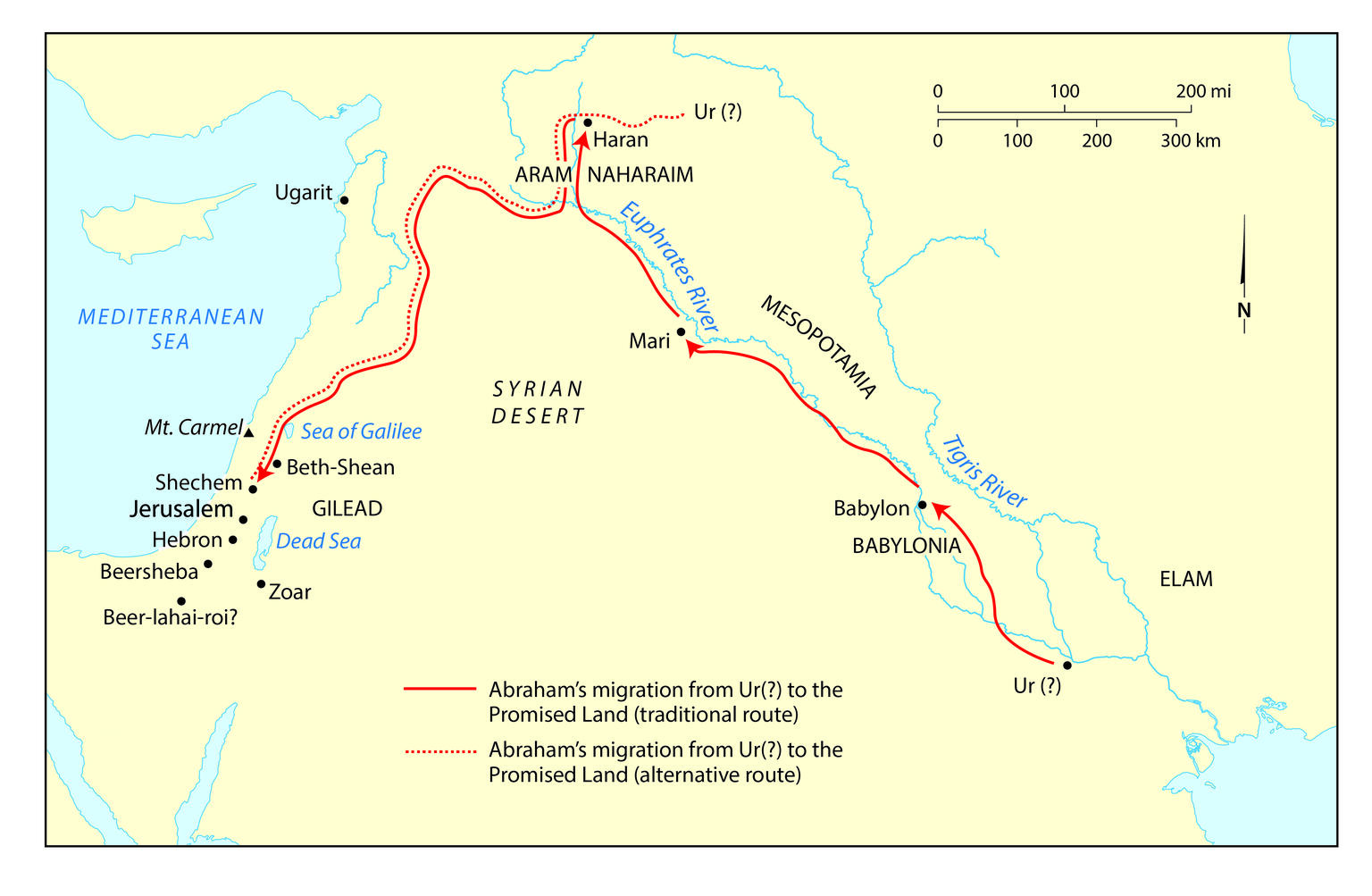
- Verse 4 is one of the quietest revolutions in Scripture: “So Abram went.” No deliberation, no recorded objection, no internal monologue. The command was given; Abram went. The narrator is doing what the narrator does best, which is letting the action carry the theology. After eleven chapters of human refusal, here is one human who simply obeys.
- He is seventy-five. The call comes late. By the genealogical conventions of the surrounding chapters, this is a man who is old but not quite ancient, and the explicit number signals that what follows is not the prelude to a young man’s career but the late-life reorientation of someone who could reasonably have considered his story complete. The covenant is going to be made with someone whose biological clock has already, by every cultural assumption of the time, run out. That detail will matter for the next ten chapters.
- Lot goes with him. Sarai goes with him. The “people whom they had acquired in Haran” go with him. The Hebrew (hanefesh asher asu) is sometimes literally rendered “the souls they had made,” which the rabbis loved to read as referring to converts: people brought into Abram’s worship of Yahweh in Haran. We can’t be sure of the meaning. What we can see is that Abram’s household is already sizable, already mixed, already a kind of small movement before it is a nation.
- Verse 6 lands him at Shechem, “the oak of Moreh.” Shechem sits in the central highlands, between Mount Gerizim and Mount Ebal. Centuries later it will be the place Joshua renews the covenant (Joshua 24), where the tribes will pronounce blessings and curses (Deuteronomy 27 to 28), where Jacob’s well will be dug, and where Jesus will sit and offer living water to a Samaritan woman (John 4). The narrator chooses Abram’s first stop with care. The promised land is being mapped, altar by altar, onto a place that the rest of the Bible will keep coming back to.
Influence callout: Ray Vander Laan
Vander Laan is at his best on this stretch of Genesis. The patriarchal narratives, in his teaching, are not just stories about distant ancestors. They are walking stories. Abram doesn’t survey the land from the air; he walks it. He builds altars at the high places. He learns the topography under his feet. The act of walking the land is itself a form of taking possession by faith. Vander Laan often points to verse 8 (“he pitched his tent”) as the picture of how the covenant family lives: a tent on the high country, an altar nearby, the land all around but not yet in hand.
- “The Canaanites were in the land at that time.” That parenthetical (verse 6) is the narrator’s small reality check. The land Abram is being given is not empty. There are people already there, with their own cities, their own gods, their own claims. The promise is being made over occupied territory, which is going to create theological and ethical questions that the rest of the Pentateuch and Joshua will have to wrestle with. Genesis 12 doesn’t resolve those questions. It just notes the situation.
- Yahweh “appeared” to Abram (verse 7). This is the first time in Scripture that the verb is used of God showing himself to a human being in a specific place after the flood. The pattern here will be repeated throughout the patriarchal narratives: Yahweh appears, makes or repeats a promise, and the patriarch builds an altar. The altars are the patriarchal equivalent of pinning a flag in the ground. They mark the places where Yahweh has been encountered. They become the geographic memory of the covenant for the family that follows.
- Notice what Abram does not do at Shechem. He does not buy land. He does not build a city. He does not stake a political claim. He builds an altar. The first claim the covenant family makes on the land is a worship claim. The promise is held, for now, only in the act of calling on the name of Yahweh in a place that belongs to other people.
- He moves on to Bethel, the place that will later be the religious center of the northern kingdom and the place where Jacob will see the ladder. Same pattern: pitch the tent, build the altar, call on the name of Yahweh. Then he keeps moving south, “still going on toward the South” (verse 9). The Hebrew is ha-Negev, the dry country. The journey isn’t a single arrival. It’s a slow walk down the spine of the land.
Influence callout: Walter Brueggemann
Brueggemann reads this stretch as the formation of a counter-imagination over against the empire-building that characterizes Genesis 1 to 11. Babel built a city to make a name; Abram pitches a tent and waits for God to make his name great. Babel grasped at heaven; Abram raises an altar on the ground. The two postures will compete throughout the rest of Scripture, and Genesis 12 sets up the tent-and-altar life as the alternative to the brick-and-tower life. The covenant family is, from the very first chapter, a critique of empire by way of contrast.
C · Genesis 12:10–20 · The detour into Egypt
¹⁰ There was a famine in the land. Abram went down into Egypt to live as a foreigner there, for the famine was severe in the land. ¹¹ When he had come near to enter Egypt, he said to Sarai his wife, “See now, I know that you are a beautiful woman to look at. ¹² It will happen that when the Egyptians see you, they will say, ‘This is his wife.’ They will kill me, but they will save you alive. ¹³ Please say that you are my sister, that it may be well with me for your sake, and that my soul may live because of you.” ¹⁴ When Abram had come into Egypt, the Egyptians saw that the woman was very beautiful. ¹⁵ The princes of Pharaoh saw her, and praised her to Pharaoh; and the woman was taken into Pharaoh’s house. ¹⁶ He dealt well with Abram for her sake. He had sheep, cattle, male donkeys, male servants, female servants, female donkeys, and camels. ¹⁷ Yahweh afflicted Pharaoh and his house with great plagues because of Sarai, Abram’s wife. ¹⁸ Pharaoh called Abram and said, “What is this that you have done to me? Why didn’t you tell me that she was your wife? ¹⁹ Why did you say, ‘She is my sister,’ so that I took her to be my wife? Now therefore, see your wife, take her, and go your way.” ²⁰ Pharaoh commanded men concerning him, and they escorted him away with his wife and all that he had. (Genesis 12:10–20, World English Bible)
- The chapter does not end on the high note of the call. It ends with a detour into Egypt and a moral failure that the narrator records with no editorial cushion. A famine hits the land. Abram, having just been promised the land, leaves the land. He goes down to Egypt, where things are greener, and on the way he panics about Sarai’s beauty and decides to pass her off as his sister. The man called to bless the nations begins, almost immediately, by deceiving the most powerful nation he encounters. Genesis is going to do this often. It will not airbrush its heroes.
Pushback note
Some commentators try to soften this episode by pointing out that, in Genesis 20:12, Abram will say Sarai is technically his half-sister (same father, different mother), so his statement here is at worst a half-truth. The text doesn’t take that defense. It treats the maneuver as a deceptive plan (“please say that you are my sister, that it may be well with me for your sake”) and shows that the consequence is Pharaoh taking Sarai into his household as a wife (verse 19), which is exactly what would not have happened if Abram had told the truth. The narrator is comfortable letting Abram look bad here. Readers should be too.
- The episode previews the exodus. Read carefully. A descent into Egypt because of famine; an oppressive Pharaoh; plagues sent by Yahweh on Pharaoh’s house; the family leaving Egypt with great wealth (verse 16: “sheep, cattle, male donkeys, male servants, female servants, female donkeys, and camels”); the pattern matches the exodus of Israel almost beat for beat. The narrator is signaling, by the structural foreshadowing, that what happens to the patriarch will happen to the patriarch’s descendants. Genesis 12 is a tiny rehearsal of Exodus 1 through 15. The covenant family’s story, even in its first generation, already carries the shape of the exodus story.
Influence callout: Tim Mackie
Mackie reads this kind of structural rhyme as the narrator’s chief tool. Genesis isn’t just telling sequential events. It’s laying down patterns that will recur. The descent-into-Egypt-and-coming-out-rich pattern will repeat with Jacob (Genesis 46 to Exodus 12), with Joseph in a different shape, and ultimately with the Messiah whose family also flees to Egypt and comes back (Matthew 2:13 to 21). The literary technique is called typology by some readers and narrative hyperlink by Mackie. Either way, the chapter is doing more than telling us what Abram did. It is teaching us how to read the rest of the story.
- Verse 16 is a hard sentence to read. “He dealt well with Abram for her sake.” The wealth Abram receives is the bride price for his wife, paid by a king who has been deceived. Abram becomes wealthy on the back of Sarai’s vulnerability. The text records this without editorial comment, which is part of how Hebrew narrative works: it shows you what happened and lets you sit with the moral weight. The inheritance Abram leaves Egypt with (livestock, servants, silver, gold, all of which will be itemized in chapter 13) is, in part, the fruit of this episode. The covenant family’s first acquisition of significant wealth comes through a deception that endangered its matriarch.
- Where is Sarai’s voice in this story? She doesn’t speak. The text doesn’t tell us what she thought, what she said, what she felt. Many modern commentators (including, recently, scholars in Nijay Gupta’s circle who read the Old Testament with attention to the women in the margins) have pressed the silence as a textual feature. The patriarchal narratives often subordinate the women’s perspectives in ways that the text itself, read carefully, lets us see and grieve. Sarai is acted upon: by Abram, by Pharaoh, by the household. The text does not approve of this. It records it. The next chapters will give Sarai more agency, but here, in the first crisis of the covenant, she is a body passed between two men.
- The plagues that strike Pharaoh’s house (verse 17) are unspecified. The Hebrew word negaim simply means “afflictions” or “blows.” We don’t know what they were. We do know they were severe enough that Pharaoh figured out that something was wrong with this household and confronted Abram directly. Pharaoh, of all people, ends up being the one who calls Abram to account in this chapter. The pagan king sees the moral situation more clearly than the called man does. That irony is part of the narrator’s point. The covenant carrier is going to need a lot of forming, and along the way the people he was sent to bless will sometimes call him to honesty in ways his own family does not.
- Pharaoh sends them away. The Hebrew verb (shalach) is the same root used for the exodus departures later, and the construction “they escorted him away with his wife and all that he had” matches almost exactly what Pharaoh will say to Moses in Exodus 12:31 to 32. The patriarch’s story is rehearsing the children’s story before the children exist. The covenant in Abram’s body is already the covenant that will shape Israel.
Influence callout: Brian Zahnd
Zahnd’s broader reading of Scripture cautions us against turning the patriarchs into moral exemplars. He insists that the Bible’s interest is in showing what God is doing in spite of the failures of his people, not in pretending the failures don’t happen. Genesis 12, in his lens, is a chapter in which God’s covenant survives Abram’s first significant failure. The promise stays. The family keeps going. The plot is not derailed. That’s the news, and it would be bad news handled poorly to dress up Abram into a tidier figure than the text gives us.
- The chapter ends with the family back in the land, intact, wealthy, and still under the promise. The detour into Egypt did not break the covenant. But it did expose what kind of man Abram is, what kind of risks the promise will run, and what kind of God this is. The rest of Genesis will keep showing us the same thing: a flawed family, a faithful God, and a promise that holds.
Reflection prompts
- The call to Abram is structured as three concentric departures: country, kindred, father’s house. What are the equivalents in your own life, the layers of inherited identity that would have to be set down for you to follow a call? Which of those layers do you suspect is most resistant to being set down?
- The promise to Abram ends with “in you all the families of the earth shall be blessed.” Abram is not blessed for himself; he is blessed so that he can be a blessing. Where in your life is your blessing pooling rather than flowing? What would it look like, this week, for the gifts you’ve been given to move through you toward someone else?
- The chapter does not end with the call. It ends with a moral failure in Egypt, recorded without editorial softening. The covenant survives the failure, but the failure is not erased. What does it free you to know that the people God has called have always been people God has had to keep working on? Where in your life are you tempted to disqualify yourself from a call God has not actually withdrawn?