
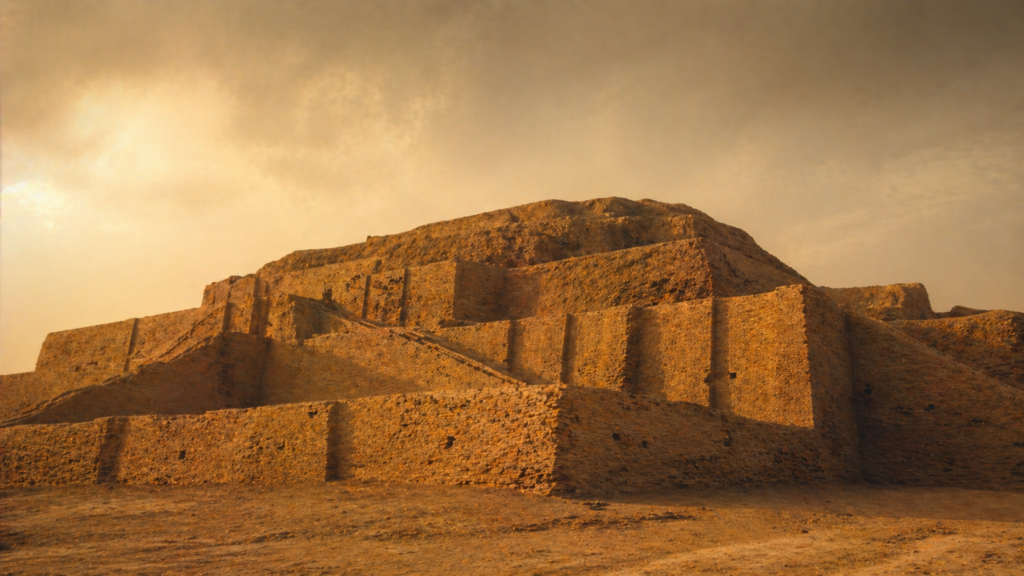
Genesis 11 has two parts. The first nine verses tell the famous Tower of Babel story. The remaining verses are a genealogy from Shem to Terah, ending with Abram. The pairing isn’t accidental.
Babel is the climax of the primeval history’s rebellion arc. From the eating in Genesis 3, to Cain’s violence in Genesis 4, to the flood-era corruption in Genesis 6, to the post-flood empire-building in Genesis 10, the trajectory has been one of mounting human refusal. Babel pulls all of it together. Humans, united in language, build a city that reaches into the heavens, naming themselves rather than being named, refusing to fill the earth as commanded. God responds. He scatters. Languages multiply. Nations divide.
But the chapter doesn’t end there. The toledot of Shem follows immediately, and it leads us to Abram. The story of God’s response to Babel begins in Genesis 12 with a single family. The post-Babel world is fragmented and proud, but God is about to call one man out of that world to begin a new thing. The pairing of Babel and the call of Abraham is one of the most important hinge-points in scripture.
The four-beat pattern that has run through Genesis 3-10 (autonomy → fracture → exile → grace) reaches its primeval-history climax here. Babel is autonomy at its most ambitious yet: a unified humanity using technology, urban planning, and centralized power to make a name for ourselves, in deliberate refusal of the be fruitful and fill the earth commission of 1:28. The fracture is communicational rather than fratricidal: humans can no longer understand each other. The exile is geographic-cultural: scattering across the earth into separate nations and languages. And the grace, easy to miss in the chapter itself, comes in the very next verse: the toledot of Shem leads to Abram, and Abram will be the seed of the blessing for all the families of the earth (12:3) that begins the cycle’s reversal. The grace at the end of every Genesis 3-11 cycle is now becoming the gospel that will work through one specific family. The post-Babel scattering is the soil into which Abrahamic blessing will be planted.
→ Read the divine council framework for the background on how Genesis 10–11 sets up Deuteronomy 32 and the apportionment of nations.
Influence callout: Michael S. Heiser (The Unseen Realm; the Deuteronomy 32 worldview)
Heiser’s reading of Genesis 11 names the scattering of nations as the canonical bridge to Deuteronomy 32:8-9, which is, in his reading, the Hebrew Bible’s deepest theological framework for understanding the nations. The MT of Deut 32:8-9 reads when the Most High gave the nations their inheritance, when he separated the sons of Adam, he set the boundaries of the peoples according to the number of the sons of Israel; but the older Dead Sea Scrolls and Septuagint readings (which most modern scholars favor as original) have according to the number of the sons of God or the angels of God. On Heiser’s reading, the disorder at Babel produces the divine response of Deut 32: YHWH assigns the rebellious nations to the lower gods of the divine council (cf. Ps 82, where YHWH judges those gods for misruling the nations), and then takes Israel as his own portion (Deut 32:9: YHWH’s portion is his people; Jacob is his allotted inheritance). The Babel scattering is the geographical-political event; the Deuteronomy 32 assignment is the supernatural-political event. The two are paired. The whole later biblical theology of the nations (the prophetic indictment of foreign gods; Paul’s account of the principalities and powers; the Great Commission’s gathering-of-the-nations reversal) takes its starting point, on Heiser’s reading, here. Genesis 11 is not just the end of the primeval history; it is the inaugural event of the Hebrew Bible’s supernatural geopolitics.
→ Read the chiastic structure framework for the literary architecture this chapter sits at the center of.
A · Genesis 11:1–9 · The Tower of Babel
¹ The whole earth was of one language and of one speech. ² As they traveled east, they found a plain in the land of Shinar, and they lived there. ³ They said one to another, “Come, let’s make bricks, and burn them thoroughly.” They had brick for stone, and they used tar for mortar. ⁴ They said, “Come, let’s build ourselves a city, and a tower whose top reaches to the sky, and let’s make a name for ourselves, lest we be scattered abroad on the surface of the whole earth.” ⁵ Yahweh came down to see the city and the tower, which the children of men built. ⁶ Yahweh said, “Behold, they are one people, and they have all one language, and this is what they begin to do. Now nothing will be withheld from them, which they intend to do. ⁷ Come, let’s go down, and there confuse their language, that they may not understand one another’s speech.” ⁸ So Yahweh scattered them abroad from there on the surface of all the earth. They stopped building the city. ⁹ Therefore its name was called Babel, because there Yahweh confused the language of all the earth. From there, Yahweh scattered them abroad on the surface of all the earth.
- “The whole earth was of one language and of one speech.” Linguistic unity is the starting state. The narrative begins with humanity speaking the same words, sharing the same vocabulary, building the same world. This isn’t praised in the text. It’s the soil out of which the rebellion will grow. A common reading assumes that the original unified language was a positive thing later ruined by Babel. The text doesn’t quite say that. It says humanity used its unity to overreach, and God’s response was to break the unity for the sake of the larger purpose.
- “They traveled east.” East again. From Eden to Cain to here, east is the direction of departure from God’s presence in Genesis. Migration eastward, in the geography of this book, is theological. The humans are moving away.
- “A plain in the land of Shinar.” Shinar is Mesopotamia, specifically the region around Babylon. The same Shinar that was Nimrod’s territory in Genesis 10:10. The text is closing the loop. The empire-builders settle in the empire-building plains. The brick-and-tar construction details (verse 3) are realistic Mesopotamian technology; they didn’t have stone in lower Mesopotamia, so they baked mud bricks. The text is grounded in real geography and real technology.
- “Let’s build ourselves a city, and a tower whose top reaches to the sky, and let’s make a name for ourselves, lest we be scattered abroad.” Three motives, three problems. (a) A city for ourselves: city-building, in Genesis, has been associated with violence and self-reliance since Cain. (b) A tower whose top reaches the sky: this is most likely a ziggurat, the stepped temple-towers of Mesopotamia. Ziggurats were built so the deity could descend from heaven to dwell with people on top. Genesis is describing humans trying to build their own access point to the divine, on their own terms. (c) Make a name for ourselves: glory-seeking. Humans want renown, shem in Hebrew. The next major character in scripture (Abram) will be given a great name by God (Gen 12:2). Babel humans want to seize what Abraham will later receive as gift. (d) Lest we be scattered: explicit defiance of God’s command in 9:1 to “be fruitful, multiply, and fill the earth.” The Babel project is anti-creation in its very motivation.
- “Yahweh came down to see the city and the tower.” Divine irony at its sharpest. The tower was built to reach the heavens, but it’s so puny God has to come down to see it. The text is gently mocking the project. From God’s perspective, this great human achievement is like an ant hill seen from above. He has to lean down to look.
- “Come, let’s go down, and there confuse their language.” The plural again. The same “let us” we saw in Genesis 1:26 and 3:22, addressed to the divine council. God is convening the assembly. The judgment-and-scattering will be a council action. Heiser and other divine-council readers connect this directly to Deuteronomy 32:8–9: God divides the nations and apportions them to “the sons of God” while keeping Israel for himself. Babel is when that apportionment happens. The 70 nations of Genesis 10 are now scattered, with each receiving a divine-being overseer who will (mostly) become a rebel. The Old Testament’s polemics against the gods of the nations make sense against this backdrop. Most modern readings have stripped this dimension out, treating Babel as a story about pride and language without its cosmic-political context. Recovering the divine council reading restores what the original audience would have heard.
- “He confused their language.” The Hebrew word for “confuse” is balal. The name Babel (which means Babylon) sounds like balal. The chapter is doing wordplay on the city’s name. Babylon, the great empire-city, is named after confusion. Genesis is making a theological claim: Babylon is the prototype of every imperial project that overreaches and gets scattered. The story sets up the prophetic critique of empire that will run through the rest of the Old Testament and culminate in Revelation’s “fall of Babylon.”
- “Yahweh scattered them abroad.” Notice the dual nature of the scattering. On one hand, it’s judgment: humans wanted to stay together and not be scattered, and God scatters them. On the other hand, it’s fulfillment: God commanded humans to fill the earth (1:28, 9:1), and the Babel rebellion was specifically refusing that commission. By scattering them, God forces the original commission to happen anyway. Judgment and grace are the same act here. The dispersal of humanity is also the populating of the earth.
- “From there, Yahweh scattered them abroad on the surface of all the earth.” The chapter’s last sentence in §A. The whole earth, all humanity, divided into nations and languages. The cosmic story is now the story of peoples, plural. The next move God makes will be to call one particular family out of that scattered world. Genesis 12 is about to begin.
- A note on Pentecost. Acts 2 will return to Babel directly. When the Spirit descends at Pentecost, people from many nations hear the gospel each in their own language. Babel scattered into incomprehension; Pentecost reverses incomprehension into mutual hearing. The languages aren’t undone; they’re transcended. Cultural and linguistic diversity isn’t a curse to be erased but a reality to be inhabited under the Spirit. Genesis 11 plants the seed for that connection. Some popular readings treat Babel as God’s permanent disapproval of human cultural difference. The text doesn’t say that, and Acts 2 explicitly reverses the incomprehension while leaving the languages themselves intact.
B · Genesis 11:10–26 · The toledot of Shem
¹⁰ This is the history of the generations of Shem. Shem was one hundred years old when he became the father of Arpachshad two years after the flood. ¹¹ Shem lived five hundred years after he became the father of Arpachshad, and became the father of more sons and daughters. ¹² Arpachshad lived thirty-five years and became the father of Shelah. ¹³ Arpachshad lived four hundred three years after he became the father of Shelah, and became the father of more sons and daughters. ¹⁴ Shelah lived thirty years, and became the father of Eber: ¹⁵ and Shelah lived four hundred three years after he became the father of Eber, and became the father of more sons and daughters. ¹⁶ Eber lived thirty-four years, and became the father of Peleg. ¹⁷ Eber lived four hundred thirty years after he became the father of Peleg, and became the father of more sons and daughters. ¹⁸ Peleg lived thirty years, and became the father of Reu. ¹⁹ Peleg lived two hundred nine years after he became the father of Reu, and became the father of more sons and daughters. ²⁰ Reu lived thirty-two years, and became the father of Serug. ²¹ Reu lived two hundred seven years after he became the father of Serug, and became the father of more sons and daughters. ²² Serug lived thirty years, and became the father of Nahor. ²³ Serug lived two hundred years after he became the father of Nahor, and became the father of more sons and daughters. ²⁴ Nahor lived twenty-nine years, and became the father of Terah. ²⁵ Nahor lived one hundred nineteen years after he became the father of Terah, and became the father of more sons and daughters. ²⁶ Terah lived seventy years, and became the father of Abram, Nahor, and Haran.
- Another toledot, this one Shem’s. The structure follows Genesis 5: name, age at fatherhood, total years, “more sons and daughters.” But notice what’s missing. Genesis 5’s drumbeat refrain, “and he died,” is gone. The death-refrain was specific to that chapter’s rhetorical purpose (feel the post-Eden mortality). Genesis 11’s genealogy has a different purpose: trace the line forward to Abraham. Mortality is implicit; the focus is continuation.
- Notice also the lifespans dropping. Shem lives 600 years total. Arpachshad lives 438. Shelah 433. Eber 464. Peleg drops sharply to 239. Reu 239. Serug 230. Nahor 148. Terah 205. Abram will live to 175. The post-flood world has shorter human lives than the pre-flood world. Whether this is read literally as a real change in human longevity, or symbolically as a marker of the world’s continued unraveling, the trajectory is clear: lives are getting shorter as we approach Abraham.
- Eber (verse 14) is the etymological source of Ibri, the Hebrew word for Hebrew. The word means “one from across” or “the one who crosses over.” This name will become significant when we get to Abram, who crosses over from Mesopotamia into Canaan. The Shemite line is being tagged ahead of time as the line of crossers-over.
- Peleg (verse 16) is the same Peleg from 10:25, “in his days the earth was divided.” Many readers connect Peleg’s name to the Babel scattering. The chronology is suggestive: Peleg is named for division, and the division is recent.
- The chapter narrows fast. Each generation gets a single line. We’re not meant to linger. The text is hurrying toward its destination: Terah, who has three sons, Abram, Nahor, Haran. The story is about to find its main character.
C · Genesis 11:27–32 · Terah’s family and the move to Haran
²⁷ Now this is the history of the generations of Terah. Terah became the father of Abram, Nahor, and Haran. Haran became the father of Lot. ²⁸ Haran died in the land of his birth, in Ur of the Chaldees, while his father Terah was still alive. ²⁹ Abram and Nahor married wives. The name of Abram’s wife was Sarai, and the name of Nahor’s wife, Milcah, the daughter of Haran who was also the father of Iscah. ³⁰ Sarai was barren. She had no child. ³¹ Terah took Abram his son, Lot the son of Haran, his son’s son, and Sarai his daughter-in-law, his son Abram’s wife. They went from Ur of the Chaldees, to go into the land of Canaan. They came to Haran and lived there. ³² The days of Terah were two hundred five years. Terah died in Haran.
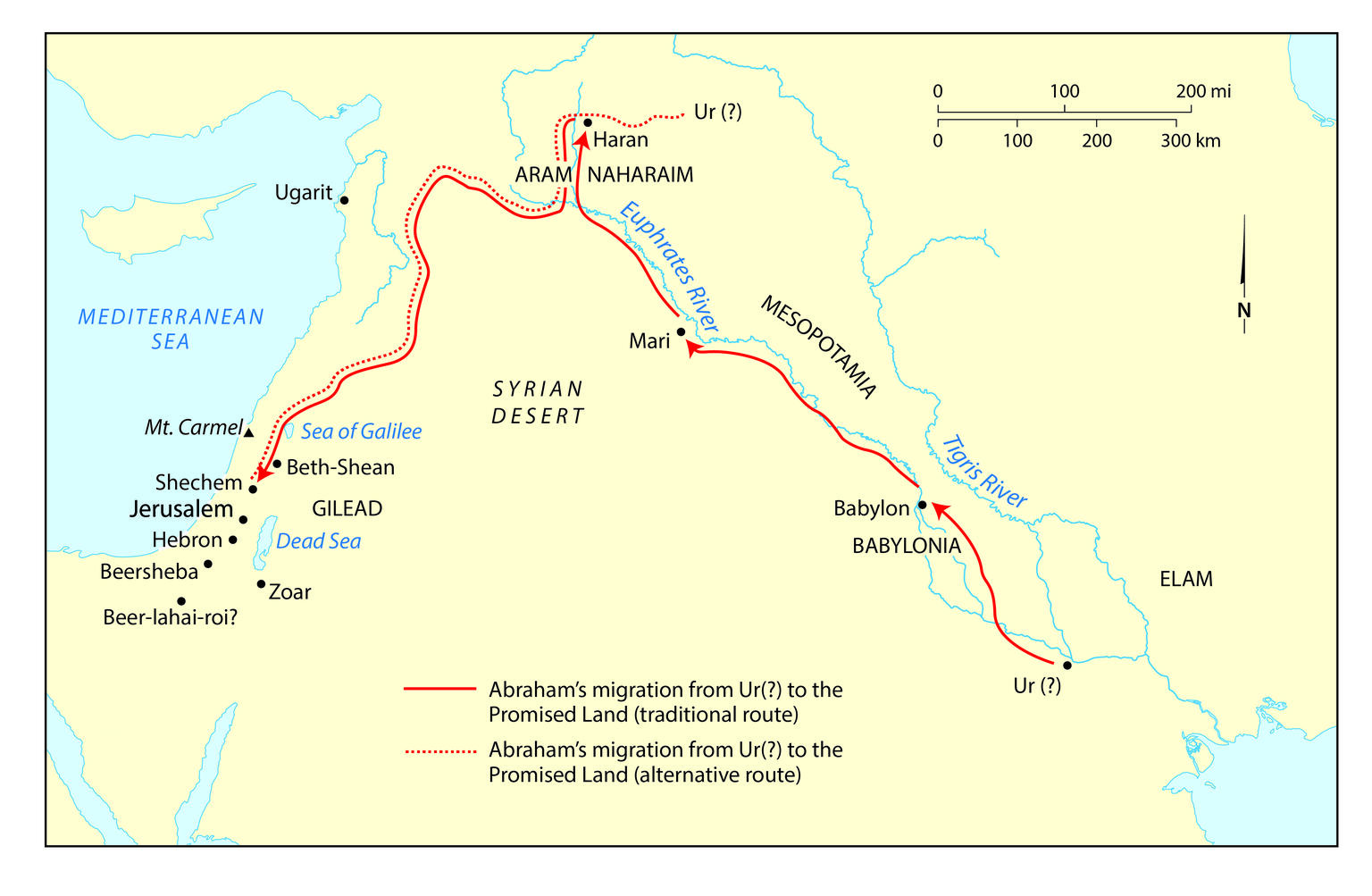
- The fifth toledot in Genesis: “this is the history of the generations of Terah.” We’ve zoomed in to a particular Mesopotamian family. Terah lives in Ur of the Chaldees, an ancient city in southern Mesopotamia (in modern Iraq). The Chaldeans were a later Babylonian people; the term is used here as the audience’s geographical reference. Ur was a real city, an early urban center with a famous ziggurat dedicated to the moon-god Sin. Abram’s family worships, presumably, the gods of Ur.
- Three brothers: Abram, Nahor, Haran. Haran has a son named Lot (Abram’s nephew, who will travel with him through the next chapters). Haran also has a daughter named Iscah (some traditions identify her with Sarai, but the text is genuinely ambiguous). Then Haran dies young, leaving his father Terah alive, an inversion of the natural order. The text notes this almost in passing.
- Abram marries Sarai. Nahor marries Milcah (Haran’s daughter, his own niece). The family stays close-knit, marrying within the clan. Then verse 30: “Sarai was barren. She had no child.” The text drops this in flatly. It will be the theological hinge of the next several chapters. Abram, the man God is about to call, has no heir. The promise that’s coming will be all the more striking for it.
- Terah, not God, initiates the move out of Ur: “Terah took Abram his son, Lot the son of Haran, his son’s son, and Sarai his daughter-in-law… They went from Ur of the Chaldees, to go into the land of Canaan.” The destination is Canaan, but they only get as far as Haran (a city in northern Mesopotamia, named for Terah’s deceased son). They settle there. Terah dies there. The departure from Ur is begun by Terah but stalls at Haran. The text is setting up the question: who will finish the journey?
- The answer comes in Genesis 12:1, the next sentence in the story: “Now Yahweh said to Abram, ‘Get out of your country, and from your relatives, and from your father’s house, to a land that I will show you.’” Genesis 11 ends with a stalled migration. Genesis 12 begins with a divine call to complete it. The primeval history (Genesis 1–11) ends. The patriarchal narrative begins. The story narrows from cosmic scope (all creation, all humanity, all nations) to one family (Abram, Sarai, Lot) and then, eventually, to one person at a time.
- Read against the Babel narrative, the call of Abram is striking. At Babel, humans gathered to make a name for themselves. With Abram, God will give him a great name (12:2). At Babel, humans refused to be scattered. With Abram, God will scatter him from his father’s house and send him to a land he doesn’t yet know. Babel was rebellion against God’s command to fill the earth. Abram’s call is obedience to a fresh command to leave and become a blessing. Genesis 11 and Genesis 12 are mirror images. The post-Babel world needs a new beginning, and God is about to start one through a barren couple in a forgotten city.
Reflection prompts
- Babel humans wanted to “make a name for themselves” by their own building. Abram will receive his great name as gift. Where in your life are you trying to make a name for yourself by your own construction? Where might that energy be better spent waiting to receive a name God wants to give?
- Babel was scattered as both judgment and fulfillment of God’s original “fill the earth” command. Where in your life has something that felt like judgment turned out to also be the only way you could fulfill what you were originally called to do?
- Genesis 11 ends with a stalled migration. Terah set out for Canaan but only got as far as Haran. Genesis 12 begins with a divine call to finish the journey. Where in your life are you currently stalled in a Haran, partway to where you sense you’re meant to be, and what would it take to hear and obey a fresh call to keep going?