
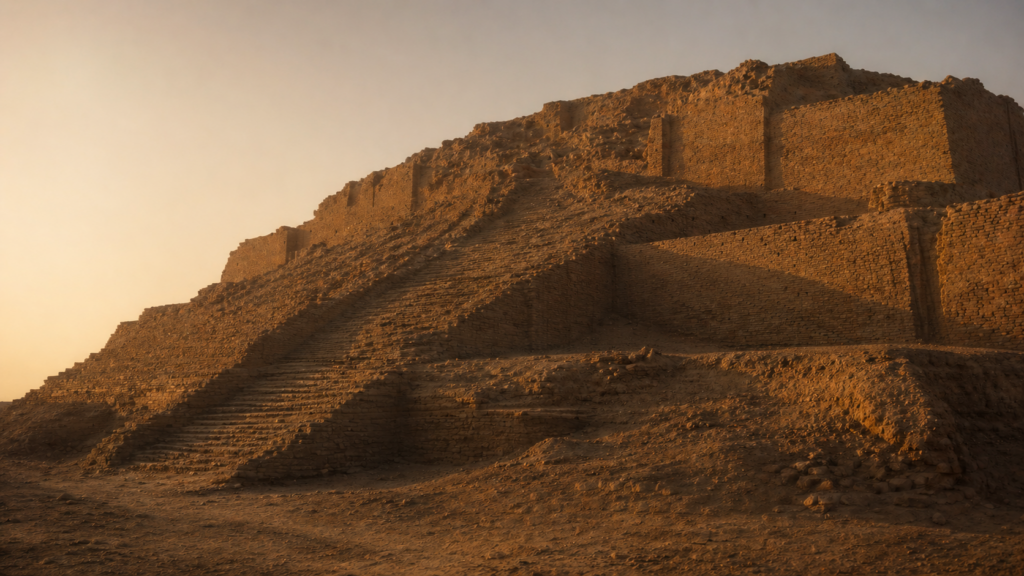
Genesis 1 isn’t a science textbook, and it isn’t myth. It’s the inaugural ceremony of the cosmos. In the world of the ancient Near East where this text first lived, gods built temples and then took up residence in them through a seven-day dedication ritual. Genesis 1 is doing exactly that, only the temple is the entire world, and the deity moving in is YHWH.
The chapter’s argument runs through ordering, not bringing-into-being. God speaks; chaos becomes function; each function gets named, blessed, and assigned a role. By day seven, the cosmos is a working sanctuary, and God is enthroned in it. The point of the chapter isn’t days one through six. It’s day seven.
That framing, what John Walton calls the cosmic temple reading, is the lens we’ll use throughout. It dissolves a lot of artificial conflicts (Genesis vs. cosmology, Genesis vs. evolutionary biology) by clarifying what kind of question Genesis 1 is actually answering. Genesis 1 is concerned with function and vocation, not material origin.
It’s worth saying this directly. Much evangelical apologetics over the last century has tried to harmonize Genesis 1 with modern cosmology and evolutionary biology, reading the days as long ages or running concordist gymnastics that map the text onto scientific data. The careful reading just doesn’t support those moves. Genesis 1 isn’t competing with science, and it isn’t friendly to it either. It’s doing something different. The energy spent defending Genesis 1 as a science textbook is energy spent missing what Genesis 1 actually is.
A short note on what we’re doing here. The structure follows the chapter’s internal logic, working through it section by section. Each section quotes the WEB text directly, then offers commentary in numbered points. Callouts pull out word studies, attributed insights from teachers in this tradition, and links to deeper frameworks. Everything closes with reflection prompts.
A · Genesis 1:1–2 · The cosmic prologue
¹ In the beginning, God created the heavens and the earth. ² The earth was formless and empty. Darkness was on the surface of the deep and God’s Spirit was hovering over the surface of the waters.
- The opening line is a polemic. Where Mesopotamian neighbors told of warring gods and a world born from a divine corpse (Marduk slaughtering Tiamat in Enuma Elish), Genesis says it plainly: one God, no rival, ordering everything by speech. The cosmos isn’t built out of violence. It’s spoken into function.
- “The heavens and the earth” is a merism: a Hebrew literary device that names the two ends of a spectrum to mean everything in between. We do the same thing in English (“she searched high and low”). It’s not a list of two things created. It’s a poetic way of saying everything that exists falls under God’s ordering work.
Word study: bara (בָּרָא)
Often translated “to create,” but in ANE context the verb carries a primarily functional meaning: to assign a role, to give something its place in an ordered system. Walton has spent decades arguing that bara in Genesis 1 is concerned with function more than material. God isn’t making physical matter from nothing here so much as turning chaos into a working sanctuary.
- The earth’s initial state, tohu va-vohu, “formless and empty”, isn’t evil. It’s unformed potential. Darkness and the deep waters are stock ANE images for chaos, but Genesis treats them as raw material, not enemies. The Spirit (ruach) hovering over the waters is the first hint of what’s about to happen: God is about to move in. Two notes worth slowing down on. First, the opening bereshit (often translated in the beginning) does not, in Hebrew, name a single starting point. The word lacks a definite article and functions more like in beginningtime or way back when, a story-opening phrase rather than a stopwatch start (the same word names the beginning of the reign of King Zedekiah in Jeremiah 28:1, where it clearly names a period rather than a moment). The phrase is doing what once upon a time does in English narrative: opening a story, not pinpointing a chronology. Second, the verb hovering (Hebrew meraḥephet, used here and only one other time in the Pentateuch, at Deuteronomy 32:11 of an eagle hovering over its nest) carries a specifically maternal-brooding image. The ruach over the waters is being staged as a mother-bird hovering protectively over a nest, a posture of patient nurture rather than imminent strike. The chapter is opening, in two short verses, on a presence-before-action picture: God hovers, then God speaks. The order matters. The cosmos’s first reality is not divine action but divine presence. Ruach itself is layered (Spirit, wind, breath), and the Bible’s later vocabulary will keep playing on all three: the Spirit who broods over the waters here will be the breath God blows into the human in 2:7, and the wind God sends over the floodwaters in 8:1.
B · Genesis 1:3–5 · Light and the first day
³ God said, “Let there be light,” and there was light. ⁴ God saw the light, and saw that it was good. God divided the light from the darkness. ⁵ God called the light “day,” and the darkness “night.” There was evening and there was morning, the first day.
- Notice what happens on day one. God doesn’t make the sun (that comes on day four). He establishes light itself, separates it from darkness, and names them. Function precedes object. This is one of the strongest indicators that Genesis 1 isn’t a chronological account of material origins. You don’t need a sun to have a “day” if the chapter is doing something other than physics.
- Day one inaugurates time itself. Before this, there was no rhythm. Now there’s evening, morning, and a one. The cosmos has cadence. The cadence will become Sabbath by chapter’s end.
Influence callout: Marty Solomon (Bema, on Genesis 1)
Solomon’s frame for Genesis 1 is one of the site’s load-bearing readings: “It is not telling us how the world came to be. It is telling us why it exists, and what it is for.” The chapter is a cosmic-temple inauguration, on Solomon’s reading, not an account of material origin. The seventh day is the chapter’s center of gravity. Humanity is the image set inside the sanctuary to mediate God’s rule. Read in this register, Genesis 1 is doing covenantal-vocational work, not scientific-cosmological work, and the modern habit of asking it to answer the wrong question has produced a century of unnecessary apologetic friction.
- The refrain “and God saw that it was good” recurs across the chapter. Tov, in Hebrew, doesn’t only mean morally pleasing or aesthetically nice. It means functioning as intended. Each day, God inspects the work and confirms: this is doing what it’s supposed to do. The cosmos works.
C · Genesis 1:6–8 · The dome and the waters
⁶ God said, “Let there be an expanse in the middle of the waters, and let it divide the waters from the waters.” ⁷ God made the expanse, and divided the waters which were under the expanse from the waters which were above the expanse; and it was so. ⁸ God called the expanse “sky.” There was evening and there was morning, a second day.
- The “expanse”, raqia in Hebrew, is the solid dome ANE peoples believed held back the cosmic waters above the earth. Job describes it as hard as molten metal (Job 37:18). Genesis 1 isn’t trying to correct ANE cosmology. It’s working within it, using the cultural picture its hearers already had, and asserting that this dome too is a thing God set in place.
- We don’t need to defend the literal physics here to take the theology seriously. The point is that the universe isn’t a one-floor open shed. It’s a structured, ordered, layered space. There’s a place for everything and everything has been put in its place. Day two establishes the sky as habitat, a function the birds will occupy on day five.
- There’s no “and it was good” on day two. Some scholars make a lot of this; others note that day three (which finishes the work begun on day two) gets the “good” judgment doubled. Don’t overread the silence. The pattern is clear at the chapter level: God names, separates, and establishes function.
D · Genesis 1:9–13 · Land and vegetation
⁹ God said, “Let the waters under the sky be gathered together to one place, and let the dry land appear”; and it was so. ¹⁰ God called the dry land “earth,” and the gathering together of the waters he called “seas.” God saw that it was good. ¹¹ God said, “Let the earth yield grass, herbs yielding seeds, and fruit trees bearing fruit after their kind, with their seeds in it, on the earth”; and it was so. ¹² The earth yielded grass, herbs yielding seeds after their kind, and trees bearing fruit, with their seeds in it, after their kind; and God saw that it was good. ¹³ There was evening and there was morning, a third day.
- Day three completes the habitat work. Sea, sky, and land, three domains, formed and named, ready to be filled. The text is structured as two triads: days 1–3 form, days 4–6 fill. Light, sea-and-sky, land on the form side. Sun-moon-stars, fish-and-birds, animals-and-humans on the fill side. Once you see the pattern you can’t unsee it.
“html <style type="text/css"> .tg {border-collapse:collapse;border-spacing:0;margin:1.5rem auto;} .tg td{border-color:black;border-style:solid;border-width:1px;overflow:hidden;padding:10px 5px;word-break:normal;} .tg th{border-color:black;border-style:solid;border-width:1px;font-weight:normal;overflow:hidden;padding:10px 5px;word-break:normal;} .tg .tg-baqh{text-align:center;vertical-align:top} .tg .tg-amwm{font-weight:bold;text-align:center;vertical-align:top} </style> <table class="tg"> <thead> <tr> <th class="tg-amwm">Form (vs tohu)</th> <th class="tg-amwm">Fill (vs vohu)</th> </tr> </thead> <tbody> <tr><td class="tg-baqh">Day 1 - Light and Dark</td><td class="tg-baqh">Day 4 - Sun, Moon, Stars</td></tr> <tr><td class="tg-baqh">Day 2 - Sea and Sky</td><td class="tg-baqh">Day 5 - Fish and Birds</td></tr> <tr><td class="tg-baqh">Day 3 - Land and Plants</td><td class="tg-baqh">Day 6 - Land Animals/Humans</td></tr> <tr><td class="tg-baqh" colspan="2">Day 7 - Rest</td></tr> </tbody> </table> “
- The land doesn’t merely receive vegetation, it yields it. The earth itself participates in the act. Plants reproduce by seed; the system is self-sustaining from the start. Creation is generative, not merely constructed.
- “After their kind” appears repeatedly here and on day five. This isn’t a taxonomic claim about species fixity (though it has been read that way in modern debates). It’s a functional claim: the system reproduces itself coherently. Categories endure.
E · Genesis 1:14–19 · Sun, moon, stars
¹⁴ God said, “Let there be lights in the expanse of sky to divide the day from the night; and let them be for signs to mark seasons, days, and years; ¹⁵ and let them be for lights in the expanse of sky to give light on the earth”; and it was so. ¹⁶ God made the two great lights: the greater light to rule the day, and the lesser light to rule the night. He also made the stars. ¹⁷ God set them in the expanse of sky to give light to the earth, ¹⁸ and to rule over the day and over the night, and to divide the light from the darkness. God saw that it was good. ¹⁹ There was evening and there was morning, a fourth day.
- Pay attention to what Genesis refuses to do: it does not name the sun or the moon. In the ANE, the sun and moon were major gods. Shamash, Sîn, Ra. To name them would be to risk treating them as divine beings. Genesis calls them “the greater light” and “the lesser light.” A theological side-eye delivered through deliberate vagueness.
- Their function is even more striking. The text gives them four roles: dividing day from night, marking signs and seasons, giving light, and ruling. They’re not gods. They’re appointed clocks. Cosmic timekeepers in service of the rhythms God established on day one.
- The whole arrangement makes day one’s work intelligible. God establishes time on day one, and on day four he creates the instruments by which that time is measured. The cosmos isn’t running on the sun’s energy; the sun is running on God’s calendar.
F · Genesis 1:20–23 · Creatures of sea and sky
²⁰ God said, “Let the waters abound with living creatures, and let birds fly above the earth in the open expanse of the sky.” ²¹ God created the large sea creatures and every living creature that moves, with which the waters swarmed, after their kind, and every winged bird after its kind. God saw that it was good. ²² God blessed them, saying, “Be fruitful, and multiply, and fill the waters in the seas, and let birds multiply on the earth.” ²³ There was evening and there was morning, a fifth day.
- The sea is now populated. Notice that the “large sea creatures” (tanninim) are explicitly created by God, the same word elsewhere translated “sea monsters” or “dragons.” In other ANE accounts these are primal chaos creatures God or the gods had to defeat. Genesis says: God made them. They’re his. There’s no shadow rival to wrestle with.
- “Be fruitful and multiply” is the first divine blessing in scripture. Reproduction is built into the design and explicitly blessed. The system isn’t just functional; it’s generative on its own behalf, with God’s good will behind it.
Word study: barak (בָּרַךְ)
“Bless.” Not merely a wish for good fortune but a divine empowerment toward flourishing. To be blessed in Hebrew thought is to receive what you need to be fruitful in your function. God’s blessing on the fish and birds is the same kind of empowerment he’ll extend to humans on day six.
G · Genesis 1:24–25 · Land creatures
²⁴ God said, “Let the earth produce living creatures after their kind, livestock, creeping things, and animals of the earth after their kind”; and it was so. ²⁵ God made the animals of the earth after their kind, and the livestock after their kind, and everything that creeps on the ground after its kind. God saw that it was good.
- Day six begins quietly. The land yields its creatures. The same generative, “earth produces” language we saw with vegetation now extends to animals. Creation is iteratively active. God speaks; the system responds.
- The categories, livestock (domesticated animals, useful to humans), creeping things, wild animals, already anticipate the human role that’s about to come. The ground is being prepared for image-bearers who will tend it.
H · Genesis 1:26–31 · Image-bearers
²⁶ Then God said, “Let us make humans in our image, according to our likeness, and let them have dominion over the fish of the sea and over the birds of the air and over the cattle and over all the wild animals of the earth and over every creeping thing that creeps upon the earth.” ²⁷ So God created humans in his image, in the image of God he created them; male and female he created them. ²⁸ God blessed them, and God said to them, “Be fruitful and multiply and fill the earth and subdue it, and have dominion over the fish of the sea and over the birds of the air and over every living thing that moves upon the earth.” ²⁹ God said, “See, I have given you every plant yielding seed that is upon the face of all the earth and every tree with seed in its fruit; you shall have them for food. ³⁰ And to every animal of the earth and to every bird of the air and to everything that creeps on the ground, everything that has the breath of life, I have given every green plant for food.” And it was so. ³¹ God saw everything that he had made, and indeed, it was very good. And there was evening and there was morning, the sixth day.
(Genesis 1:26–31, NRSVue)
- The plural “let us” has launched a thousand sermons. Trinitarian reading? Royal “we”? Divine council? Michael Heiser argues persuasively that this is the divine council motif: God speaking to the heavenly assembly that surrounds his throne in much of the rest of the Old Testament. (Compare Psalm 82, 1 Kings 22:19–22, Job 1–2, Isaiah 6, Daniel 7.) That doesn’t preclude a Trinitarian reading retrospectively, but in its original context the plural is most naturally read as God addressing his court. The text isn’t worried about the question. It’s worried about the act: humanity is being commissioned with deliberation, with care, with witnesses.
- Across Mesopotamia and Egypt, “image of god” was royal language. Pharaoh was the tut (image) of Ra. Mesopotamian kings were called the ṣalmu of their patron deity. The image was the deity’s representative on earth, mediating divine rule. Genesis takes this title and democratizes it. Every human, male and female, bears the image. Every human is commissioned to rule on God’s behalf. In its ancient Near Eastern world, this is genuinely revolutionary. The other piece of ANE image vocabulary worth knowing is the temple-statue. Across Mesopotamia, Egypt, and Canaan, the image of a god was a physical statue placed inside that god’s temple, marking the deity’s presence and authority over the domain. Inscriptions sometimes called such statues the living presence of the god. If Genesis 1 is staging the cosmos as God’s temple, then humans on day six are the living statues placed in the sanctuary, signaling God dwells here. This also illuminates the second commandment: it is striking that the very first prohibition God gives Israel after the Exodus is do not make any graven image, because the cosmos already has a living image (the human person), and the divine temple does not need a competitor. It’s also worth saying what the original text is not doing. It isn’t claiming the image consists in human reason, or in the soul, or in moral conscience. Those readings entered Christian thought through Augustine, Aquinas, and the long marriage of theology with Greek philosophy. The Hebrew text isn’t asking what kind of capacity makes us image-bearers. It’s giving us a vocation: we represent God in creation. The capacities-based readings have their own coherence, but they aren’t what Genesis is doing.
- The word translated “subdue” (kabash) is strong. So is “have dominion” (radah). Read flatly, these can sound like commands to exploit. Read in the context of imaging God’s rule, they’re commissions to extend the order God has just established into the rest of creation. The dominion is imaging-dominion: ruling as God rules, which in this chapter has been ordering, blessing, and giving function. Never extracting or destroying.
→ Read the image of God framework for a deeper treatment of tselem Elohim in its ANE context.
→ Read the vocabulary of humanity framework for the Hebrew vocabulary at work in 1:26-27. Adam is the generic word for “humanity,” used inclusively here; zachar (male) and neqevah (female) are the biological-sex pair; both are bound together in the image. The pair is original to creation, not derived after the fact.
- Then the diet: humans and animals are both given plants. The original creation, on this telling, is vegetarian. The picture is one of complete shalom, no creature feeding on another. This will not last, but it’s where we begin. The point is the direction of creation, not the literal menu.
- “It was very good.” The seventh refrain of tov, but this time intensified, tov me’od. The whole thing, taken together, is very good. The cosmos is a working temple. The image-bearers are in place. All that remains is the sanctuary’s inauguration.
I · Genesis 2:1–3 · Day seven and the cosmic temple
¹ The heavens, the earth, and all their vast array were finished. ² On the seventh day God finished his work which he had done; and he rested on the seventh day from all his work which he had done. ³ God blessed the seventh day, and made it holy, because he rested in it from all his work of creation which he had done.
- We’re crossing the chapter break here for a reason: the seven-day structure of Genesis 1 isn’t complete without day seven. The chapter and verse divisions came centuries later. The story God is telling runs straight through.
- Rest, in ANE thought, isn’t napping. It’s settled rule from one’s proper place. When a king “rested” in the ancient world, it meant his enemies were defeated and he was enthroned, governing from his throne in his temple. Day seven is God moving into the cosmic temple and sitting down.
- This is why Walton calls it the cosmic temple inauguration. Six days of preparing and assigning function. One day of moving in. The point of the whole chapter is now visible: the world isn’t a stage God built for humans. It’s a temple God built for himself, in which humans serve as priests bearing his image. The seven-day temple-dedication frame is not a Walton-invented theory; it is widely attested across the ancient Near East. The Gudea Cylinder (Sumerian, c. 2100 BCE) records a seven-day temple-dedication for the god Ningirsu. Enuma Elish and later Babylonian inscriptions tie temple-dedication festivals to seven-day ceremonial patterns. Mari ritual texts from the eighteenth century BCE prescribe seven-day rituals for sacred space, including the enthronement of the deity’s image at the close. Canaanite ritual texts describe Baal’s temple-dedication as a multi-day ceremonial sequence. The pattern is everywhere in the cultural water Genesis was written into. What Genesis does is reframe the pattern: the temple in this case is not a small building in a city; it is the entire cosmos, and the deity moving in is not one of many but the one who has just spoken everything into ordered function.
Influence callout: John Walton (The Lost World of Genesis One; Genesis 1 as Ancient Cosmology)
Walton is the modern scholar whose work most directly underwrites the site’s reading of Genesis 1. His core argument: the ancient Near Eastern intellectual world is concerned with function (what something does, what role it plays) more than with material origin (what physical stuff something is made of). On Walton’s reading, the verb bara names the assignment of function, not the manufacture of matter. Day one assigns the function of time. Day two assigns the function of weather and sky. Day three assigns the function of food. Days four through six fill those functional spaces with their functionaries. Day seven is the cosmic-temple inauguration: the deity moves into the sanctuary he has just brought to functional readiness. Walton points to the consistent ANE pattern of seven-day temple-dedications (Gudea Cylinder, Enuma Elish, Mari, Canaanite Baal cycle), and to the consistent Hebrew Bible link between cosmos and temple (Ps 78:69; Isa 66:1) to ground the reading. The pastoral payoff is significant: Walton’s frame dissolves the modern argument-with-science by clarifying what kind of question Genesis 1 is actually answering. The chapter is not a competing account of how the world materially came to be. It is the inaugural ceremony of the cosmos as God’s dwelling-place. The whole site reads Genesis through this lens; this callout is its name and source.
→ Read the cosmic temple framework for the full Walton treatment.
- Sabbath, on this reading, isn’t an interruption of “real life.” It’s the goal of creation. Everything God has been doing for six days has been pointing toward this: a habitat in which he himself can dwell. When Israel later receives Sabbath as commandment, they’re being invited into something built into the architecture of the cosmos. They aren’t escaping work. They’re entering rest with God in the sanctuary. The Israelites who first heard Genesis 1 had just come out of slavery in Egypt, where their value was measured by production: bricks per day, the constant threat of more bricks, less straw (Exodus 5). Sabbath in this register is also resistance. Pharaoh’s economy says you are what you produce. Yahweh’s economy says you are an image-bearer who shares in the Creator’s rest, regardless of what you produced this week. The seventh-day rhythm is an anti-Pharaoh pattern built into the world’s foundations. The cosmos itself stops on the seventh day; the disciple-community of every later century is being invited to stop with it.
- The seventh day is “blessed” and “made holy.” It’s the first thing in the Bible to receive the designation kadosh, holy, set apart, sacred. Notice what’s holy: not a place yet, but a time. The first holy thing in scripture is a day. Israel will spend the rest of its existence learning to inhabit that time.
Reflection prompts
- If creation is a temple and you are an image-bearer, what does your daily work look like as priestly vocation?
- Where in your life are you trying to control chaos through combat (Marduk vs. Tiamat) rather than through ordering speech (Genesis 1)?
- What does it mean that Sabbath is the goal of creation, not the interruption of it? How does that change how you keep it, or whether you keep it at all?